Jupiters Temperature: Shivering Depths and Burning Heights
Jupiter, the largest planet in the solar system, is a world of dramatic extremes. Unlike Earth, whose temperature varies with latitude and the suns intensity, Jupiters temperature is dictated more by altitude and its own intense internal heat than by sunlight. This article dives deep into Jupiters temperature, its atmospheric layers, what heats it, and why its upper reaches glow much hotter than the surface below.
Understanding Jupiters Average Temperature
- Average temperature: Approximately -234°F (-145°C)—extremely cold by Earth standards.
- Atmospheric pressure reference: Temperature is usually measured at a point where atmospheric pressure matches Earths surface (1 bar).
Because Jupiter is almost 800 million km (about 484 million miles) from the Sun, its surface-level atmosphere gets little energy from sunlight. Its frigid baseline is not because of how close or far you are to Jupiters equator—the way temperature changes for us on Earth—but by how high above Jupiters surface you go.
Layers of Jupiters Atmosphere: Composition and Temperatures
Jupiters atmosphere isnt like any rocky planets. Rather than a solid surface, Jupiter is a giant, deep sea of gases and fluids. Its mostly hydrogen (with helium, ammonia, methane, water vapor, and other trace gases).
- Hydrogen: The dominant gas, making up most of Jupiters atmosphere.
- Helium: The second most common element, about 10% by volume.
- Other gases: Ammonia (~0.07% by ratio), methane, and other trace elements are present in the upper atmosphere.
Atmospheric Layers and Their Temperatures
| Layer/Altitude | Approximate Temperature | Key Features |
|---|---|---|
| Deep Atmosphere/Surface (1 bar) | -145°C (-234°F) | Defined by pressure equal to Earth’s surface |
| Troposphere (~50 km above ‘surface’) | -160°C (-260°F) | Temperature drops further with altitude |
| Stratosphere/Upper atmosphere | Up to 725°C (1340°F) | Superheated by interactions at high altitude |
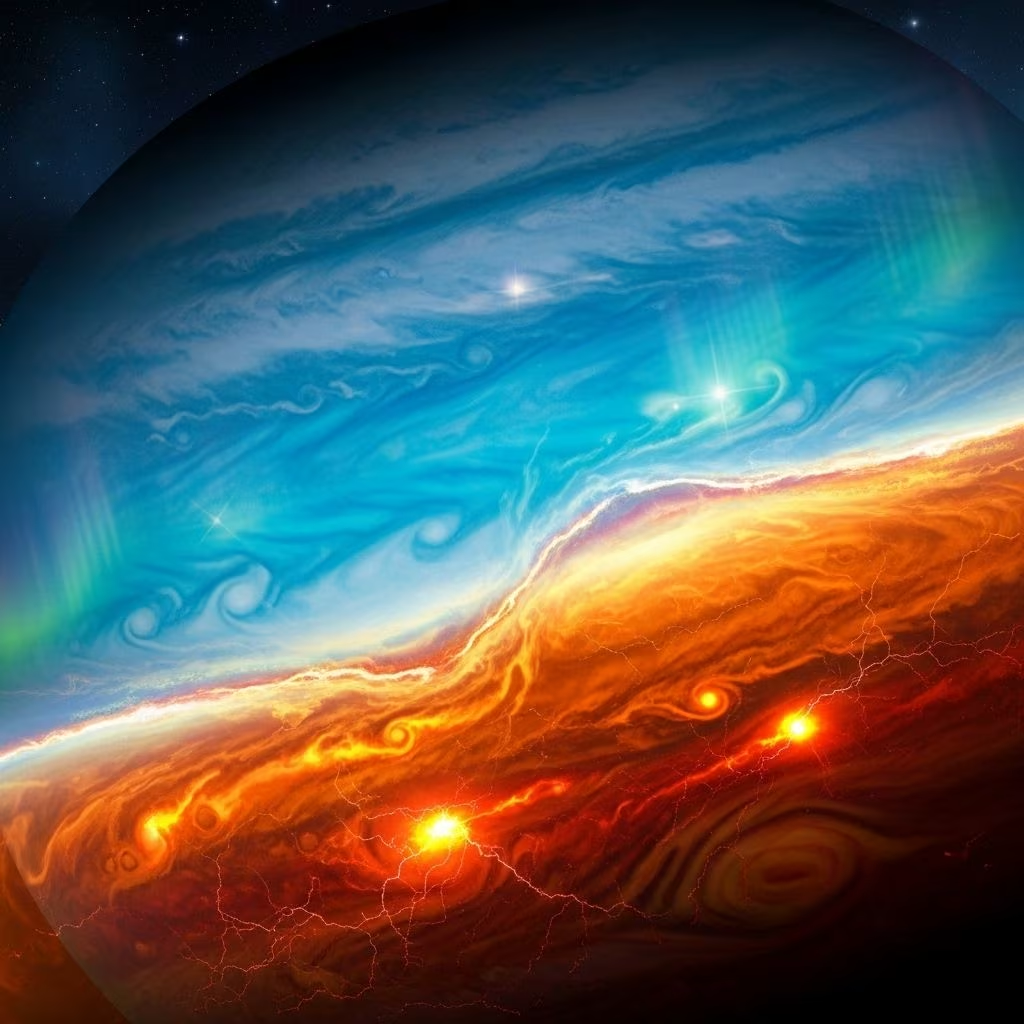
From Jupiters surface to about 50 km (30 miles) up, the temperature actually drops, ranging from -100°C (-150°F) at the lower boundary to about -160°C (-260°F) further up. But above this, the temperature climbs dramatically—reaching as high as 1340°F (725°C) more than 600 miles (1,000 kilometers) up.
Can You Stand on Jupiter?
Despite scientists referring to a surface, it is not solid and you could not stand on it. If you descended into the planet, gases would turn to liquids and then plasma long before reaching the core, making Jupiter an inhospitable world for terrestrial travelers.
What Heats Jupiter?
Jupiter is cold on its surface—by Earth standards—but it also radiates more heat than it receives from the Sun. Most of the gas giants warmth comes not from our star but from deep inside its vast body.
- Solar Heating: Only a fraction of the energy reaching Jupiter comes from the sun, due to the planets enormous distance.
- Internal Heating: Jupiters core and lower layers remain hot due to leftover heat from its formation (roughly 4.5 billion years ago).
- Convection currents: Liquid and plasma hydrogen deep inside are stirred by powerful convection—a process that constantly brings heat upwards.
- Chemical interactions: The physical and chemical reactions among the planets various gases contribute to varying temperatures in different layers.
Unlike Earth, which is heated mainly by the Sun, Jupiters atmosphere is kept warm (relative to how cold it could be) by intense inner heating, helping the planet avoid freezing into an icy wasteland despite its location on the outer reaches of the solar system.
Why Is Jupiters Upper Atmosphere So Hot?
A peculiar feature of Jupiter is the way its upper atmosphere is hotter than its surface. Scientists have found that more than 1,000 km above the planets baseline surface, temperatures can surpass 1,340°F (725°C)a.
- Solar wind and magnetic interactions: High in the atmosphere, interactions between solar radiation, Jupiters powerful magnetic field, and ionized gases can create these extraordinary temperatures.
- Dynamic atmospheric flows: The motion of gases, heat-trapping chemistry, and magnetospheric currents all contribute to superheating at these altitudes.
This hot upper layer creates a paradox—Jupiter is mostly cold, but its highest atmospheric reaches are some of the hottest locations on any planet in the solar system.
Comparing Jupiters Temperature to Earth and Other Planets
| Planet | Min. Surface Temperature | Max. Atmosphere Temperature | Heating Source |
|---|---|---|---|
| Earth | -89°C (-128°F) | 56°C (134°F) | Solar energy |
| Mars | -125°C (-195°F) | 20°C (70°F) | Solar energy |
| Jupiter | -145°C (-234°F) | 725°C (1,340°F) | Internal heat, solar wind |
| Venus | 462°C (864°F) | 464°C (867°F) | Solar energy, greenhouse effect |
Jupiters minimum temperature at its cloud tops is colder than Marss coldest spots, but its upper atmosphere is far hotter than anything found on terrestrial planets.
Jupiters Unique Atmospheric Chemistry
Beyond hydrogen and helium, Jupiters atmosphere is flooded with compounds that help define its temperature and coloration:
- Ammonia: About 0.07% by mixing ratio with H2.
- Water vapor: Present mostly in deeper atmospheric layers.
- Methane: Traces in upper layers contribute to photochemical reactions.
- Other heavy elements: Enriched in the outermost gas layers and deplete downward.
This mixture results in vibrant bands, storms, and some of the most iconic cloud patterns seen in our solar system.
Frequently Asked Questions (FAQs)
Q: How cold is Jupiter compared to Earth?
A: Jupiters average temperature near the pressure-defined surface is about -234°F (-145°C), much colder than Earths coldest recorded temperatures.
Q: Does Jupiter have a solid surface?
A: No, Jupiter is a gas giant; it transitions from gas through liquid and plasma to an unknown core. There is nowhere to stand.
Q: Why does Jupiters upper atmosphere get so hot?
A: Magnetic field interactions, solar wind, and dynamic flows in the Jovian atmosphere heat the upper layers to over 1300°F (725°C).
Q: What drives Jupiters internal heat?
A: Convection from liquid and plasma hydrogen left over from Jupiters planetary formation keeps its interior warm.
Q: Is Jupiter ever warm enough to support life?
A: Not as we know it. While its upper layers are blisteringly hot, the lower layers are inhospitable—either too cold, too gaseous, or too dense for life as we know it.
Quick Facts About Jupiters Temperature
- Jupiter radiates more heat than it receives from the Sun.
- Atmospheric temperature varies dramatically with altitude.
- Heating comes from internal convection and solar wind—not just the Sun.
- Most of Jupiter is uninhabitable: no solid ground, wild storms, and freezing or superheated gases.
Related Reading & Resources
- Jupiters Magnetic Field: How It Traps and Heats Atmospheric Gases
- Giant Planet Formation & Interior Heating
- Comparisons of Solar System Temperatures
References
- https://www.space.com/18391-jupiter-temperature.html
- https://www.skyatnightmagazine.com/space-science/how-hot-is-jupiter
- https://study.com/academy/lesson/facts-about-jupiter-atmosphere-temperature-mass.html
- https://science.nasa.gov/jupiter/jupiter-facts/
- https://science.nasa.gov/resource/solar-system-temperatures/
- https://www.britannica.com/place/Jupiter-planet/Temperature-and-pressure
- https://en.wikipedia.org/wiki/Jupiter
- https://www.britannica.com/place/Jupiter-planet
- https://www.astronomy.com/science/jupiter/
- https://en.wikipedia.org/wiki/Atmosphere_of_Jupiter
- https://www.isas.jaxa.jp/en/topics/002678.html
- https://www.universetoday.com/articles/temperature-of-jupiter
- https://www.universetoday.com/articles/how-hot-is-jupiter
- https://lco.global/spacebook/solar-system/jupiter/
- https://www.telescopenerd.com/celestial-objects/jupiter.htm
- https://www.missionjuno.swri.edu/jupiter/atmosphere?show=hs_jupiter_atmosphere_story_the-weather-on-jupiter
- https://planetfacts.org/temperature-on-jupiter/