Aries is one of the most enduring and recognizable constellations of the zodiac, celebrated for its mythological ties, distinct stars, and its pivotal role in the history of astronomy. Spanning the heavens between Pisces and Taurus, Aries marks the beginning of the zodiac in Western astrology and boasts a legacy connecting ancient cultures, navigation, and modern science.
What is Aries?
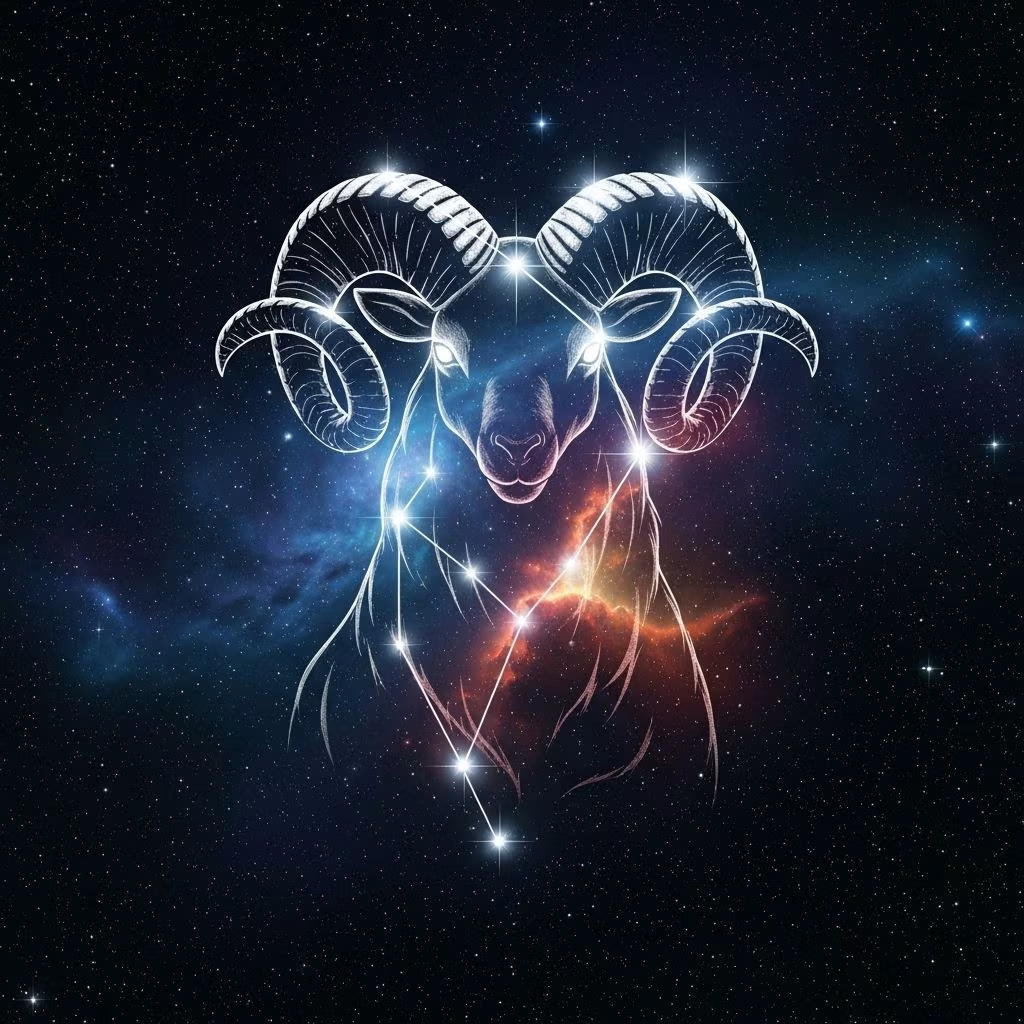
Aries is a zodiac constellation located in the Northern celestial hemisphere. Latin for “ram,” Aries is symbolized by the horns of a ram (♈︎) and is one of 88 modern constellations officially recognized today. Ranking as the 39th largest out of all, Aries covers an area of 441 square degrees, about 1.1% of the night sky.
- Abbreviation: Ari
- Genitive: Arietis
- Position: Lies between Pisces to the west and Taurus to the east
- Visibility: Best seen in the Northern Hemisphere from November to March
- Coordinates (J2000): Right ascension 3h, declination +20°
Historical and Cultural Significance
Aries has been known since antiquity and was one of the 48 constellations first catalogued by Greek astronomer Ptolemy in the 2nd century CE. It holds a special place in many cultures and mythologies—especially Greek mythology, where Aries represents the Ram of the Golden Fleece, central to the tale of Jason and the Argonauts.
- In Babylonian astronomy, Aries symbolized a farmhand before being associated with a ram.
- The constellation’s stars were part of twin inspectors in China and were seen as a porpoise in Marshall Islands’ folklore.
- Traditionally marks the vernal equinox in Western astronomy—the point where the Sun crosses the celestial equator in March, signaling the start of spring.
Where is Aries Located?
The Aries constellation resides in the first quadrant of the Northern Hemisphere (NQ1) and is surrounded by the constellations Pisces, Taurus, Triangulum, Perseus, and Cetus.
- Best latitudes for viewing: +90° to -60°
- Best months to observe: November and December, rising in the east at sunset and reaching its peak in the night sky during the late fall
Neighboring Constellations
- Pisces
- Taurus
- Triangulum
- Perseus
- Cetus
Main Stars of Aries
Though Aries is a relatively dim constellation—none of its stars shine above 2nd magnitude—it features several notable stars, each with its own unique properties. Collectively, these stars have guided humanity for millennia.
| Star Name | Bayer Designation | Apparent Magnitude | Distance (ly) | Notes |
|---|---|---|---|---|
| Hamal | Alpha Arietis | 2.0 | 66 | Brightest star; an orange giant |
| Sheratan | Beta Arietis | 2.6 | 59 | Second brightest; white binary |
| Mesarthim | Gamma Arietis | 3.9 | 204 | Binary system, white main sequence |
| 41 Arietis (Bharani) | 41 Arietis | 3.6 | 160 | Also known as Bharani |
- Other named stars: Botein (Delta Arietis), Lilii Borea (39 Arietis)
- Formal star names approved by the International Astronomical Union (IAU)
Notable Stars Detailed
- Hamal (Alpha Arietis): The brightest star in Aries and an orange giant, visible even from light-polluted city skies. Hosts a candidate exoplanet detected in 2011.
- Sheratan (Beta Arietis): A blue-white star and the second brightest, notable as a spectroscopic binary system.
- Mesarthim (Gamma Arietis): Historically known as the “First Star in Aries” and visible as a beautiful binary through small telescopes.
- 41 Arietis (Bharani): Noted for its distinctive color (blue-white main sequence).
Aries in Greek Mythology: The Story of the Golden Fleece
Aries is inextricably linked to the famous Greek myth of Jason and the Argonauts. In the legend, the constellation commemorates the ram with the golden fleece, sent by the god Hermes to rescue Phrixus and Helle from their wicked stepmother. Upon accomplishing the task, the ram was sacrificed to Zeus, and its fleece became an object of heroic quest, sought by Jason and his companions on one of ancient Greece’s greatest adventures.
- The ram’s fleece was hung in the sacred grove of Ares and guarded by a ever-vigilant dragon.
- The legend adds to Aries’ astrological associations with quests, new beginnings, and leadership.
Deep Sky Objects in Aries
While Aries is not known for a wealth of spectacular deep-space objects, it still includes several intriguing galaxies and star systems that can be observed with moderate telescopes.
- NGC 772 (Fiddlehead Galaxy): An unbarred spiral galaxy about 130 million light-years away, located just southeast of Aries’ stars.
- NGC 1156: A dwarf irregular galaxy, relatively faint but fascinating for amateur astronomers interested in observing distant galactic structures.
Aries contains no Messier objects—a rarity among zodiac constellations—but multiple galaxies and minor star clusters.
Meteor Showers Associated with Aries
Several meteor showers have their radiant point in Aries, making the constellation a focal point for skywatchers during certain times of the year.
- Daytime Arietids (peaks in June): Among the strongest daylight meteor showers.
- Epsilon Arietids
- May Arietids
- Delta Arietids
- Aries-Triangulids
The activity of these showers varies, but the Daytime Arietids are notably prominent for radio meteor observers, as their meteors are primarily visible when the Sun is above the horizon.
Exoplanets and Notable Celestial Objects
Aries is also home to several stars with confirmed exoplanets. To date, at least 13 stars in Aries are known to host planets. Notable systems include:
- HD 12661: Yellow dwarf star with two detected planets, both more massive than Jupiter.
- HIP 14810: Yellow dwarf, hosting three confirmed planets discovered in the late 2000s.
- Alpha Arietis (Hamal): Candidate for exoplanet based on radial velocity measurements.
When and How to See Aries
Aries’ visibility changes throughout the year, but the optimal time for observation in the Northern Hemisphere is during November and December. Here’s what to expect:
- Late October: Rises in the east at sunset, highest at midnight.
- November–December: Best observation window, high in the sky around 10–8 p.m. (local time).
- January: Highest in the early evening, setting toward sunrise.
To locate Aries, look for a three-star curve or line stretching from east to west between the prominent constellations of Taurus and Pisces. The brightest star, Hamal, helps to anchor Aries’ location in the sky.
Aries’ Role in Astrology
In astrology, Aries (March 21 to April 19) starts the zodiac and is associated with traits like boldness, independence, and leadership. Its glyph (♈︎) recalls the ram’s horns, symbolizing strength and initiative. While these attributions are not based on astronomical properties, they remain deeply rooted in global cultures.
Other Cultural Interpretations
- Babylonian astronomers linked the stars of Aries to a farm laborer, only later associating them with the ram.
- Chinese astronomy depicted Aries as part of a collection of stars known as twin inspectors.
- In the Marshall Islands, Aries’ stars formed a constellation often regarded as a dolphin, highlighting the diversity of stellar mythologies.
Astronomical Naming and Designations
- IAU Abbreviation: Ari
- Genitive Form: Arietis (used in star catalogs)
- Stars with IAU-approved names:
- Hamal
- Sheratan
- Mesarthim
- 41 Arietis (Bharani)
- Botein (Delta Arietis)
- Lilii Borea (39 Arietis)
Quick Facts About Aries
- Rank by Size: 39th largest constellation
- Area: 441 square degrees
- Number of main stars: 4–6, depending on brightness cutoff
- No Messier objects within its boundaries
Frequently Asked Questions About Aries
Q: When is the best time to view Aries?
A: In the Northern Hemisphere, Aries is most visible from late October through January, peaking in visibility during November and December when it’s highest in the night sky at about 8–10 p.m. local time.
Q: What are the brightest stars in Aries?
A: The most prominent stars are Hamal (Alpha Arietis), Sheratan (Beta Arietis), Mesarthim (Gamma Arietis), and 41 Arietis (Bharani).
Q: What myth is associated with Aries?
A: Aries is linked to the Golden Fleece myth from Greek legend, where Jason & the Argonauts embark on a quest for the mystical fleece guarded by a fierce dragon.
Q: Can Aries be seen from the Southern Hemisphere?
A: Yes, Aries can be seen from most locations south of +90° and as far as -60°, though it appears lower in the sky the farther south you go.
Q: Which meteor showers originate from Aries?
A: Notable Aries meteor showers include the Daytime Arietids and the Epsilon Arietids along with several others peaking at different times of the year.
Summary Table: Aries at a Glance
| Aspect | Details |
|---|---|
| Symbol | ♈︎ (The Ram) |
| Brightest Star | Hamal (Alpha Arietis) |
| Area | 441 sq. degrees |
| Astrological Sign | March 21 – April 19 |
| Key Myths | Golden Fleece (Jason & the Argonauts) |
| Best Viewing (Northern Hemisphere) | November – December |
| Main Neighbors | Pisces, Taurus, Triangulum, Perseus, Cetus |
| Notable Deep Sky Objects | NGC 772, NGC 1156 |
Further Exploration
Whether you’re an astronomy enthusiast, a mythology buff, or simply someone who enjoys stargazing on crisp winter nights, Aries offers a connection to the past and a vista of scientific wonder. Explore the sky during its peak months, trace the curving line of its starlight, and reflect on the myths and discoveries this humble group of stars has inspired for millennia.
References
- https://en.wikipedia.org/wiki/Aries_(constellation)
- https://www.constellation-guide.com/constellation-list/aries-constellation/
- https://www.go-astronomy.com/constellations.php?Name=Aries
- https://www.britannica.com/place/Aries
- https://cosmonova.org/aries-constellation-need-know/
- https://theskylive.com/sky/constellations/aries-constellation
- https://www.centreofexcellence.com/aries-constellation/
- https://star-name-registry.com/constellations/aries
- https://starregister.org/aries.php
- http://www.seasky.org/constellations/constellation-aries.html
- https://en.wikipedia.org/wiki/Aries_(astrology)
- https://www.astronomytrek.com/constellations/aries/
- https://opticsmag.com/aries-constellation-facts/
- https://blogs.missouristate.edu/physics/2023/08/09/get-to-know-the-aries-constellation/
- https://usvao.org/aries-constellation-facts/
- https://lovethenightsky.com/aries-constellation-guide/
- https://theplanets.org/constellations/aries-constellation/
- https://www.jameswebbdiscovery.com/universe/100-interesting-facts-about-the-aries-constellation
- https://universemagazine.com/en/interesting-facts-about-aries-constellation-stars-planets-myths/
- https://www.universetoday.com/articles/aries