


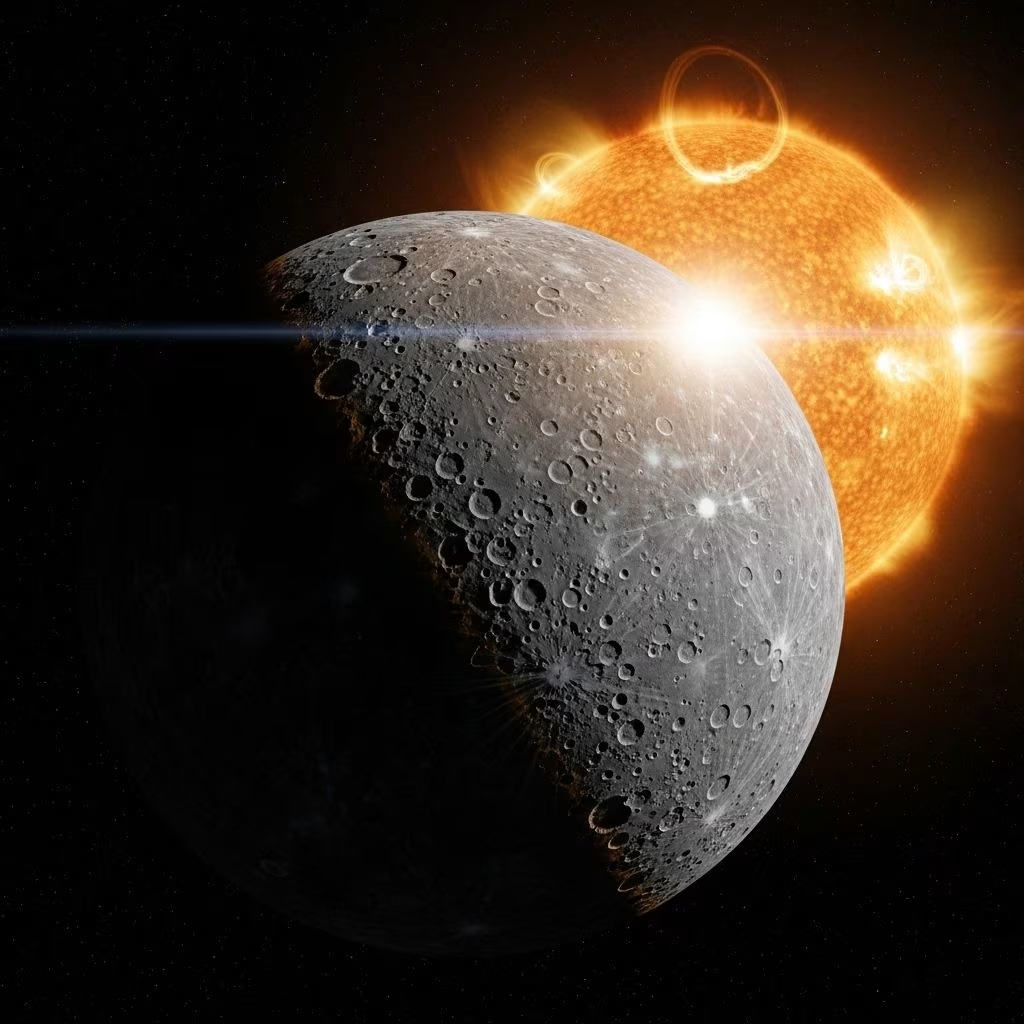
Mercury: The Sun’s Closest Planetary Neighbor
Mercury, the planet most intimately bound to the Sun, captivates astronomers and planetary scientists with its extreme environment, mysterious surface, and its role in the history of solar system formation. As the innermost planet and the smallest rocky planet, Mercury is a world of contrasts—blistering heat, bone-chilling cold, a barely-there atmosphere, and landscapes pocked by billions of years of cosmic impacts.
Overview and Quick Facts
- Position: First planet from the Sun
- Diameter: Approximately 4,880 km (3,030 mi)
- Surface gravity: About 38% that of Earth
- Orbital period: 88 Earth days
- Sidereal day (rotation): 58.65 Earth days
- Mean surface temperature: 167°C (332°F)
- Temperature range: −180°C (−300°F) to 430°C (800°F)
- Atmosphere: Extremely thin exosphere
- Moons: None
- Symbol: ☿
Mercury in Our Solar System
Mercury orbits only 57.9 million km (0.39 AU) from the Sun, making it the planet that sweeps most rapidly through our solar system at an average orbital speed of 47.4 km/second. With no moons and a dense, metallic core comprising most of its volume, it stands out among its neighbors.
| Feature | Mercury | Earth | Moon |
|---|---|---|---|
| Diameter (km) | 4,880 | 12,742 | 3,474 |
| Gravity (m/s2) | 3.7 | 9.8 | 1.6 |
| Atmosphere | Exosphere | Multiple layers | Very thin exosphere |
| Orbital period (days) | 88 | 365.25 | 27.3 |
How Mercury Got Its Name
Mercury draws its name from the Roman messenger god, famed for speed and mobility—fitting for a planet that races around the Sun more quickly than any other. Its symbol (☿) also derives from the god’s caduceus, a staff topped with wings and snakes.
Observing Mercury: Challenges and Tips
Mercury is a difficult target for both amateur astronomers and professionals. It’s always close to the horizon, enveloped in twilight after sunset or before dawn, never straying far from the Sun’s glare.
- Best viewing times: Just after sunset or before sunrise; look for Mercury low in the sky.
- Apparent brightness: Occasionally reaches magnitude −1.9, though typically fainter.
Orbital and Rotational Oddities
Mercury exhibits a remarkable spin-orbit resonance: the planet completes three rotations on its axis for every two orbits around the Sun. This creates a unique pattern where one Mercurian solar day (from one sunrise to the next) lasts 176 Earth days—making a single day on Mercury span two years.
- Orbital eccentricity (how much the orbit deviates from a circle): 0.2056—more than any other planet
- Inclination to ecliptic: 7.0°
- Almost zero axial tilt
This combination means Mercury experiences intense temperature swings, with prolonged periods of sunlight and darkness on its surface.
Mercury’s Extreme Climate
Mercury’s proximity to the Sun and thin exosphere produce dramatic temperature extremes.
- Daytime temperatures: Up to 430°C (800°F)
- Nighttime temperatures: As low as −180°C (−300°F)
- Permanently shadowed craters: At the poles, where water ice persists amid the deep freeze
The almost negligible atmosphere means there’s no insulation between day and night, resulting in these wild contrasts.
Mercury’s “Atmosphere”: The Exosphere
Mercury’s envelope of gases, called an exosphere, is so thin it’s almost a vacuum. It consists mostly of oxygen, sodium, hydrogen, helium, and potassium, sourced from the solar wind and the planet’s surface.
- Surface pressure: about 10−15 bar—one of the lowest of any world in the solar system
This exosphere is unable to support weather, clouds, or life.
Magnetic Field and Magnetosphere
Unusual for such a small, rocky planet, Mercury possesses a global magnetic field—about 1% the strength of Earth’s. It’s likely produced by a partially molten iron core. Its presence deflects solar wind, shaping a modest magnetosphere.
- Magnetic field strength: 0.003 gauss
- Magnetosphere causes interactions with solar particles and surface chemistry
Mercury’s Surface: A World of Craters and Cliffs
Resembling Earth’s Moon at first glance, Mercury’s surface is etched with ancient scars.
- Impact craters: Evidence of billions of years of collisions
- Scarps (cliffs): Result of the shrinking and cooling planet
- Rupes system: Gigantic thrust faults crisscross the surface
Major Surface Features
- Caloris Basin: One of the largest impact structures in the solar system, about 1,550 km (960 mi) across
- Bright ray systems: Streaks of ejected material around craters
- Plains: Both ancient and smooth plains formed by volcanic activity
Compared to the Moon, Mercury is denser and exhibits features such as long scarps and lack of large lava seas (maria), highlighting its unique tectonic history.
Water Ice at the Poles
Permanently shadowed crater floors near Mercury’s poles remain cold enough to shelter water ice. Despite surface temperatures reaching extreme highs elsewhere, these craters never see sunlight.
- Confirmed by: Messenger spacecraft and Earth-based radar observations
- The source of water is likely from comets, asteroids, or solar wind interactions
Mercury’s Core and Interior Structure
Mercury’s metallic core makes up over 60% of its volume—the largest core (proportionally) among the rocky planets. A dense, iron-rich composition gives Mercury its high density (5.43 g/cm3).
- Core: Iron-nickel, possibly with some sulfur
- Mantle: Relatively thin compared to other planets
- Crust: Rocky, pockmarked by ancient impacts
Exploring Mercury: Missions Past and Present
Studying Mercury up-close is technically daunting. Only two spacecraft have visited:
- Mariner 10 (1974–1975): First to image Mercury and reveal its craters, magnetic field, and thin atmosphere
- Messenger (2011–2015): Orbited Mercury and mapped its surface, discovered water ice, measured the magnetic field, and explored surface chemistry
Upcoming missions, like ESA/JAXA’s BepiColombo, aim to decode Mercury’s geology, exosphere, and magnetic environment in even greater detail.
Mercury in Scientific Context
Mercury plays a unique role in planetary science:
- Testing relativity—its precise orbit provided a way for scientists, including Einstein, to validate general relativity.
- Understanding rocky planet evolution—informs models for planets close to other stars.
- Learning about solar system formation from its dense core and thin mantle.
Frequently Asked Questions (FAQs)
Q: Why is Mercury so hard to observe?
Mercury is close to the Sun, making it visible only near dusk or dawn for brief periods. Its low altitude and glare add difficulty for observation.
Q: Does Mercury have any moons?
No, Mercury does not have any moons. Its proximity to the Sun likely prevents stable moon orbits.
Q: Is there water on Mercury?
Messenger confirmed water ice in the permanently shadowed craters at Mercury’s poles, even amid extreme environmental conditions.
Q: How does Mercury’s magnetic field compare to Earth’s?
Mercury’s magnetic field is about 1% as strong as Earth’s but is unique for a planet of its size and type.
Q: Has Mercury been explored by spacecraft?
Yes. NASA’s Mariner 10 and Messenger, along with observations from Earth, have expanded our understanding. Future missions like BepiColombo will continue the exploration.
Key Scientific Data
| Parameter | Value |
|---|---|
| Mean distance from Sun | 57.9 million km (0.39 AU) |
| Orbital eccentricity | 0.2056 |
| Mean orbital velocity | 47.36 km/sec |
| Mass | 3.30 × 10²³ kg |
| Density | 5.43 g/cm3 |
| Surface area | 74.8 million km2 |
Conclusion: Mercury’s Role in the Solar System
Mercury, a planet of extremes and enigmas, offers a window into the formation and evolution of rocky planets. Its scorching days, frigid nights, lack of moons, and magnetic mysteries continue to challenge scientists and inspire future missions. With each visit and each discovery, Mercury helps us piece together the cosmic puzzle of our solar system and the rocky worlds beyond.
References
- https://science.nasa.gov/mercury/facts/
- https://en.wikipedia.org/wiki/Mercury_(planet)
- https://www.britannica.com/place/Mercury-planet
- https://www.space.com/36-mercury-the-suns-closest-planetary-neighbor.html
- https://www.nhm.ac.uk/discover/planet-mercury.html
- https://space-facts.com/mercury/
- https://www.space.com/27013-strange-mercury-facts-photos.html
- https://spaceplace.nasa.gov/all-about-mercury/en/
- https://www.rocketstem.org/2020/03/26/mercury-facts-questions-history/
- https://www.planetary.org/worlds/mercury
- https://www.skyatnightmagazine.com/space-science/guide-to-the-planets-mercury
- https://airandspace.si.edu/explore/stories/mercury
- https://www.britannica.com/place/Mercury-planet/Basic-astronomical-data
- https://www.funkidslive.com/learn/top-10-facts/top-10-facts-about-mercury/
- https://www.astrogirl-au.com/post/facts-about-mercury
- https://sciencenotes.org/mercury-planet-facts/
- http://www.starnetlibraries.org/wp-content/uploads/2019/03/Planet-Signs.pdf
- https://historyinnumbers.com/places/space/solar-system/planet-mercury/
- https://www.planetsforkids.org/planet-mercury.html


