How to Destroy the Earth: Scientific Approaches and Cosmic Catastrophes
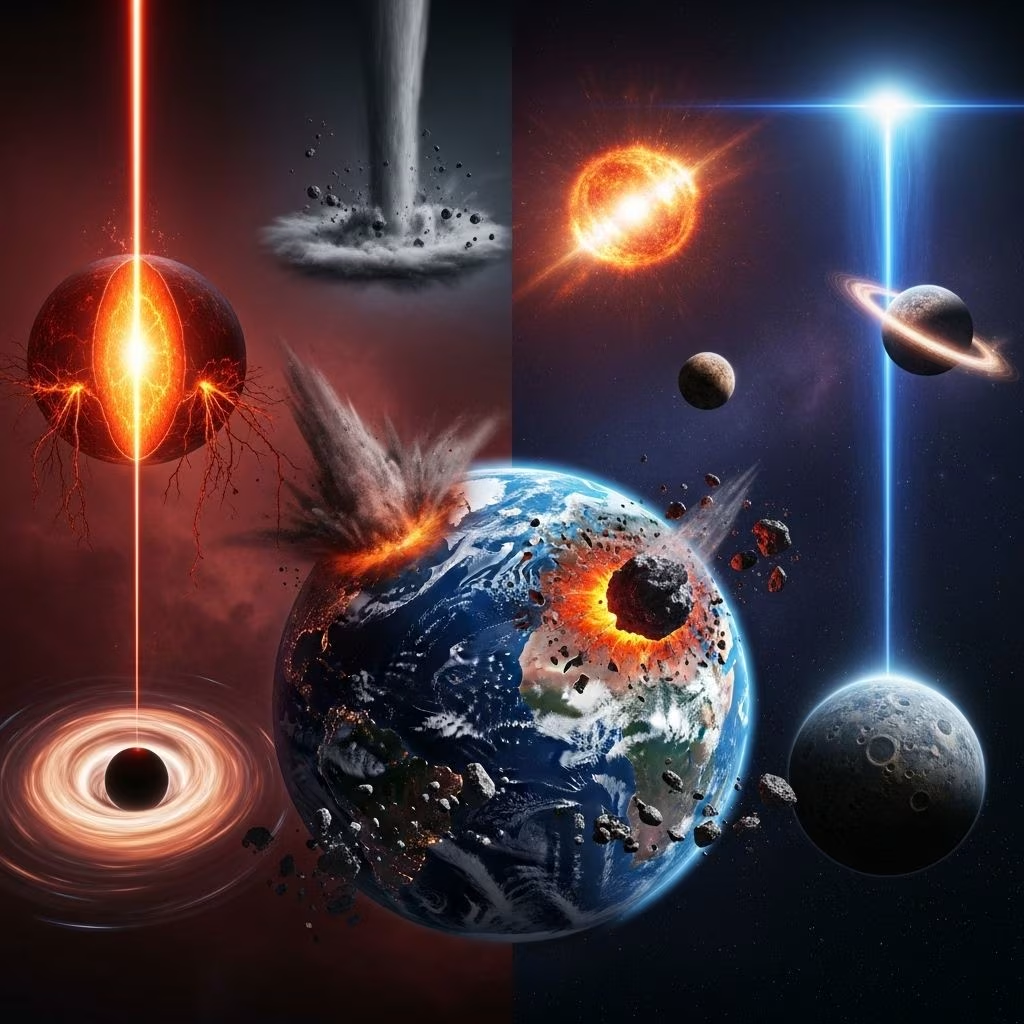
For centuries, destruction on Earth has captured both scientific and fictional imaginations. While disaster movies paint dramatic pictures of planetary annihilation, genuine obliteration of the entire planet is exponentially more difficult than popular culture would suggest. The Earth is billions of years old, a gargantuan sphere of rock and metal, and it’s survived asteroid impacts, supervolcanoes, and cosmic collisions throughout its history. But what would it really take to erase Earth from existence? Here, we examine the most credible (and some wildly implausible) methods humanity or the cosmos might employ to utterly destroy our home planet.
Not So Easy: Earth’s Robustness
Before diving into annihilation scenarios, it is vital to acknowledge that Earth is astonishingly resilient. At approximately 4.55 billion years old and weighing nearly 6 sextillion tons, the planet has withstood tremendous violence over its existence. Any practical or theoretical attempt to destroy Earth must overcome immense gravitational binding energy—the energy binding all its atoms together. This intractable fact makes Earth’s total destruction a herculean, or more accurately, an almost impossible task.
1. Total Existence Failure
What you need: Nothing, except an unfathomable twist of probability.
Method: The universe is governed by quantum mechanics, where—even if astronomically unlikely—there exists a chance that every atom in the Earth could spontaneously vanish. This scenario, sometimes termed a quantum fluctuation or total existence failure, would require every particle comprising the planet to simultaneously cease to exist—much like flipping a coin and landing heads every time for more times than there are atoms in the universe.
- Odds so astronomically low they surpass a googolplex to one.
- Would require either luck beyond comprehension or a hypothetical device capable of manipulating probabilities at a fundamental quantum level.
Result: Utter and instantaneous nonexistence. Earth would simply blink out of reality. While irresistible to the imagination, this is so improbable that it can be dismissed as science fiction or fantasy.
2. Pulverized by Impact with a Blunt Instrument
What you need: A massive object, such as a large asteroid or even a planet—think Mars or Venus.
Method: The principle is straightforward: Anything can be destroyed if you hit it hard enough.
- An object of sufficient mass—at least 60% of Earth’s mass if traveling at minimum impact velocity (11 km/s)—colliding with Earth could shatter it entirely.
- Mars (about 11% of Earth’s mass) or Venus (about 81% of Earth’s mass) are possible candidates—assuming you could accelerate one into the other at astronomical speed.
- Alternatively, a smaller object (such as an asteroid weighing 10 trillion tons) would suffice if you could accelerate it to a significant fraction of light speed (e.g., 90% of the speed of light).
Analysis: Overcoming Earth’s gravity to prevent the rubble from coalescing back into a planet amplifies the required energy by orders of magnitude. While physically plausible (given unimaginable resources and time), this remains far beyond current human capability.
Final state: Fragments of former Earth, potentially scattered across the solar system, never to recombine.
3. Eaten by Von Neumann Machines
What you need: At least one self-replicating machine—known as a Von Neumann machine—that can build copies of itself using Earth’s raw materials.
Method: Deploy a machine capable of consuming iron, silicon, and other elements abundant in Earth’s crust and mantle. The machine replicates using local resources, with each copy going on to create further copies. The exponential growth results in a swarm of machines eating more and more of the planet until nothing of value remains.
- This method’s speed depends on replication intervals and resource collection efficiency.
- Full planetary consumption could take decades to centuries, depending on machine design and replication speed.
Final act: The machines (and any converted planetary remnants) could be commanded to launch themselves into the sun for a thorough destruction, ensuring no trace of Earth remains.
Inspiration: This concept is derived from theoretical nanotechnology and has been popularized in science fiction literature (e.g., Arthur C. Clarke’s “2010: Odyssey Two”).
4. Annihilation by Antimatter
What you need: An amount of antimatter equal in mass to the entire Earth.
Method: Antimatter is composed of subatomic particles that are the mirror of those in conventional matter. When matter and antimatter meet, they annihilate completely, converting their entire mass to pure energy.
- If you could somehow generate or acquire 6 septillion tons of antimatter and bring it into perfect contact with the Earth’s matter, the resulting annihilation would release more energy than the sun produces over thousands of years.
Challenges:
- Humanity can presently produce only a few nanograms of antimatter per year—nowhere near what is required.
- Storage and containment of even microgram amounts of antimatter require extremely advanced and stable technology due to the risk of premature annihilation.
Result: Earth is transformed into a rapidly expanding fireball of gamma rays and subatomic debris, ceasing to exist as any recognizable structure.
5. Vacuum Detonation (False Vacuum Decay)
What you need: A way to change the fundamental nature of the vacuum itself—perhaps via high-energy particle physics incidentally or by accident.
Method: According to some models of particle physics, our universe may be in a “false vacuum” state—a local, but not the absolute, minimum of energy. If a lower-energy true vacuum exists, a small bubble of this “real vacuum” could, in principle, be triggered. This bubble would expand at the speed of light, altering the laws of physics in its wake and eradicating all atomic structure—Earth included.
- No technology currently exists to intentionally initiate a vacuum decay, but some fear high-energy collider experiments might have a remote theoretical risk (current consensus says they’re exceedingly safe).
Final state: Not only Earth, but the entire visible universe would be reconfigured or destroyed as the bubble expanded, wiping out reality as we know it.
6. Gradual Disassembly via Mass Drivers
What you need: Enough massive, high-powered electromagnetic launchers (mass drivers) to gradually hurl the Earth’s mass out into space.
Method: Using giant electromagnetic railguns several miles or even hundreds of miles in length, begin launching millions of tons of rock and metal into space, piece by piece, in excess of Earth’s escape velocity (11.2 km/s). Over centuries, each chunk further reduces Earth’s overall mass and gravitational cohesion. To finish the job, molten core and mantle materials would also be launched, until the battered husk was entirely scattered into space.
- Requires staggering energy inputs and the construction of industrial-scale machinery covering entire continents and powered for centuries.
- Eventually, nothing remains at the original orbit except for a thin cloud of planetary debris drifting through the solar system.
Result: Incredibly laborious and unlikely, but theoretically possible given enough time, infrastructure, and energy.
7. Artificial Collision with a Neutron Star or Black Hole
What you need: Technology capable of moving stellar-mass objects, such as a neutron star or black hole.
Method: Direct Earth’s orbit into the path of a neutron star or guide a black hole into the inner solar system. The gravitational tidal forces would tear Earth apart violently—the matter would be ripped from the planet and either accrete onto the black hole or be flung out as high-speed jets.
- Manipulating objects of this scale is profoundly beyond any current or foreseeable technology, given their massive gravity and energy.
Result: Earth’s matter is spaghettified (stretched by tidal forces) and consumed or dispersed, leaving nothing behind but scattered particles or energy signatures.
8. Exotic Theoretical Methods
Other speculative ways to destroy the Earth draw heavily from advanced physics and imagination. These range from opening an artificial wormhole to a neutron star, subjecting Earth to intense gamma rays and gravitational collapse, to advanced forms of quantum manipulation. While these approaches capture the imagination, most remain in the realm of speculative science or science fiction.
- Opening wormholes remains entirely theoretical.
- Manipulating the Higgs field or cosmic strings are hypothetical scenarios without practical basis in current science.
- Some are broad enough to threaten not just our planet, but all of known existence.
The Practical Impossibility of Total Earth Destruction
Even the most advanced or destructive technologies currently available—or on the visible horizon—fall short of Earth’s total eradication. The sheer scale of material, energy, and entropy required is, for now, beyond the realm of practical human endeavor. Indeed, most realistic threats to the planet’s biosphere (life-supporting environment)—nuclear war, uncontrolled climate change, pandemic, or even modest asteroid strikes—would render the planet uninhabitable, but leave its core structure fundamentally unscathed. Genuine annihilation remains either cosmic in scale or solidly in the domain of science fiction.
Comparison Table: Prospects for Earth’s Destruction
| Method | Requirements | Plausibility | Final State |
|---|---|---|---|
| Total Existence Failure | Impossibly improbable quantum event | Science fiction only | Instant nonexistence |
| Pulverized by Impact | Massive planet or relativistic asteroid | Theoretically possible, practically impossible | Scattered debris |
| Von Neumann Machines | Self-replicating nano-robots | Theoretically plausible, but unproven | Consumed, machines remain |
| Antimatter Reaction | Earth’s mass in antimatter | Energetically plausible, unachievable | Complete annihilation to energy |
| Vacuum Detonation | Triggering vacuum decay | Purely hypothetical, catastrophic | Universal alteration/destruction |
| Mass Drivers | Centuries of industrial disassembly | Technically possible, logistically monstrous | Planetary dust |
| Neutron Star / Black Hole | Stellar-scale engineering | Beyond foreseeable technology | Consumed, dispersed particles |
Frequently Asked Questions (FAQs)
Q: Could a nuclear war destroy the Earth entirely?
A: No. While a global nuclear war could devastate human civilization and much of the biosphere, it would not have remotely enough energy to obliterate the planet itself.
Q: What is the most likely way the planet might be destroyed?
A: In natural terms, the Earth will eventually be consumed by the sun as it expands into a red giant in about five billion years. Total cosmic or artificial destruction remains extremely unlikely.
Q: Can black holes on Earth (such as those produced by particle colliders) swallow the planet?
A: No astronomical evidence or theoretical work supports this fear. Any micro black holes that might be created would evaporate by Hawking radiation almost instantly.
Q: Could an asteroid impact destroy Earth?
A: No known asteroid, short of planetary size, could obliterate Earth entirely. The worst impacts can sterilize the surface, but the planet’s mass and structure would remain mostly intact.
Q: What will eventually happen to the Earth?
A: Barring unknown cosmic threats or ambitions for planetary-scale engineering, Earth will persist until the solar system’s ultimate fate—likely when it is enveloped or destroyed as the sun evolves, or eventually subsumed by stellar or galactic processes.
References
- https://www.space.com/43014-how-to-destroy-the-earth.html
- https://www.space.com/24895-space-junk-wild-clean-up-concepts.html
- https://www.livescience.com/17875-destroy-earth-doomsday.html
- https://www.theastroholic.co.uk/blog/the-astroholic-explains-s02e01-how-to-destroy-the-earth
- https://www.youtube.com/watch?v=39huofn2NOU
- https://www.universetoday.com/39553/destruction-of-earth/amp/
- https://www.youtube.com/watch?v=W4UfmOHjiJg
- https://thescience360.com/this-much-energy-can-blown-up-entire-earth/
- https://davidson.weizmann.ac.il/en/online/database/physics/ten-ways-destroy-earth-%E2%80%93-science-fiction-or-daunting-reality
- https://www.wonderslist.com/things-most-likely-to-destroy-the-earth/
- https://www.science.org/content/article/scienceshot-destroy-earth-comfort-your-computer
- https://www.physicsforums.com/threads/crazy-idea-how-to-destroy-the-earth.849625/
- https://time.com/archive/6934680/blowing-up-the-planet-with-asteroids/
- https://gizmodo.com.au/2020/08/12-ways-humanity-could-destroy-the-entire-solar-system/
- https://futurism.com/experts-worried-destroying-space-station-damage-environment