


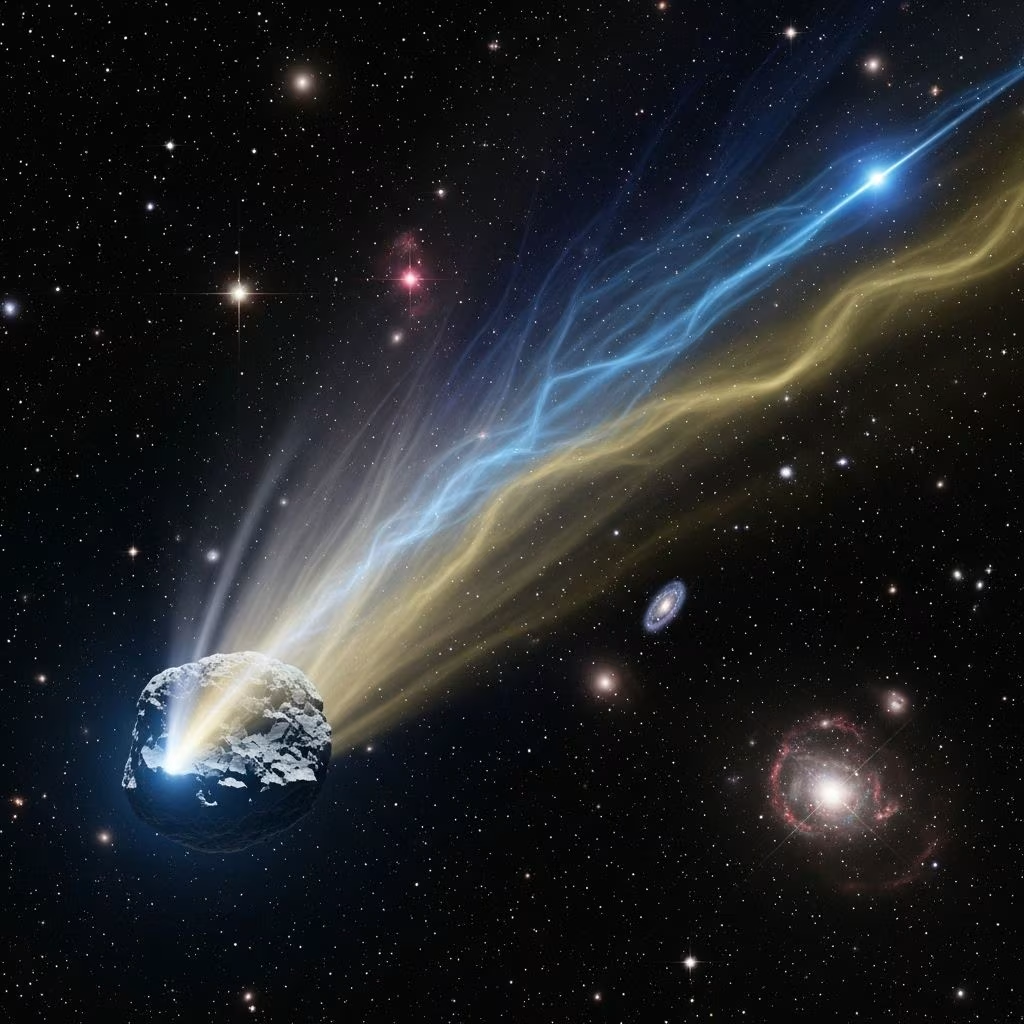
Comets: Everything You Need to Know About the ‘Dirty Snowballs’ of Space
Comets, often dubbed as cosmic ‘dirty snowballs,’ have fascinated humanity for centuries. Their sudden appearances, long glowing tails, and mysterious origins have made them subjects of awe, study, and superstition from ancient civilizations to modern astronomy. This article provides a comprehensive exploration of comets, from their structure to their role in unveiling the secrets of our solar system.
What Is a Comet?
A comet is a small, icy body that orbits the Sun and becomes active as it approaches the Sun’s warmth, developing a fuzzy head (coma) and often a long glowing tail. Comets are unique members of our solar system because they contain pristine material from its birth—making them time capsules that preserve the chemistry of the early solar nebula.
The nickname ‘dirty snowball’ comes from their composition: a mixture of dust, rock, and various ices such as water, carbon dioxide, ammonia, and methane. When far from the Sun, comets remain as frozen, inert nuclei, but as they get closer, sunlight heats these ices, causing them to sublimate (turn directly from solid to gas). This process forms the spectacular coma and tail, which can stretch for millions of kilometers.
Anatomy of a Comet: Structure and Components
Understanding a comet’s anatomy helps unravel the physical processes that take place as it journeys through the solar system.
- Nucleus: The solid core, typically only a few kilometers across, composed of rock, dust, and ices. It is irregular in shape and very dark, often covered with a crust of organic materials and dust.
- Coma: The cloud of gas and dust that forms when sunlight heats the nucleus, enveloping it in an atmosphere that can be thousands of kilometers wide.
- Tails: Most distinctive when a comet is near the Sun. Two main types:
- Gas/Ion tail: Composed of charged particles blown away directly from the comet by the solar wind, always pointing away from the Sun.
- Dust tail: Made up of small, solid particles that are pushed away from the nucleus by radiation pressure; often broader and curves slightly along the comet’s orbital path.
- Hydrogen envelope: An invisible cloud of hydrogen atoms that can extend for millions of kilometers around some comets.
| Component | Description |
|---|---|
| Nucleus | Solid, central part. Few km to tens of km across. Made of rock and ices. |
| Coma | Cloud of gas/dust around nucleus formed by solar heating. |
| Ion Tail | Straight, bluish. Formed by gases ionized and pushed by solar wind. |
| Dust Tail | Curved, white/yellowish. Made of fine solid particles pushed by light. |
Tail and Coma Formation: The Science Behind the Glow
Outgassing is the process driving a comet’s spectacular display. When a comet gets close enough to the Sun, solar radiation heats its nucleus. The heat vaporizes some of the ices, transforming them into gas and carrying dust away with them. This creates a surrounding coma and, under the influence of the solar wind and radiation, stretches material into tails that can span millions of kilometers.
Key points about tail and coma formation:
- Tails always point away from the Sun, regardless of the direction of the comet’s travel.
- The ion tail forms quickly and straight, while the dust tail is broader and often curved.
- The closer a comet gets to the Sun, the more intense the outgassing, the larger its coma, and the brighter and longer its tails.
Coma and tail formation are not only visually stunning but also critical to understanding a comet’s structure, composition, and the conditions in the early solar nebula.
Where Do Comets Come From?
Comets originate from two main distant regions of our solar system:
- Oort Cloud:
- A vast spherical shell surrounding the solar system, extending from about 2,000 to 100,000 AU (astronomical units) from the Sun.
- Believed to be the reservoir of long-period comets, which can have orbits lasting hundreds of thousands—sometimes millions—of years.
- Comets are occasionally sent into the inner solar system by the gravitational influence of passing stars or the galactic tide.
- Kuiper Belt (and Scattered Disc):
- A ring of icy bodies beyond Neptune, in the plane of the solar system.
- Source of short-period comets, which have orbits of less than 200 years and travel in the same direction as the planets around the Sun.
- Objects from the Kuiper belt are sometimes perturbed by Neptune’s gravity into comet-like orbits.
Recently, a population known as main-belt comets has been identified within the asteroid belt. These objects have nearly circular orbits, distinguishing them from typical comets.
Cometary Orbits and Classification
Comets exhibit a diverse range of orbits and can be classified based on their period and origin:
- Short-Period Comets:
- Origin: Kuiper belt and scattered disc
- Orbital Period: < 200 years
- Examples: Halley’s Comet, Encke’s Comet
- Long-Period Comets:
- Origin: Oort cloud
- Orbital Period: > 200 years to millions of years
- Often plunge into the inner solar system after being perturbed by stars or other forces
- Examples: Comet Hale-Bopp, Comet Hyakutake
- Single-Aparition (Non-Periodic) Comets:
- May pass through the solar system only once on a hyperbolic trajectory
- Often ejected into interstellar space after their first encounter
Comets generally follow highly eccentric elliptical orbits, bringing them close to the Sun and then back out to the solar system’s remote boundaries. Their paths can be heavily influenced by the giant planets, especially Jupiter, which can alter or capture them as Jupiter-family comets.
Famous and Bright Comets
Throughout history, some comets have become legends, dazzling observers on Earth and offering valuable scientific insights:
| Comet Name | Year of Noted Appearance | Key Facts |
|---|---|---|
| Halley’s Comet | Visible every ~76 years (last in 1986) | Best-known; recorded since 240 BCE; returns on regular schedule. |
| Hale-Bopp | 1997 | Spectacularly bright; visible for over a year; one of the most observed comets of the 20th century. |
| Hyakutake | 1996 | Came very close to Earth; visible in Northern Hemisphere; extremely bright tail. |
| Comet NEOWISE | 2020 | Stunning pandemic-era display; visible to naked eye; long, broad tail. |
| Comet C/2022 E3 (ZTF) | 2023 | Dubbed the “green comet” due to its color; visible with binoculars. |
Other notable comets include Encke (shortest period known), Shoemaker-Levy 9 (famously collided with Jupiter), and Lovejoy (displayed prominent tail structure).
Comets and the Formation of the Solar System
Comets are more than spectacular lightshows—they are keys to understanding the origin and evolution of the solar system. Their primordial ices and dust have been little altered since the solar system’s infancy about 4.6 billion years ago.
Key points:
- Comets are believed to be remnants from the protoplanetary disk—essentially icy leftovers from the solar system’s formation.
- Studying the composition of comet nuclei and dust reveals information about the early solar system’s chemical conditions.
- Organic molecules and water found in comets suggest they could have played a role in delivering key ingredients for life to early Earth and other planetary bodies.
- Recent scientific studies reveal that differences in how comets break up as they near the Sun are tied to their places of origin in the early solar system, contributing to the diversity of meteor showers we see on Earth.
Comet research reshapes our theories about where planetary building blocks came from and what factors led to the emergence of habitable worlds.
Observing and Exploring Comets
Anyone can observe comets during their brightest apparitions, sometimes using just the naked eye. Observers can spot a comet as a fuzzy patch in the sky, sometimes with a bright head and long tail sweeping away from the Sun.
Tips for observing comets:
- Use online sky charts or dedicated apps to track upcoming visible comets.
- Binoculars or small telescopes can enhance the view, especially for fainter comets.
- Best observing conditions are under dark skies, far from city lights.
Spacecraft missions, such as ESA’s Rosetta (exploring Comet 67P/Churyumov-Gerasimenko) and NASA’s Deep Impact and Stardust (which studied and collected samples from comets), have revolutionized our understanding of comet composition and activity. These missions have allowed scientists to analyze a comet’s surface, jets, dust, and ices in unprecedented detail.
Frequently Asked Questions (FAQ)
Q: What is the difference between an asteroid and a comet?
A: Comets are made largely of ice, dust, and rocky material, forming striking tails when heated by the Sun, while asteroids are rocky or metallic objects that generally remain inert and do not produce tails.
Q: Why do some comets have green tails?
A: The green color comes from molecules such as diatomic carbon (C2) and cyanogen (CN) in the coma fluorescing in sunlight.
Q: Can comets hit the Earth?
A: The odds of a comet striking Earth in any given year are extremely low, but impacts do occur on cosmological timescales. The impact of Comet Shoemaker-Levy 9 on Jupiter demonstrated the potential effects of such collisions.
Q: What determines a comet’s tail length?
A: Tail length depends on the comet’s activity (how much material it releases) and the Sun’s intensity. Closer approaches to the Sun mean larger and brighter tails.
Q: Are all comets visible to the naked eye?
A: No, only a small fraction become bright enough to be observed without telescopes. Most remain faint, requiring optical aid.
Q: Where will the next bright comet appear?
A: Active comet discoveries are ongoing. Several comets visible to amateurs are predicted each year; check astronomical calendars and resources for forecasts.
Further Reading and Resources
- NASA Solar System Exploration – Comets
- European Space Agency – Rosetta Mission Archive
- International Comet Quarterly
- Online sky tracking applications (e.g., Stellarium, SkySafari)
Comets remain one of the most thrilling spectacles of the night sky and key to unlocking the history and chemistry of our solar system.
References
- https://www.space.com/comets.html
- https://www.space.com/astronomy/solar-system/comets
- https://starwalk.space/en/news/what-are-comets
- https://science.nasa.gov/solar-system/comets/
- https://en.wikipedia.org/wiki/Comet
- https://spaceplace.nasa.gov/comets/en/
- https://nasaspacenews.com/2024/09/how-comets-reveal-our-solar-systems-birth/
- https://www.livescience.com/space/astronomy/comets
- https://www.astronomy.com/science/what-are-comets-and-where-do-they-come-from/
- https://www.astronomy.com/science/comets-an-essential-guide-to-the-snow-cones-of-space/
- https://www.britannica.com/science/comet-astronomy
- https://newspaceeconomy.ca/2025/07/07/what-are-comets/
- https://www.livescience.com/space/comets/nasa-confirms-that-mysterious-object-shooting-through-the-solar-system-is-an-interstellar-visitor-and-it-has-a-new-name
- https://www.britannica.com/science/comet-astronomy/Spacecraft-exploration-of-comets
- https://www.skyatnightmagazine.com/space-science/a-guide-to-comets
- https://www.americanscientist.org/article/how-were-the-comets-made
- https://www.the-independent.com/space/3i-atlas-comet-interstellar-object-earth-tail-b2828191.html


