The Moon’s changing appearance throughout the month has fascinated humanity for millennia. This article provides an in-depth look at the science behind Moon phases, the reasons for their progression, and their broader significance for Earth and sky-watchers alike.
What Are Moon Phases?
The term Moon phases refers to the changing shapes of the Moon as seen from Earth over the course of about a month. What we perceive as phases are merely the varying portions of the Moon’s sunlit half that are visible to us, caused by the geometric relationship between the Sun, the Moon, and Earth as the Moon orbits our planet.
- The Moon does not produce its own light; its glow comes from sunlight reflected from its surface.
- At any instant, half the Moon is sunlit. Changes in our view of that illuminated half create the different phases.
- A complete cycle of phases is called the synodic month, lasting about 29.5 days.
The Science of the Lunar Cycle
The Moon’s path around Earth results in regular changes in its appearance. The lunar cycle, or synodic month, is the interval between two consecutive new moons, lasting on average 29.5 days due to the combined effects of the Moon’s motion around Earth and Earth’s motion around the Sun.
- The Moon orbits Earth in an elliptical path, always keeping the same face (the “near side”) turned our way due to synchronous rotation.
- As it moves, our view of the sunlit portion varies predictably—from fully dark to fully illuminated and back again.
- Different Moon phases mark distinct points along this orbit.
The primary phases each mark a specific moment when Earth, Moon, and Sun have a particular geometric alignment. The intermediate phases describe the transition between these moments, resulting in the familiar, gradually morphing shapes in our night sky.
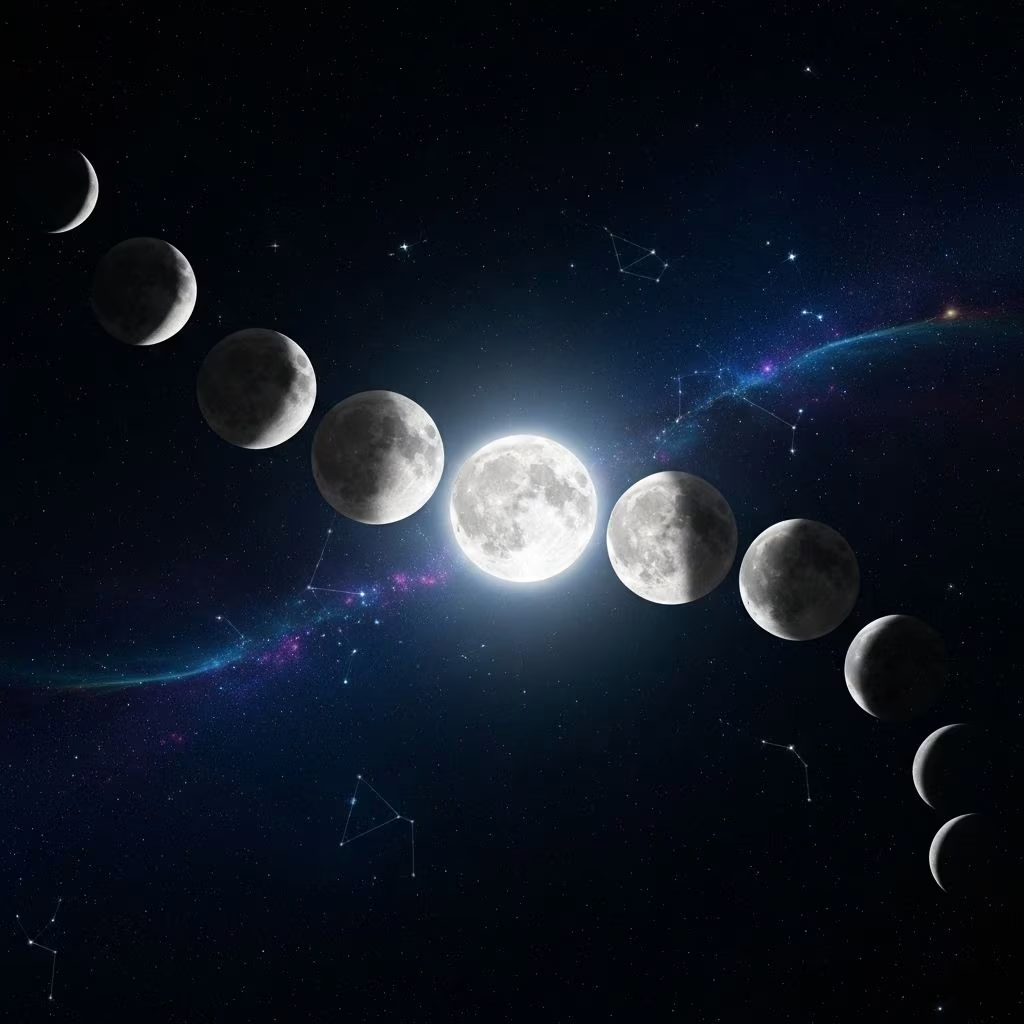
The Eight Phases of the Moon, In Order
There are eight official phases of the Moon, alternating between primary and intermediate stages:
- New Moon (primary)
- Waxing Crescent (intermediate)
- First Quarter (primary)
- Waxing Gibbous (intermediate)
- Full Moon (primary)
- Waning Gibbous (intermediate)
- Third Quarter (primary, sometimes called Last Quarter)
- Waning Crescent (intermediate)
| Phase | Type | Main Visible Feature | Illumination (%) | Rising/Setting Time |
|---|---|---|---|---|
| New Moon | Primary | Invisible (or nearly so) | ~0% | Rises and sets with the Sun |
| Waxing Crescent | Intermediate | Thin crescent | 1–49% | Late morning to sunset |
| First Quarter | Primary | Half-moon | ~50% | Noon to midnight |
| Waxing Gibbous | Intermediate | More than half, but not full | 51–99% | Afternoon to early morning |
| Full Moon | Primary | Fully illuminated | ~100% | Sunset to sunrise |
| Waning Gibbous | Intermediate | More than half, but decreasing | 99–51% | Evening to morning |
| Third Quarter | Primary | Half-moon (other side illuminated) | ~50% | Midnight to noon |
| Waning Crescent | Intermediate | Thin crescent, shrinking | 49–1% | Pre-dawn hours |
Details: Moon Phases Explained
New Moon
The New Moon marks the start of the lunar month. The Moon is positioned between Earth and the Sun, making its sunlit side face away from Earth. The Moon is nearly invisible (except during rare solar eclipses), as the far side is illuminated.
- Illumination: 0% (approximate).
- Rises and sets: With the Sun.
- Special note: A solar eclipse can occur if the Moon, Sun, and Earth align perfectly in the ecliptic, casting the Moon’s shadow on Earth.
Waxing Crescent
In the Waxing Crescent phase, a slim arc of the Moon appears in the west after sunset. “Waxing” means increasing, as more of the Moon becomes visible each night. In the Northern Hemisphere, the lit segment is on the right; in the Southern Hemisphere, it’s to the left.
- Illumination: 1–49% (growing).
- Visible: Shortly after sunset.
First Quarter
The First Quarter phase arrives about one week after new moon. Half of the Moon’s disk is visible, with the sunlit half on the right (Northern Hemisphere). Despite the term “quarter,” the moon appears half illuminated to observers.
- Illumination: 50%.
- Visible: From noon to midnight.
Waxing Gibbous
Following first quarter, the Waxing Gibbous phase continues the Moon’s brightening. The term “gibbous” refers to anything larger than a semicircle but less than a full circle. The visible surface grows nightly until the moon is fully illuminated.
- Illumination: 51–99%.
- Visible: Most of the night.
Full Moon
The Full Moon occurs when Earth is directly between the Sun and Moon, with the entire near side bathed in sunlight. This phase is bright enough to cast shadows and often inspires cultural stories and traditions worldwide.
- Illumination: 100%.
- Visible: Sunset to sunrise.
- Special note: A lunar eclipse can occur at full moon, when the Moon passes into Earth’s shadow.
Waning Gibbous
After full moon, the glowing surface decreases each night: this is the Waning Gibbous phase. “Waning” means shrinking, as the Moon moves past the full stage to become less illuminated.
- Illumination: 99–51% (decreasing).
- Visible: After sunset until the morning hours.
Third Quarter (Last Quarter)
A week after the full moon, the Moon reaches the Third Quarter phase. It again appears half illuminated—but this time, the left half is lit in the Northern Hemisphere. The opposite half is visible compared to first quarter.
- Illumination: 50%.
- Visible: From midnight to noon.
Waning Crescent
The Waning Crescent is the final phase before the cycle restarts at new moon. Only a fading sliver of light is seen, just before sunrise. Eventually, the Moon vanishes from sight as it transitions into a new moon.
- Illumination: Shrinking from 49% to 0%.
- Visible: Predawn hours.
Tidal Effects and Eclipses
Tides and the Lunar Cycle
The gravitational pull of the Moon is the primary driver of tides on Earth. The magnitude and timing of tides are strongly influenced by the phase of the Moon:
- Spring tides: Occur during both New and Full Moon. The Sun, Moon, and Earth are aligned, producing stronger gravitational forces and more extreme high and low tides.
- Neap tides: Happen during First and Third Quarter phases when gravitational forces partly cancel each other, resulting in less pronounced tides.
Lunar and Solar Eclipses
Eclipses occur when the Sun, Earth, and Moon align precisely at New Moon (solar eclipse) or Full Moon (lunar eclipse):
- Solar eclipse: Moon passes directly between Sun and Earth at New Moon, casting a shadow on Earth.
- Lunar eclipse: Earth passes between Sun and Moon at Full Moon, and the Moon moves into Earth’s shadow.
Tips for Observing the Moon
Viewing the Moon has delighted both amateur and professional astronomers for centuries. Here are practical tips for observing its phases:
- Look up shortly after sunset to see the waxing crescent and evening gibbous phases.
- During the first and third quarters, the Moon is often visible in the afternoon and early evening sky.
- Full Moons rise at sunset and set at sunrise, perfect for all-night viewing—and photography.
- Note that during a New Moon, the Moon is virtually invisible or lost in the Sun’s glare.
- For best detail, view the Moon using binoculars or a telescope when it is in its crescent or gibbous phases; features such as craters and mountains are highlighted by dramatic shadows.
Fascinating Facts about Moon Phases
- The same side of the Moon always faces Earth. This is called synchronous rotation or tidally locked rotation.
- It takes the Moon about 27.3 days to orbit Earth once (sidereal month), but 29.5 days to complete a full cycle of phases (synodic month).
- Each phase lasts about 3.7 days on average, but the exact duration can vary slightly.
- In some cultures, the lunar calendar is still used to mark the passage of time and set holidays and festivals.
- Terms like “supermoon” or “blue moon” are modern popularizations and not scientific terms for phases.
- The far (“dark”) side of the Moon is only “dark” in the sense of being unknown; it too experiences day and night and all the Moon phases.
Frequently Asked Questions (FAQs)
How many Moon phases are there?
There are eight main phases in the lunar cycle: four primary and four intermediate phases.
Why do we see different phases of the Moon?
The phases occur because of the Moon’s position relative to Earth and Sun, altering how much of the sunlit surface we see as the Moon orbits Earth.
Why do we only see one side of the Moon?
The Moon rotates at the same rate it orbits Earth (synchronous rotation), causing only one hemisphere—the “near side”—to face us permanently.
Do the Moon phases affect tides?
Yes. New and Full Moons produce higher “spring” tides, while First and Third Quarters yield milder “neap” tides due to the gravitational alignment of Sun and Moon.
How long does each Moon phase last?
Each phase averages about 3.7 days, but can differ due to orbital variations and the elliptical path of the Moon around Earth.
How can I tell if the Moon is waxing or waning?
During waxing phases, the illuminated area is increasing (leading up to full moon). During waning phases, the lit portion shrinks (after full moon). In the Northern Hemisphere, a waxing Moon is lit on the right, waning on the left; this pattern is reversed in the Southern Hemisphere.
When does the Moon rise tonight?
Moonrise time depends on phase. It rises with the Sun at new moon, in the afternoon at first quarter, at sunset during full moon, and after midnight for the waning crescent.
Do Moon phases influence human behavior?
While folklore suggests lunar influence on sleep, mood, or animals, there is no consistent scientific evidence linking Moon phases with human behavior.
Are Moon phases the same for everyone on Earth?
Yes, the sequence and timing of phases are the same worldwide, but the appearance of crescents and the orientation of the lighted portion differs between hemispheres.
What is a “Blue Moon”?
A “Blue Moon” generally refers to the second full moon in a single calendar month—a rare occurrence but not an official phase.
References
- https://www.space.com/62-earths-moon-phases-monthly-lunar-cycles-infographic.html
- https://www.timeanddate.com/astronomy/moon/phases.html
- https://spaceplace.nasa.gov/moon-phases/en/
- https://science.nasa.gov/moon/moon-phases/
- https://en.wikipedia.org/wiki/Lunar_phase
- https://www.lpi.usra.edu/education/skytellers/moon-phases/
- https://www.planetary.org/articles/the-phases-of-the-moon-explained
- https://www.natgeokids.com/uk/discover/science/space/the-phases-of-the-moon/
- https://starwalk.space/en/moon-calendar
- https://astrobackyard.com/moon-phases/
- https://www.space.com/18880-moon-phases.html
- https://faroutguides.com/understanding-the-8-phases-of-the-moon/
- https://www.iop.org/explore-physics/moon/phases-and-orbits-moon
- https://www.vedantu.com/physics/moon-phases
- https://www.youtube.com/watch?v=f4ZHdzl6ZWg
- https://www.khanacademy.org/science/middle-school-earth-and-space-science/x87d03b443efbea0a:the-earth-sun-moon-system/x87d03b443efbea0a:the-moon-and-its-motions/v/phases-of-the-moon
- https://www.moonconnection.com/moon_phases.phtml
- https://www.skyatnightmagazine.com/space-science/why-does-the-moons-appearance-change
- https://www.youtube.com/watch?v=AQ5vty8f9Xc
- https://www.thenightsky.com/blog/understanding-phases-of-the-moon