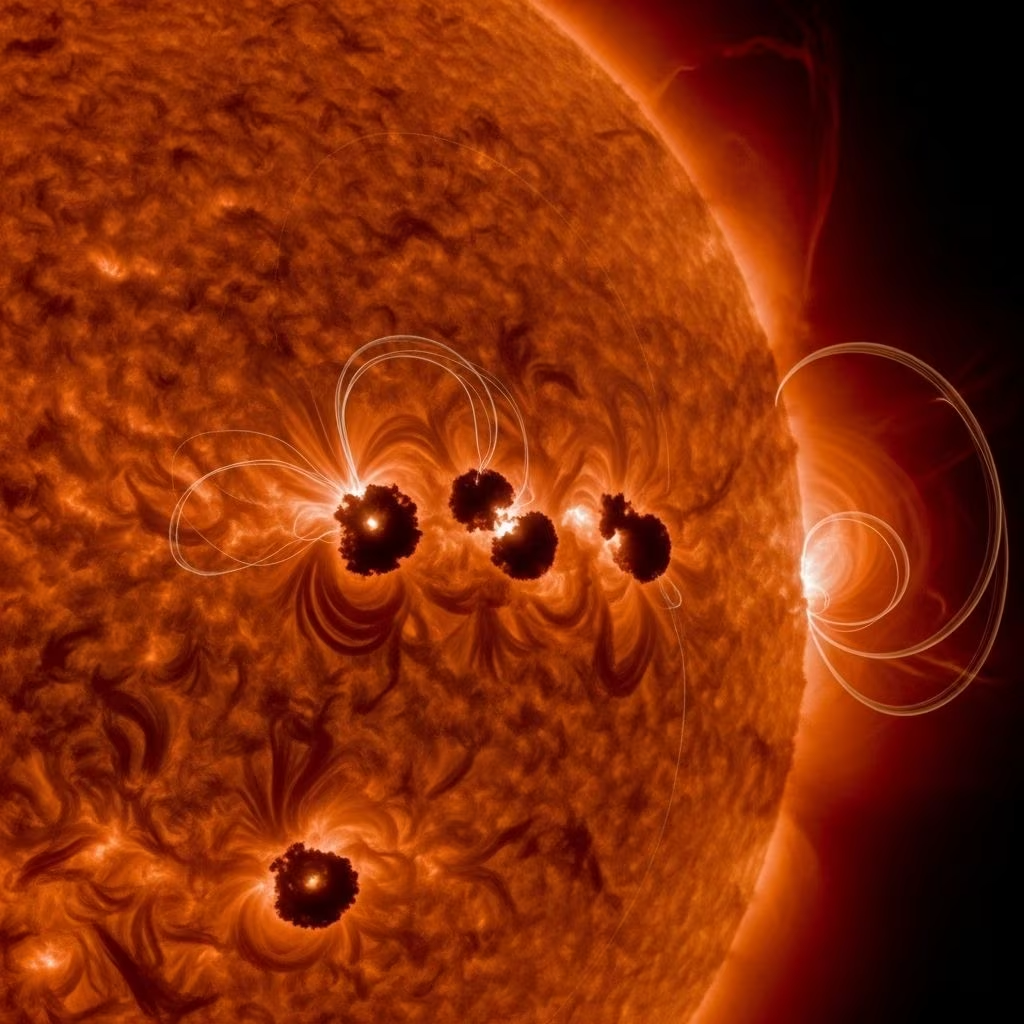
What is a Dyson Sphere?
Dyson spheres are hypothetical megastructures proposed to capture the entire energy output of a star, providing almost limitless power for an advanced civilization. Instead of relying on planetary resources, a Dyson sphere would encircle a star with solar-collecting structures, harnessing energy at a stellar scale.
- Originated as a theoretical solution to the ultimate energy needs of advanced civilizations.
- Not an enclosed, rigid shell, but potentially a swarm of solar collectors or satellites.
- Popularized in scientific discourse and science fiction alike.
Key Features
- Constructed around a star (like our Sun).
- Harvests energy directly from the star’s emitted light and heat.
- Could provide energy many orders of magnitude greater than current planetary sources.
Origins and Inspiration
The concept of the Dyson sphere was formally introduced by physicist Freeman Dyson in 1960, inspired by earlier science fiction, especially Olaf Stapledon’s 1937 novel “Star Maker”. In this story, civilizations shroud their stars with energy-capturing structures, focusing solar output for intelligent use.
- Dyson’s seminal paper discussed how such structures could help detect alien civilizations, giving SETI researchers a new angle for their search.
- Since Dyson’s publication, megastructures like the Dyson sphere have inspired generations of scientists, engineers, and writers.
Dyson’s Original Vision
Freeman Dyson imagined an advanced civilization’s evolution requiring ever-increasing amounts of energy, eventually constructing enormous structures around their home star to support continued growth and technological capability.
How a Dyson Sphere Would Work
At its core, a Dyson sphere converts the star’s energy—primarily in the form of electromagnetic radiation—into usable power for a civilization. The method centers on familiar principles of solar energy, scaled up to an astronomical degree.
- The primary collection technique likely uses the photovoltaic effect—where solar cells convert light into electricity.
- Energy could then be relayed wirelessly or via physical connections to inhabited planets or space habitats.
- The structure could appear as a dense array of satellites (a Dyson swarm), a single enormous shell (the classic shell concept), or even a band (the “Dyson ring”).
In practical visions, the sphere is rarely envisioned as a solid, continuous shell (which would be structurally unstable), but as a vast cluster of independent energy collectors distributed around the star.
Types of Dyson Spheres
| Type | Description | Structural Complexity | Plausibility |
|---|---|---|---|
| Dyson Shell | A solid, continuous shell that fully encloses the star. | Extreme (likely impossible with current physics) | Low |
| Dyson Swarm | A swarm of satellites and solar collectors orbiting in a dense cloud around the star. | High, but more achievable than a shell | Moderate |
| Dyson Ring | A single ring or partial band of collectors orbiting the star. | Complex (but conceptually simpler) | Higher (at least as a precursor structure) |
Technological Challenges
Despite its allure, constructing a Dyson sphere presents seemingly insurmountable technical challenges with our current knowledge and capabilities:
- Materials Science: No known material could withstand the stresses of a contiguous shell at planetary orbit size—the structure would collapse or break apart.
- Resource Requirements: Building even a Dyson swarm would demand the mass equivalent of entire planets, requiring the disassembly of worlds such as Mercury, Venus, and Mars to provide raw materials.
- Stability: Gravitational forces could easily destabilize a shell, pulling sections inward if even slightly displaced. A swarm or ring is less unstable but still presents dramatic engineering hurdles.
- Energy Transmission: Transporting vast amounts of collected energy to habitats or planets—perhaps via microwaves or lasers—would be a major challenge unto itself.
- Maintenance & Control: Precise orbital mechanics, collision avoidance, and self-repairing systems would be essential in structures of such enormous scale.
Why Build a Dyson Sphere?
The underlying motivation for constructing a Dyson sphere is energy demand far beyond the capacity of any single planet. It serves as a natural endpoint for the technological advancement of a civilization classified as Type II on the Kardashev Scale—a civilization that harnesses the full energy output of its star.
- Population growth, technological advancement, and computational needs would all drive demand for more energy.
- For a species aiming to colonize and terraform new worlds, or support vast artificial habitats, only stellar-scale energy would suffice.
- Building such a structure could potentially ensure the longevity of a civilization, shielding it from planetary-scale disasters or the limitations of a single world.
The Kardashev Scale and Cosmic Megastructures
The Kardashev Scale, introduced by astrophysicist Nikolai Kardashev, categorizes civilizations by energy use:
- Type I: Harnesses all available energy on its home planet.
- Type II: Can harvest the total energy output of its home star (Dyson sphere territory).
- Type III: Utilizes the energy of an entire galaxy.
The Dyson sphere concept epitomizes the leap from planetary (Type I) to stellar-scale (Type II) technology, an evolutionary step that some believe would be inevitable for any long-lived, ambitious civilization—human or alien.
Dyson Spheres in the Search for Extraterrestrial Intelligence (SETI)
One of Dyson’s original arguments was that the waste heat from such a megastructure would emit large quantities of infrared radiation—making Dyson spheres detectable from across interstellar distances.
- Scientists have searched for stars with unexpected infrared signatures that might suggest the presence of an artificial construct.
- No definitive evidence has emerged, but certain anomalies remain candidates for follow-up.
- In 2015, anomalous light fluctuations around star KIC 8462852 (“Tabby’s Star”) led to widespread speculation about possible Dyson swarms, though natural explanations prevail.
Dyson Spheres in Science Fiction and Culture
Beyond the boundaries of science, Dyson spheres have become a staple of science fiction and speculative thought. Their appearances in literature, film, and gaming fuel the imagination and provide frameworks to explore the nature of advanced civilizations.
- Larry Niven’s “Ringworld”: An iconic novel envisioning a giant ring—a partial Dyson structure—around a star.
- Video Games and TV: Dyson spheres are featured in various media as colossal settings and cosmic engineering marvels.
- Inspirations: The concept sparks wide-ranging discussions about the future of humanity, the search for life, and the destiny of technology.
Addressing Common Questions
Could humanity ever build a Dyson sphere?
With current technology, even a Dyson swarm is far beyond our capabilities. The raw material requirements and logistics demand breakthroughs in automation, robotics, and propulsion, as well as resources on a planetary scale. However, as humanity’s ambitions grow and its technology matures, such megastructures might move from fantasy toward reality.
Would a Dyson sphere block sunlight to Earth?
If constructed as a solid shell, yes—but the most feasible models involve discrete satellites and collectors, leaving much of the light and heat to reach surrounding planets. In practice, such an undertaking would require careful planning to avoid catastrophic planetary consequences.
How would energy be delivered from a Dyson sphere?
In theory, energy collected by vast solar arrays could be transmitted using wireless power transfer technologies such as high-powered lasers or microwaves, or stored within orbiting habitats or artificial planets.
Has anyone ever seen evidence of a Dyson sphere?
So far, astronomers have identified no conclusive signs of artificial megastructures in space. Researchers do scan for unusual infrared emissions, but all candidates have so far had natural explanations.
Potential Benefits and Risks
- Benefits
- Unprecedented energy generation could support trillions of humans or advanced AI civilizations.
- Could enable planet-scale engineering, interstellar travel, or huge computational projects.
- Risks
- Construction could disrupt the solar system, fragment planets, and fundamentally alter planetary environments.
- Technological collapse could leave hazardous debris orbiting the star.
- Unintended ecological or stellar consequences with little earthly precedent.
Future Possibilities and Theoretical Developments
As science and engineering continue to advance, Dyson sphere research informs both practical space engineering and far-future speculation:
- Concepts such as self-replicating nanobots might automate construction, harvesting asteroid belts or planetary crusts for raw materials.
- Miniaturized Dyson “bubbles” could one day power entire habitats or starships.
- Studying Dyson spheres provides insight into what alien megastructures might look like—shaping SETI efforts and our understanding of life’s cosmic potential.
Frequently Asked Questions (FAQs)
What is the main purpose of a Dyson sphere?
To collect and utilize as much energy as possible from a star, supporting advanced civilizations beyond the energy capacities of planets.
How big would a Dyson sphere need to be?
A Dyson sphere at Earth’s orbital distance would have a radius of about 150 million kilometers (93 million miles).
Why don’t we see Dyson spheres in our galaxy?
It’s possible that such structures are rare, have not yet been built, emit energy that escapes detection, or simply are beyond our current observational capacities.
Could Dyson spheres be detected by their infrared signature?
Yes, theoretically, as a Dyson sphere would re-radiate absorbed energy in the infrared, making it visible to specialized telescopes—although no such structure has yet been confirmed.
Conclusion: Bridging Science and Imagination
The Dyson sphere stands as a symbol—both a radical engineering concept and a profound question about a civilization’s destiny. While likely impossible for humanity to realize for centuries or millennia, it pushes the boundaries of physics, engineering, and imagination. As humanity prepares to step further into the cosmos, the legacy of Freeman Dyson’s vision endures, inspiring us to contemplate just how far our reach—and our dreams—might someday extend.
References
- https://en.wikipedia.org/wiki/Dyson_sphere
- https://energyeducation.ca/encyclopedia/Dyson_sphere
- https://science.howstuffworks.com/environmental/energy/dyson-sphere.htm
- https://www.skyatnightmagazine.com/space-science/dyson-sphere
- https://www.youtube.com/watch?v=QnFAQrR58SY
- https://www.bajajfinserv.in/what-is-dyson-sphere
- https://en.wiktionary.org/wiki/Dyson_sphere
- https://www.youtube.com/watch?v=jxSY1tsI1NA
- https://www.sciencefocus.com/space/dyson-spheres
- https://en.wikipedia.org/wiki/Dyson’s_sphere
- https://quantumzeitgeist.com/what-are-dyson-spheres/
- https://www.worldatlas.com/space/what-is-a-dyson-sphere.html
- https://osr.org/en-uk/blog/astronomy-uk/what-is-a-dyson-sphere/
- https://www.scribd.com/document/462915537/Dyson-Sphere
- https://beyond-universe.fandom.com/wiki/Dyson_sphere