Jupiter’s Moons: An Overview
Jupiter stands out as the ruling giant of our solar system, not only for its immense mass but also for the extraordinarily rich system of satellites that orbit the planet. As of April 2025, astronomers have confirmed 97 moons circling Jupiter, a number unrivaled by any other planet. Collectively, these natural satellites form what scientists call the Jovian system—a dynamic and diverse satellite family that ranges from tiny irregular fragments to gigantic, planet-sized worlds.
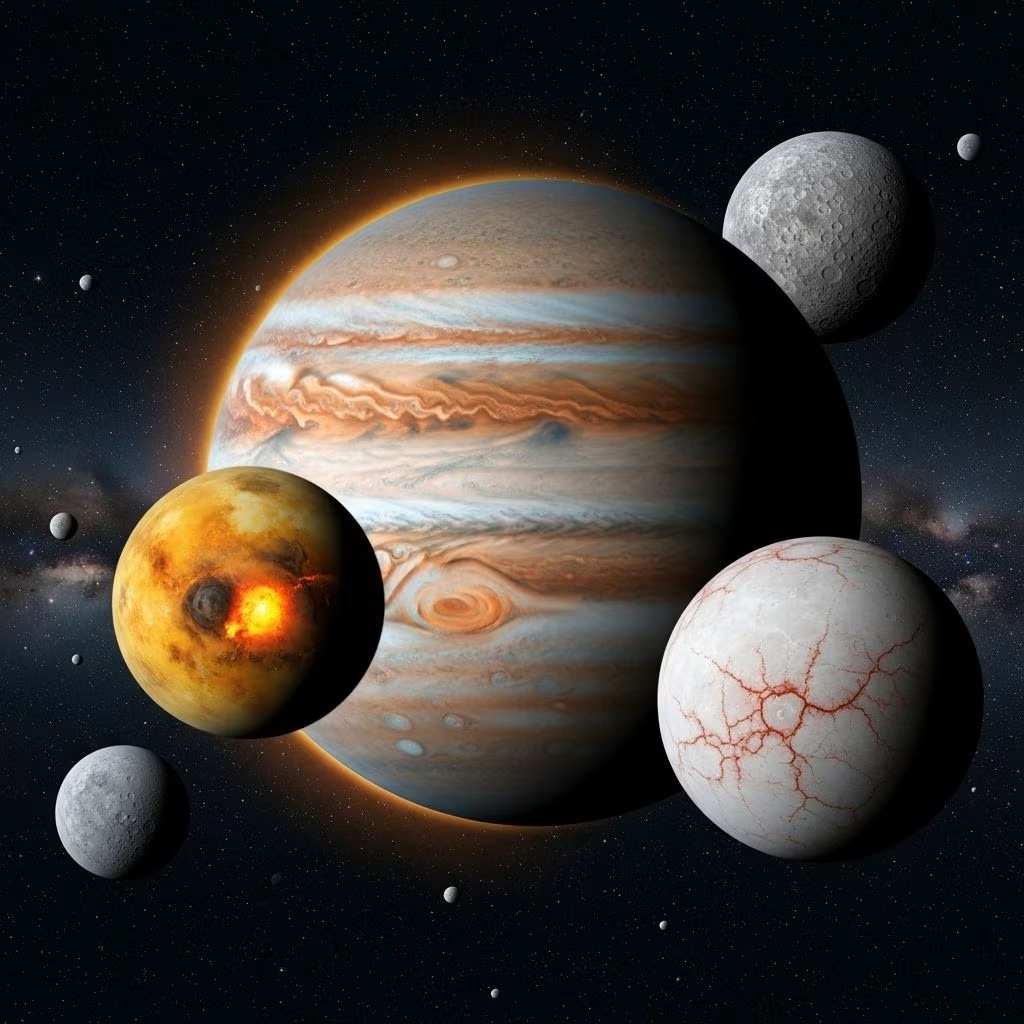
Though the vast majority of these moons are relatively small, four massive satellites—Io, Europa, Ganymede, and Callisto—dominate the system in size and scientific interest. Known as the Galilean moons, their discovery marked the first time humans observed objects orbiting a body other than Earth, shaping our understanding of the cosmos.
How Many Moons Does Jupiter Have?
The exact number of Jupiter’s moons has evolved as astronomers discover more satellite candidates and confirm their orbits. As of April 2025:
- Confirmed moons: 97
- Includes the 4 large Galilean moons
- The rest are predominantly kilometers-sized or smaller, irregular satellites
- Estimates suggest Jupiter may ultimately have >100 irregular moons larger than 1 km in diameter, plus hundreds of even smaller ones
The moons are typically grouped according to their orbital characteristics and origins:
- Regular satellites: 8 moons with prograde, nearly circular orbits, close to Jupiter’s equatorial plane
- Irregular satellites: Outer moons with highly inclined, often retrograde orbits, usually smaller and more distant
The Discovery of Jupiter’s Moons
Jupiter’s moons were the first celestial bodies observed to orbit another planet. This historic discovery occurred in 1610, when Galileo Galilei used his improved telescope to spot four bright points near Jupiter. These were Io, Europa, Ganymede, and Callisto—the main Galilean moons. Simon Marius, a German astronomer, made independent observations at the same time and contributed to naming these moons.
The identification of smaller moons began much later, with the first confirmed in 1892. Modern telescopes and surveys, especially those conducted in the 21st century, have dramatically expanded Jupiter’s satellite count, hinting at hundreds of tiny, transient moonlets and irregular objects orbiting the planet.
The Galilean Moons: Giants of the Jovian System
The four Galilean satellites—Io, Europa, Ganymede, Callisto—are Jupiter’s largest moons and account for 99.997% of the total mass found within its moon system. Each of these moons is larger than the planet Mercury, and their complexity and diversity have made them prime candidates for scientific study and future exploration.
| Moon | Diameter (km) | Main Features |
|---|---|---|
| Io | 3,643 | Most volcanically active body in the Solar System |
| Europa | 3,122 | Likely subsurface ocean beneath icy crust |
| Ganymede | 5,268 | Largest moon in the Solar System; has a magnetic field |
| Callisto | 4,821 | Heavily cratered and ancient surface; potential subsurface ocean |
Io
Io is notable for its extreme volcanic activity, driven by tidal heating from interactions with Jupiter and neighboring moons. Its surface is painted in vibrant yellows, reds, and whites—evidence of sulfur volcanism. Lava fountains, calderas, and volcanic pits make this a world in constant geological turmoil. The persistent surface renewal means few impact craters preserve Io’s ancient past.
Europa
Europa’s smooth, bright icy surface is crisscrossed by dark streaks and cracks. Observations strongly suggest a vast liquid water ocean beneath its frozen shell. This ocean, potentially in contact with the moon’s rocky mantle, makes Europa a prime location in the search for extraterrestrial life. NASA and ESA missions targeting Europa hope to glean more about its subsurface and habitability.
Ganymede
Ganymede is the largest moon in the Solar System, even bigger than Mercury, and it stands out as the only moon known to generate its own magnetic field. Its complex, tectonically scarred surface showcases bright, grooved regions and older, dark, cratered terrain, pointing to a dynamic history.
Callisto
Callisto is distinguished by its heavily cratered surface, the oldest in the Solar System. Its ancient scars provide a window into the history of impacts in Jupiter’s realm. Recent data suggest a possible subsurface ocean, though its isolation from the surface may render it less habitable than Europa or Ganymede.
Inner and Small Moons
Beyond the Galilean giants, Jupiter’s inner moon population includes small, irregularly shaped bodies that often serve a crucial role in maintaining Jupiter’s faint ring system. These inner moons include:
- Metis
- Adrastea
- Amalthea
- Thebe
Most of these moons are less than 200 kilometers across and are likely composed of water ice, dust, and rock. Images and data from missions such as Galileo have revealed highly irregular shapes, cratered surfaces, and areas of varying brightness. Amalthea, for example, is one of the largest and was named for a nymph from Greek mythology.
Irregular Moons and Moon Families
Irregular moons orbit far from Jupiter and have highly inclined, sometimes retrograde orbits. Many are believed to be captured asteroids or Kuiper Belt objects, often fragmented into collisional families by impacts. These moons are small, dark, often only a few kilometers in diameter, and make up the vast majority of Jupiter’s satellite count.
Key features of irregular moons:
- Believed to have been captured by Jupiter’s gravity
- Often grouped in collisional families with similar orbits
- Possess very low reflectivity, indicating carbon-rich, primitive surfaces
- Some follow highly elongated or retrograde orbital paths
Not all of these irregular satellites have been officially named; many are awaiting further confirmation and study.
Formation and Origin
The origin of Jupiter’s moons reflects the tumultuous environment of the early solar system. Scientists believe the Galilean moons formed concurrently with Jupiter itself, from a disk of gas and dust surrounding the newly-formed planet. In contrast, the bulk of small and irregular moons are likely captured bodies, drawn from asteroid populations or the Kuiper Belt. Some have even been formed from collisional debris following giant impacts in Jupiter’s gravitational sphere.
Jupiter’s Ring System and the Role of Moons
Jupiter is encircled by a faint system of rings, first discovered by Voyager 1 in 1979. Micrometeoroid impacts on the inner moons such as Metis and Adrastea create dust that feeds and maintains these rings, highlighting a dynamic interplay between moons and rings.
Jupiter’s Satellites: Quick Facts
- Jupiter has the most moons of any planet in the solar system (as of 2025)
- The Galilean moons each have their own complex geology and potential for subsurface oceans
- The smallest moons are only a kilometer across; the largest, Ganymede, is bigger than Mercury
- Most of Jupiter’s moons are irregular, asteroid-like objects with highly inclined orbits
- Many moons await proper names and full characterization
Why Are Jupiter’s Moons Important?
The diversity of Jupiter’s moons offers a natural laboratory for planetary science and astrobiology. Scientists study these satellites to:
- Understand planetary system formation in the early solar system
- Explore the potential habitability of icy moons with subsurface oceans
- Investigate the outcomes of giant planet migration, capture, and collisional history
- Compare satellite evolution processes across giant planets
Europa, Ganymede, and possibly Callisto are prime candidates in the search for extraterrestrial life, inspiring dedicated missions such as NASA’s Europa Clipper and ESA’s JUICE mission.
Frequently Asked Questions (FAQs)
Q: How many moons does Jupiter really have?
A: As of April 2025, Jupiter has 97 confirmed moons, with the possibility of many more small, irregular satellites yet to be officially confirmed.
Q: Which is the largest of Jupiter’s moons?
A: Ganymede is the largest moon, not just of Jupiter but in the whole solar system, with a diameter of 5,268 km (3,273 miles).
Q: Can any of Jupiter’s moons support life?
A: While no direct evidence of life has been found, Europa and Ganymede have subsurface oceans that may harbor the conditions necessary for life as we know it. Scientific missions in the coming decades will search for signs of habitability.
Q: Why are some moons called irregular?
A: Irregular moons orbit at large distances from Jupiter, often with high inclinations and eccentricities, and many in retrograde motion—opposite to Jupiter’s rotation. These characteristics suggest they were captured instead of forming with Jupiter.
Q: Who discovered the Galilean moons?
A: They were independently discovered by Galileo Galilei and Simon Marius in 1610. Galileo’s observations provided strong evidence for the heliocentric model of the solar system.
Table: Key Features of Major Jovian Moons
| Name | Type | Diameter (km) | Orbital Characteristics | Major Features |
|---|---|---|---|---|
| Io | Galilean | 3,643 | Prograde, near equatorial | Extreme volcanism; sulfurous surface |
| Europa | Galilean | 3,122 | Prograde, near equatorial | Icy crust, possible liquid ocean below |
| Ganymede | Galilean | 5,268 | Prograde, near equatorial | Largest moon; magnetic field |
| Callisto | Galilean | 4,821 | Prograde, near equatorial | Old, cratered terrain; possible ocean |
| Amalthea | Inner | 250 | Close prograde | Irregular shape; source of ring dust |
| Himalia | Irregular | 170 | Distant prograde | Largest non-Galilean moon; possible captured asteroid |
What Lies Ahead: Missions and Future Exploration
Human curiosity about Jupiter’s moons is driving a new era of space exploration. NASA’s Europa Clipper will investigate Europa’s habitability and search for biosignatures, while the European Space Agency’s JUICE (JUpiter ICy moons Explorer) mission will closely study Ganymede, Callisto, and Europa. These missions will provide:
- High-resolution imaging of surface features
- Subsurface radar and spectroscopic data
- Studies of magnetic environments and surface composition
- Closer looks at the mysterious small moons and ring system
With each mission and improved observation, our understanding of Jupiter’s moons will grow, unraveling the secrets of planetary origins, geologic activity, and possibly, the conditions for life beyond Earth.
References
- https://en.wikipedia.org/wiki/Moons_of_Jupiter
- https://science.nasa.gov/jupiter/jupiter-moons/
- https://www.britannica.com/topic/moons-of-Jupiter-2236909
- https://science.nasa.gov/jupiter/jupiter-moons/all-jupiter-moons/
- https://en.wikipedia.org/wiki/Galilean_moons
- https://lasp.colorado.edu/outerplanets/moons_galilean.php
- https://www.dlr.de/en/research-and-transfer/projects-and-missions/juice/the-small-moons-of-jupiter
- https://www.go-astronomy.com/moons-of-jupiter.htm
- https://www.planetary.org/articles/what-are-jupiters-galilean-moons
- https://eclipse23.com/blogs/eclipse-education/the-moons-of-jupiter
- https://saganplanetwalk.com/jupiter/jupiters-moons/
- https://www.livescience.com/space/planets/how-many-moons-does-jupiter-have
- https://www.missionjuno.swri.edu/jupiter/moons/
- https://lovethenightsky.com/jupiters-moons-guide/
- http://www.spaceopedia.com/solar-system/moons/jupiter-moons/
- https://astronoo.com/en/moons-of-jupiter.html
- https://web.pa.msu.edu/people/horvatin/Astronomy_Facts/planet_pages/Jupiters_moons.htm
- http://www.whillyard.com/science-pages/our-solar-system/jupiters-moons.html
- https://study.com/academy/lesson/jupiters-moons-discovery-names-characteristics.html