


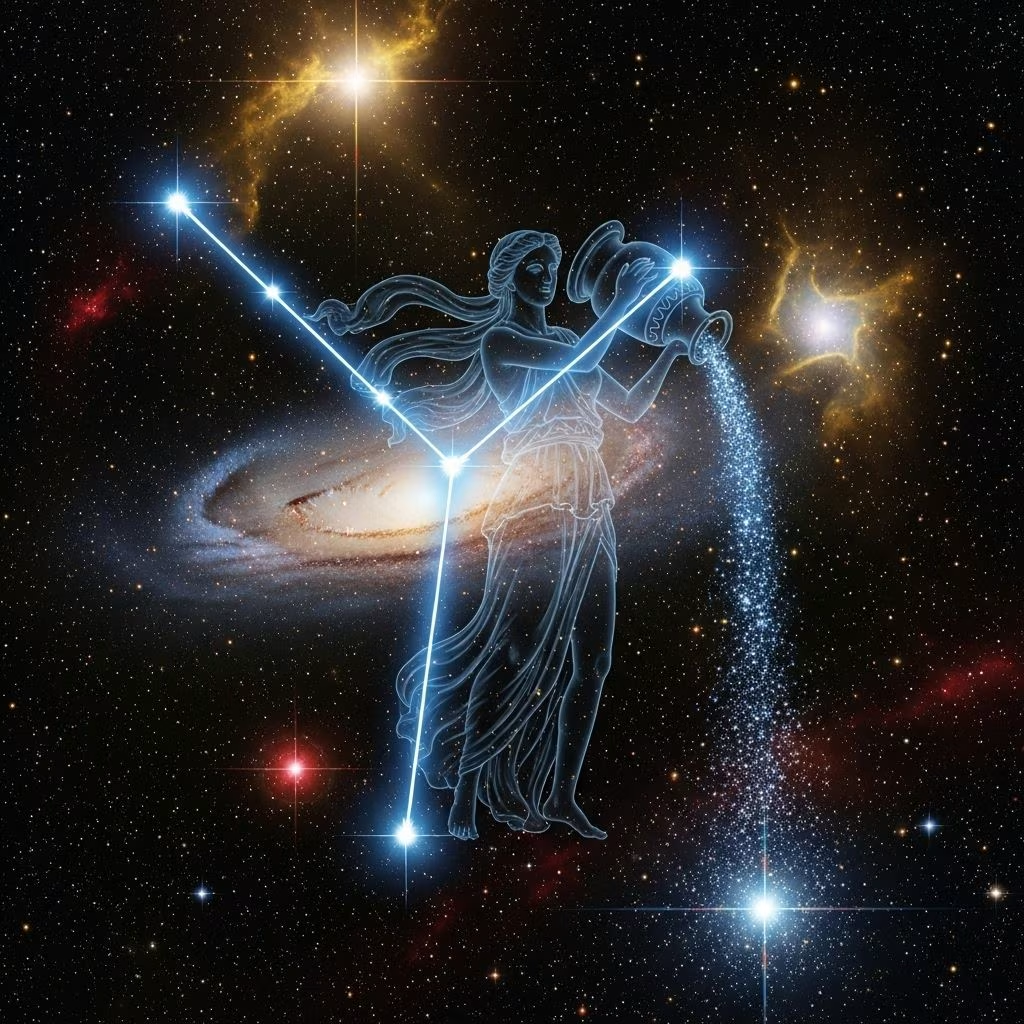
Aquarius Constellation: The Water Bearer of the Night Sky
The Aquarius constellation is one of the oldest and most recognizable star patterns in the celestial sphere. Known as the Water Bearer, Aquarius is a significant member of the zodiac family, intertwining astronomical relevance and rich mythology. This article takes a detailed look at its characteristics, history, stars, deep sky objects, and its place in culture and science.
Overview and Visibility
- Latin Name: Aquarius — meaning “water-bearer” or “cup-bearer”
- Symbol: ♒ (represents flowing water)
- Hemisphere: Predominantly southern, but visible from most locations around the globe.
- Location: On the celestial equator, bordered by Capricornus, Pisces, Cetus, Piscis Austrinus, Sculptor, and Equuleus.
- Visibility Range: Latitudes 65°N to 90°S.
- Best Viewing Month: October.
- Area: 980 square degrees — the tenth largest constellation.
- Quadrant: SQ4 (fourth quadrant of the Southern Hemisphere).
- Genitive: Aquarii.
- Abbreviation: Aqr.
- Asterism: Water Jar.
Aquarius Among Neighbors: The Sea Region
Aquarius lies in a part of the sky known as the “Sea,” a region dotted with other water-related constellations, including Pisces, Eridanus, and Cetus. This positioning has historically emphasized Aquarius’s connection to water and fertility myths.
Historical Roots and Mythology
Ancient Civilizations
- Babylonian Origin: Aquarius was catalogued in ancient Babylon as GU.LA (“The Great One”), representing the god Ea, often shown with an overflowing vase.
- Greek Cataloguing: Officially catalogued by Greek astronomer Ptolemy in the 2nd century CE.
- Historical Significance: Aquarius held importance in rain and fertility rituals, being associated with seasonal wet weather in ancient times.
Greek Mythology
- Ganymede: The most enduring Greek legend links Aquarius to Ganymede, a handsome mortal youth abducted by Zeus and brought to Mount Olympus as the cupbearer for the gods. Because of his new role, Ganymede was symbolically depicted as pouring water, hence “the Water Bearer”.
- Deucalion and the Flood: In another myth, Aquarius represents Deucalion, son of Prometheus, and his wife Pyrrha. They survived a catastrophic flood sent by Zeus to cleanse humankind and repopulated the Earth — another close reference to the water theme.
Main Stars of Aquarius
The constellation’s stars are generally faint, with only two surpassing third magnitude. Yet, they feature notable supergiants and asterisms:
- Sadalsuud (Beta Aquarii): The brightest star, a yellow supergiant at magnitude 2.91, located about 610 light-years away.
- Sadalmelik (Alpha Aquarii): The second brightest, a yellow G-type supergiant at magnitude 2.95, approximately 520 light-years distant.
- Skat (Delta Aquarii): Blue-white star, magnitude 3.27.
- Sadachbia (Gamma Aquarii): Magnitude 3.85.
- Albali (Epsilon Aquarii), Ancha (Theta Aquarii), Situla (Kappa Aquarii): Other named stars in the constellation.
- Exoplanet Hosts: Aquarius contains at least 17 stars with confirmed exoplanets, including systems like TRAPPIST-1, Gliese 876, WASP-47, and HD 215152.
| Star Name | Bayer Designation | Apparent Magnitude | Distance (light-years) | Star Type |
|---|---|---|---|---|
| Sadalsuud | Beta Aquarii | 2.91 | ~610 | Yellow Supergiant |
| Sadalmelik | Alpha Aquarii | 2.95 | ~520 | Yellow Supergiant |
| Skat | Delta Aquarii | 3.27 | ~160 | Blue-White |
| Sadachbia | Gamma Aquarii | 3.85 | ~160 | Main Sequence |
Deep Sky Objects in Aquarius
Aquarius hosts a wealth of fascinating deep sky objects, popular targets for both professional and amateur astronomers:
- Messier 2 (M2): Large globular cluster, 37,500 light-years away, one of the richest clusters in the Milky Way.
- Messier 72 (M72): A more distant and less concentrated globular cluster.
- Aquarius Dwarf Galaxy: Small galaxy orbiting the Milky Way.
- Atoms for Peace Galaxy (NGC 7252): Notable for its peculiar shape, the result of galactic merger.
- Saturn Nebula (NGC 7009): Named for its resemblance to the planet Saturn due to its distinct ring-like structure.
- Helix Nebula (NGC 7293): One of the closest planetary nebulae to Earth, sometimes called the “Eye of God” due to its appearance.
Meteor Showers Associated with Aquarius
Aquarius is host to several annual meteor showers, some of which offer spectacular views:
- Eta Aquariids: Peak in early May. Known for swift, bright meteors; associated with Halley’s Comet.
- Delta Aquariids: Peak in late July; moderate activity and best viewed after midnight.
- Iota Aquariids: Peak in early August.
- March Aquariids: Minor shower peaking around March.
Meteor Shower Table
| Meteor Shower Name | Peak Month | Parent Comet | Average Zenithal Hourly Rate |
|---|---|---|---|
| Eta Aquariids | May | Halley’s Comet | 10-40 |
| Delta Aquariids | July | Unknown | 15-20 |
| Iota Aquariids | August | Unknown | 2-8 |
| March Aquariids | March | Unknown | 1-5 |
How to Find Aquarius in the Night Sky
- Look for the Water Jar: The asterism formed by several stars (including Sadalmelik, Sadalsuud, and Skat) roughly forms the shape of a jar pouring water.
- October is Best: At this time, Aquarius is high in the southern sky after nightfall for observers in northern latitudes.
- Locate Surrounding Constellations: Start from nearby Pisces or Capricornus and scan the sky for Aquarius’s subtle star pattern.
- Use Binoculars: Many of Aquarius’s stars are faint, so binoculars or telescopes greatly enhance visibility.
Scientific Significance and Discovery
- Zodiac Position: The Sun passes through Aquarius from mid-February to mid-March, marking the corresponding astrological period.
- Exoplanet Research: Systems like TRAPPIST-1 (a compact planetary system with seven Earth-size exoplanets) are crucial for the search for life beyond our solar system.
- Stellar Evolution: The yellow supergiants in Aquarius, Sadalsuud and Sadalmelik, are examples of advanced stellar evolutionary stages.
The Role of Aquarius in Astrology
While science focuses on stars and galaxies, Aquarius also holds a pivotal place in astrology. Assigned to those born between January 20 and February 18, Aquarius is considered a symbol of originality, innovation, and humanitarian ideals. Its symbol—two wavy lines—reflects its association with water and the concept of spiritual nourishment.
Frequently Asked Questions (FAQs)
Q: What is the brightest star in Aquarius?
A: Sadalsuud (Beta Aquarii) is the brightest star in Aquarius, with an apparent magnitude of 2.91.
Q: Can Aquarius be seen from the Northern Hemisphere?
A: Yes, Aquarius can be viewed from much of the Northern Hemisphere, best seen during October.
Q: Which deep sky objects are found in Aquarius?
A: Notable deep sky objects include Messier 2, Messier 72, the Helix Nebula, the Saturn Nebula, the Aquarius Dwarf Galaxy, and NGC 7252.
Q: What is the mythological significance of Aquarius?
A: Aquarius is linked to the Greek myth of Ganymede, the cupbearer to the gods, and ancient Babylonian depictions of the rain god Ea.
Q: What meteor showers are associated with Aquarius?
A: The Eta Aquariids, Delta Aquariids, Iota Aquariids, and March Aquariids meteor showers all originate from the Aquarius region.
Quick Facts About Aquarius
- Family: Zodiacal
- Size Rank: 10th largest constellation
- Area: 980 square degrees
- Brightest Star: Sadalsuud (Beta Aquarii)
- Number of Named Stars: 11
- Stars Hosting Planets: 17
- Major Meteor Showers: 4
Conclusion
The Aquarius constellation is a tapestry of myth, science, and celestial beauty. From its ancient origins and captivating legends to its wealth of astronomical wonders, Aquarius continues to intrigue stargazers and scientists alike. Whether spotted with the naked eye in October skies or explored through a telescope, Aquarius remains a testament to humanity’s enduring fascination with the stars.
References
- https://en.wikipedia.org/wiki/Aquarius_(constellation)
- https://www.constellation-guide.com/constellation-list/aquarius-constellation/
- https://theskylive.com/sky/constellations/aquarius-constellation
- https://www.go-astronomy.com/constellations.php?Name=Aquarius
- https://theplanets.org/constellations/aquarius-constellation/
- https://www.jameswebbdiscovery.com/universe/100-fascinating-facts-about-the-aquarius-constellation
- https://www.unistellar.com/blog/aquarius-constellation/
- https://www.ebsco.com/research-starters/astronomy-and-astrophysics/aquarius
- https://www.britannica.com/place/Aquarius-astronomy
- https://stardate.org/astro-guide/topic/aquarius
- https://www.centreofexcellence.com/aquarius-constellation/
- https://opticsmag.com/aquarius-constellation-facts/
- https://spaceiusa.com/aquarius/
- https://lovethenightsky.com/aquarius-constellation-guide/
- https://www.planetguide.net/aquarius-constellation/
- https://www.constellation-guide.com/constellation-list/Aquarius-constellation/
- https://nineplanets.org/aquarius-constellation/
- https://space.fandom.com/wiki/Aquarius_(constellation)


