


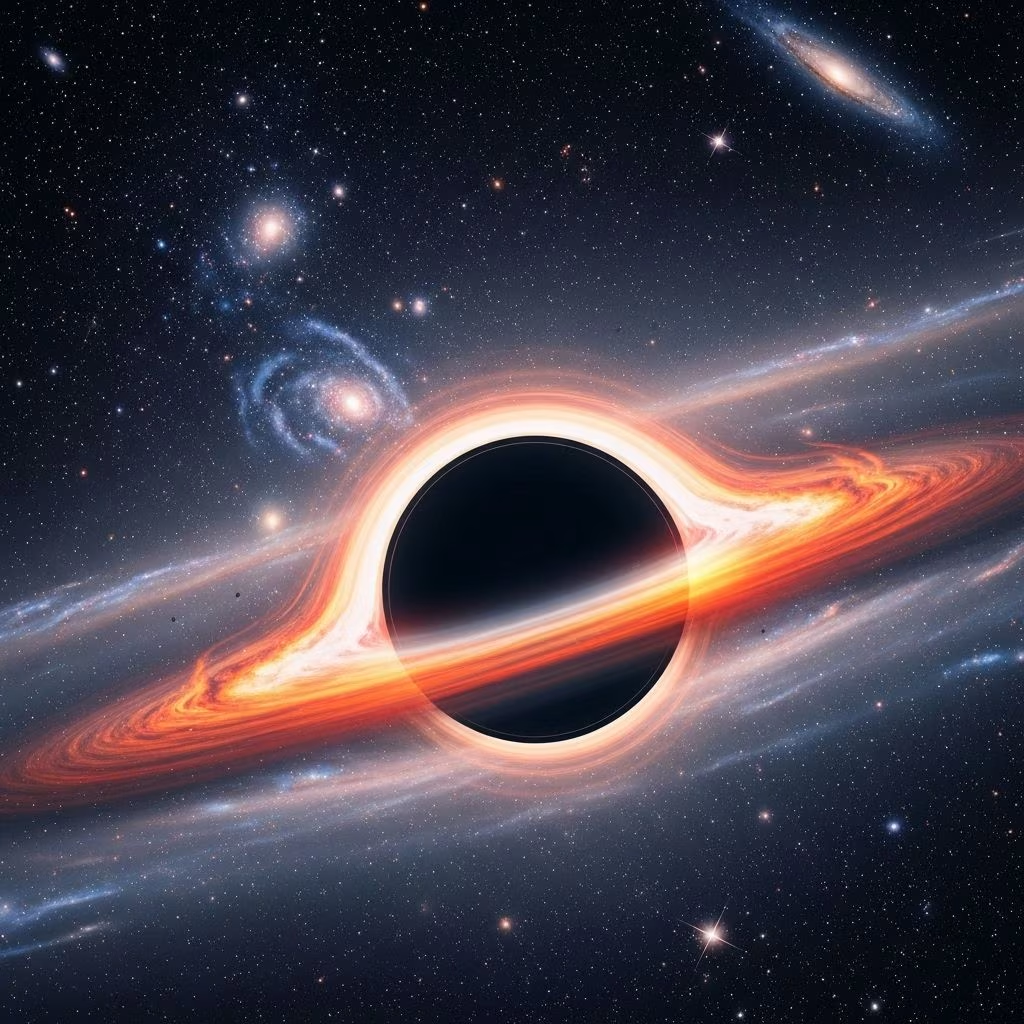
The Biggest Black Hole Ever: A Record-Breaking Discovery
In a groundbreaking achievement for astrophysics, scientists have detected what may be the most massive black hole ever measured: a titanic beast at the center of a galaxy, with a mass estimated at 36 billion times that of our Sun. This cosmic leviathan resides in the foreground of a spectacular gravitational lensing system known as the Cosmic Horseshoe, some 6 billion light-years from Earth. Its discovery propels our understanding of galactic evolution and the nature of black holes to new heights, challenging theoretical boundaries and catalyzing novel methods in astronomical measurement.
What Is the Cosmic Horseshoe?
The Cosmic Horseshoe refers to an extraordinary lensing system—a celestial alignment where the immense gravity of a foreground galaxy warps and magnifies the light of a distant background galaxy, creating an Einstein ring reminiscent of a horseshoe shape. The lensing galaxy in question, labeled LRG 3-757, typifies a luminous red galaxy (LRG)—enormous, diffuse, and elliptical, shining mostly in infrared with minimal star formation.
Key features of the Cosmic Horseshoe:
- Foreground Galaxy: The host of the ultramassive black hole, LRG 3-757, is about 100 times more massive than the Milky Way.
- Gravitational Lensing: Light from a background galaxy is intensified and distorted around LRG 3-757, producing the luminous horseshoe-shaped arc visible via advanced telescopes.
- Einstein Ring Formation: This rare alignment offers astronomers a unique window into galactic structure and the measurement of invisible central masses.
Unveiling the Ultramassive Black Hole
The central black hole in LRG 3-757, measured at an unfathomable 36 billion solar masses, far exceeds the mass of black holes found in our own Milky Way and most other known galaxies. For comparison, the Milky Way’s central supermassive black hole, Sagittarius A*, is about 4 million solar masses—making this newly measured black hole nearly 10,000 times heavier.
This discovery not only shatters previous records but also approaches the upper theoretical mass limit for black holes in the known universe, raising profound questions about how such objects grow and evolve.
How Was the Monster Measured?
Pinpointing the precise mass of a black hole lurking at the heart of a distant galaxy demands innovative approaches and cutting-edge physics. For this ultramassive black hole, astronomers combined two advanced techniques:
- Gravitational Lens Modeling: By meticulously analyzing the bent and amplified light arc—the Einstein ring—around the Cosmic Horseshoe, scientists could infer the total mass in the lensing galaxy, including its hidden constituents.
- Stellar Dynamics: Tracking the motion and velocity of stars near the galactic center allowed for a secondary estimate of the central mass, reinforcing results from lens modeling.
This dual-method approach substantially increased the certainty of the measurement, surpassing the more indirect estimates often used in prior black hole mass determinations. According to astronomers, this system’s geometry provides a unique and robust laboratory for such calculations.
The Importance and Implications of the Discovery
The detection of an ultramassive black hole on this scale has far-reaching consequences for astrophysics, cosmology, and future research:
- Challenges Existing Models: The mass of 36 billion suns challenges prevailing models of black hole formation and growth, as it nears the theoretical limit set by current physics.
- Sheds Light on Galaxy Evolution: Since ultramassive black holes are thought to play a pivotal role in regulating star formation and the fate of their host galaxies, this discovery informs theories about galactic lifecycle and cosmic structure.
- Provides Comparison for Existing Black Holes: It dwarfs other famous supermassive black holes, such as that in Messier 87 (M87), which weighs about 6.5 billion solar masses. The new record-holder is in a class of its own.
- Tightens Measurement Certainty: The innovative approach in lens modeling and dynamics heralds better measurement accuracy for future discoveries.
How Do Black Holes Reach Such Immense Size?
Scientists are investigating several scenarios to explain how a black hole can grow to such colossal proportions:
- Galaxy Mergers: Collisions and merging of massive galaxies can funnel enormous amounts of matter into the central black hole, allowing it to balloon in mass over billions of years.
- Efficient Accretion: Long periods of uninterrupted accretion—where gas and stars spiral in and feed the black hole—might result in supermassive or ultramassive growth.
- Early Universe Seeds: Black holes that began forming in the first few hundred million years after the Big Bang could have a head start, accumulating mass at incredible rates, sometimes powering ancient quasars.
Yet, observations such as those from the Chandra X-ray Observatory reveal that some black holes can grow “by leaps and bounds,” surpassing limits once thought insurmountable, demanding revisions to cosmic growth models.
Black Holes and the Fabric of Spacetime
The gravity of ultramassive black holes is so intense that it not only warps spacetime locally but can influence the cosmic web on galactic scales. Gravitational lensing, as seen in the Cosmic Horseshoe, is a direct manifestation of this effect, providing:
- Naturally Amplified Telescopes: Distant galaxies behind the lens are magnified, offering astronomers a peek into regions otherwise too faint or distant to study.
- Evidence of General Relativity: Every arc and ring verifies Einstein’s predictions about gravity and the curvature of space.
- Measurements of Invisible Mass: Lensing acts as a cosmic scale by which the hidden weight of the central black hole is revealed.
Comparing the Giants: Black Hole Masses Across the Universe
| Black Hole | Host Galaxy | Estimated Mass | Distance from Earth |
|---|---|---|---|
| LRG 3-757 | Cosmic Horseshoe | 36 billion solar masses | 6 billion light-years |
| Sagittarius A* | Milky Way | ~4 million solar masses | 27,000 light-years |
| M87 | Messier 87 | 6.5 billion solar masses | 53 million light-years |
| TON 618 | Quasar Host | ~66 billion solar masses (uncertain) | 1.2 billion light-years |
This table places the newly measured LRG 3-757 black hole at the summit of direct mass detections, while acknowledging claims from less certain methods that suggest even greater masses.
Why Is Measuring Black Hole Mass So Difficult?
Determining the mass of a black hole, especially in distant galaxies, is a formidable challenge. The difficulties include:
- Indirect Observations: Many black holes are inferred by their gravitational effects, not directly observed.
- Uncertainties in Modeling: High-mass estimates often rely on complex models with significant uncertainties, especially in quasar hosts.
- Limited Stellar Data: For faraway galaxies, resolving individual stellar motions around the black hole is nearly impossible without advanced telescopes or lensing phenomena.
- Lensing Advantages: The Cosmic Horseshoe’s alignment uniquely counteracts these obstacles, yielding a highly reliable mass measurement.
Astrophysical Impact: What Does This Mean for Science?
The implications of this monumental discovery ripple through multiple domains:
- Cosmic Growth Models: Forces a rethink of how quickly and efficiently black holes can grow in different epochs of the universe.
- Galaxy-Black Hole Relationships: Strengthens the observed trend that more massive galaxies host more massive central black holes.
- Limits of Theoretical Physics: Touches the edge of theoretical predictions and may illuminate new physics if larger masses are found.
- Precision Measurement Breakthrough: Sets a new standard for using gravitational lensing and dynamics together for mass detection.
Frequently Asked Questions (FAQs)
Q: How was the ultramassive black hole in the Cosmic Horseshoe detected?
A: Scientists used gravitational lens modeling—analyzing the shape and intensity of the Einstein ring—and detailed stellar dynamics to accurately compute the black hole’s mass.
Q: Why is this discovery considered more reliable than previous massive black hole detections?
A: The unique lensing geometry provided an unusually precise laboratory, allowing more direct and confident mass measurement compared to estimates based primarily on indirect quasar properties.
Q: Does every galaxy have an ultramassive black hole?
A: Most known galaxies host supermassive black holes, but only the largest and most massive galaxies, like LRG 3-757, are believed to host ultramassive black holes exceeding several billion solar masses.
Q: How does this discovery affect our understanding of galactic evolution?
A: The result reinforces the notion that black holes and host galaxies grow together, often through mergers and accretion, shedding light on the intertwined fate of structure in the universe.
Q: Are there black holes even larger than this in the universe?
A: Some indirect measurements and theoretical models suggest larger candidates exist, but the certainty and reliability of this new measurement stand out as the most robust among current records.
What Comes Next?
The discovery of the 36-billion-solar-mass black hole in the Cosmic Horseshoe invites new questions and research avenues:
- Search for Larger Black Holes: Will future measurements using improved lensing, stellar dynamics, or X-ray observations uncover even heavier monsters?
- Fine-tuning Theories: Astrophysicists are racing to update models to account for the mechanisms that could produce such immense black holes, including rapid early-universe growth spurts.
- Technological Advances: The next generation of telescopes (such as JWST and ELT) and enhanced data processing promise more detailed views into the black hole census across the universe.
Glossary of Key Terms
- Black Hole: A region of spacetime where gravity is so strong that nothing—not even light—can escape.
- Supermassive Black Hole: A black hole typically found at the center of a galaxy, with a mass ranging from millions to billions of solar masses.
- Ultramassive Black Hole: An exceptionally large black hole, with a mass exceeding several billion solar masses.
- Gravitational Lensing: The bending of light from a distant object due to the gravitational field of a massive intervening object, producing magnified or distorted images.
- Einstein Ring: A circular lensed image created when a distant source, massive lens, and observer are precisely aligned.
- LRG 3-757: The luminous red galaxy hosting the biggest known black hole, at the center of the Cosmic Horseshoe system.
Summary
The detection of a black hole with 36 billion times the mass of our Sun marks a defining achievement in astronomy. Located in the heart of the Cosmic Horseshoe galaxy, this ultramassive behemoth reshapes our understanding of cosmic limits, the formation and growth of galaxies, and the technological frontier of astronomical measurements. As telescopes and analytical methods improve, scientists are poised to push these boundaries further, revealing the true scale and mystery of monsters lurking at the heart of the universe.
References
- https://www.space.com/astronomy/black-holes/the-biggest-black-hole-ever-seen-scientists-find-one-with-mass-of-36-billion-suns
- https://en.wikipedia.org/wiki/List_of_most_massive_black_holes
- https://www.earth.com/news/largest-ultramassive-black-hole-ever-seen-cosmic-horseshoe-lrg-3-757/
- https://www.science.org/content/article/new-method-reveals-perhaps-most-massive-black-hole-yet-spotted
- https://www.nasa.gov/missions/chandra/nasas-chandra-finds-black-hole-with-tremendous-growth/
- https://ras.ac.uk/news-and-press/research-highlights/most-massive-black-hole-ever-discovered-detected
- https://phys.org/news/2025-08-universe-earliest-black-hole-monster.html
- https://www.sci.news/astronomy/cosmic-horseshoe-black-hole-14122.html
- https://www.livescience.com/space/black-holes/colossal-black-hole-36-billion-times-the-mass-of-our-sun-is-one-of-the-largest-ever-seen-in-the-universe
- https://science.nasa.gov/blogs/webb/2025/07/15/nasas-webb-finds-possible-direct-collapse-black-hole/
- https://cosmosmagazine.com/space/astronomy/biggest-black-hole-discovered/
- https://phys.org/news/2025-08-billion-solar-masses-cosmic-horseshoe.html
- https://www.port.ac.uk/news-events-and-blogs/news/university-of-portsmouth-helps-discover-most-massive-black-hole-ever
- https://www.youtube.com/watch?v=Wy4h20i0QeA
- https://news.berkeley.edu/2025/05/08/not-one-but-two-massive-black-holes-are-eating-away-at-this-galaxy/
- https://mcdonaldobservatory.org/news/releases/20250806-0


