What Is Jupiter Made Of?
Jupiter is the largest and most massive planet in our solar system, towering above its neighbors in both physical size and influence. As a quintessential gas giant, Jupiter offers a fascinating case study in planetary composition, structure, and formation. Unveiling the secrets of what Jupiter is made of requires exploration across its swirling cloud layers, turbulent atmosphere, and the shrouded depths of its interior.
Jupiter at a Glance
- Fifth planet from the Sun
- Largest planet in the solar system (diameter ~142,984 km at the equator)
- Mass: About 318 times that of Earth
- Classified as a gas giant
Key Facts & Physical Characteristics
- Orbital period: 11.86 Earth years
- Distance from Sun: ~5.20 AU (778.5 million km)
- Density: 1.326 g/cm³ (lower than terrestrial planets)
- Surface: No solid surface; gaseous and liquid layers
What Takes Up Most of Jupiter?
The atmosphere and interior of Jupiter are overwhelmingly made up of two elements:
- Hydrogen: By far the dominant component
- Upper atmosphere: ~90% by volume
- By mass: ~76% in atmosphere, ~71% in interior
- Exists as molecular hydrogen in upper layers and metallic hydrogen in deeper layers
- Helium:
- Second most abundant element
- Upper atmosphere: ~10% by volume
- By mass: ~24% in atmosphere, ~24% in interior
| Layer | Hydrogen (%) | Helium (%) | Other Elements (%) |
|---|---|---|---|
| Upper Atmosphere (by volume) | 90 | 10 | <1 |
| Atmosphere (by mass) | 76 | 24 | <1 |
| Interior (by mass) | 71 | 24 | 5 |
The Layers of Jupiter
Jupiter is structured as a series of concentric layers, each distinguished by changes in composition, temperature, and pressure:
1. The Atmosphere
Jupiter’s visible face is dominated by its dynamic, multicolored cloud bands. The atmosphere is the outer shell where we observe its iconic features, such as the Great Red Spot and turbulent storms.
- Primarily composed of hydrogen and helium
- Trace compounds include: methane, ammonia, water vapor, phosphine, hydrogen sulfide, carbon monoxide, neon, ethane, and other hydrocarbons
- Crystals of frozen ammonia form the top layer of clouds, responsible for bright white streaks
- Complex chemistry creates multi-hued bands: ammonia, ammonium hydrosulfide, and water make up cloud layers at different depths
- Upper clouds: ammonia ice
- Middle clouds: ammonium hydrosulfide
- Lower clouds: water droplets and ice
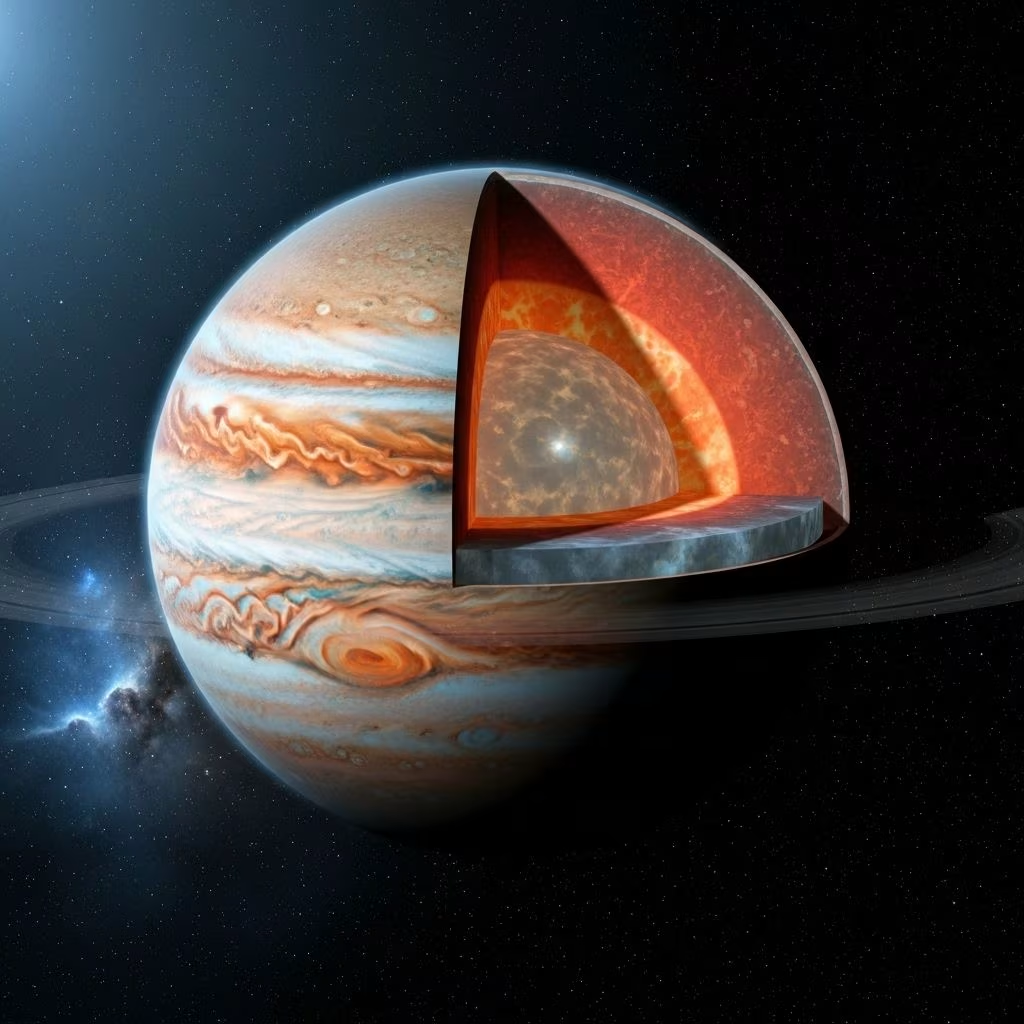
2. The Interior
Descending beneath the clouds, the structure of Jupiter becomes harder to probe, but decades of research and missions like Juno unravel a general model:
- Molecular hydrogen layer: Above the deeper regions, hydrogen exists as a supercritical liquid due to extreme pressure and temperature.
- Metallic hydrogen layer: At immense pressures (over 1.3 million atmospheres), hydrogen molecules break apart and form a “metallic” fluid that conducts electricity.
- Core:
- Once believed to be solid and compact
- Juno mission’s data support a diffuse, mixed core, possibly extending 30–50% of Jupiter’s radius
- Composed of heavy elements (7–25 Earth masses), distributed across a wide region
- The core may have formed via collision, or through gradual accumulation and mixing during planet formation
Supercritical Fluids in Jupiter’s Deep Layers
Jupiter’s interior pressure and temperature place hydrogen into a supercritical fluid state, where distinctions between liquid and gas vanish. This exotic behavior complicates probes of Jupiter’s true interior boundaries, making the planet’s composition even more mysterious and captivating.
Trace Elements and Compounds in Jupiter
While hydrogen and helium dominate, Jupiter’s trace chemicals play outsized roles in shaping its weather, color, magnetism, and cloud structures. Important trace compounds and their effects include:
- Methane (CH4): Contributes to infrared absorption and coloring
- Ammonia (NH3): Forms crystals at high altitudes, responsible for cloud tops
- Water vapor (H2O): Found deeper, makes up lower cloud layers
- Phosphine (PH3): Present in upper atmosphere, signals deep convection
- Hydrogen sulfide (H2S): Contributes to sulfur chemistry
- Carbon compounds: Ethane (C2H6), carbon monoxide (CO), and trace benzene
- Neon, oxygen, sulfur: Noble gases and elemental traces, much less than solar abundances
Jupiter’s Formation and the Solar Nebula
Jupiter’s chemical makeup reflects the primordial environment of the early solar system. Its proportions of hydrogen and helium closely match those of the solar nebula—the disk of gas and dust that surrounded the newborn Sun.
- Jupiter formed first among the planets
- Inward migration of Jupiter influenced the architecture and chemical history of other planets
- Heavy elements and elaborate chemistry provide clues to formation, accretion, and past planetary collisions
The differences in composition between Jupiter, Saturn, Uranus, and Neptune stem from their locations and the availability of elements and ices during formation. Unlike the “ice giants” Uranus and Neptune, Jupiter and Saturn retain a solar-like abundance of hydrogen and helium.
Comparing Jupiter to Other Gas Giants
| Planet | Hydrogen (%) | Helium (%) | Other Elements (%) |
|---|---|---|---|
| Jupiter | 71–76 | 24 | ~5 |
| Saturn | ~75 | ~25 | Trace |
| Uranus | ~83 | ~15 | 2 |
| Neptune | ~80 | ~19 | 1 |
Saturn’s composition closely matches Jupiter’s, while Uranus and Neptune are enriched in heavier elements and ices due to their more distant position in the solar system.
Why Doesn’t Jupiter Have a Solid Surface?
Jupiter’s immense pressure and temperature gradient mean it lacks a distinct, solid surface. Its gaseous outer layers blend seamlessly into deep supercritical fluids. Even a hypothetical probe would encounter rising pressure and density, never quite “landing” in the classical sense.
The Core: A Deep Mystery
Direct observation of Jupiter’s core is impossible, but the Juno spacecraft’s gravity measurements provide crucial insights:
- The “core” is not a compact, solid ball, but a vast region where heavy elements are intermixed with hydrogen and helium
- The diffuse core likely arose from collisional mixing and/or gradual accretion
- The core’s total mass may be 7–25 Earth masses, widely distributed
Frequently Asked Questions About Jupiter’s Composition
Q: What is the most common element on Jupiter?
A: Hydrogen is the most abundant element, making up the vast majority of Jupiter’s mass and volume.
Q: Does Jupiter have water?
A: Yes, trace amounts of water vapor exist in Jupiter’s atmosphere and interior, although the planet is mostly hydrogen and helium.
Q: Does Jupiter have a solid surface?
A: No. Jupiter lacks a solid surface; its gaseous atmosphere transitions into supercritical fluids as pressure increases toward the core.
Q: Is Jupiter’s composition similar to the Sun?
A: Yes. Jupiter’s heavy abundance of hydrogen and helium is comparable to the Sun and reflects the makeup of the primordial solar nebula.
Q: What is Jupiter’s core made of?
A: Jupiter’s core consists of heavy elements (metals, rock, and ice), but these are diffused in a broad region mixed with hydrogen and helium. It is not a single, compact solid core.
Key Takeaways
- Jupiter’s composition is primarily hydrogen and helium, matching the chemical makeup of the Sun and the early solar system.
- Trace elements contribute to Jupiter’s cloud colors, storms, and chemistry: ammonia, methane, water vapor, and complex organics.
- The interior is layered with molecular and metallic hydrogen, with a diffuse core of heavy elements.
- No solid surface: Jupiter is a true gas giant.
Further Reading & Resources
- NASA Juno Mission: Unraveling Jupiter’s interior structure and composition
- Comparative planetology: Understanding differences among gas giants
- Solar Nebula Theory: Tracing the chemical origins of the planets
References
- https://en.wikipedia.org/wiki/Jupiter
- https://science.nasa.gov/jupiter/jupiter-facts/
- https://www.missionjuno.swri.edu/jupiter/the-interior?show=hs_jupiter_the-interior_story_jupiters-structure
- https://www.missionjuno.swri.edu/origin?show=hs_origin_story_whats-in-jupiters-core
- https://www.aeronomie.be/en/encyclopedia/jupiter-gas-giant-planetary-facts
- https://study.com/academy/lesson/facts-about-jupiter-atmosphere-temperature-mass.html
- https://nssdc.gsfc.nasa.gov/planetary/factsheet/jupiterfact.html
- https://en.wikipedia.org/wiki/Atmosphere_of_Jupiter
- https://www.space.com/18388-what-is-jupiter-made-of.html
- https://www.britannica.com/place/Jupiter-planet/The-interior
- https://www.spacecentre.co.uk/news/space-now-blog/the-planets-jupiter/
- https://lasp.colorado.edu/mop/files/2015/08/jupiter_ch4-1.pdf
- https://courses.lumenlearning.com/suny-astronomy/chapter/composition-and-structure-of-planets/
- https://www.britannica.com/place/Jupiter-planet
- https://www.dlr.de/en/research-and-transfer/projects-and-missions/juice/jupiter-gas-giant-and-ringed-planet
- https://www.universetoday.com/articles/does-jupiter-have-a-solid-core
- https://www.worldatlas.com/space/what-is-jupiter-made-of.html
- https://sos.noaa.gov/catalog/datasets/jupiter-still/