


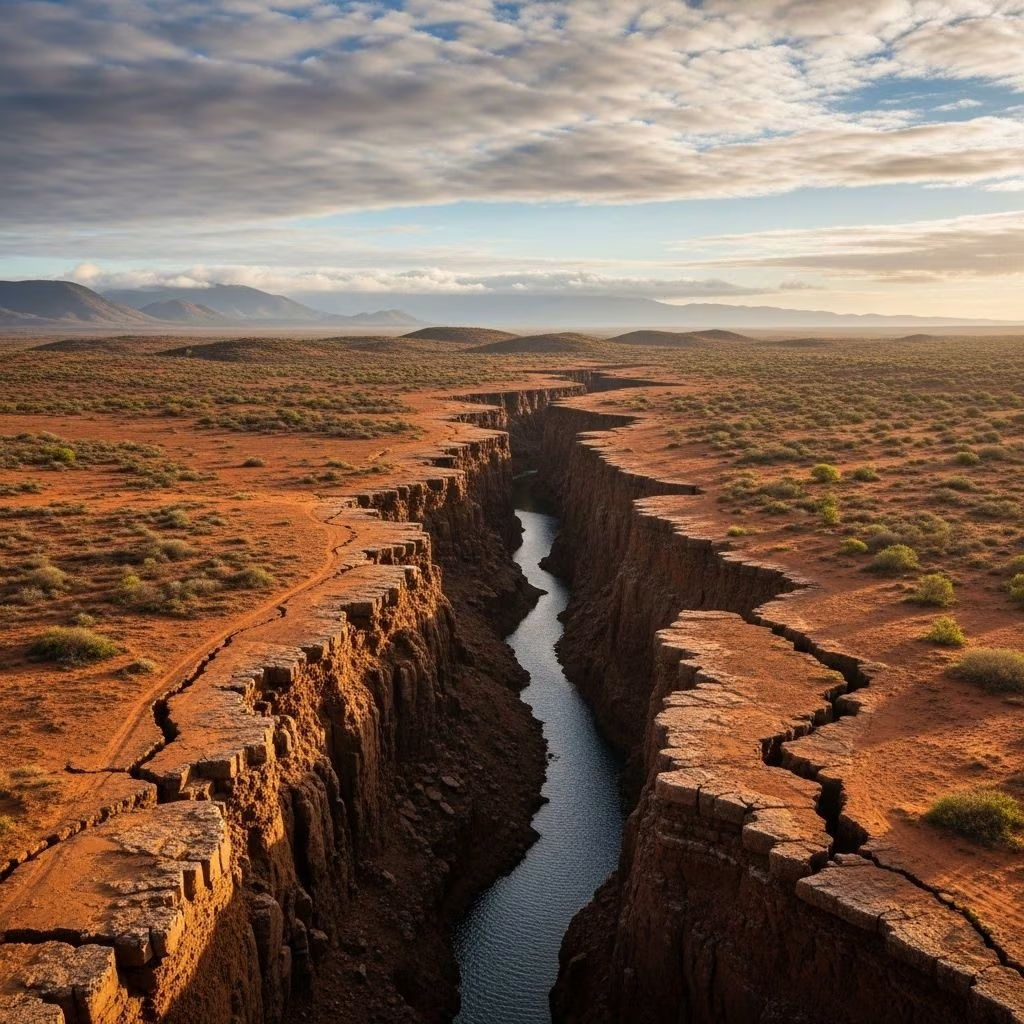
Africa’s Secret Rift: The Start of a Continent Divided
Beneath the savannas and mountains of East Africa, a slow-motion drama is unfolding. Massive geologic forces, invisible yet relentless, are tearing Africa apart. If this process continues for millions of years, it will form a brand new ocean and split Africa into two landmasses. This phenomenon is happening within the East African Rift—a sprawling series of cracks, valleys, and volcanoes stretching thousands of kilometers through the continent.
Understanding Africa’s Dynamic Geology
Africa’s geological activity is shaped by the motion of the African Plate, part of the planet’s shifting tectonic plates. The continent rests atop not one, but several plates, the largest being the Nubian (or African) Plate and the Somali Plate. Their slow separation creates the rift that may eventually reshape the map of the world.
The East African Rift: Earth Cracking Apart
The East African Rift System (EARS) stretches over 3,000 kilometers from the Red Sea in the north, through Ethiopia, Kenya, Tanzania, and down toward Mozambique in the south. This rift is far more than a dramatic valley; it’s an active, evolving tectonic plate boundary where the African Plate is splitting into two: the larger Nubian Plate to the west, and the Somali Plate to the east.
- Rift Length: Over 3,000 km (1,800+ miles)
- Plate Movement Rate: 6–7 millimeters per year
- Major Regions Affected: Ethiopia, Kenya, Tanzania, Uganda, Mozambique
The current rate seems slow, but given geologic time—millions of years—it will lead to major geographic transformations.
How a Continent Splits: The Science of Rift Formation
Continental rifting begins when powerful tectonic forces stretch the Earth’s crust. As the crust thins and fractures, vast valleys, or grabens, form. Magma from deep within the Earth rises to fill these cracks, sometimes erupting as volcanoes, other times cooling beneath the surface to form new rock.
- Stage 1: Rifting with the formation of fault lines and valleys
- Stage 2: Increased volcanic activity and magma upwelling
- Stage 3: If rifting continues, the valley may drop below sea level and flood, forming a new sea or ocean basin
The East African Rift is unique because it represents a continent in the midst of active rifting, allowing scientists to study the process in real-time.
Geologic Features of the Rift: Volcanoes, Lakes, and Valleys
The tearing of Africa is not a silent process. It creates dramatic landscapes brimming with geological activity:
- Deep Rift Valleys: Sheer-sided valleys like the ones in Ethiopia and Kenya mark the rift’s path.
- Volcanoes: The region is studded with active and extinct volcanoes, such as Mount Kilimanjaro and Mount Kenya.
- Great Lakes: Many of Africa’s largest lakes (Lake Tanganyika, Lake Malawi, Lake Turkana) are rift lakes, formed in the valley’s depression.
- Hot Springs & Geysers: These are evidence of the intense geothermal activity as magma approaches the surface.
Strikingly, these geologic processes have sculpted some of the world’s most spectacular scenery and created fertile soils, supporting a range of unique ecosystems.
A Modern Example: The Ethiopian Crack
In 2005, a massive crack over 56 kilometers (35 miles) long opened in Ethiopia within days after a series of earthquakes. This event offered scientists a rare snapshot of how quickly rifting can, under certain conditions, progress.
Why Is the African Rift Splitting?
The splitting of Africa is driven by the movement of tectonic plates, themselves powered by deep forces in the Earth’s mantle:
- Mantle Convection: Heat and material rise from deep within the planet, pushing plates apart.
- Magma Upwelling: As the crust thins, magma from the mantle intrudes upward, causing more fissures and volcanic activity.
- Pre-existing Weaknesses: Ancient cratons and suture zones—regions where earlier continental collisions occurred—are more prone to ripping apart.
This dynamic is particularly intense along the East African Rift, where rock types, past geologic history, and modern tectonics converge.
The Geologic Timeline: How Long Until a New Ocean?
Continents split at glacial speeds. On current estimates, it will take between 5 and 10 million years before the separation is complete and seawater begins to flood the new rift, creating an ocean.
- 0–1 million years: Continual widening of the rift valley, more volcanic eruptions and earthquakes.
- 1–5 million years: Valley drops below sea level, water starts to seep in and shallow seaways may form.
- 5–10 million years: Rift fully splits, a fully-fledged new ocean appears between the Somali and Nubian plates, severing eastern Africa from the rest of the continent.
These processes have historical precedents, such as the opening of the Red Sea when Arabia split from Africa over 25 million years ago.
What’s at Stake? Human, Ecological, and Geopolitical Impacts
The concept of a continent splitting feels abstract, but its effects will be profound for:
- African Communities: Millions live along the rift; earthquakes, volcanoes, and ground fissures continually pose risks.
- Wildlife Habitats: The changing landscape influences migration, river systems, and biodiversity in the rift.
- Resources: The rift is rich in geothermal energy and minerals, making it a center for economic development and potential geopolitical tension.
- New Coastlines: When the ocean forms, landlocked countries (like Uganda and Zambia) could suddenly gain coasts, dramatically shifting regional economics.
Seismic and Volcanic Hazards
The East African Rift is seismically active. Earthquakes and volcanic eruptions are ongoing threats. Notable volcanoes like Ol Doinyo Lengai in Tanzania and Erta Ale in Ethiopia are among the world’s rare “active carbonatite volcanoes” and form part of an evolving geologic landscape.
The Broader Story: How Continents and Oceans Form
The splitting of Africa is part of Earth’s grand tectonic dance. Over hundreds of millions of years, supercontinents assemble and break apart in cycles known as the Wilson Cycle. The forces now rending Africa have shaped every continent and ocean through Earth’s history.
| Process | Example | Time Scale |
|---|---|---|
| Continental rifting | East African Rift | 10s of millions of years |
| Ocean formation | Atlantic Ocean | ~200 million years ago |
| Mountain building | Himalayas | Ongoing (since 50 million years ago) |
| Plate collision | Indian and Eurasian Plate | 50 million years ago – present |
But to see these stages while they unfold, as in Africa now, is a rare scientific opportunity.
Looking Forward: The Future of Africa’s Rift
Geologists now watch the rift’s progress using GPS, satellite imagery, and seismic sensors. While the process will take millions of years—far beyond any human lifespan—its legacy is unfolding today in earthquakes, volcanic eruptions, and the formation of new landscapes.
The research in this region can deepen our understanding of how continents change, how hazardous geological processes develop, and how humans might adapt to future changes in geography.
Frequently Asked Questions (FAQs)
Q: How certain is it that a new ocean will form in Africa?
A: While tectonic models and geological evidence strongly suggest the East African Rift will eventually open into a new ocean, the full process will take millions of years and depends on ongoing rifting and volcanic activity.
Q: What evidence do scientists have that Africa is splitting?
A: GPS measurements, satellite data, earthquake records, the 2005 Ethiopian rift crack, and active volcanoes all indicate continual divergence along the riftdefining this as an active tectonic boundary.
Q: Which countries will be most affected by the rift’s progress?
A: Ethiopia, Kenya, Tanzania, Mozambique, and nearby nations in East Africa are positioned directly along the rift and will see the most profound geologic and geographic changes.
Q: How does the East African Rift compare to other rift zones?
A: The East African Rift is one of the best examples of active continental rifting, much like the early stages of the Red Sea and the earlier Atlantic Ocean, but unique for being visible on land and currently inhabited.
Q: Will humans witness the creation of the new ocean?
A: The creation of an ocean is a process much slower than a human lifetime, but people today can observe its beginnings—earthquakes, volcanic eruptions, and landscape changes along the rift.
Key Takeaways
- The East African Rift is an active continental rift where Africa is slowly splitting.
- If rifting continues, a new ocean will eventually form, dividing the continent.
- This process showcases the immense power and scale of Earth’s tectonic forces.
- The immediate effects—earthquakes, volcanoes, landscape change—already impact millions of people living in the rift.
As scientists continue to study Africa’s rifting, our understanding of continental movement, deeply-rooted tectonic forces, and Earth’s evolving surface will expand. The slow tearing of Africa is a testament to the restless dynamism of our planet.
References
- https://en.wikipedia.org/wiki/African_plate
- https://www.iris.edu/hq/inclass/animation/africatectonic_setting_and_earthquake_history
- https://earthhow.com/african-plate/
- https://en.wikipedia.org/wiki/East_African_Rift
- https://www.britannica.com/place/Africa/Geologic-history
- https://africa-arabia-plate.weebly.com
- https://theweek.com/news/science-health/960092/africas-tectonic-shift-how-the-continent-is-splitting-apart
- https://study.com/academy/lesson/african-tectonic-plate-facts-movement.html
- https://www.youtube.com/watch?v=dJndGhTa1Xo
- https://www.geolsoc.org.uk/science-and-policy/plate-tectonic-stories/east-african-rift-valley/
- https://www.youtube.com/watch?v=9OFyI2hsQ3k
- https://pubs.usgs.gov/gip/dynamic/understanding.html
- https://africa-arabia-plate.weebly.com/future-tectonics.html
- https://www.irsm.cas.cz/materialy/acta_content/2023_doi/Savchyn_AGG_2023_0003.pdf
- https://www.msnucleus.org/membership/html/k-6/pt/plate/1/ptpt1_3a.html
- https://www.zmescience.com/science/news-science/africa-rift-valley-split-new-ocean/
- https://www.jpost.com/environment-and-climate-change/article-735092


