Red Lightning: Unveiling the Mysteries of Sprites in Earth’s Atmosphere
Red lightning, also known as sprites, is one of nature’s most elusive and visually arresting phenomena, captivating both scientists and skywatchers alike. Appearing high above powerful thunderstorms, these radiant crimson flashes offer clues about Earth’s atmospheric complexity and the impact of climate on our planet’s electrical systems. This article delves into what sprites are, how they are observed, their scientific importance, and why they remain one of meteorology’s great unsolved riddles.
What Is Red Lightning?
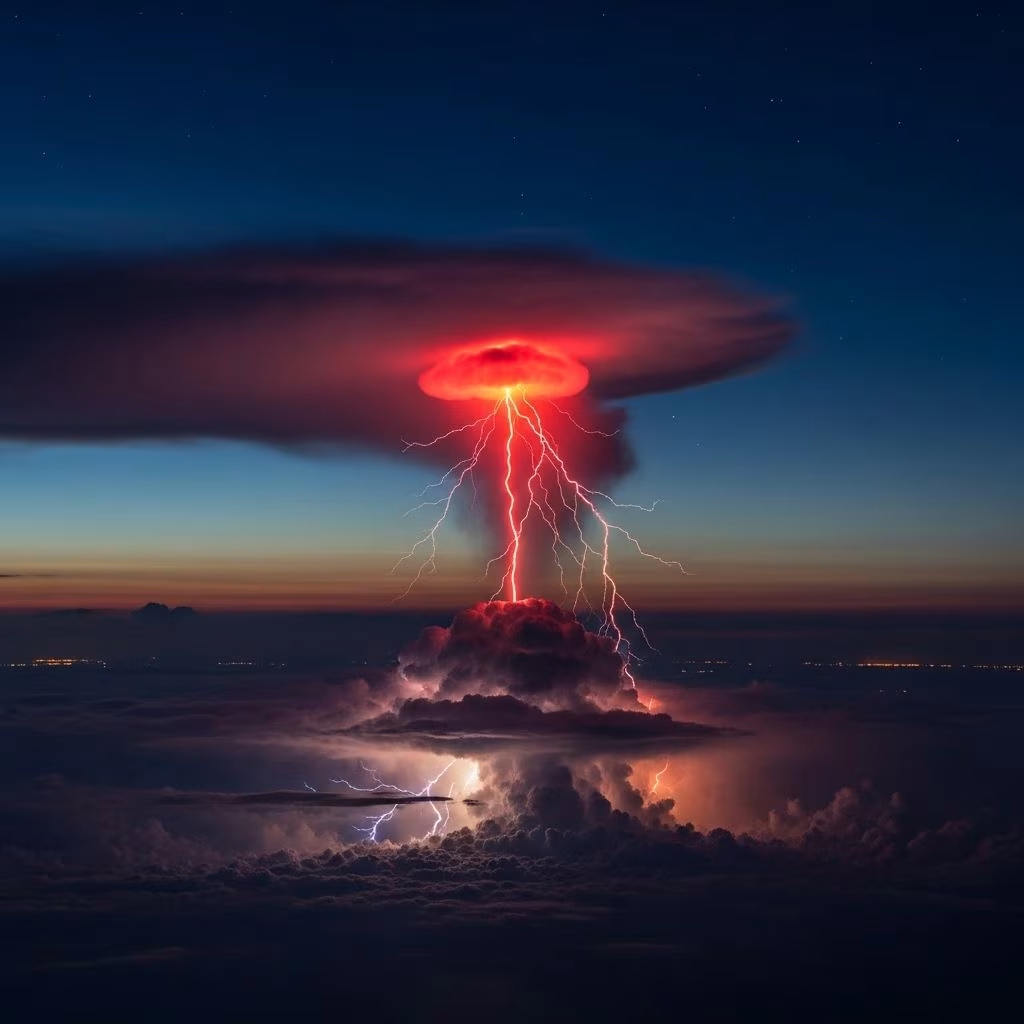
Red lightning or sprites are brief, red-hued electrical discharges that occur high above large thunderstorm systems. Unlike typical lightning, which travels downward from clouds toward the Earth, sprites propel upward into the mesosphere, the layer of atmosphere about 50-85 km above the surface.
- Sprites are typically caused by powerful, positive lightning strikes from the tops of thunderstorm clouds.
- They illuminate the upper atmosphere in shades of red, pink, or orange, creating a stunning, almost alien visual effect.
- The phenomenon usually lasts only a fraction of a second, often less than a millisecond.
While they were once thought to be rare or even mythical among pilots and skywatchers, technological advances and observations from high altitudes and space have confirmed their existence and even revealed their complexity and diversity.
The Spectacle Seen from Space
Sprites are incredibly difficult to observe from the ground. Their high-altitude location, rapid duration, and the necessity of a dark, unobstructed sky mean that the best views often come from the International Space Station (ISS) or orbiting satellites. Several astronauts, including NASA’s Matthew Dominick and ESA’s Andreas Mogensen, have managed to capture sprites in recent years, providing unprecedented insights.
- In a recent event, astronaut Matthew Dominick captured a red sprite over the South Atlantic while photographing a lightning storm from the ISS.
- Dominick’s image, which revealed the sprite in a single frame from a time-lapse, was hailed as a ‘rare event’ even among seasoned space observers.
- ESA’s Andreas Mogensen has captured both sprites and the even rarer ‘blue jets’, using special neuromorphic cameras that enhance sprite detection.
Why Are Sprites Red?
The striking red color of sprites results primarily from their extremely high altitude. Here, interactions between the burst of electricity and the nitrogen molecules in the upper atmosphere produce red light. The process includes:
- Positive lightning from the top of thunderclouds creating a burst of energy.
- This energy excites nitrogen molecules, which then emit light with red wavelengths.
- Under certain conditions, sprites may exhibit pink, orange, or even purple hues, depending on atmospheric composition.
How Scientists Study Red Lightning
Interest in sprites surged after their photographic discovery in the late 20th century, followed by an explosion of research as technology improved. The ISS has become a prime vantage point, with dedicated missions and instrument deployments focusing on sprite observation and analysis.
The Neuromorphic Camera Revolution
One milestone was the deployment of neuromorphic cameras aboard the ISS. Unlike regular cameras, which rely on a shutter to capture sequential images, neuromorphic cameras detect and register only changes in light intensity.
- This allows them to detect fleeting phenomena such as sprites far more efficiently than traditional imaging technology.
- Neuromorphic cameras offer higher sensitivity and frame rates, essential for documenting millisecond lightning events.
This approach has enabled European astronauts to capture ultra-detailed images of sprites, revealing subtle structures and transient shapes that go undetected by ground-based instruments.
The Science of Sprite Formation
The exact mechanics behind sprite creation remain a subject of ongoing research, but several fundamental principles are understood:
- Sprites are triggered by powerful positive cloud-to-ground lightning strikes, which create massive electric fields above storm clouds.
- These electric fields momentarily ionize the upper atmosphere, producing an electrical discharge — the sprite — that shoots upwards.
- Sprites often resemble jellyfish, carrots, or columns, spanning as much as 30 miles (48 km) across and reaching even greater vertical dimensions.
Sprites are part of a family of upper-atmospheric lightning phenomena, including:
- Blue Jets: Upward-flowing discharges that take on a vivid blue coloration and extend from cloud tops into the stratosphere.
- Elves: Extremely short-lived disks of light that expand rapidly above thunderstorms.
Are Sprites Related to Regular Lightning?
Sprites are intimately associated with thunderstorms, but they differ markedly from familiar lightning bolts:
- Regular lightning generally travels from the cloud base to the ground or within clouds.
- Sprites, in contrast, move upward and do not touch the Earth’s surface.
- While regular lightning can be seen frequently in any thunderstorm, sprites are rare and usually appear only during highly energetic storm events with strong positive lightning.
Significance and Scientific Importance
Sprites are not only visually spectacular, but they also provide valuable data for understanding atmospheric electricity, thunderstorm dynamics, and even potential climate change indicators.
Climate Change and Lightning
There is growing evidence that the behavior and frequency of sprites, as well as other lightning phenomena, may be evolving due to human-induced changes in climate. Research presented at the European Geophysical Union conference highlighted:
- Powerful thunderstorms with ‘overshooting’ cloud tops may inject greenhouse gases and aerosols into the stratosphere.
- Sprites could serve as markers or indicators of such atmospheric events, offering a new way to investigate links between severe weather and climate change.
Sprites and Atmospheric Chemistry
By studying sprites, scientists are able to:
- Quantify the impact of lightning on the composition of the upper atmosphere.
- Understand electrical energy transfer between layers of the atmosphere.
- Investigate how thunderstorms contribute to the movement of trace gases and particles.
History and Discoveries
While anecdotal reports of unusual high-altitude lightning have circulated for decades, it was only in the late 20th century that sprites were conclusively documented. Key milestones include:
- The first confirmed photographic evidence of sprites in the late 1980s and early 1990s.
- Significant imaging efforts by astronauts on the space shuttle and the ISS throughout the 2000s and 2010s.
- Publication of remarkable sprite images in prestigious scientific journals, bringing attention to their significance.
Each new observation has motivated further research, with technology enabling more precise data collection and analysis with each passing year.
Why Are Sprites So Difficult to Observe?
Several factors make sprite detection and photography especially challenging:
- Sprites occur at altitudes of 50 km or more — far above standard cloud decks.
- The events last for only milliseconds, often occurring in isolation amid widespread thunderstorm activity.
- Bright moonlight, city lights, or atmospheric haze can mask their appearance when viewed from the ground.
- Space-based observations, while less affected by these limitations, require specialized instruments and precise timing.
Red vs. Blue Lightning: Are They the Same?
| Feature | Red Lightning (Sprites) | Blue Lightning (Jets) |
|---|---|---|
| Appearance | Red, pink, or orange | Blue or violet |
| Occurs At | 50-90 km above surface | 20-50 km above surface |
| Direction | Upwards from thunderstorm tops | Upward jets from thunderstorm clouds |
| Duration | Milliseconds | Hundreds of milliseconds |
| Discovery | Late 20th century (space imaging) | 1990s (aircraft & space observation) |
Key point: Neither red nor blue lightning is “stronger”; differences in color result from altitude and atmospheric composition, not intensity.
Frequently Asked Questions (FAQs)
Q: What causes red sprites to form?
A: Red sprites form when powerful positive lightning strikes from thunderstorm tops create intense electric fields that ionize the thin, nitrogen-rich upper atmosphere, releasing a brief red glow detectable from space and select ground locations.
Q: Are sprites dangerous to humans or aviation?
A: No, sprites occur well above normal flight altitudes and have no direct impact on ground or air safety. Their effects are limited to atmospheric layers far above commercial or private air traffic.
Q: Can red sprites be predicted?
A: While they are associated with energetic thunderstorms and positive lightning, predicting the exact time and place of sprite formation remains extremely difficult due to their rarity and dependency on storm intensity and upper atmospheric conditions.
Q: Do sprites look the same everywhere in the world?
A: Sprites are observed globally above major thunderstorms. Their appearance varies based on altitude, viewing angle, and atmospheric composition, but the characteristic red or pink color is consistent due to nitrogen excitation.
Q: Have sprites always existed?
A: Sprites are a natural part of Earth’s atmosphere and have likely occurred for millennia, but they were first scientifically documented only in the late 20th century due to their brief, high-altitude nature.
Key Takeaways
- Red lightning or sprites are upward-traveling lightning phenomena associated with powerful thunderstorms and are visible mostly from space.
- Sprites last only milliseconds, span huge distances, and result from positive lightning exciting nitrogen molecules high in the atmosphere.
- Space missions on the ISS have provided crucial images and data, thanks to advanced cameras and dedicated observation campaigns.
- Studying sprites sheds light on storm physics, atmospheric chemistry, and even broader climate trends.
- Sprites remain among the least-understood phenomena in meteorology, blending scientific intrigue with visual wonder.
For scientists and skywatchers, the study of sprites is just beginning. Each fleeting pulse of red lightning above Earth’s storms is a reminder of the complexities still hidden in our own sky.
References
- https://www.space.com/iss-red-lightning-sprite-thunderstorm-image
- https://www.space.com/30286-enormous-red-sprites-space-update.html
- https://en.wikipedia.org/wiki/Sprite_(lightning)
- https://news.ssbcrack.com/nasa-astronaut-captures-stunning-image-of-rare-jellyfish-shaped-lightning-sprite-from-space/
- https://spaceyv.com/red-lightning/
- https://www.livescience.com/51968-red-lightning-photographed-from-space.html
- https://www.smithsonianmag.com/smart-news/mysterious-red-sprite-appears-in-nasa-astronaut-photo-from-the-space-station-what-is-this-strange-electrical-flare-180986946/
- https://www.earth.com/news/nasa-extraordinary-event-photo-storms-red-sprites-from-iss/
- https://www.earthobservatory.nasa.gov/images/153422/sprites-camera-action
- https://www.earth.com/news/stunning-red-sprite-lightning-captured-from-space/
- https://www.nasa.gov/image-article/a-midsummer-red-sprite-seen-from-space/
- https://www.livescience.com/planet-earth/weather/astronaut-snaps-giant-red-jellyfish-sprite-over-north-america-during-upward-shooting-lightning-event
- https://www.youtube.com/watch?v=cMZbb0YSkvc
- https://www.atlasobscura.com/articles/iss-lightning-in-space-sprites-elves
- https://www.youtube.com/watch?v=2lCGf3ami3E
- https://orbitaltoday.com/2025/07/07/nasa-astronaut-captures-rare-red-lightning-sprite-from-space/
- https://www.savvydime.com/strange-red-lights-in-space-witnessed-from-the-iss-by-nasa-astronaut/
- https://universemagazine.com/en/astronaut-spotted-a-mysterious-phenomenon-in-the-earths-atmosphere-from-space-photo/
- https://www.iflscience.com/nasa-astronaut-captures-red-sprites-dancing-above-thunderstorms-on-earth-75057