


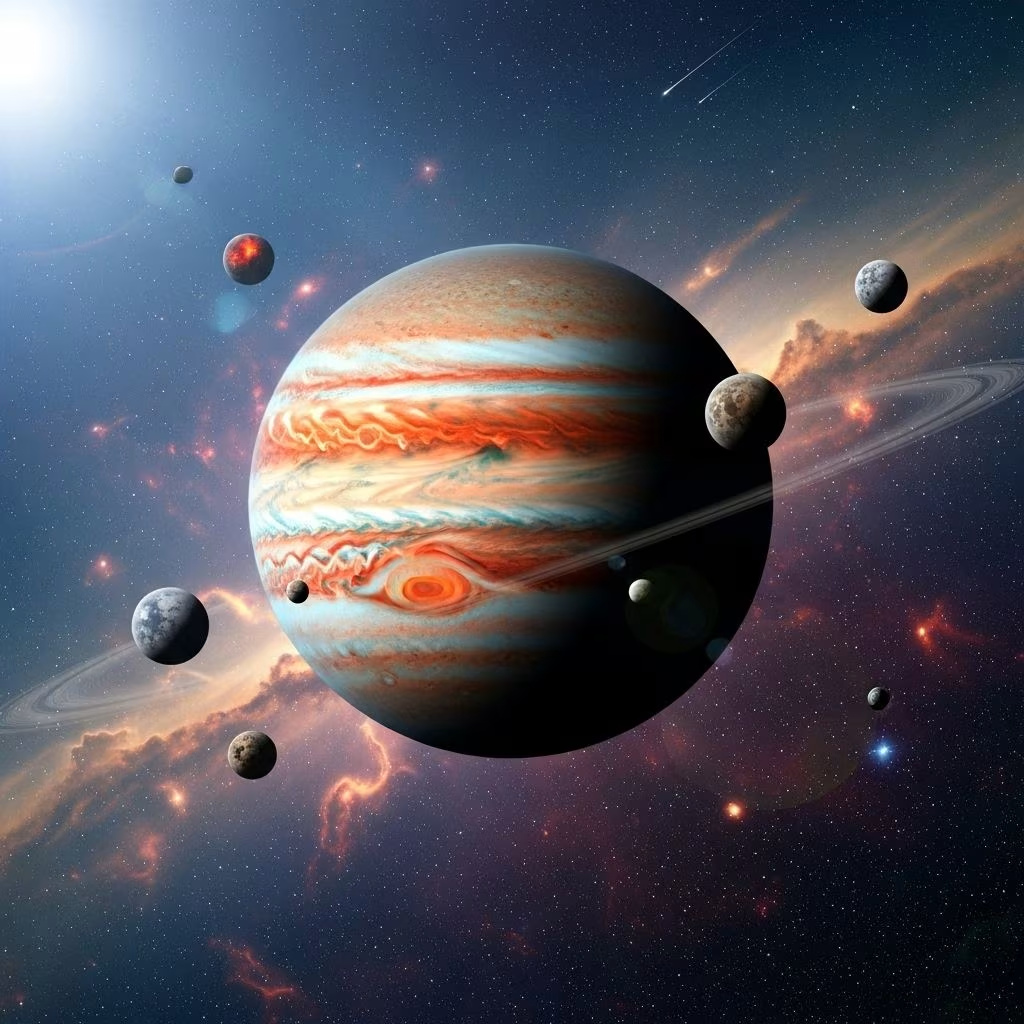
Jupiter stands as the largest and most influential planet in our solar system. This gas giant’s immense size, swirling stripes, powerful storms, myriad of moons, and subtle rings make it an enduring object of fascination for astronomers, scientists, and skywatchers alike. Studying Jupiter unveils insights into the nature of planetary formation and the dynamic processes at work in our cosmic neighborhood.
Jupiter at a Glance
- Fifth planet from the Sun
- Largest planet in the solar system—over 11 times Earth’s diameter
- Gas giant composed mainly of hydrogen and helium
- Possesses at least 92 moons, including four large “Galilean moons”
- Known for prominent bands, the Great Red Spot, and faint rings
Jupiter is easily observable from Earth and is second only to Venus in brightness among the planets. Through even a small telescope, features like its equatorial bands and the movements of its largest moons are visible to amateur astronomers. Its outsized influence has shaped the history and structure of our solar system in dramatic ways.
How Big is Jupiter?
The statistics highlighting Jupiter’s enormity are truly spectacular. It possesses:
- Diameter: About 143,000 km (88,900 miles), more than 11 times Earth’s diameter
- Mass: Roughly 318 times that of Earth, greater than that of all other planets combined
- Volume: Sufficient to fit about 1,300 Earths inside it
This incredible bulk ensures Jupiter’s gravitational power reaches far and wide, tugging at asteroids, comets, and even influencing spacecraft sent to explore the outer solar system.
| Property | Jupiter | Earth |
|---|---|---|
| Diameter | 143,000 km | 12,742 km |
| Mass | 1.9 x 1027 kg | 5.97 x 1024 kg |
| Volume (Earths inside) | ~1,300 | 1 (reference) |
| Distance from Sun | ~778 million km (5.2 AU) | ~150 million km (1 AU) |
| Orbital Period | 11.86 years | 1 year |
A Gas Giant of Stripes and Storms
Jupiter lacks a solid surface and is composed together of:
- Hydrogen – ~76%
- Helium – ~24%
- Small amounts of methane, water vapor, ammonia, and other elements
Its upper atmosphere is characterized by alternating light and dark cloud bands moving in opposite directions. These belts are produced by jet streams, chemical differences, and powerful winds—making Jupiter a planet of perpetual storminess and beauty. The most striking of its storms is the Great Red Spot—a colossal high-pressure system broader than Earth itself and raging for hundreds of years.
The Great Red Spot
- About 16,000 km (9,900 miles) wide
- A massive anticyclonic storm system
- First observed in the 17th century and still enduring
- Resides in Jupiter’s southern hemisphere
Other storms, appearing as white ovals and brown barges, erupt regularly throughout the planet’s turbulent atmosphere, illustrating the incredible energy and activity within Jupiter’s cloud tops.
A Shallow Ring System and Magnetosphere
Though Saturn is famous for its dazzling rings, Jupiter also sports a faint system:
- Four main rings: Halo, Main, Amalthea gossamer, Thebe gossamer
- Composed mostly of dust from collisions involving Jupiter’s small moons
- Discovered by Voyager 1 in 1979
In addition to rings, Jupiter’s powerful magnetosphere—generated by the motion of metallic hydrogen deep inside the planet—creates spectacular auroras and acts as a protective force for its moons.
Jupiter’s Dozens of Moons
Jupiter has the most moons of any planet, with at least 92 natural satellites confirmed as of 2025. Many are small and irregular, but four stand out as major worlds in their own right—the Galilean moons:
- Io: The most volcanically active body in the solar system
- Europa: Believed to harbor a subsurface ocean beneath its icy crust, considered a top target for potential extraterrestrial life
- Ganymede: The largest moon in the solar system (even bigger than Mercury)
- Callisto: Heavily cratered, ancient surface with possible underground oceans
These moons, discovered by Galileo Galilei in 1610, continue to inspire research and speculation, especially as missions begin to seek evidence of habitability on moons like Europa and Ganymede.
Jupiter’s Profound Impact on the Solar System
Jupiter’s giant mass exerts powerful gravitational effects:
- Shapes planetary orbits: Influences the orbits of neighboring planets, including causing gaps in the asteroid belt (known as Kirkwood gaps)
- Protective role: Its gravity diverts or absorbs many comets and asteroids, helping protect inner planets—including Earth—from impacts
- Creates short-period comets: Attracts and captures comets into Jupiter family orbits
- Assists spacecraft: Used for gravity assists to accelerate and adjust trajectories of missions heading to the outer solar system (Voyager, Cassini, New Horizons, and more)
Without Jupiter, our solar system’s planetary alignments and the very history of impacts on Earth might look dramatically different.
Formation and Evolution
Jupiter formed early in the history of the solar system, collecting massive amounts of gas and dust before the Sun ignited fully as a star. Its formation:
- Occurred rapidly, possibly within the first few million years as the solar nebula coalesced
- Likely paved the way for the formation of smaller planets by clearing out vast zones of debris
- Has been linked to events like planetary migration, which shaped the current layout of our solar system
Some theories suggest that if Jupiter had grown just 80 times more massive, it could have ignited nuclear fusion—becoming a kind of brown dwarf rather than a planet.
Exploring Jupiter
Since the dawn of the space age, several spacecraft have visited Jupiter, providing critical data and breathtaking imagery:
- Pioneer 10 and 11: First flybys in the early 1970s
- Voyager 1 and 2: Provided stunning images and discovered rings and new moons in 1979
- Galileo: Orbiter from 1995-2003, studied the planet and its major moons in depth
- Juno: Arrived in 2016, continuing to study Jupiter’s interior, atmosphere, and magnetic field
Future missions, such as the European Space Agency’s JUICE (Jupiter Icy Moons Explorer), aim to explore the habitat potential of Jupiter’s frozen moons and deepen our understanding of giant planet systems.
Jupiter in the Night Sky
Jupiter is a regular feature of the night sky, sometimes visible for months at a time. With even a small telescope, observers can watch:
- The planet’s striped cloud bands
- Shifting positions of the Galilean moons—even over a single night
- The transient shadow transits and occasional eclipses of its moons
- The pale, elusive rings under ideal viewing conditions
Frequently Asked Questions (FAQs)
Q: Why is Jupiter called a “gas giant”?
A: Jupiter is called a gas giant because it is primarily composed of light elements, mainly hydrogen and helium, and lacks a solid, well-defined surface like terrestrial planets.
Q: How many moons does Jupiter have?
A: Jupiter has at least 92 known natural satellites, ranging from small, irregular bodies to its four massive Galilean moons.
Q: What makes the Great Red Spot red?
A: The exact cause of the Great Red Spot’s color is still under study, but it may involve compounds like phosphorus or complex organic molecules interacting with sunlight and Jupiter’s dynamic atmosphere.
Q: Has any spacecraft landed on Jupiter?
A: No spacecraft has landed on Jupiter, as it lacks a solid surface and the temperatures and pressures of its lower atmosphere are extreme and crushing.
Q: Why is Jupiter significant for Earth and life?
A: Jupiter’s gravitational influence has helped shield Earth from asteroid and comet impacts, influencing the stability and habitability of our solar system.
Fun Facts About Jupiter
- If Jupiter’s mass were 80 times greater, it would have become a small star
- It rotates rapidly, once every 9.9 hours—the shortest day of all planets
- Its magnetic field is the strongest of any planet in the solar system—about 20,000 times Earth’s
- It radiates more heat than it receives from the Sun
- Jupiter’s largest moon, Ganymede, is bigger than Mercury
References
- NASA – Jupiter Facts
- Encyclopaedia Britannica
- German Aerospace Center – Jupiter
- Wikipedia – Jupiter
References
- https://science.nasa.gov/jupiter/jupiter-facts/
- https://science.nasa.gov/jupiter/
- https://en.wikipedia.org/wiki/Jupiter
- https://www.youtube.com/watch?v=-AakWzvAgRM
- https://www.funkidslive.com/learn/top-10-facts/top-10-facts-about-jupiter/
- https://www.dlr.de/en/research-and-transfer/projects-and-missions/juice/jupiter-gas-giant-and-ringed-planet
- https://www.planetary.org/worlds/jupiter
- https://www.skyatnightmagazine.com/space-science/what-is-biggest-planet
- https://www.britannica.com/science/How-Big-Is-Jupiter
- https://www.britannica.com/place/Jupiter-planet
- https://skyandtelescope.org/astronomy-resources/smallest-and-largest-planets-in-our-solar-system/
- https://www.usatoday.com/story/news/nation/2025/05/23/jupiter-size-study-gas-giant/83793238007/
- https://lco.global/spacebook/solar-system/jupiter/
- https://www.youtube.com/watch?v=8sUAiEX4qPQ
- https://www.worldatlas.com/space/what-is-the-largest-planet-in-the-solar-system.html
- https://testbook.com/static-gk/largest-planet-in-the-solar-system


