What Planetary Alignments Mean for Science and Astronomy
Every so often, planets in our solar system converge into remarkable configurations that both awe the public and intrigue scientists. When several planets seem to form a line in the sky, we witness what astronomers call a planetary alignment. While these events are visually stunning and inspire curiosity about our universe, they also unlock unique opportunities for astronomical research, planetary dynamics, and technological advancement. This article explores the nature, causes, significance, and scientific potential of planetary alignments, with a focus on the latest rare parade of planets lighting up the night sky.
Overview: What Is a Planetary Alignment?
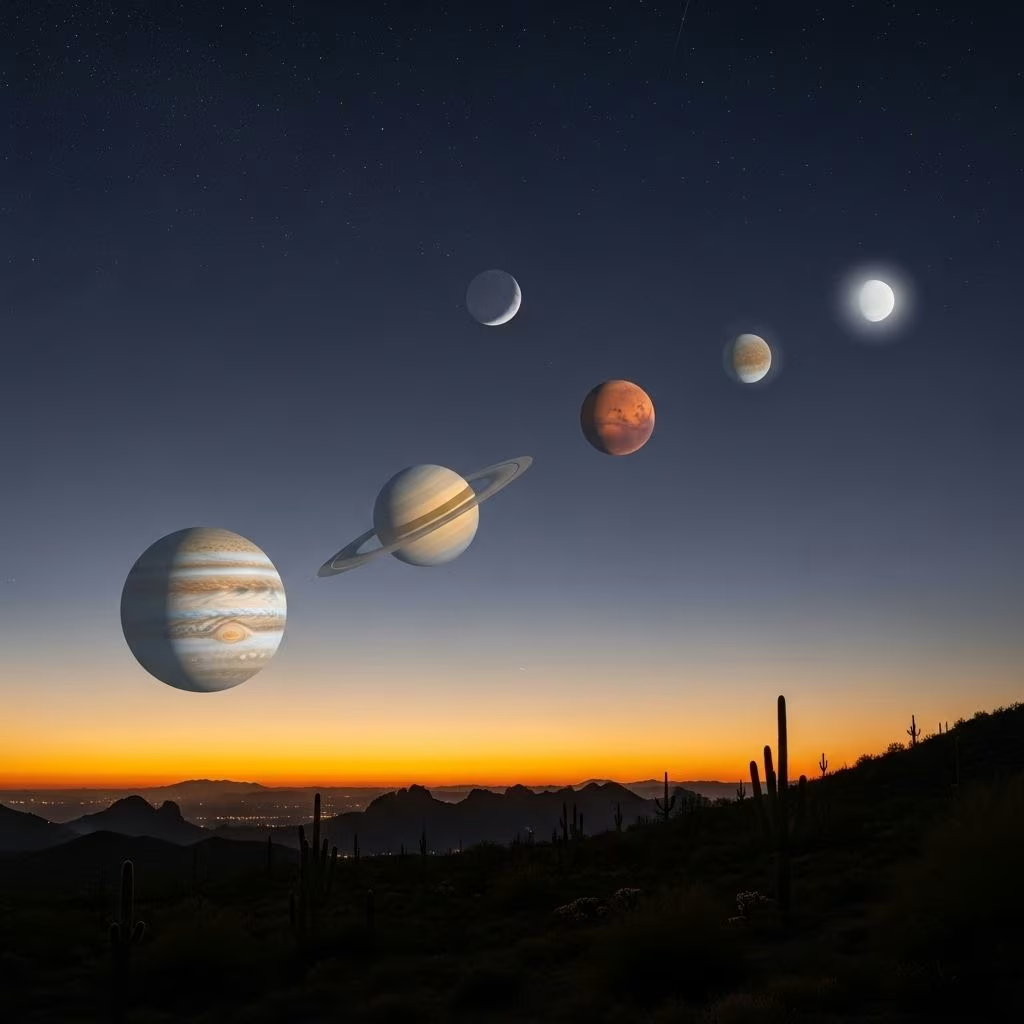
A planetary alignment occurs when planets appear to line up from our vantage point on Earth, often forming a row or arc across the sky. Importantly, the planets are not physically aligned in space; their positions merely overlap along a similar path due to their orbits around the Sun. This optical effect depends on each planet’s location in its respective orbit and our line of sight from Earth[12].
- Not a perfect straight line in three-dimensional space.
- Caused by the orbits of planets aligning from Earth’s perspective.
- The event is sometimes colloquially called a planet parade or cosmic lineup.
Why Are Major Planetary Alignments So Rare?
While partial alignments involving three or four planets are relatively common, alignments of six or seven visible planets are rare and may only occur a few times per century. This rarity is because:
- Each planet has a different orbital period and speed.
- Planets must occupy the same part of the sky when visible from Earth.
- Weather and light conditions can further limit observation.
The last notable six-planet alignment occurred in June 2022, with Mercury, Venus, Mars, Jupiter, Saturn, and Uranus participating. In February 2025, skywatchers expect to see all seven planets (excluding Earth) simultaneously[12]. Major alignments like these require decades to recur.
| Planet | Orbital Period (Earth Years) |
|---|---|
| Mercury | 0.24 (88 days) |
| Venus | 0.62 (225 days) |
| Earth | 1 |
| Mars | 1.88 (687 days) |
| Jupiter | 11.9 |
| Saturn | 29.5 |
| Uranus | 84 |
| Neptune | 165 |
Historical and Upcoming Alignments
Planetary alignments have fascinated humans for millennia. Ancient texts and sky-watching cultures often attributed cosmic alignments with omens or special meanings, though modern science views them as natural consequences of orbital mechanics. Recent and future noteworthy alignments include:
- June 2022: Six planets visible together in the dawn sky.
- February 28, 2025: Predicted seven-planet parade, a rare occurrence in modern astronomy.
Thanks to advanced models and orbital calculations, astronomers now predict major alignments decades in advance.
Scientific Value: Insights Unlocked by Alignments
Though planetary alignments lack mysterious influence, they are scientifically valuable for several reasons:
- Calibration of Instruments: Multiple bright targets in proximity help optimize and calibrate telescopic arrays and detectors.
- Gravity and Tidal Effects: While planetary gravitational interactions are subtle compared to the moon’s or sun’s effect on Earth, these events help test models of celestial mechanics and planetary motion.
- Space Missions: Spacecraft launches are sometimes timed to take advantage of planetary alignments, making interplanetary travel more fuel-efficient by leveraging close approaches for gravity assists and slingshot maneuvers.
- Public Engagement: Major alignments inspire both amateur stargazers and professional astronomers, driving public interest and science literacy.
- Comparative Observations: The simultaneous appearance of multiple planets offers rare opportunities to compare atmospheric features, brightness, and other attributes under similar conditions.
How Planetary Alignments Aid Space Exploration
Space agencies closely monitor planetary positions for planning spacecraft trajectories. When planets align conveniently, missions like Voyager, Galileo, and Cassini have used gravity assists to reach their far destinations with less fuel and shorter travel times. Alignments save resources and make ambitious explorations possible.
The Mechanics Behind Planetary Alignments
The phenomenon of planetary alignment rests on orbital dynamics. Here’s how it works:
- Each planet orbits the Sun in an elliptical path dictated by gravity and speed.
- Alignment occurs when their ‘elongation’ (angular separation from the Sun as seen from Earth) brings multiple planets into the same general region of our sky.
- Kepler’s laws of planetary motion, as well as conservation of angular momentum, govern how and when these lineups form.
- Planets do not physically cluster together — their distance from each other remains vast even during alignments.
In rare cases, spectacular grand alignments have all planets on the same side of the Sun, though this is exceedingly infrequent[13].
Key Factors Influencing Alignment
- Orbital Period: How long each planet takes to complete a revolution.
- Orbital Inclination: The tilt of each planet’s orbit, which affects visibility.
- Gravitational Interactions: Subtle influences reshaping orbits incrementally over time.
- Angular Momentum: Conserved rotational motion impacting the alignment timing.
Cultural, Mythological, and Social Impact
Throughout history, planetary alignments have sparked speculation about their impact on human affairs. While science disproves any direct connection to social or geological events, the widespread visibility and rarity have made planetary alignments meaningful in:
- Astrology, where alignments are credited with influencing personality or fate (no scientific support for these claims).
- Literature and myth, as metaphors for cosmic harmony or upheaval.
- Public outreach events, inspiring awe and curiosity.
Today, scientists and educators use alignments to engage the public and promote space literacy, explaining the real physics behind the spectacle.
Frequently Asked Questions
Q: Can planetary alignments affect Earth’s climate or tides?
No, the gravitational pull of distant planets is negligible compared to the Moon and Sun when it comes to tidal forces or climate patterns.
Q: Have all eight planets in our solar system ever perfectly aligned?
No, due to varying orbital inclinations and periods, a perfect eight-planet straight-line alignment is virtually impossible. Most notable alignments involve six or seven planets grouped together in part of the sky.
Q: Can planetary alignments be predicted?
Yes, thanks to precise models of planetary motion, astronomers can predict future alignments decades in advance.
Q: Why do these alignments inspire so much interest?
Major planetary alignments are rare, beautiful, and showcase the vast scale and elegant order of our solar system. They provide an accessible way for everyone to connect with astronomy and inspire the next generation of scientists.
Q: Is there any scientific evidence for planetary alignments causing disasters?
No, there is no scientific support for the idea that planetary alignments cause earthquakes, weather changes, or other disasters on Earth.
Quick Facts About Planetary Alignments
- A planetary alignment happens when three or more planets appear in the same region of the sky from Earth’s perspective.
- Major alignments are predictable, rare, and scientifically valuable for both research and outreach.
- No mythological, magical, or supernatural effects have ever been confirmed.
- Upcoming planetary alignments are powerful opportunities to observe and study planets in real time.
Final Thoughts
Planetary alignments are some of the most captivating and scientifically meaningful phenomena in astronomy. They not only showcase the dynamism and complexity of our solar system, but also provide unique windows for research, instrument calibration, and global science engagement. Whether you’re a seasoned astronomer or a casual sky watcher, witnessing a planetary parade is a rare chance to connect with the cosmos and appreciate the deep harmony of celestial motion. Keep looking up—the next cosmic lineup may be just around the corner.
References
- https://www.space.com/planetary-alignments-mean-for-science-astronomy
- https://www.space.com/planetary-alignments-mean-for-science-astronomy&rut=2432903313d73e95e4bb192fcc0fe9fa917bd7347d6439fa46b63e806402918e
- https://starwalk.space/en/news/what-is-planet-parade
- https://science.nasa.gov/solar-system/skywatching/planetary-alignments-and-planet-parades/
- https://www.youtube.com/watch?v=-tkcY4Dv5K4
- https://www.astronomy.com/science/what-it-means-when-planets-align/
- https://www.cbsnews.com/news/planetary-parade-alignment-space/
- https://spaceyv.com/planetary-alignments/
- https://www.scienceguysofsanantonio.com/science-guys-blog/the-magic-of-planetary-alignments-a-cosmic-phenomenon
- https://www.youtube.com/watch?v=O4UT-SD-OWs
- https://www.freeastroscience.com/2024/11/the-science-behind-planetary-alignments.html
- https://rkeevision.com/2025/01/22/six-planet-alignment-science-guide-2025/
- https://ophiuchus-horoscope.com/the-science-behind-planetary-alignments/
- https://www.livescience.com/space/planets/have-all-8-planets-ever-aligned
- https://blog.oup.com/2015/10/rare-planetary-alignments/
- https://academiaworldnews.com/the-science-behind-planetary-alignments-what-the-2025-event-reveals-about-our-solar-system/
- https://olhardigital.com/science-and-space/what-is-a-planetary-alignment/