The cosmos is filled with astonishing sights: billions of galaxies, sprawling nebulae, and mysteries as deep as time itself. But one of the most profound questions in astronomy asks—does the universe have an edge? And if so, what, if anything, lies beyond?
Understanding the Observable Universe
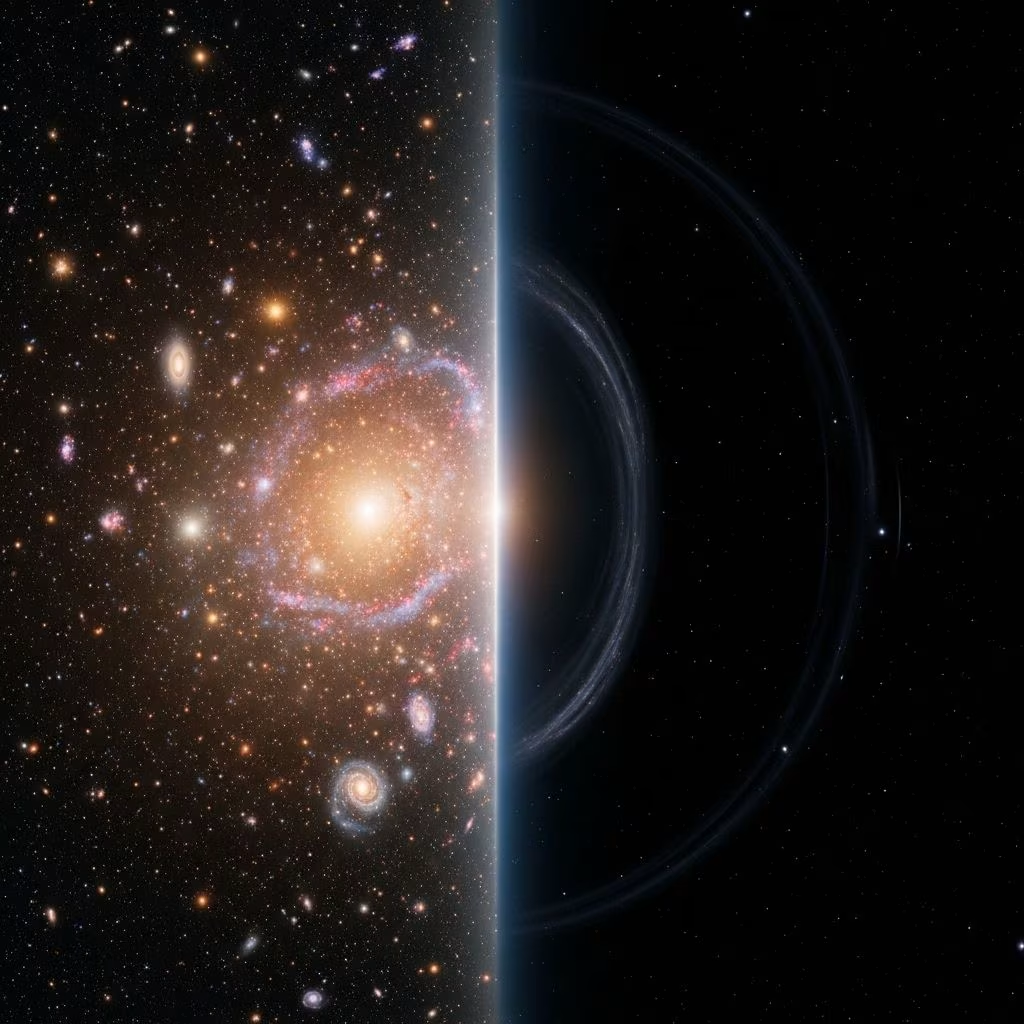
To make sense of what might be at the ‘edge’ of the universe, it’s important to understand the concept of the observable universe. This is the region of space from which light has had enough time, since the beginning of the universe, to reach us. Its boundary is not a true edge, but rather a limit to what we can see.
- Diameter: About 93 billion light-years across.
- Age: Universe is about 13.8 billion years old.
- Nature of the boundary: Not a wall or a sharp edge, but a horizon beyond which light hasn’t reached us yet.
This means that for every observer—on Earth, on a distant exoplanet, or in another galaxy—their observable universe is centered on themselves, defined by their location and the time that has passed since the Big Bang.
Why Can’t We See Beyond?
The speed of light sets a fundamental limit on how far we can see; anything farther is hidden by the sheer immensity of time and space. Objects beyond this limit are receding so quickly due to the expansion of the universe that their light will never reach us, no matter how much time passes.
Does the Universe Have a Physical Edge?
Many naturally wonder if, like an island in an ocean, the universe could have a literal edge—a place where space and time end, and something truly different or nothingness begins.
- Scientific consensus: There is no evidence of a physical edge or boundary.
- Cosmological principle: The laws of physics and the distribution of matter are the same everywhere, suggesting no privileged center or edge.
As Robert McNees, a physicist, explains, the universe looks the same in every direction and from every place, at sufficiently large scales. This makes the idea of a traditional edge unlikely.
Shapes and Topology of the Universe
Just as Earth’s surface feels flat on local scales but is actually a sphere without edges, the universe may have a topology (overall shape and structure) that precludes edges altogether.
- Flat (infinite) model: The universe may be infinite and unbounded.
- Closed (spherical) model: The universe could curve back on itself, like the surface of a sphere—finite yet unbounded.
- Open (hyperbolic) model: The universe may have a saddle-shaped curvature and expand forever.
| Model | Description | Edge? |
|---|---|---|
| Flat | Extends infinitely in all directions | No |
| Closed | Finite, curves back on itself (like a sphere) | No |
| Open | Infinite with negative curvature | No |
In none of these mainstream models is there a known ‘edge’—just different ways the universe might go on forever, or loop back on itself.
The Expanding Universe
A key consideration is that the universe isn’t static. Since the Big Bang, it has been expanding—galaxies rush away from each other as space itself stretches.
- As the universe expands, the observable universe grows: we can see light from progressively more distant regions.
- At extreme distances, galaxies and matter recede from us faster than the speed of light due to the stretching of space, effectively forever hiding them from us.
This relentless expansion means that more of the universe becomes unobservable over time: distant galaxies will slip beyond our cosmic horizon and disappear from view.
What Lies Beyond the Observable Universe?
So, if there isn’t a physical edge—and yet there is a boundary to what we can see—what exists beyond that limit?
Possibilities Beyond the Horizon
- More universe: The most mainstream view is that there’s simply more of the same—galaxies, stars, and space extending far beyond our cosmic horizon.
- Cosmic inflation: In the early universe, rapid inflation stretched small regions into vast, possibly infinite expanses. Our observable universe is likely a tiny patch of a vastly larger cosmos.
- Different physical conditions: Some theories propose that beyond our universe could be regions with different laws of physics, constants, or even different numbers of dimensions.
Analogies from Everyday Experience
To help imagine a boundaryless universe, think of the surface of a sphere (like Earth). It’s finite in area but has no edges. You could walk forever and never fall off. Similarly, if you traveled far enough in the “closed universe” model, you might eventually return to your starting point. The challenge is, just as Earth’s surface extends in two dimensions and curves in three, cosmic topology might bend through unvisualizable higher dimensions.
The Edge and Beyond: Infinite or Multiversal?
Is the Universe Infinite?
One of the leading ideas is that the universe is infinite. If so, there’s no end—space simply continues forever, with more stars and galaxies beyond any reach of observation.
- In an infinite universe, the concept of “beyond” becomes irrelevant—there is nothing outside, because space itself has no limit.
- If the universe is finite but unbounded (like a sphere’s surface), you could theoretically travel forever and never find an edge or frontier.
The Multiverse Hypothesis
Another exciting, though speculative, possibility is the existence of a multiverse: multiple universes, perhaps with different laws of physics, existing parallel to ours.
- Bubble universes: Our universe may be one bubble in a much larger cosmic foam. Other bubbles could have their own Big Bangs and histories.
- Parallel universes: Some versions of quantum mechanics suggest that every possibility creates a new universe—a literally infinite multiverse.
- Blending borders: In some models, universes might even overlap, or be separated by vast empty regions.
In this view, asking “What’s beyond the edge?” could mean asking “What’s next to our universe?”—but these realms may forever elude direct observation.
Limits of Knowledge: What We Might Never Know
Despite rapid advances in technology and theory, the true nature of what lies beyond our universe—if anything—even the shape and extent of all reality, may be fundamentally beyond observation.
- The speed of light, cosmic expansion, and the nature of spacetime combine to hide vast tracts of reality from us, possibly forever.
- Theoretical models give us insight, but many will remain untestable for the foreseeable future.
Why Does the Universe Seem Edgeless?
Just as explorers once wondered if sailing far enough would lead to the edge of the world (only to discover Earth was round and edgeless), modern cosmology suggests the universe is edgeless. Even if the universe is finite in size, its nature could still be such that traveling in one direction eventually loops you around with no boundary in sight.
Critically Examining the Edge: What Scientists Think
Let’s review the main scientific perspectives on the cosmic edge:
- No evidence for an edge: All current data suggest the universe is homogeneous (the same throughout) and isotropic (looks the same in all directions) at large scales.
- Observable universe is not the whole universe: What we see is limited by the age of the universe and the speed of light.
- The shape of the universe determines its boundaries: Whether flat, open, or closed, standard cosmological models avoid an abrupt, wall-like frontier.
| Idea | Edge? | Testable? |
|---|---|---|
| Infinite universe | No | Not directly |
| Closed (spherical) universe | No | Mostly theoretical |
| Multiverse | N/A | No current evidence |
In Summary: The Edge is a Limit of Perception, Not a Boundary
The prevailing view is that the universe has no physical edge. There is a limit to sight and interaction—the observable universe—but beyond it, the cosmos likely continues, possibly forever. The question remains a tantalizing one, blending philosophy and science, imagination and empirical study.
Frequently Asked Questions (FAQs)
Q: Is there really an edge to the universe?
A: There is no evidence for a physical edge or boundary—only the observable universe’s limit, defined by how far light has traveled since the Big Bang.
Q: What would happen if you reached the edge?
A: Most models suggest you wouldn’t find a wall. If the universe is finite but unbounded, traveling far enough in one direction could eventually return you to your starting point.
Q: Could there be other universes past our own?
A: The multiverse theory proposes this is possible, but such realms would likely be forever inaccessible to observation from our own universe.
Q: Will we ever observe beyond our expanding cosmic horizon?
A: Probably not. Due to cosmic expansion, distant regions eventually move away faster than light can reach us, rendering them permanently unobservable.
Q: How do scientists study the shape and limits of the universe?
A: By measuring cosmic background radiation, the distribution of galaxies, and employing mathematical models. But these only inform us about our observable patch.
Key Takeaways
- The universe, as far as we know, has no physical edge.
- The observable universe is a horizon set by light’s travel time, not a boundary in space.
- Ideas about what might lie beyond include simply more space, infinite expansion, or even a multiverse.
- The true answer may be forever out of reach, but exploring this question continues to push science forward.
References
- https://www.space.com/33005-where-is-the-universes-edge-op-ed.html
- https://www.space.com/what-comes-after-space-kids-ask
- https://universemagazine.com/en/edge-of-the-universe-what-lies-beyond-its-horizon/
- https://lasttheory.com/article/what-is-beyond-the-universe
- https://futurism.com/what-lies-beyond-the-edge-of-the-observable-universe
- https://www.youtube.com/watch?v=34OJXQeIn64
- https://www.skyatnightmagazine.com/space-science/does-universe-have-edge
- https://astronimus.com/beyond-the-observable-universe-what-lies-at-the-edge-of-space/
- https://www.livescience.com/33646-universe-edge.html
- https://www.astronomy.com/science/where-is-the-edge-of-the-universe/
- https://www.youtube.com/watch?v=eXdyCUnCF-0
- https://ithy.com/article/what-lies-beyond-space-dr9wvzu0
- https://theenlightenmentjourney.com/what-happens-when-we-reach-the-edge-of-the-universe/
- https://astronomicca.com/2018/07/11/where-is-the-edge-of-the-universe/
- https://www.edge-of-knowledge.com/deep-space-content
- https://bigthink.com/starts-with-a-bang/ask-ethan-what-does-the-edge-of-the-universe-look-like/
- https://www.meer.com/en/70003-what-is-beyond-the-edge-of-the-universe