


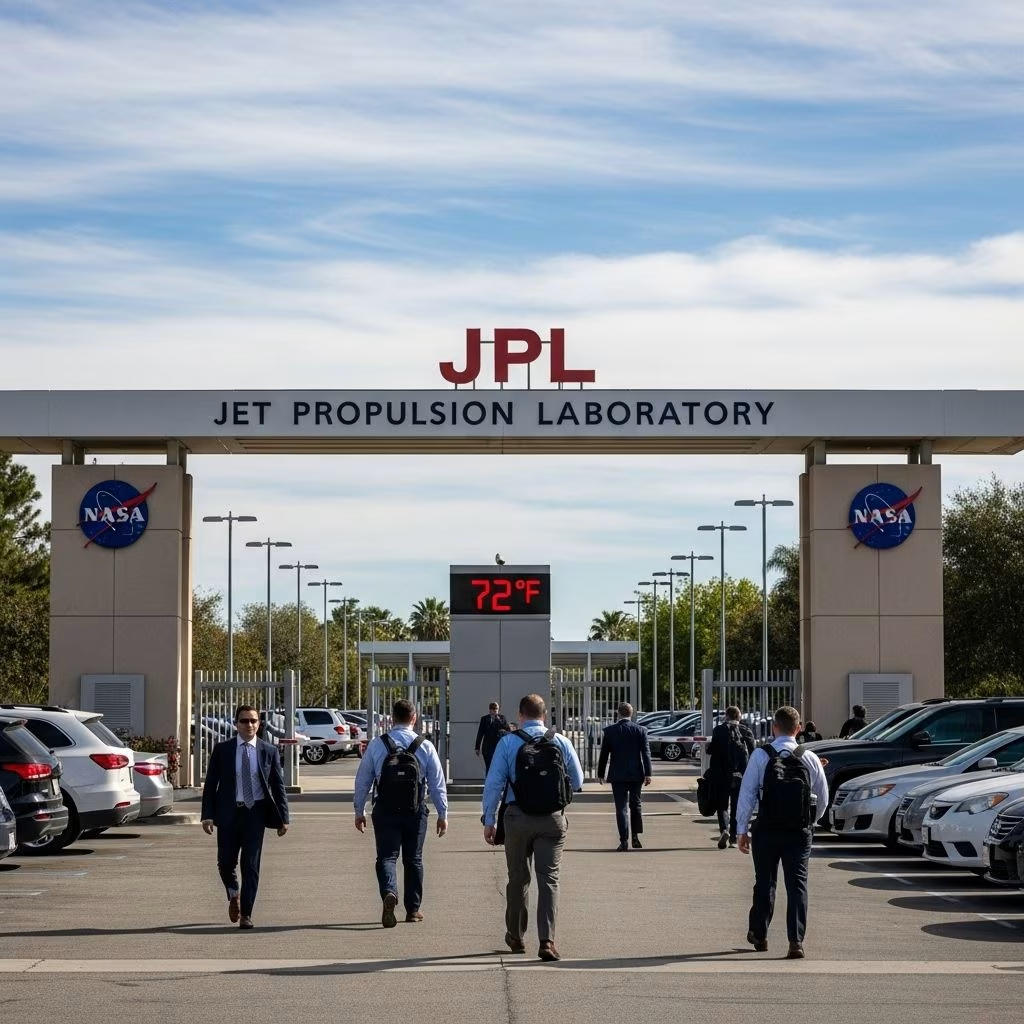
NASA’s JPL Ends Telework: Over 1,000 Employees Called Back to Office
In a significant shift for the agency, NASA’s Jet Propulsion Laboratory (JPL) has announced the termination of its longstanding telework policy. The move phases out remote work for more than 1,000 employees, mandating a full return to the Pasadena, California campus in 2025. This decision follows major budget cuts, a substantial wave of recent layoffs, and mounting uncertainty over the future of key space science missions.
Background: JPL’s Telework Era and the Pandemic Response
The COVID-19 pandemic prompted a dramatic rethinking of workplace operations across sectors. NASA’s JPL was no exception. Since 2020, thousands of engineers, scientists, and support staff conducted mission-critical work from remote locations. The hybrid and telework models, once adopted as a necessity, became a fixture of lab life, fostering both operational continuity and newfound flexibility for staff.
- Hybrid operations supported planetary missions and deep space communications remotely.
- Remote protocols enabled broad workforce participation—even for those outside California.
- Work-from-home policies, backed by advances in secure communications and remote collaboration tools, ensured that projects like Mars rover operations, satellite missions, and planetary defense could continue with minimal interruption.
JPL’s Announcement: End of Telework Policy
On May 22, 2025, an internal email notified JPL personnel that the telework policy would be phased out. The policy will affect California-based employees first, with a return date of August 25, while remote workers in other states must return by October 27. The communication stated unequivocally: “Employees who do not return by their required date will be considered to have resigned.”
- The onsite work mandate seeks to bring more than 1,000 employees—currently working remotely—back to the main campus and NASA locations.
- JPL’s workforce is over 5,500 strong, and this move signals a definitive end to the telework arrangements that have prevailed since 2020.
Key Dates
- August 25, 2025: California-based remote employees required to return
- October 27, 2025: Out-of-state teleworkers required to return
Budgetary Pressures and Nationwide Workforce Reductions
The decision to end telework comes amid deepening budget uncertainty for NASA. A proposed 25% budget cut under the Trump administration’s 2026 proposal has created ripples throughout the agency and especially at JPL, which leads many of NASA’s robotic planetary exploration missions.
- JPL is funded by NASA but managed by the California Institute of Technology (Caltech).
- The “skinny budget” proposal directly jeopardizes several ongoing and future JPL programs, with the Mars Sample Return mission cited as a principal casualty.
- Budget cuts have already resulted in two rounds of layoffs in the past year, amounting to over 12% of the JPL workforce—approximately 855 jobs lost.
Link Between Budget Cuts and Telework Termination
- While JPL management has not officially linked the return-to-office requirement with budget reductions, the timing and operational focus suggest strategic realignment to manage with fewer resources.
- Some observers note that eliminating telework may be a way to quietly reduce headcount further, especially among remote employees who may not return or cannot relocate.
Employee Concerns: Impact on Morale and Workforce Stability
The abrupt end to telework has sparked widespread concern among JPL staff, especially after a challenging year with layoffs and restructuring. Many employees perceive the move as a form of “silent layoff” for remote workers, noting the lack of severance requirements for employees who opt not to return.
- Forced relocations raise challenges for employees who moved away from California or made major life changes during remote operations.
- Commuting difficulties and local disruptions—like those caused by the recent Palisades Fire—compound logistical challenges for workers returning to the Pasadena campus.
- JPL’s memo mentioned exemptions may be possible “in extremely rare circumstances,” but the bar for approval remains high.
Official Rationale and Leadership Perspective
According to JPL management, the return-to-office policy is a proactive step to maintain mission readiness and strengthen lab culture. Outgoing Director Laurie Leshin, along with incoming Director Dave Gallagher, co-signed the return-to-work directive, framing the shift as internally driven rather than mandated by NASA headquarters.
- Leadership transition coincides with the policy: Laurie Leshin steps down June 1, succeeded by Dave Gallagher.
- Officials reiterated that the plan is essential for “operational discipline” and ensuring on-site resources are fully leveraged after years of remote or hybrid modes.
- Senior leaders claim campus infrastructure can accommodate the anticipated influx of returning employees, including workspace and parking availability, though some staff remain skeptical.
The Mars Sample Return Mission and the Broader NASA Landscape
Budget-driven changes at JPL are closely tied to the fate of the Mars Sample Return (MSR) mission. This flagship program, which aimed to retrieve samples collected by the Perseverance rover on Mars, has been.
- Restructured and subsequently cancelled under the 2026 budget proposal.
- The reduction or loss of MSR funding precipitated significant staff reductions and drew attention to the vulnerability of ambitious, multi-year space science projects.
NASA’s planetary defense, solar system exploration missions, and research on astrobiology and climate are all affected by uncertain funding streams, with JPL bearing a large share of responsibility for these efforts.
Concerns About the Return-to-Office Transition
Staff and observers have voiced anxieties about:
- The adequacy of workplace accommodations as hundreds of employees converge on buildings that have not operated at full capacity in years.
- Parking, workspace, and general logistical readiness for the full complement of staff.
- The risk that talent may be lost if valued employees, unable or unwilling to return on-site, choose to resign rather than relocate or endure new commutes.
- The overall morale effect following layoffs, cost-cutting initiatives, and program uncertainty.
Implications for Local Economy and Scientific Output
The end of remote work at JPL is further expected to have ripple effects:
- Pasadena’s local economy must adjust to a sudden influx of office commuters and their attendant demand for housing, transportation, and services.
- On-campus collaboration may accelerate, but at the possible expense of employee retention—especially for highly qualified scientists and engineers with competing offers from other sectors that still support remote work.
- NASA’s unique portfolio of robotic missions—many of them headquartered or managed at JPL—continues to face strategic uncertainty for the coming decade as federal budget priorities shift.
Reactions from the Scientific Community and NASA Stakeholders
JPL employees, independent scientists, and national space policy experts have reacted variously to the mandate:
- Some argue that on-site collaboration is essential for creative problem-solving in highly integrated technical teams, especially as missions grow in scope and complexity.
- Others contend that the end of telework is a step backward, curbing flexibility and inclusivity, and risking the flight of specialized talent to private space sector roles or other research institutions with more progressive workplace models.
- Leadership acknowledges these concerns but maintains the changes are necessary for operational and institutional coherence during turbulent times.
Accommodations and Exemptions
The internal JPL memo does offer a potential, though limited, path for exemptions:
- “Time-limited exemptions” may be granted, subject to review and approval by senior management.
- Criteria for approval are strict and intended to be rarely granted, focusing on cases with compelling personal or professional justification.
- This leaves little recourse for the majority of remote workers who moved or reorganized their lives around the availability of remote work.
Frequently Asked Questions (FAQs)
Q: Why is JPL ending its telework policy?
A: JPL cites operational needs and internal management decisions, but the timing makes clear the influence of budget cuts, restructuring, and the need to optimize on-site collaboration after layoffs and project cancellations.
Q: Who will be affected by the policy change, and when?
A: Over 1,000 employees working remotely must return to the Pasadena lab or other on-site locations. California-based staff must return by August 25, 2025. Out-of-state remote employees have until October 27, 2025.
Q: Will there be exceptions or accommodations for special situations?
A: Time-limited exemptions may be requested in “extremely rare” cases with a strong justification, but these require approval from senior leadership and are expected to be granted infrequently.
Q: How does this decision relate to recent layoffs at JPL?
A: The return-to-office mandate follows significant job reductions at JPL. Although not formally connected, many employees view the end of telework as an additional way to manage staffing levels in the face of shrinking budgets.
Q: What is the status of the Mars Sample Return mission amid these changes?
A: The Mars Sample Return mission has been cancelled under the current federal budget proposal, which has contributed to layoffs and overall operational restructuring at JPL.
Summary Table: Telework Policy Changes and Impacts
| Aspect | Previous Policy | New Policy (2025) |
|---|---|---|
| Work Location | Remote/hybrid allowed (pandemic response) | Mandatory on-site presence |
| Timeline | Since 2020 | By August 25 (CA)/October 27 (out-of-state) 2025 |
| Staff Affected | Over 1,000 remote employees | All returning on-site |
| Budget Context | Relatively stable post-pandemic | Facing up to 25% cut (FY2026 proposal) |
| Major Mission Impacted | Mars Sample Return ongoing | Mars Sample Return cancelled |
Looking Ahead: The Future of Work at NASA-JPL
As JPL moves forward with a fully on-site operational model, the transition serves as a microcosm of broader challenges facing the U.S. space sector. Adapting to changing federal priorities, managing workforce resilience, and balancing organizational tradition with changing expectations about where and how scientific work is conducted remain urgent tasks.
NASA and JPL’s adaptations over the next year will be closely watched not only for their immediate workforce implications, but also for what they signal about the future of American space science and engineering in a rapidly evolving, resource-constrained environment.
References
- https://www.space.com/space-exploration/nasas-jet-propulsion-lab-ending-telework-policy-for-over-1-000-employees
- https://www.jpl.nasa.gov/news/jpl-to-transition-to-fully-onsite-work/
- https://www.jpl.nasa.gov/stateofthelab/
- https://opentools.ai/news/nasas-jet-propulsion-lab-calls-employees-back-to-the-office-amid-budget-concerns
- https://orbitaltoday.com/2025/05/26/nasas-jet-propulsion-lab-ends-telework-forcing-over-5500-employees-back-on-site/
- https://opentools.ai/news/nasas-jpl-ends-remote-work-era-return-to-office-by-2025
- https://www.skyatnightmagazine.com/news/nasa-ends-remote-working-what-means-space-science
- https://www.ndtv.com/world-news/amid-trumps-funding-cuts-nasa-shelves-wfh-policy-for-workers-at-jet-propulsion-lab-8488994
- https://nodesk.co/articles/nasas-jet-propulsion-lab-ending-remote-work-policy/
- https://nasawatch.com/personnel-news/jpl-wants-everyone-to-return-to-their-offices/
- https://www.skyatnightmagazine.com/news/nasa-jpl-return-to-office
- https://pasadenanow.com/main/nasa-orders-jpl-to-telework-only-status
- https://oversight.house.gov/wp-content/uploads/2023/09/House-Oversight-Telework_NASA.pdf
- https://spaceflightnow.com/2020/03/17/nasa-institutes-mandatory-agency-wide-telework-policy/
- https://www.youtube.com/watch?v=wBqi5sc_L0Y
- https://t3n.de/news/nur-raumsonden-duerfen-noch-remote-arbeiten-nasa-forschungszentrum-jpl-ruft-angestellte-zurueck-ins-buero-1689308/
- https://www.youtube.com/watch?v=GCIffnHA4_E
- https://www.federaltimes.com/federal-oversight/congress/2023/09/14/lawmakers-question-nasa-other-agency-leaders-over-telework-policies/


