


Neil Armstrong’s Iconic Moon Landing Quote: The Story Behind the Words
On July 20, 1969, the world listened in awe as Neil Armstrong became the first human to set foot on the lunar surface. As he stepped onto the moon, his words—broadcast to millions worldwide—immediately entered the collective memory: “That’s one small step for man, one giant leap for mankind.” But what Armstrong actually said in that historic moment has since sparked debate, fueled analysis, and become an enduring mystery of the Apollo program.
The Moment: July 20, 1969
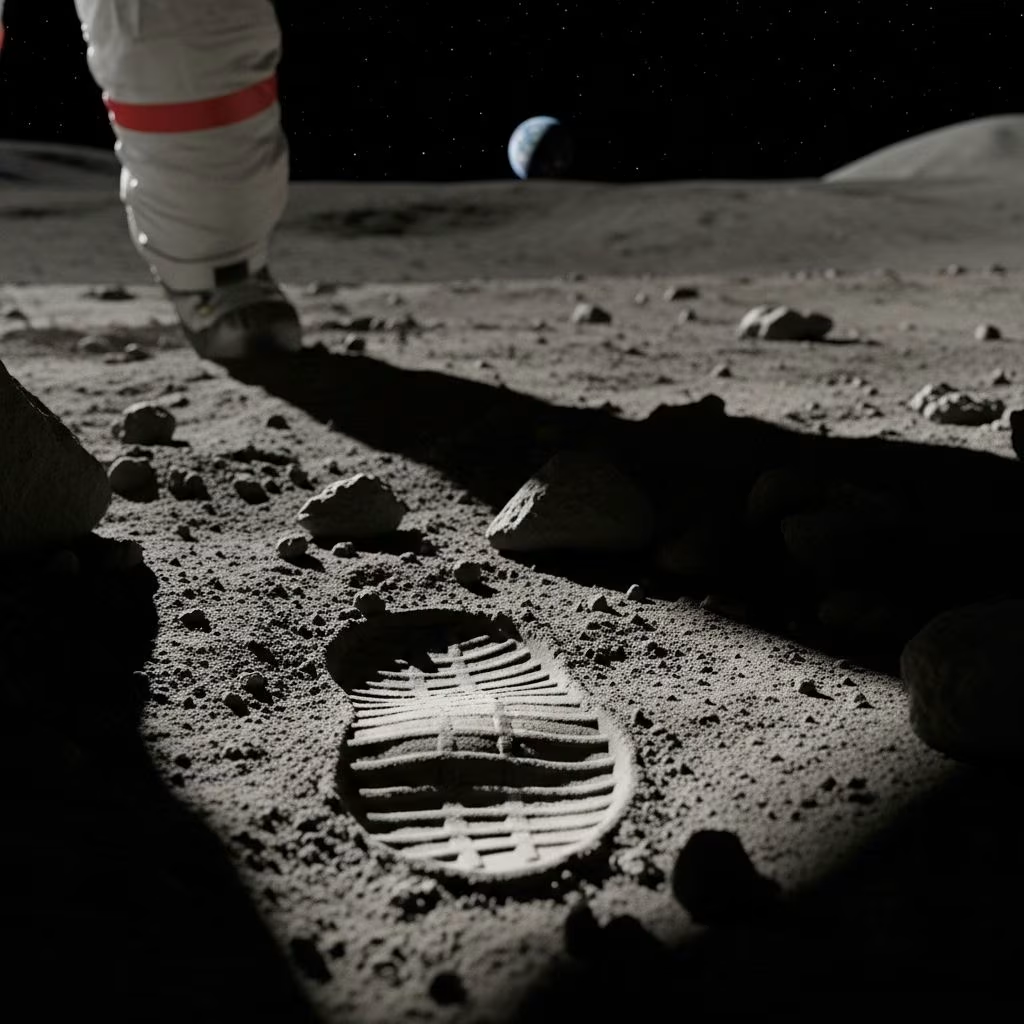
As the Apollo 11 lunar module Eagle touched down in the Sea of Tranquility, history paused. Armstrong carefully descended the ladder, describing the surface as “fine and powdery.” With the world watching, he planted his left foot onto the dusty lunar soil and delivered one of humanity’s most famous lines.
- Over 600 million television viewers and radio listeners witnessed the landing live.
- The phrase instantly symbolized the immense human achievement.
- Buzz Aldrin soon joined Armstrong, and together they conducted experiments, raised the US flag, and explored the lunar surface.
The Quote as Heard on Earth
The words recorded by NASA, reported by the press, and immortalized in textbooks and documentaries were:
“That’s one small step for man, one giant leap for mankind.”
This phrase instantly resonated with people, reflecting both the literal step taken and the metaphorical leap for all humanity. But from the very moment he returned to Earth, Armstrong maintained that a small but crucial word had been missed.
What Did Armstrong Actually Say?
After the mission, Armstrong clarified that he had intended—and believed he had uttered—a slightly different phrase:
“That’s one small step for a man, one giant leap for mankind.”
Armstrong explained, “It’s just that people just didn’t hear [the ‘a’],” and said he had always intended to include the indefinite article to make a clear distinction between a single individual and all of humanity.
Why the ‘A’ Matters: Grammar and Meaning
- Without “a,” the phrase equates “man” and “mankind,” making the passage almost tautological.
- With the “a,” “one small step for a man” refers to Armstrong as an individual, contrasted against “a giant leap for mankind,” referencing all of humanity.
This subtle difference dramatically changes the meaning and poetic resonance of the quote, leading to decades of debate over what Armstrong actually said.
Listening Back: The Search for the Missing ‘A’
The question of what Armstrong truly said on the moon led to extensive audio studies and linguistic analyses.
- In private and press interviews, Armstrong insisted the “a” was spoken, but he admitted he could not hear it on official recordings.
- At the 30th anniversary of the moon landing in 1999, he remarked, “I thought I said it. I can’t hear it when I listen on the radio reception here on Earth, so I’ll be happy if you just put it in parentheses.”
Technical Explanations
Experts and NASA staff have suggested several plausible reasons for the missing word:
- The “a” may have been obscured due to static, radio transmission quality, or Armstrong’s Midwestern accent.
- Caretaker audio equipment of the time may have lacked the fidelity to capture subtle sounds amid lunar static.
- The cadence of Armstrong’s speech may have compressed the words, making the short vowel less perceptible to listeners.
The 2006 Computer Analysis: Evidence for the ‘A’
For decades, the debate over Armstrong’s intended message remained unresolved, until a remarkable development in 2006.
- Peter Shann Ford, an Australian computer programmer, conducted a detailed analysis of the audio signal from NASA’s recordings.
- Ford used sound analysis software to study Armstrong’s speech waveform, searching specifically for any trace of the elusive “a.”
- He discovered a brief sound gap—roughly 35 milliseconds—between “for” and “man,” consistent with Armstrong speaking “a,” even though it was nearly inaudible to the human ear.
- Ford’s findings provided scientific support for Armstrong’s account, although some linguists remain cautious about interpreting such fleeting signals as definitive proof.
NASA’s Position
- NASA has consistently supported Armstrong’s intentions, placing greater stock in the astronaut’s memory and his stated aim to distinguish individual action from humanity’s collective progress.
- An official NASA memo recorded that astronauts should express their feelings in their own words, with little or no coaching, so the emotion is genuine.
The Origin of the Phrase: Was It Scripted or Spontaneous?
Questions have also arisen regarding whether Armstrong’s words were pre-scripted or the result of spontaneous inspiration. The official record and Armstrong’s own reflections provide some clarity:
- Armstrong affirmed he composed the line himself, sometime after Apollo 11’s landing but before setting foot on the moon.
- He said, “I thought about it after landing … but just something that was kind of passing around subliminally or in the background.”
- NASA discouraged astronauts from relying on pre-approved statements, instead favoring authentic emotional responses capturing the reality of their experiences.
Armstrong’s memorable line, therefore, was personal—simple, understated, yet solemn—reflecting his personality and the broader ethos of the mission.
The Enduring Legacy of ‘One Small Step’
More than five decades after Apollo 11, Armstrong’s words continue to reverberate across generations, inspiring countless scientists, students, and dreamers. The quote’s impact includes:
- Symbolizing the extraordinary achievements possible through collective effort and perseverance.
- Serving as a touchstone for subsequent explorations, both human and robotic, across the solar system.
- Permeating pop culture, referenced in music, literature, cinema, and political discourse.
- Reminding humanity of how far it has come, and hinting at what lies ahead in the stars.
Popular References in Media and Culture
- The phrase appears in countless science documentaries, space exhibits, and national memorials.
- Artists and writers have adapted and parodied the quote to symbolize breakthroughs in science, technology, and society at large.
- It remains one of the most instantly recognizable utterances in the English language.
Debates and Perspectives: Did the Controversy Matter?
| Interpretation | Key Arguments | Main Stakeholders |
|---|---|---|
| Grammatical precision matters | Including the “a” clarifies the difference between the individual (Armstrong) and the collective (mankind). | Linguists, historians, grammarians |
| Intended meaning & spirit matters more | The inspirational sentiment remains, regardless of the minor audio ambiguity. | General public, NASA, Armstrong |
| Technical limitations excuse any omission | Moon-Earth radio lag, static, and 1960s audio tech make near-perfect accuracy nearly impossible. | Audio engineers, NASA |
| Legacy is unaffected | The words’ historical impact and poetic resonance are preserved either way. | Educators, students, media |
Quotes from Armstrong and Others
- Neil Armstrong (on the missing “a”): “The ‘a’ was intended. I thought I said it. I can’t hear it when I listen on the radio reception here on Earth, so I’ll be happy if you just put it in parentheses.”
- NASA documentation: “The truest emotion … is what the explorer feels within himself.”
- 2006 analysis by Peter Shann Ford: Suggested that the ‘a’ likely was spoken but ran together due to Armstrong’s accent and transmission quality.
FAQ: Neil Armstrong’s ‘One Small Step’ Quote
Did Neil Armstrong say ‘a man’ or just ‘man’?
Armstrong always insisted he said “one small step for a man,” but the “a” is not clearly audible in the recording. Analyses have found evidence that he likely did say it, though the debate continues.
Why does the missing ‘a’ matter in his quote?
With “a man,” Armstrong refers to himself as an individual, contrasting that step with the leap for all mankind. Without it, the statement is more ambiguous and less poetically precise.
Was the famous line pre-scripted by NASA?
No, Armstrong composed the phrase himself and NASA discouraged pre-scripted remarks. The words were personal, reflecting his experience and thoughts.
Has technology proven what Armstrong said?
Advanced audio analysis has found a faint sound consistent with “a,” supporting Armstrong’s claim, but some experts argue the evidence is still inconclusive due to technological limits.
How has Armstrong’s quote influenced space history?
The phrase is now an immortal symbol of human progress, inspiring science, education, and exploration worldwide.
‘One Small Step’ in Popular Culture
- Regularly cited in movies, novels, music, and public speeches as a symbol of monumental achievement.
- NASA missions and private space enterprises often invoke the phrase to emphasize their own milestones.
- Used in classrooms and museums to teach about Apollo, language, and the power of human ambition.
The Human Side of a Historical Moment
Perhaps the most poignant aspect of Armstrong’s words is their humility and universality. Rather than boast or wax poetic, the statement captures the modesty, curiosity, and awe that define the spirit of exploration. Armstrong’s own reaction to the controversy—good-natured acceptance—reflects his character and the values underpinning Apollo 11.
- The lasting debate over one missing word is a reminder that history is both a product of human memory and technological limits.
- Yet the sentiment behind “one small step” remains undiminished by uncertainty, continuing to inspire those who listen anew.
Key Takeaways
- Neil Armstrong’s first words on the moon remain among history’s most famous quotes, emblematic of the Apollo era and human achievement.
- The presence or absence of the word “a” in his statement remains debated, hinging on audio analysis and Armstrong’s own recollections.
- The broader message, celebrating both the individual and society’s collective leap forward, continues to resonate globally.
- The episode serves as a case study in how language, technology, and myth-making intertwine at pivotal moments in history.
Further Reading
- NASA Oral Histories — Detailed interviews with astronauts, including Armstrong’s reflections.
- Peter Shann Ford’s Audio Analysis — Technical papers and press coverage of the 2006 audio findings.
- Apollo 11 Mission Transcripts — Official NASA records of the moon landing broadcast.
References
- https://www.navytimes.com/news/your-navy/2019/07/13/armstrongs-famous-one-small-step-quote-explained/
- https://time.com/5621999/neil-armstrong-quote/
- https://www.youtube.com/watch?v=J6jplPkbe8g
- https://www.space.com/17307-neil-armstrong-one-small-step-quote.html
- https://airandspace.si.edu/stories/editorial/one-small-step-man-or-man
- https://library.nashville.org/blog/2021/06/one-small-step-man-one-giant-leap-mankind-neil-armstrong
- https://whyy.org/articles/armstrongs-famous-one-small-step-quote-explained/
- https://www.purdue.edu/uns/html4ever/1999/9903.Armstrong.apollo.html
- https://en.wikipedia.org/wiki/One_small_step
- https://universe.byu.edu/2019/07/15/armstrongs-famous-one-small-step-quote-explained-1/
- https://www.nasa.gov/history/55-years-ago-apollo-11s-one-small-step-one-giant-leap/
- https://www.youtube.com/watch?v=cwZb2mqId0A
- https://en.wikipedia.org/wiki/One_Small_Step
- https://www.skyatnightmagazine.com/space-missions/one-small-step-for-man
- https://news.uoregon.edu/content/what-were-neil-armstrongs-famous-first-words-moon
- https://www.science.org/content/article/linguists-question-armstrong-s-famous-moon-landing-quote
- https://www.indiatoday.in/science/story/neil-armstrong-s-famous-one-small-step-quote-explained-1568574-2019-07-14


