Neil Armstrong: The First Human to Walk on the Moon
Neil Armstrong stands etched in the chronicles of history as the first person to set foot on the Moon. As commander of NASA’s Apollo 11 mission, his measured steps on July 20, 1969, accomplished one of humanity’s greatest feats: turning the dream of lunar exploration into triumphant reality.
Contents
- Early Life and Early Aviation Career
- Path to Space: Becoming an Astronaut
- The Apollo 11 Mission
- One Small Step: Humanity’s First Lunar Walk
- After Apollo: Armstrong’s Later Career
- Influence and Legacy
- Frequently Asked Questions (FAQs)
Early Life and Early Aviation Career
Neil Alden Armstrong was born on August 5, 1930, in Wapakoneta, Ohio. From a young age, Armstrong displayed a keen fascination with flight and engineering. By 16, he had already earned his pilot’s license, and shortly after, he began studying aeronautical engineering at Purdue University. However, the outbreak of the Korean War reshaped his path, leading him to serve as a naval aviator from 1949 to 1952, where he flew 78 combat missions.
- Raised in a family that valued education and discipline.
- Developed a profound interest in aircraft, engineering, and science.
- Pilot’s license earned before his driver’s license, demonstrating early dedication to aviation.
Following his military service, Armstrong returned to Purdue, completed his degree, and pursued a career as a test pilot with the National Advisory Committee for Aeronautics (NACA), which would eventually become NASA. He participated in advanced research programs, including high-speed test flights of experimental aircraft such as the X-15, pushing the boundaries of altitude and speed.
Path to Space: Becoming an Astronaut
Armstrong’s notable performance as a test pilot brought him into the spotlight during the dawn of the space race. In 1962, he was selected as part of NASA’s second group of astronauts, famously known as the ‘New Nine’.
- Served as backup command pilot for Gemini 5.
- Piloted Gemini 8 in March 1966, performing the first successful docking of two spacecraft in orbit, despite experiencing critical technical issues requiring quick thinking and calm resolve.
Armstrong’s blend of engineering prowess, aviation skill, and composure during high-stress situations earned him the coveted role of mission commander for Apollo 11—the first lunar landing mission backed by a commitment from President John F. Kennedy to land a man on the Moon and return him safely to Earth.
The Apollo 11 Mission
The Apollo 11 mission symbolizes the pinnacle of 20th-century exploration, underpinned by years of rigorous planning and engineering innovation. The crew comprised:
- Neil Armstrong – Mission Commander
- Edwin “Buzz” Aldrin – Lunar Module Pilot
- Michael Collins – Command Module Pilot
The crew blasted off atop the immense Saturn V rocket from Kennedy Space Center, Florida, on July 16, 1969. The spacecraft consisted of three modules:
- Command Module (Columbia): Housed the crew for most of the mission and reentry.
- Service Module: Provided life support, fuel, and power.
- Lunar Module (Eagle): Designed to land two astronauts on the Moon and bring them back to lunar orbit.
| Component | Function |
|---|---|
| Command Module (Columbia) | Main crew cabin and reentry vehicle |
| Service Module | Supplies power, propulsion, and life-support |
| Lunar Module (Eagle) | Lands on and launches from the Moon |
Tens of thousands of NASA engineers, scientists, and contractors contributed to the mission’s success. The journey from launch pad to lunar orbit took roughly three days. Once in orbit, Armstrong and Aldrin transferred to the Eagle for the historic descent.
One Small Step: Humanity’s First Lunar Walk
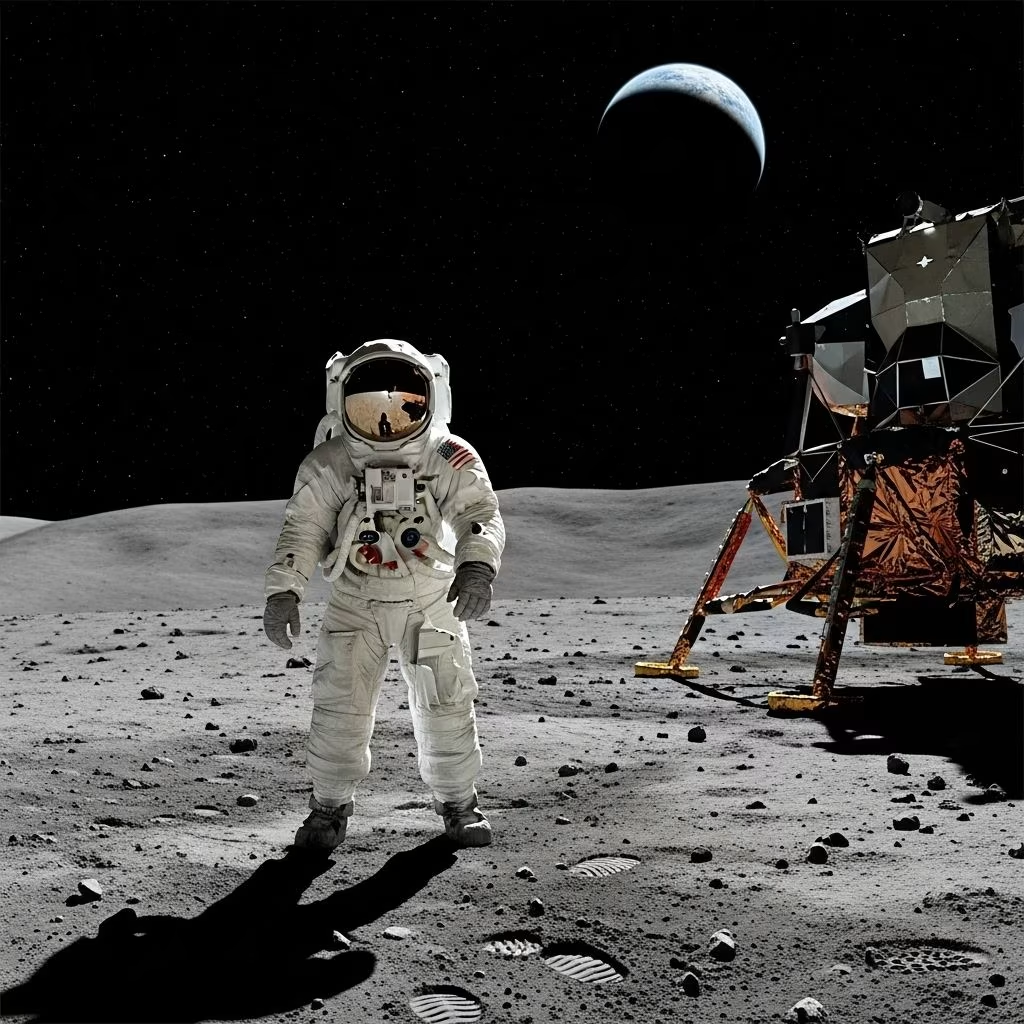
On July 20, 1969, at 20:17 UTC, the Eagle touched down in the Sea of Tranquility. Armstrong’s calm proficiency was on full display as he manually piloted the lander around hazardous boulders and craters to a safe landing site. With millions watching live, Armstrong descended the ladder and famously declared:
“That’s one small step for man, one giant leap for mankind.”
- After Armstrong, Buzz Aldrin descended to join him on the surface.
- The pair spent about 2.5 hours outside the spacecraft, collecting 21.5 kg (47.5 lbs) of lunar material, conducting experiments, and taking photographs.
- Michael Collins orbited overhead in Columbia, maintaining vital communication and support.
- The lunar surface EVA lasted approximately 21 hours and 36 minutes.
- On rejoining Collins in lunar orbit, the crew prepared for their journey home—splashed down safely in the Pacific Ocean on July 24, 1969.
The successful return completed the greatest milestone of the Apollo program, fulfilling Kennedy’s vision and opening a new chapter in humanity’s exploration of the cosmos.
After Apollo: Armstrong’s Later Career
Post-Apollo, Armstrong shied away from further public astronaut roles, choosing instead to apply his knowledge and experience to education, industry, and public service. He became a professor of aerospace engineering at the University of Cincinnati, teaching and inspiring a new generation of students for nearly a decade. In addition, Armstrong served on a number of important commissions and corporate boards, including:
- Deputy Chairman of the Presidential Advisory Committee for the Peace Corps.
- Participant in investigations of notable aerospace disasters, lending credibility and insight.
- Board member and adviser to several companies advancing aviation and technology.
He maintained lifelong advocacy for aerospace research, lending quiet but unwavering support to NASA’s subsequent missions.
Influence and Legacy
Neil Armstrong’s influence is profound and enduring—his name is synonymous with exploration and perseverance. He never sought celebrity, instead championing science, teamwork, and humility. Armstrong’s achievement inspired not just a nation, but the entire world, illuminating what humans can accomplish through ambition, discipline, and collaboration.
- In 2014, NASA renamed its Dryden Flight Research Center to Armstrong Flight Research Center in his honor.
- Countless schools, scholarships, memorials, and scientific honors bear his name.
- Armstrong’s approach emphasized that every individual’s contribution—from engineers and technicians to mission planners—was essential to success.
Armstrong passed away on August 25, 2012, but his legacy lives on, inspiring new generations to dream, explore, and discover.
Frequently Asked Questions (FAQs)
Q: What did Neil Armstrong do before he became an astronaut?
A: Armstrong served as a naval aviator in the Korean War, flew as a test pilot for NACA and NASA, and participated in advanced experimental aircraft programs such as the X-15.
Q: What was the significance of the Apollo 11 mission?
A: Apollo 11 was the first mission to land humans on the Moon. Armstrong’s first step marked a pivotal moment in human history and fulfilled President Kennedy’s goal of “landing a man on the Moon and returning him safely to Earth.”
Q: Who were the other astronauts on Apollo 11?
A: Armstrong’s crewmates were Buzz Aldrin (who joined him on the Moon) and Michael Collins (who piloted the Command Module in lunar orbit).
Q: Did Neil Armstrong leave anything on the Moon?
A: Yes, Armstrong and the Apollo 11 crew left behind scientific equipment such as seismometers, a plaque commemorating the landing, an American flag, and other mementos.
Q: What did Armstrong do after Apollo 11?
A: Armstrong became a university professor, served on national commissions and corporate boards, and advocated for science and engineering education.
Notable Timeline of Armstrong’s Career
- 1930: Born in Wapakoneta, Ohio
- 1949-1952: Served as naval aviator during the Korean War
- 1955: Joined the NACA Lewis Flight Propulsion Laboratory
- 1962: Selected as NASA astronaut
- 1966: Command pilot for Gemini 8 (first docking in space)
- 1969: Commander of Apollo 11; first man to walk on the Moon
- 1971: Left NASA to begin teaching career
- 2012: Died at the age of 82
References
- NASA Apollo 11 Mission Overview
- NASA Armstrong Biography
- Encyclopedia Britannica: Neil Armstrong
References
- https://en.wikipedia.org/wiki/Apollo_11
- https://www.nasa.gov/mission/apollo-11/
- https://www.space.com/6946-40-years-apollo-11-note-neil-armstrong.html
- https://www.youtube.com/watch?v=cwZb2mqId0A
- https://www.space.com/apollo-11-moon-landing-science-legacy.html
- https://www.nasa.gov/humans-in-space/astronauts/former-astronauts/former-astronaut-neil-a-armstrong/
- https://www.britannica.com/biography/Neil-Armstrong
- https://airandspace.si.edu/explore/stories/apollo-11-moon-landing
- https://en.wikipedia.org/wiki/Neil_Armstrong
- https://www.youtube.com/watch?v=rvmFeJu4maU
- https://study.com/academy/lesson/neil-armstrong-biography-facts-moon-landing.html
- https://www.natgeokids.com/uk/discover/science/space/neil-armstrong-facts/
- https://billofrightsinstitute.org/essays/neil-armstrong-and-the-moon-landing
- https://www.rmg.co.uk/stories/space-astronomy/how-many-people-have-walked-on-moon
- https://www.britannica.com/topic/Apollo-11
- https://memorycherish.com/neil-armstrong-moon-landing-astronaut-biography-space-exploration/