How Far Away Is Saturn? Understanding the Distance of the Ringed Planet
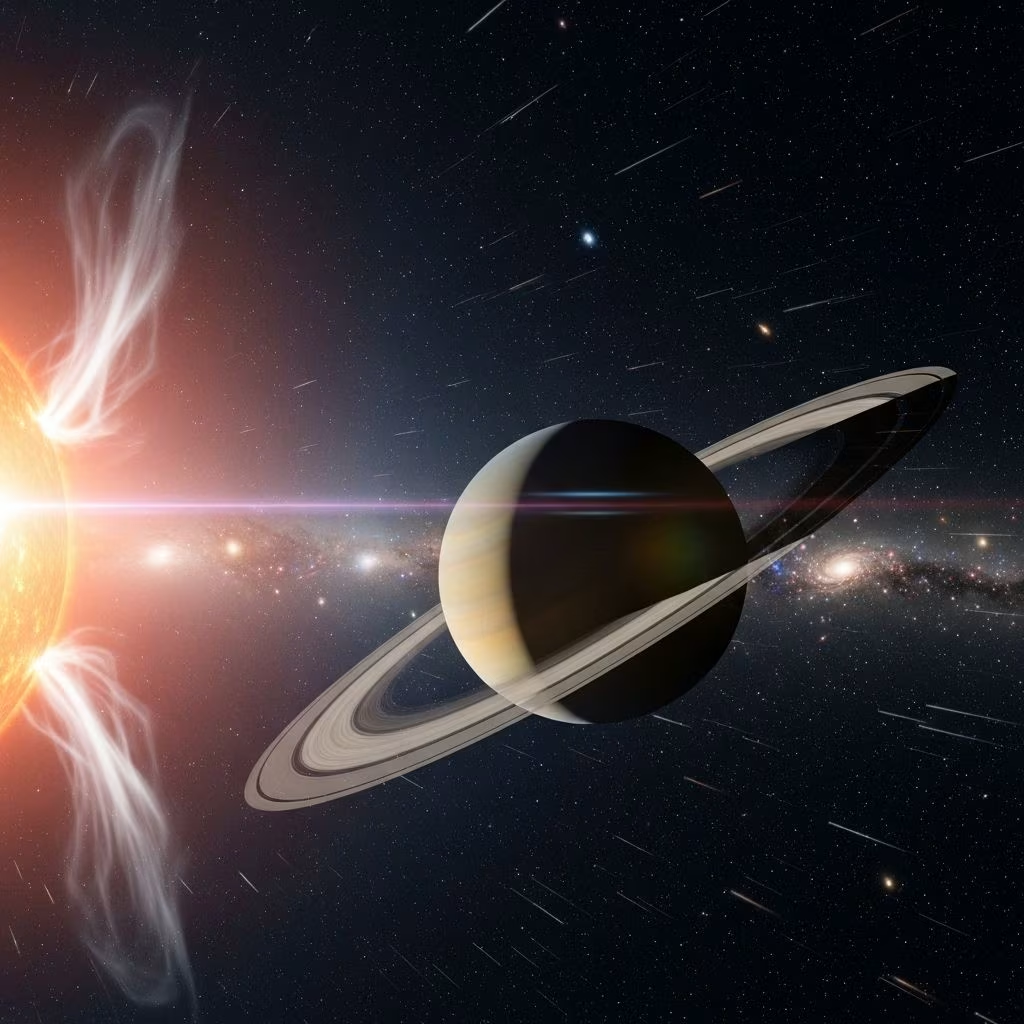
Saturn, the sixth planet from the Sun and one of the most striking objects in our solar system, captivates astronomers and skywatchers alike with its brilliant rings and immense size. But one of the most common questions about this gas giant remains: just how far away is Saturn? The answer — as with many things in astronomy — is not fixed, and depends on the ever-changing positions of Saturn, Earth, and the Sun throughout their orbits. In this article, we explore the dynamic nature of Saturn’s distance from Earth and the Sun, how these values are measured, what they mean for observers and space missions, and more.
Key Facts About Saturn
Before delving into Saturn’s shifting place in the sky, it helps to review some vital statistics about the planet:
- Position in Solar System: Sixth planet from the Sun
- Average Diameter: About 116,460 km (72,366 miles)
- Mass: 95 times that of Earth
- Orbital Period: 29.5 Earth years (one Saturn year)
- Notable Feature: Spectacular system of icy rings
But how far is this giant from us and our star, really? The answer begins with Saturn’s relationship to the Sun.
Saturn’s Distance from the Sun
Saturn is well known as the sixth planet from the Sun, but its exact distance is not a simple, static number. This is because Saturn, like every planet, orbits the Sun in a slightly elliptical (oval-shaped) path rather than a perfect circle. Here are the key data points:
| Statistic | Distance (km) | Distance (miles) | In Astronomical Units (AU) |
|---|---|---|---|
| Closest to Sun (Perihelion) | 1.35 billion | 839 million | ~9.05 AU |
| Farthest from Sun (Aphelion) | 1.50 billion | 934 million | ~10.04 AU |
| Average Distance | 1.43 billion | ~886–891 million | ~9.58 AU |
For reference, 1 Astronomical Unit (AU) is the average distance from the Earth to the Sun (~149.6 million km or 93 million miles).
Saturn’s orbit, due to its elliptical shape, means that the distance from the Sun varies by several hundred million kilometers or miles across its 29.5-year-long journey around our star.
How Far Is Saturn from Earth?
The next question, and the one most likely to capture people’s imaginations, is about Saturn’s varying distance from Earth. Because both planets orbit the Sun at different speeds and along different paths, their separation is constantly changing. Here’s a look at the numbers:
- Closest Approach (Opposition): About 1.2 billion km (746 million miles) [when Earth is directly between the Sun and Saturn]
- Farthest Separation (Conjunction): Up to 1.7 billion km (1 billion miles) [when Saturn is on the far side of the Sun from Earth]
- Average Distance: Typically cited as 1.4 billion km (886 million miles)
The variation is the result of the two planets’ elliptical orbits and the fact that Saturn’s orbit is tilted by about 2.4 degrees relative to Earth’s orbital plane.
Why Does Saturn’s Distance from Earth Change?
Saturn’s changing distance is driven by two main factors:
- Relative Orbit Speeds: Earth orbits the Sun much faster than Saturn. Our planet completes one trip around the Sun every year, while Saturn takes nearly 29.5 years to do so.
- Orbital Geometry: With Saturn’s path being larger and slightly tilted, the two planets sometimes line up (opposition) and sometimes are on opposite sides of the Sun (conjunction), affecting the distance between them.
As Earth passes “between” Saturn and the Sun on its yearly journey, we temporarily get much closer to Saturn — creating cycles in visibility and apparent size.
How Long Does It Take to Get to Saturn?
Given such massive distances, traveling to Saturn is a formidable challenge:
- At Light Speed: Light from Saturn takes between about 1 hour 7 minutes (at closest) to about 1 hour 30 minutes (at farthest) to reach Earth.
- By Spacecraft: Past missions have taken different routes and times:
- Pioneer 11: About 6.5 years (launched 1973, flyby 1979).
- Voyager 1: Roughly 3 years and 2 months (launched September 1977, flyby November 1980).
- Cassini: Nearly 7 years (launched 1997, arrived July 2004; route included planetary gravity assists).
The exact duration depends on mission design, chosen trajectory, and positions of planets at launch.
How Do Astronomers Measure Saturn’s Distance?
Modern astronomers rely on a combination of methods to accurately estimate planetary distances:
- Radar and Radio Waves: Signals are beamed to spacecraft or bounced off planets, and the return time is precisely measured.
- Direct Spacecraft Ranging: Missions equipped with precise clocks and navigation tools send back location and distance data.
- Orbital Calculations: By tracking the orbits of planets in three-dimensional space, astronomers can predict positions and distances with high accuracy.
- Stellar Parallax and Triangulation: Used for determining scale within the solar system, especially in historical astronomy.
These techniques enable distances to be tracked over time as both Saturn and Earth change position.
Saturn in Opposition and Conjunction: Brightness and Visibility
Every 378 days (about 54 weeks), Earth “laps” Saturn in its orbit. During this alignment, called opposition, Saturn is on the same side of the Sun as Earth and appears both closest and brightest in our night sky. Conversely, during conjunction, Saturn is as far as it can be from us, hidden behind the Sun.
- At Opposition: Saturn’s apparent brightness increases (visual magnitude can reach -0.5)
- At Conjunction: Saturn barely visible or not visible, appearing fainter than 1.1 magnitude
This cycle of oppositions and conjunctions changes how bright and large Saturn seems through telescopes or binoculars from Earth.
Can You See Saturn from Earth?
Despite the immense distances involved, Saturn is often visible to the naked eye from Earth — especially at or near opposition. However, to see the planet’s iconic rings, you’ll need at least powerful binoculars or a small telescope.
- Saturn appears as a bright, star-like object in the night sky.
- At periods of opposition, it is particularly easy to spot due to maximum brightness.
- Even modest backyard telescopes can reveal Saturn’s rings and some of its moons.
How Saturn’s Distance Compares to Other Planets
| Planet | Average Distance from Sun (million km) | Average Distance from Earth (million km) |
|---|---|---|
| Jupiter | 778 | 588 |
| Saturn | 1,427 | 1,200 |
| Uranus | 2,870 | 2,700 |
| Neptune | 4,500 | >4,300 |
Saturn is much farther from us than Jupiter but less distant than Uranus or Neptune, placing it among the outer planets known as the gas giants.
Frequently Asked Questions (FAQs)
Q: How many miles is Saturn from Earth right now?
A: Saturn’s current distance changes daily. On average, it is about 886 million miles (1.4 billion km) away, but this can vary from as close as 746 million miles (1.2 billion km) at opposition to nearly 1 billion miles (1.7 billion km) at conjunction.
Q: Why does Saturn’s distance from Earth change so much?
A: Both Saturn and Earth move around the Sun at different speeds and distances — Earth every 365 days, Saturn every 29.5 years. Their changing relative positions shift their separation throughout the year.
Q: Can I see Saturn’s rings with binoculars?
A: Standard binoculars may show Saturn as a bright, slightly elongated point, but generally a small telescope (25x magnification or higher) is needed to clearly resolve the rings.
Q: How long was the Cassini mission’s journey to Saturn?
A: Cassini took nearly seven years to travel from Earth to Saturn, using several flybys (past Venus, Earth, and Jupiter) to gain momentum along the way.
Q: How do scientists measure Saturn’s distance today?
A: They use techniques like radar ranging, radio tracking of spacecraft, and advanced orbital models, which provide high-precision data that is continually updated as Saturn’s position changes.
Further Reading & Observing
- Track Saturn’s current distance and visibility using real-time astronomy apps or observatory websites.
- For live telescope views, visit major observatories or online space platforms during Saturn’s opposition.
- Check star charts or planetarium software for Saturn’s current position in the night sky, as it changes from month to month.
Saturn’s immense distance from Earth — punctuated by cycles of closeness and remoteness — is a testament to the dynamic, ever-shifting nature of our solar system. Whether glimpsed as a tiny point through a telescope or studied by spacecraft, the ringed giant remains one of the most awe-inspiring, remote worlds within our cosmic reach.
References
- https://theskylive.com/how-far-is-saturn
- https://science.nasa.gov/saturn/facts/
- https://starlust.org/how-far-away-is-saturn-now/
- https://en.wikipedia.org/wiki/Saturn
- https://www.britannica.com/question/How-far-is-Saturn-from-Earth
- https://theskylive.com/saturn-info
- https://www.britannica.com/place/Saturn-planet
- https://www.youtube.com/watch?v=lzKBKSbAF50
- https://lovethenightsky.com/how-far-away-is-saturn/
- https://www.telescopenerd.com/celestial-objects/saturn-distance.htm
- https://nssdc.gsfc.nasa.gov/planetary/factsheet/saturnfact.html
- https://www.youtube.com/watch?v=W399_VADwYM
- https://www.universetoday.com/articles/how-far-is-saturn-from-earth
- https://www.vedantu.com/question-answer/how-far-is-saturn-from-earth-class-8-physics-cbse-5ffe6af54eb9ab112430c673
- http://scienceline.ucsb.edu/getkey.php?key=4233
- https://www.astrojunkies.com/how-far-is-saturn-from-earth/
- https://rochaksafar.com/how-far-is-saturn-from-earth-in-light-years/