Mercury’s Atmosphere: The Solar System’s Most Elusive Envelope
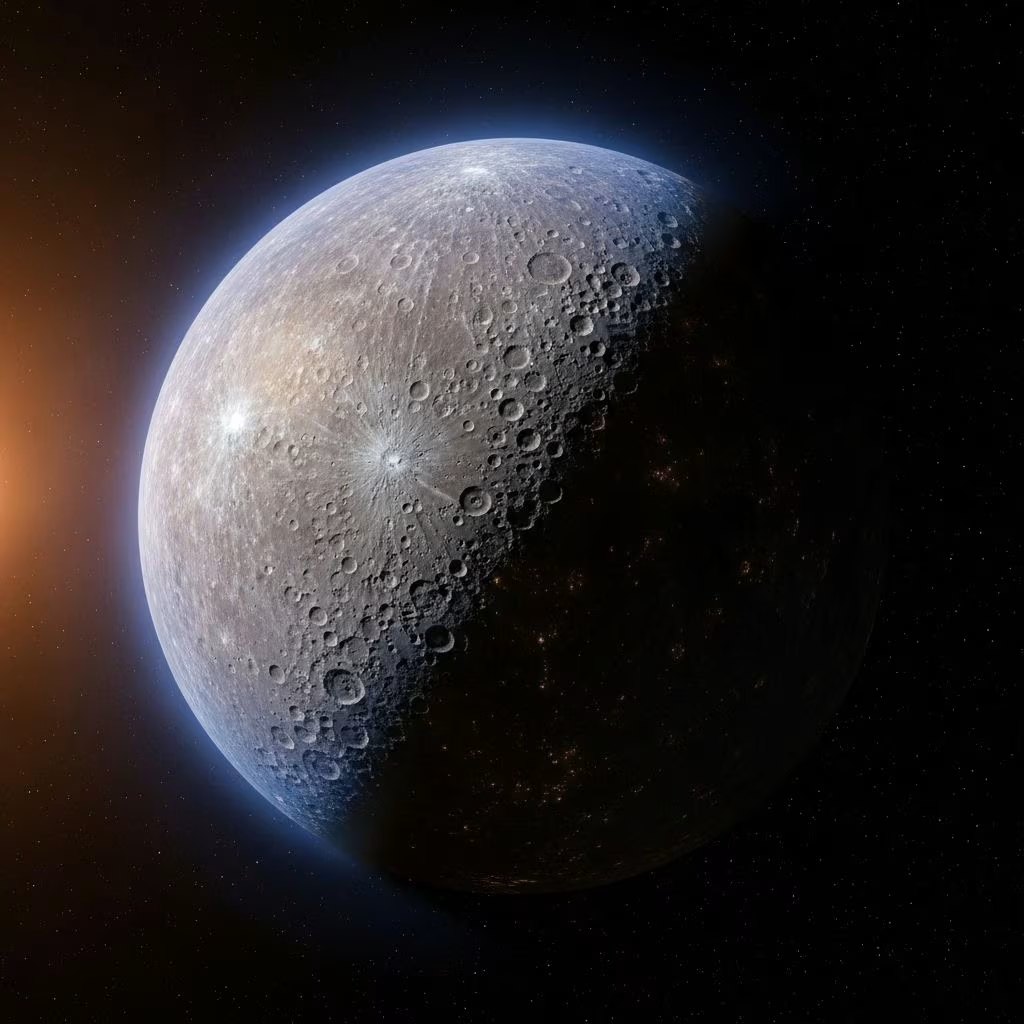
As the innermost planet of our solar system, Mercury faces extremes in temperature and exposure to the solar wind. These harsh conditions have shaped one of the most extraordinary environments found on any known world: an atmosphere so thin and fragile that it challenges the very definition of the term. This article delves into the mysteries of Mercury’s atmosphere — technically known as an exosphere — its composition, how it forms, and what it reveals about the planet’s past and future.
What Is an Exosphere?
The airless-seeming state of Mercury arises because its gaseous envelope is not a conventional atmosphere, but an exosphere. An exosphere is a region where gas molecules are so sparse that they rarely collide, instead flying in ballistic trajectories or escaping into space. This distinguishes Mercury’s exosphere from the thicker, more interactive atmospheres of planets like Earth or Venus[12].
Understanding Mercury’s Exosphere
Mercury’s exosphere is extremely tenuous. Its atmospheric pressure at the surface is less than one trillionth of Earth’s — so low that a single molecule might float above the planet for days without striking another. Unlike other planetary bodies, Mercury’s exosphere is in constant flux, replenished by a variety of dynamic sources.
Composition: What Is Mercury’s Exosphere Made Of?
The composition of Mercury’s exosphere is uniquely diverse for such a thin layer. Scientists have detected the presence of several elements and compounds:
- Oxygen (O2): The most abundant detected gas, making up a significant portion of the exosphere.
- Sodium (Na): Highly visible, responsible for an observable yellow glow around the planet during specific observations from Earth.
- Hydrogen (H2): A light and rapidly escaping component.
- Helium (He): Supplied by the solar wind and present in small quantities.
- Potassium (K): Found in trace amounts, influencing spectral signatures.
- Calcium (Ca) & Magnesium (Mg): Detected in even smaller traces, derived largely from the planetary surface or meteoritic impacts.
- Carbon dioxide (CO2): Traces potentially detected, though in extremely minor proportions.
| Gas | Approximate Percentage | Source / Notes |
|---|---|---|
| Oxygen (O2) | ~42% | From surface rocks & solar wind; quickly lost to space |
| Sodium (Na) | ~29% | Released by solar photon impact on surface & meteoroid strikes |
| Hydrogen (H2) | ~22% | Primarily from solar wind and surface Processes |
| Helium (He) | ~6% | Delivered by solar wind |
| Potassium (K) | ~1% | Trace; ejected by impacts and solar irradiation |
| Calcium (Ca) | trace | Surface vaporization & cosmic impacts |
| Magnesium (Mg) | trace | Surface vaporization & meteoroid bombardment |
| Carbon dioxide (CO2) | trace | Possible minor component |
How Is Mercury’s Exosphere Created?
Because Mercury’s gravity is low and it has no extensive magnetic field, the planet cannot trap gases for long. Its exosphere is not a remnant of a primordial atmosphere but is constantly replenished through various processes:
- Solar Wind Sputtering: The Sun’s continuous outflow of charged particles (solar wind) bombards Mercury’s surface, kicking off atoms and molecules into the exosphere.
- Photon-Stimulated Desorption: High-energy solar photons strike the surface, freeing atoms such as sodium and potassium directly into the exosphere.
- Meteorite Impacts: Frequent cosmic dust and meteoroid bombardment vaporizes surface material, injecting additional elements and compounds.
- Thermal Desorption: Mercury’s daytime surface reaches up to 430°C (800°F), and some volatiles can be released simply by heating.
- Outgassing: Minor amounts of gases may seep out from beneath the surface as a relic of Mercury’s formation.
Loss Processes: Why Doesn’t Mercury Have a Thick Atmosphere?
Mercury’s tiny mass (about 5.5% of Earth’s) means it cannot hold onto light gases for long. Key loss mechanisms include:
- Thermal Escape: Atoms achieve escape velocity and are lost to space, especially on the hot daylight side.
- Sweeping by Solar Wind: The solar wind strips away loose atoms that reach higher altitudes.
- Photoionization: Intense sunlight ionizes particles, helping the solar wind carry them off Mercury.
Observing Mercury’s Exosphere
Observing the exosphere directly is a major scientific challenge due to its incredible thinness. Mercury is best seen from Earth shortly after sunset or before sunrise, hugging close to the horizon. High-powered spectrographs and ultraviolet imaging aboard spacecraft have provided most of what we know today[16].
Space Missions and Discoveries
- Mariner 10 (1974–1975): The first spacecraft to directly confirm Mercury’s extremely tenuous exosphere.
- MESSENGER (2011–2015): Mapped the exosphere and found seasonal and regional variations in composition, especially for sodium, calcium, and magnesium.
- Ground observatories: Detected variable sodium “tails” stretching away from Mercury when its sodium-rich exosphere is blown by the solar wind, observable in certain wavelengths.
Comparisons: Mercury versus Other Planetary Atmospheres
| Planet | Main Constituents | Surface Pressure | Atmospheric Structure |
|---|---|---|---|
| Mercury | O2, Na, H2, He, K, Ca, Mg (trace) | <1 nanobar | Exosphere (collisionless, ultra-thin) |
| Venus | CO2 (96%), N2 (3%) | ~92,000 millibar (Earth = 1) | Dense, layered (troposphere, cloud decks, etc.) |
| Earth | N2 (78%), O2 (21%), Ar, CO2 | 1,013 millibar | Multilayered, supports life |
| Mars | CO2 (95%), N2 (2.7%), Ar | ~6–7 millibar | Thin, but has weather and clouds |
Mercury’s Exosphere in Motion: Tails and Seasonal Changes
One captivating feature of Mercury’s exosphere is its “tail”: when sodium and other elements are ejected by sunlight and solar wind, they can form a billowing tail of gas stretching millions of kilometers away from the Sun. These features wax and wane with Mercury’s orbital position, solar activity, and even meteor showers bombarding the planet[17][11].
Variability and Dynamics
- Sodium Tails: Maximum near perihelion (closest approach to the Sun); visible in the yellow-orange spectral range.
- Calcium & Magnesium: Highly variable, often increased during peak meteoric activity.
- Space Weather Effects: Solar storms and flares can cause rapid changes in exospheric density and composition, as observed by space probes.
Does Mercury Have an Ozone Layer or Clouds?
Unlike Earth or Venus, Mercury has no clouds, no rain, and no ozone layer to block harmful radiation. Its exosphere is so thin that it cannot provide protection from ultraviolet or cosmic rays, nor can it trap heat or erode the brutal temperature extremes found on the surface.
Why Study Mercury’s Exosphere?
Learning about Mercury’s ultra-thin, reactive exosphere offers important insights for planetary science:
- Planetary Evolution: Reveals how the inner planets lose and recycle atmospheres over time.
- Comparative Planetology: Sheds light on why Earth retained a dense atmosphere while Mercury did not.
- Solar System History: Provides clues about early solar activity, surface chemistry, and meteoritic influx in the solar neighborhood.
- Astrobiology: Helps define habitability boundaries and surface environment hazards.
Key Takeaways: Mercury’s Exosphere at a Glance
- Mercury’s exosphere is among the thinnest of any planet, technically not a true atmosphere.
- It is continuously replenished and lost, with main sources being solar wind, surface vaporization, and meteoroid impacts.
- Composed mostly of oxygen, sodium, hydrogen, helium, and potassium, with traces of other elements.
- Shows dynamically changing structure: sodium tails, seasonal enhancements, and rapid response to solar and cosmic conditions.
Frequently Asked Questions (FAQs) about Mercury’s Atmosphere
Q: Can humans survive on Mercury’s surface with a spacesuit?
A: No. Even with a spacesuit, the extreme lack of atmospheric pressure, high surface temperatures (daytime up to 430°C/800°F), and lethal radiation would make survival impossible for current technology.
Q: Why doesn’t Mercury have a thick atmosphere like Earth or Venus?
A: Mercury’s small gravity can’t hold light gases, and its closeness to the Sun leads to high temperatures and intense solar wind erosion, which quickly strip away any accumulated gases.
Q: How often does Mercury’s exosphere change?
A: The density and composition of Mercury’s exosphere shift from hour to hour and region to region, influenced by solar activity, meteor showers, and the planet’s position in its eccentric orbit.
Q: Has any spacecraft “felt” Mercury’s atmosphere directly?
A: Yes, NASA’s MESSENGER orbiter and earlier Mariner 10 “sampled” the exosphere by flying through its fringes, measuring atoms and ions escaping from the surface.
Q: Does Mercury’s exosphere protect its surface from space?
A: No. Mercury’s exosphere is far too thin to block significant radiation or prevent the surface from being scorched by the Sun and battered by meteoritic impacts.
References
- https://en.wikipedia.org/wiki/Atmosphere_of_Mercury
- https://www.space.com/18644-mercury-atmosphere.html
- https://en.wikipedia.org/wiki/Mercury_(planet)
- https://www.britannica.com/place/Mercury-planet/The-atmosphere
- https://www.universetoday.com/articles/atmosphere-of-mercury
- https://study.com/learn/lesson/mercury-surface-atmosphere-composition.html
- https://study.com/learn/lesson/video/mercury-surface-atmosphere-composition.html
- https://www.youtube.com/watch?v=yHyfBlKw_uw
- https://science.nasa.gov/mercury/facts/
- https://nssdc.gsfc.nasa.gov/planetary/factsheet/mercuryfact.html
- https://www.nhm.ac.uk/discover/planet-mercury.html
- https://planetfacts.org/the-atmosphere-of-mercury/
- https://web.archive.org/web/20180207004957/https:/www.universetoday.com/22088/atmosphere-of-mercury/
- https://education.seattlepi.com/mercury-thin-thick-atmosphere-5421.html
- https://spacemesmerise.com/en-gb/blogs/planets/exploring-the-mysterious-atmosphere-of-mercury-composition-and-characteristics
- https://en.atomiyme.com/atmosphere-of-mercury-composition-what-is-mercurys-atmosphere/
- https://wellwisp.com/what-is-mercurys-atmosphere/
- https://www.astro22.com/what-is-the-atmosphere-of-mercury/
- https://nineplanets.org/questions/does-mercury-have-an-atmosphere/