


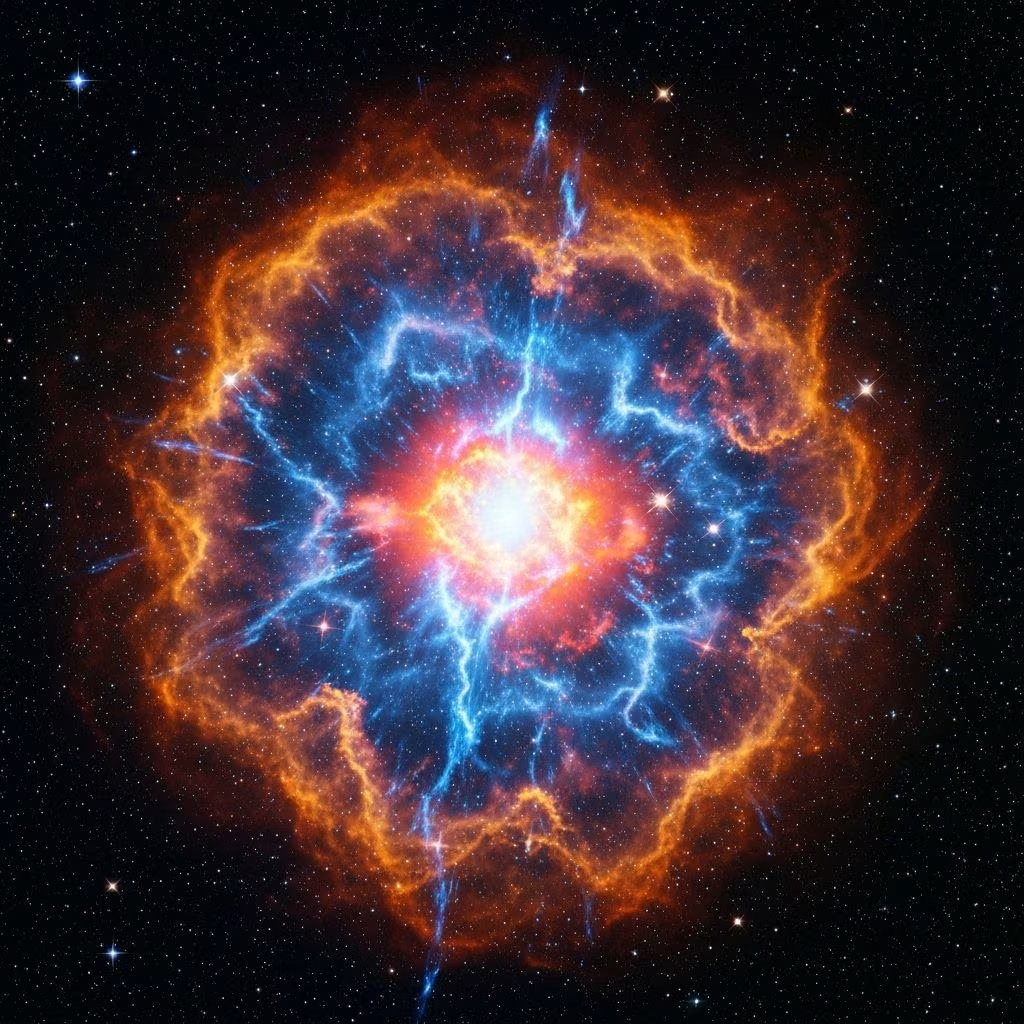
What Is a Supernova?
A supernova is among the most dramatic phenomena in the cosmos: the intense explosion marking the end of a star’s life. This stellar event temporarily rivals—sometimes even outshines—the light of an entire galaxy before fading over weeks or months. From astronomical discoveries to cosmic chemistry, supernovas provide a dazzling window into stellar life and death, influencing everything from the creation of elements to the very shape of galaxies.
Defining a Supernova
- Supernovas are cataclysmic explosions of stars, in which immense energy is unleashed in the final moments of stellar evolution.
- The peak luminosity can be comparable to that of a whole galaxy, making these events visible across vast cosmic distances.
- After the explosion, material is ejected at tremendous speeds, forming an expanding shell called a supernova remnant.
How Do Supernovas Happen?
Not every star ends in a supernova; the scenario depends on stellar mass and binary relationships. Scientists have identified two main pathways for these stellar detonations:
Main Mechanisms of Supernova Explosions
| Type | Trigger | Result |
|---|---|---|
| Type Ia | Thermonuclear explosion in a white dwarf after gaining mass from a companion. | Complete destruction of the star; produces standard candle for cosmology. |
| Core Collapse (Type II, Ib, Ic) | Massive star (>eight times our Sun) burns through fuel, core collapses under gravity. | Often leaves behind a neutron star or black hole, ejects outer layers. |
Type Ia: The White Dwarf Detonation
- Occurs in binary systems: a white dwarf and a main sequence star orbit each other.
- The white dwarf draws material from the companion—eventually triggering runaway nuclear fusion that obliterates the star in a brilliant flash.
- Because the brightness reach is so uniform, astronomers use Type Ia supernovas as “standard candles” to measure cosmic distances.
Core Collapse: Death of Massive Stars
- Stars at least eight times as massive as our Sun fuse elements in their cores through their lives.
- When fusion reaches iron, energy production halts, causing the core to collapse under its own gravity.
- The collapse ignites a shock wave that expels the star’s outer layers in a supernova explosion, often leaving a neutron star or black hole.
The Anatomy of a Dying Star
Massive stars resemble layer cakes—with lighter elements like hydrogen and helium at the surface, and heavier elements like silicon, sulfur, and iron forming deeper layers toward the core. When a supernova blows off the star’s surface, astronomers get a rare look at these internal regions.
- Recent observations revealed supernovas where outer hydrogen and helium are stripped away, exposing inner layers rich in silicon, sulfur, and argon before the explosion. This confirms the “onion-like” structure of massive stars.
- Such events offer astronomers a glimpse of stellar interiors rarely observable from Earth, confirming theoretical models of stellar layering.
Extreme Supernovas: Stripped to the Core
New types of supernova have been discovered, where stars are “stripped to the bone.” This means the outer layers are lost before the explosion, leaving astronomers with access to the star’s deeper chemical makeup.
Why Supernovas Matter
Though supernovas are individually rare—roughly three per century in our galaxy—their effects on the universe are profound and ongoing.
Cosmic Alchemy: Making the Elements
- Supernovas forge and release elements from oxygen to rubidium, enriching the cosmos beyond the basics of hydrogen and helium.
- The blast waves spread these elements across space, seeding future generations of stars, planets, and—ultimately—life itself.
Shock Waves and Star Formation
- Supernovas generate powerful shock waves that compress nearby clouds of gas and dust in the interstellar medium, triggering the birth of new stars.
Source of Cosmic Rays and Gravitational Waves
- Exploding stars launch high-energy particles known as cosmic rays throughout space.
- Some supernova events may also produce detectable gravitational waves, ripples in spacetime predicted by Einstein’s theory of general relativity.
The Supernova Discovery Timeline
Humans have observed supernovas for centuries, with major milestones in astronomy marked by dramatic “new stars” that lit up the skies.
- SN 1604 (Kepler’s Supernova): The last supernova witnessed in our own Milky Way, visible to the naked eye.
- SN 1572 (Tycho’s Supernova): Another famous event, studied by Tycho Brahe, fundamental for advancing the understanding of celestial phenomena.
- SN 1987A: The most recent supernova observable with the unaided eye, occurring in the Large Magellanic Cloud.
- With modern telescopes, astronomers detect supernovas in distant galaxies regularly, though the next “Milky Way naked-eye” supernova remains eagerly anticipated.
Supernovas and the Expanding Universe
Supernovas—especially Type Ia—play a key role in measuring cosmic distances and deciphering the universe’s expansion.
- Type Ia supernovas offer standard, easily measurable luminosities, making them invaluable for calculating distances between galaxies.
- Studies of supernovas have helped astronomers refine the Hubble constant, which expresses the universe’s rate of expansion. Debates over the precise value (a mystery known as “Hubble tension”) are ongoing, with supernova observations at the heart of efforts to resolve them.
- The James Webb Space Telescope recently observed a remote supernova nicknamed “Hope,” providing crucial data for these cosmological puzzles.
Types and Classification of Supernovas
Supernovas are classified by their spectra and physical triggers. Here’s a breakdown of the main types and their distinguishing features:
- Type Ia: Thermonuclear runaway in white dwarf stars within binary systems, lacking hydrogen in their spectra.
- Type II: Core collapse in massive stars still retaining hydrogen in their outer layers.
- Type Ib/Ic: Core collapse supernovas where the star has lost much or all of its hydrogen (Ib) and helium (Ic) envelopes before explosion.
| Supernova Type | Main Trigger | Spectral Features | Remnant |
|---|---|---|---|
| Type Ia | White dwarf detonation in binary | No hydrogen lines | No remnant left (star unbound) |
| Type II | Core collapse of massive star | Strong hydrogen lines | Neutron star or black hole |
| Type Ib/Ic | Core collapse without hydrogen/helium envelope | Weak/no hydrogen and helium lines | Neutron star or black hole |
Observing Supernovas: From Ancient Times to Modern Telescopes
Supernovas have captivated astronomers—and laypeople—for centuries:
- Before telescopes, supernovas were seen as “new stars,” often interpreted as omens.
- Modern imaging and spectroscopy allow astronomers to analyze supernova remnants and their compositions in detail, helping piece together stellar history.
With space telescopes like Hubble and Webb, scientists now routinely find and study supernovas billions of light-years away, each offering fresh clues about stellar evolution and the universe’s expansion.
Supernovas: The Impact on Earth and Beyond
- Although rare locally, a close supernova could affect Earth’s biosphere, altering atmospheric chemistry and even triggering mass extinctions.
- Supernovas help shape galaxies by dispersing energy, material, and igniting star-forming regions.
Frequently Asked Questions (FAQs)
Q: How common are supernovas in our galaxy?
A: Supernovas in the Milky Way occur about three times per century, but most are too distant or obscured by dust to be visible to the naked eye.
Q: What happens to a star after a supernova?
A: The core of a massive star might become a neutron star or, if enough mass remains, a black hole. In the case of a Type Ia supernova, the white dwarf is entirely destroyed.
Q: Why do scientists study supernovas?
A: Supernovas reveal vital information about the life cycle of stars, the creation of chemical elements, and the processes governing galaxy evolution. They are also essential tools for measuring the universe’s size and expansion rate.
Q: Can supernovas be dangerous for life on Earth?
A: Only very nearby supernovas (within 30 light-years) pose a risk—potentially damaging ozone and altering the atmosphere, but such events are extremely rare.
Conclusion: The Enduring Importance of Supernovas
Supernovas may represent the final act of a star’s existence, but they are among the universe’s principal engines of creation and change. From forging elements to lighting new galaxies and solving cosmic mysteries, these explosions are a testament to the power and elegance of the physical laws that govern our cosmos. As astronomers discover new types of stripped supernovas or use stellar explosions to resolve fundamental debates, our understanding of the universe continues to expand—fueled by the remnants of stars that have died but, in doing so, have given rise to countless new worlds.
References
- https://www.space.com/astronomy/astronomers-discover-strange-new-type-of-supernova-this-is-the-first-time-we-have-seen-a-star-that-was-essentially-stripped-to-the-bone
- https://www.space.com/james-webb-space-telescope-hubble-tension-supernova-hope
- https://en.wikipedia.org/wiki/Supernova
- https://starwalk.space/en/news/t-coronae-borealis-nova-star-exploding
- https://www.livescience.com/space/astronomy/a-new-star-has-exploded-into-the-night-sky-and-you-can-see-it-from-north-america
- https://space.fandom.com/wiki/Supernova
- https://www.youtube.com/watch?v=pcu1ROcBCMg
- https://rfpwriting.com/article/what-is-a-supernova-nasa-space-place-nasa-science-for-kids
- https://www.britannica.com/science/supernova
- https://www.iflscience.com/never-before-seen-supernova-proves-crucial-fact-on-the-interior-of-stars-80507
- https://www.sciencedaily.com/releases/2022/11/221110143813.htm
- https://www.youtube.com/watch?v=FjuuEXZUoRE
- https://www.skyatnightmagazine.com/space-science/what-happen-supernova-close-to-earth
- https://www.energy.gov/science/doe-explainssupernovae
- https://cosmosmagazine.com/space/explosive-beginnings-of-a-supernova-spotted-for-the-first-time/
- https://cosmosmagazine.com/space/sixteen-ways-of-looking-at-a-supernova/
- https://www.freethink.com/space/supernova-explosion


