


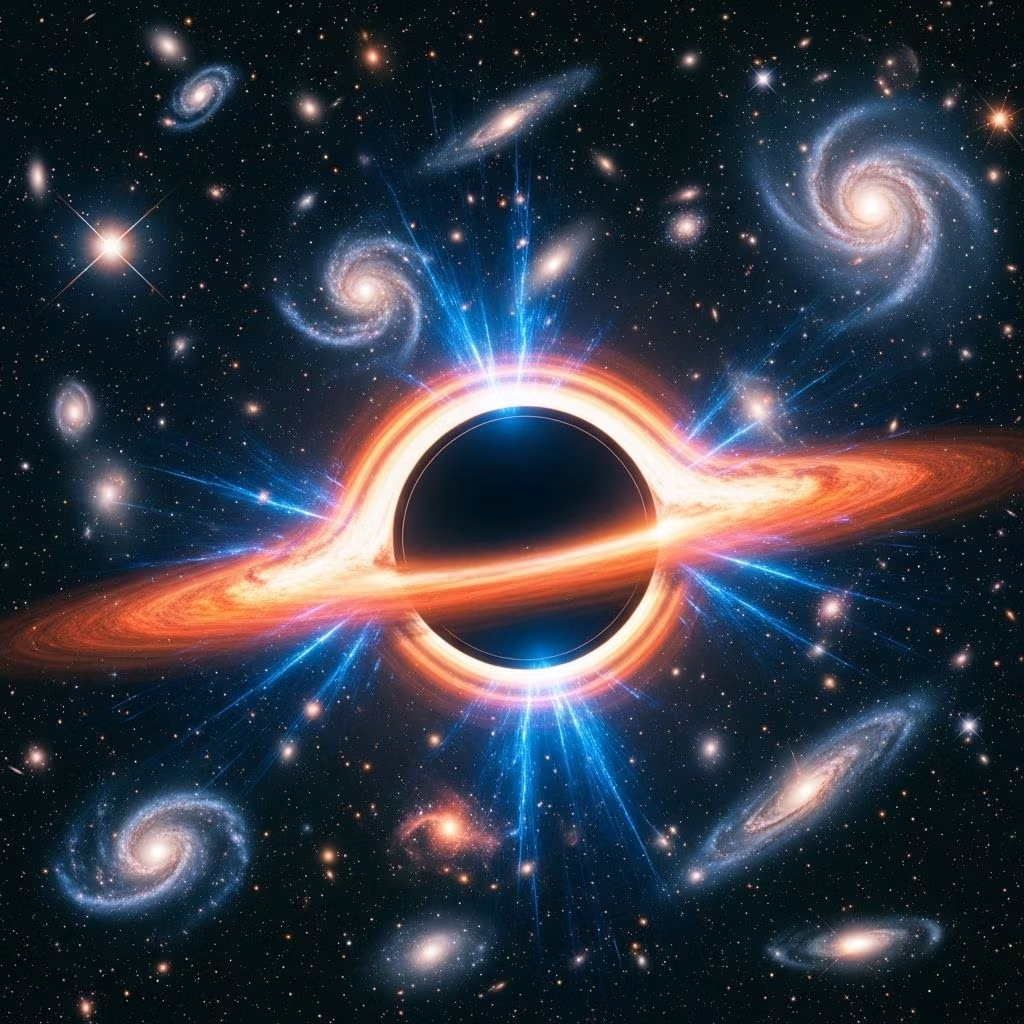
Where Do Black Holes Lead? Unraveling Cosmic Mysteries
\n
Black holes stand among the universe’s most fascinating and perplexing phenomena. Their powerful gravity can trap even light, raising one of the most enduring questions in astrophysics: where do black holes lead? Scientists have long speculated on the fate of matter and information entering these cosmic abysses. Are black holes truly the ultimate dead ends, or could they be gateways to other realms, times, or even universes?
\n\n
The Nature of a Black Hole
\n
At their core, black holes are regions of spacetime possessing gravitational fields so intense that nothing—not light, not information—can escape once it crosses the event horizon. Inside lies the singularity, a point of infinite density where current physics breaks down. Black holes were theoretically predicted by Einstein’s general relativity and later corroborated by observable effects, such as intense X-ray emissions and gravitational wave signals from cosmic collisions.
\n\n
- \n
- Stellar-mass black holes: Form from the collapse of massive stars.
- Supermassive black holes: Lurk in the centers of galaxies, including the Milky Way.
- Primordial black holes: Hypothetically formed in the earliest moments after the Big Bang.
\n
\n
\n
\n\n
The Event Horizon: The Point of No Return
\n
The event horizon is the boundary surrounding a black hole, beyond which escape is impossible. Once matter crosses this line, it can never communicate with the outside universe. For an outside observer, anything falling into a black hole appears to slow down and freeze at the event horizon due to extreme gravitational time dilation. Inside, however, gravity inexorably pulls all that enters towards the singularity.
\n\n
What Happens Inside a Black Hole?
\n
Despite advances in astrophysics, the interior of a black hole remains veiled in mystery. The singularity represents a ‘divide by zero’ in Einstein’s equations—a breakdown where spacetime curvature and density both become infinite. Most current theories suggest that, at the singularity, all information and matter are irrevocably destroyed or at least rendered unrecognizable by any known physics.
\n
Yet, some quantum theories propose that the singularity isn’t a definitive end. There may be mechanisms—still poorly understood—that allow information to persist in some encoded or transformed fashion.
\n\n
Where Do Black Holes Lead? Theories and Hypotheses
\n
One of the greatest mysteries is what, if anything, lies beyond a black hole’s event horizon. Here are the main scientific and speculative theories:
\n\n
1. Dead Ends: The Traditional View
\n
- \n
- According to classical general relativity, a black hole is a one-way trap. Anything falling in is inexorably crushed at the singularity and permanently lost to the universe.
- This leads to the question of information loss—does the universe truly allow information to be destroyed, or is there a quantum loophole?
\n
\n
\n\n
2. Wormholes: Portals to Other Places or Times
\n
Wormholes, also known as Einstein-Rosen bridges, are hypothetical tunnels through spacetime that might connect distant regions of the universe or even parallel universes.
\n
- \n
- Einstein’s field equations admit solutions resembling wormholes, but such structures would likely be highly unstable and collapse instantly unless exotic ‘negative energy’ matter kept them open.
- Some theorists speculate that black holes could serve as entrances to these tunnels, leading to distant points in space or even alternate dimensions. No direct observational evidence for traversable wormholes exists.
\n
\n
\n\n
3. White Holes: Theoretical Opposites
\n
The concept of a white hole is the time reverse of a black hole: nothing can enter a white hole and everything inside must be expelled. Some speculative models suggest matter entering a black hole emerges from a white hole elsewhere, potentially linking disparate parts of the universe. However, white holes remain purely theoretical, with none detected in nature.
\n\n
4. Alternate Universes: Black Holes as Cosmic Gateways
\n
- \n
- Some cosmological models propose that black holes may spawn entire new universes on the ‘other side’ of their event horizons.
- As described by physicist Nikodem Popławski and echoed in recent findings, if spacetime torsion inside a black hole prevents complete collapse to a singularity, a bounce or ‘big bang’-like event may occur inside, seeding a companion universe.
- This could even imply that our own universe originated inside a black hole in a parent universe—a concept known as black hole cosmology or the ‘universe in a black hole’ theory.
\n
\n
\n
\n\n
5. The Information Paradox and Hawking Radiation
\n
In the 1970s, Stephen Hawking showed that quantum effects cause black holes to emit Hawking radiation. Over vast timescales, black holes slowly lose energy and eventually evaporate. But if radiation contains no imprint of the stuff that fell in, where did the original information go? This black hole information paradox remains unresolved and at the heart of efforts to reconcile quantum mechanics and gravity.
\n\n
- \n
- Some physicists suspect that information escapes in the radiation, albeit in a highly scrambled form.
- Others propose that the event horizon itself stores information, or that the information remains within a residual ‘remnant’ left after the black hole evaporates.
\n
\n
\n\n
Table: Main Theories of Black Hole Destinations
\n
| Theory | Description | Observational Evidence |
|---|---|---|
| Dead End/Singularity | Classical collapse to a point of infinite density. No escape; information may be lost. | Implied by general relativity; no direct observation possible. |
| Wormhole | Hypothetical tunnels linking different regions of spacetime or other universes. | Mathematically plausible, but no empirical support. |
| White Hole | The time-reversed analog of a black hole; possible exit point for black hole matter. | Purely theoretical; never observed. |
| Alternate Universe | Black holes spawn baby universes with their own spacetime. | Speculative; fits some quantum gravity models. |
\n\n
Recent Discoveries Fueling New Ideas
\n
Modern technologies, like the Event Horizon Telescope and gravitational wave detectors (LIGO and Virgo), have allowed astronomers to image black hole shadows and detect black hole collisions, providing invaluable data on their nature. The James Webb Space Telescope has made stunning discoveries about the rotation and structure of galaxies, hinting at possible underlying patterns that may tie back to black hole origins.
\n\n
- \n
- Research suggests that, if our universe had a preferred axis of rotation, this could point to origins inside a rotating black hole, as some cosmologists propose.
- Observational projects continue to probe the environments around event horizons, searching for clues about the possible emergence of information or matter elsewhere.
\n
\n
\n\n
Black Holes in Popular Culture and Science Fiction
\n
The enigma of black holes has inspired countless books, movies, and television series. Titles such as \”Interstellar\” explore ideas like wormhole travel and higher-dimensional realities, while science fiction writers have long speculated about civilizations traversing or harnessing black holes as gateways or energy sources.
\n\n
Frequently Asked Questions (FAQs)
\n
Q: Is there any real evidence that black holes lead anywhere else?
\n
A: To date, no direct observational evidence suggests that black holes connect to other locations in our universe or beyond. The idea of wormholes remains a fascinating but unproven hypothesis.
\n\n
Q: What would happen to a person who falls into a black hole?
\n
A: After crossing the event horizon, tidal gravitational forces would increase dramatically, leading to a process known as \”spaghettification\”—stretching and compressing any object until it breaks apart at the atomic level.
\n\n
Q: Could black holes be used for time travel?
\n
A: Wormholes theoretically might permit shortcuts through spacetime, suggesting possibilities for time travel. However, stable, traversable wormholes would require types of matter and energy not known to exist, making it highly improbable with current physics.
\n\n
Q: What is Hawking radiation, and does it solve the information paradox?
\n
A: Hawking radiation is a subtle emission predicted by quantum effects at the event horizon. While it implies that black holes do not last forever, whether information is truly preserved in this radiation is still a subject of debate among physicists.
\n\n
Q: Could our universe itself be inside a black hole?
\n
A: Some cosmological models support the idea that the universe may exist inside a higher-dimensional black hole in a parent cosmos. While speculative, certain patterns, such as preferred rotation axes in galaxies, are consistent with this possibility but not definitive proof.
\n\n
Key Takeaways
\n
- \n
- Black holes represent regions from which nothing, not even light, can escape once past the event horizon.
- The fate of matter and information within black holes remains among the greatest puzzles in astrophysics.
- Theories about where black holes \”lead\” range from singular oblivion, to wormhole passageways, to alternate universe creation.
- Recent observations continue to challenge and expand our understanding of these extraordinary cosmic phenomena.
\n
\n
\n
\n
\n
References
- https://www.space.com/extreme-black-holes-have-hair
- https://www.space.com/space-exploration/james-webb-space-telescope/is-our-universe-trapped-inside-a-black-hole-this-james-webb-space-telescope-discovery-might-blow-your-mind
- https://en.wikipedia.org/wiki/Black_hole
- https://science.nasa.gov/universe/black-holes/
- https://www.sentintospace.com/post/space-education-black-holes
- https://www.nasa.gov/universe/what-are-black-holes/
- https://news.uchicago.edu/explainer/black-holes-explained
- https://spaceyv.com/black-hole-theory-all-things-you-need-to-know/
- https://www.sciencefocus.com/space/black-hole-mystery
- https://www.astronomy.com/science/black-holes-explained-by-an-astrophysicist/
- https://www.youtube.com/watch?v=Q6kJaMf3Lgo
- https://www.scribd.com/document/597984970/All-About-Space-Black-Holes-First-Edition-2021
- https://www.scirp.org/journal/paperinformation?paperid=73137
- https://editverse.com/black-holes/
- https://heliomtech.com/black-holes-and-space-time/
- https://www.britannica.com/science/black-hole
- https://futurism.com/universe-trapped-inside-black-hole
- https://www.youtube.com/watch?v=I53GwKLF9Ck


