James Webb Space Telescope Revisits the Hubble Ultra Deep Field
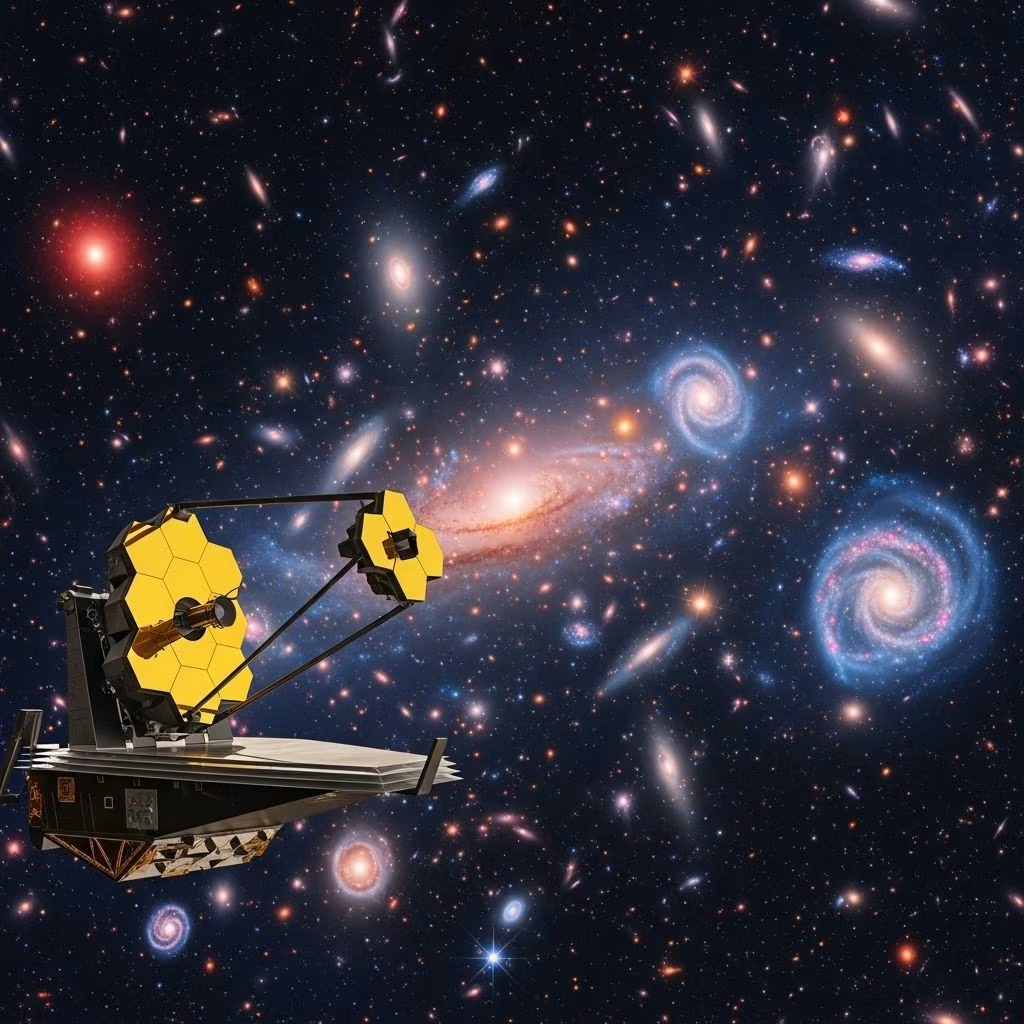
The James Webb Space Telescope (JWST) has returned to the visual territory of one of humanity’s most iconic astronomical images—the Hubble Ultra Deep Field (HUDF). This dramatic observation offers a fresh infrared perspective on over 2,500 galaxies, tracing light from the present universe back to only a few hundred million years after the Big Bang.
From Hubble’s Deep Fields to the JWST Era
In 1995, the Hubble Space Telescope stunned the world by peering deep into a tiny, apparently blank patch of sky, capturing thousands of galaxies and providing clues to the universe’s early history. This view was extended in 2004 with the Ultra Deep Field, a project that has since become a scientific and cultural reference for the universe’s vastness and diversity. Over subsequent years, Hubble returned repeatedly to this region, updating the images with improved infrared capabilities—each time pushing the boundaries of how far we could see into space and time.
- Hubble Deep Field (HDF): First deep stare, 1995
- Hubble Ultra Deep Field (HUDF): Extended deep view, 2004
- Multiple revisits: 2009, 2012, 2014—improved with Wide Field Camera 3’s near-infrared channels
- Ultra Deep Field size: About 2.4 arcminutes square—less than one tenth the diameter of the Full Moon
- Number of galaxies observed: ~10,000 in the optical; thousands more in infrared
The Limits of Hubble—and JWST’s New Frontier
While Hubble’s sensitivity and resolution revolutionized cosmic discovery, its instruments are limited to optical and near-infrared light. At the highest redshifts—meaning the farthest and earliest galaxies—the visible light from these ancient objects is stretched by the expansion of the universe into wavelengths beyond Hubble’s reach. To transcend these limits, astronomers needed a next-generation observatory capable of seeing deeper into the infrared.
The JWST Advanced Deep Extragalactic Survey (JADES)
Enter the JWST Advanced Deep Extragalactic Survey (JADES), a key mission program for the James Webb Space Telescope. JADES targets the same deep field regions as Hubble—the 1995 Deep Field and the 2004 Ultra Deep Field—but with advanced infrared instruments, particularly:
- NIRCam (Near-Infrared Camera): Sensitivity at 1.9 to 4.8 microns
- MIRI (Mid-Infrared Instrument): Sensitivity at longer mid-infrared wavelengths
This approach allows JWST to reveal thousands of new cosmic objects that were previously invisible, including:
- Faint galaxies from the first few hundred million years following the Big Bang
- Galaxies whose light is heavily reddened by cosmic dust
- Galaxies containing very old, red stars formed near the beginning of the universe
JWST vs Hubble: A Comparative Table
| Hubble Ultra Deep Field | JWST JADES Ultra Deep Field | |
|---|---|---|
| Wavelength Range | Optical & Near-Infrared (0.4–1.6 μm) | Near-Infrared & Mid-Infrared (1–28 μm) |
| Number of Galaxies Detected | ~10,000 | Over 2,500 in JADES image; potentially tens of thousands total |
| Look-back Time | Up to 13.2 billion years | Up to 13.5+ billion years |
| Color Representation | Natural color composites | False color (since IR is invisible to humans) |
| Revealed Phenomena | Galaxy clusters, star-forming regions, ancient galaxies | Even fainter galaxies, more obscured by dust, earliest star formation |
Inside the New JWST JADES Ultra Deep Field Image
The new JWST image, released as part of JADES, delivers a visual census of cosmic history. In this field, each dot or smudge is a distant galaxy—some from our cosmic neighborhood, others harking from when the universe was just a few percent of its current age.
- Red Galaxies: Either star-forming galaxies hidden by dust or highly evolved galaxies with older redder stars. Dust absorbs their visible light, reradiating it in infrared, so they brighten in JWST’s view.
- Greenish-White Galaxies: These are at very high redshift, meaning we see them as they existed within the first billion years after the Big Bang.
- Blue and Cyan Galaxies: These are closer (low redshift) and therefore appear brighter to JWST’s NIRCam than to MIRI, dominated by younger, hotter stars.
The image is constructed in false color, mapping the infrared information to visual colors we can see, since infrared light is invisible to the human eye.
The Science Behind the Image
- Dust and Star Formation: By accessing the mid and near-infrared, JWST can peer through dust, detecting star formation that would be invisible in optical light.
- Galactic Archaeology: The ability to see faint, ancient galaxies allows researchers to trace the buildup of galaxies, their stars, and elemental enrichment over cosmic time.
- Dark Matter & Large-Scale Structure: Detailed surveys of these deep fields reveal how galaxies are distributed, offering insights into dark matter and the evolution of the cosmic web.
What Makes “Deep Fields” Special?
Deep field imaging projects like HUDF and JADES are time-intensive, focusing hours or even days of exposure on a single region of sky. The scientific payoff, however, is immense:
- Unprecedented Galaxy Census: These images provide a vast catalog of galaxies at myriad evolutionary stages.
- Understanding Galaxy Evolution: Observing galaxies at many redshifts, astronomers study how they grow, interact, and change over time.
- Constraints on Cosmology: Deep fields help estimate the age, composition, and fate of the universe.
Galaxies Across the Eons: What JWST’s Deep Field Reveals
With JWST’s deeper, dust-penetrating vision, astronomers are able to:
- See galaxies whose light began its journey less than 400 million years after the Big Bang.
- Uncover star-forming regions otherwise hidden from view by clouds of gas and dust.
- Examine the colors, shapes, and luminosities of galaxies across epochs, tracking their evolution.
The Power of Multi-Instrument Observations
Combining data from JWST’s NIRCam and MIRI (and earlier Hubble data) expands the catalog and delivers sharper, more comprehensive portraits of galaxies. Differences in wavelength coverage let scientists separate distant, early-universe targets from closer cosmic objects.
The Role of Dust, Reddening, and False Color
Many galaxies imaged by JWST appear red because:
- Distance Redshift: Light from early galaxies is stretched (“redshifted”) as the universe expands.
- Dust Obscuration: Dust absorbs visible light and re-emits it in infrared, making star-forming galaxies look redder in these wavelengths.
- Stellar Aging: Older stellar populations emit more reddish light.
Because infrared is outside human vision, image colors are mapped according to scientific convention, letting astronomers visually sort star-forming, dusty, or mature galaxies at various distances.
Connecting the Dots: How Deep Fields Advance Cosmology
- Map the size and distribution of galaxies from the first billion years to the present.
- Identify major mergers, collisions, and gravitationally bound galaxy groups, the seeds of today’s galaxy clusters.
- Observe star formation rates and chemical enrichment through cosmic history.
Astronomical Techniques
- Multi-Wavelength Synergy: Combine JWST’s long-wavelength images with Hubble’s optical data for comprehensive views.
- Spectroscopic Follow-Up: Use JWST’s instruments to determine galaxy redshifts, composition, and star formation properties.
Visualizing the Universe—What JWST’s Image Means for Us
The new JWST deep field imagery is not simply beautiful; it tells a story of origins, cosmic growth, and the dynamic processes that continue to shape the universe. Some galaxies imaged are:
- The first to form after the Big Bang, seen at infancy.
- Sites of intense star formation and stellar death.
- Massive, mature systems that challenge our models of early cosmic structure.
Frequently Asked Questions (FAQs)
Q: What is the main difference between the JWST Deep Field and Hubble Ultra Deep Field?
A: The JWST Deep Field image probes to longer infrared wavelengths, revealing even fainter and more dust-obscured early galaxies, thus extending the visible range of cosmic history beyond Hubble’s reach.
Q: How does JWST “see” through cosmic dust?
A: Infrared wavelengths can penetrate dust clouds that block visible light, allowing astronomers to uncover star-forming regions and hidden structures within distant galaxies.
Q: Why do some galaxies appear different colors in JWST images?
A: The colors represent different infrared wavelengths mapped to visual channels, signifying varying redshift, stellar populations, or dust content.
Q: How far back in time do the JWST Deep Field images let us see?
A: JWST’s most distant galaxies are observed as they were about 13.5 billion years ago, capturing the universe just a few hundred million years after the Big Bang.
What’s Next for JWST and Deep Field Research?
The first JWST deep field images are just the beginning. Astronomers plan to:
- Undertake deeper and wider surveys, mapping the cosmic web in greater detail.
- Stack and combine data from JWST, Hubble, and ground-based observatories for richer information.
- Pinpoint the formation times of the first stars and galaxies with greater precision.
Together, these advances promise unprecedented insight not just into distant galaxies, but into the fundamental nature of space and time itself.
References
- https://en.wikipedia.org/wiki/James_Webb_Space_Telescope
- https://webbtelescope.org/images
- https://www.space.com/astronomy/james-webb-space-telescope/james-webb-space-telescope-revisits-a-classic-hubble-image-of-over-2-500-galaxies
- https://esawebb.org/images/
- https://www.space.com/astronomy/james-webb-space-telescope/james-webb-space-telescope-captures-thousands-of-galaxies-in-a-cosmic-feast-image
- https://esawebb.org/images/potm2504a/
- https://wonderfulengineering.com/james-webb-space-telescope-revisits-a-classic-hubble-image-of-over-2500-galaxies/
- https://www.indiatoday.in/science/story/james-webb-telescope-discovers-2500-hidden-galaxies-in-iconic-hubble-image-2766520-2025-08-05
- https://www.indiatoday.in/amp/science/story/james-webb-telescope-discovers-2500-hidden-galaxies-in-iconic-hubble-image-2766520-2025-08-05
- https://science.nasa.gov/mission/webb/
- https://science.nasa.gov/missions/webb/nasas-webb-uncovers-galaxy-population-driving-cosmic-renovation/
- https://www.asc-csa.gc.ca/eng/satellites/jwst/science-images-from-james-webb-space-telescope.asp
- https://esahubble.org/images/archive/category/galaxies/
- https://www.advancedsciencenews.com/cosmic-vine-discovered-by-the-james-webb-space-telescope/
- https://www.youtube.com/watch?v=M-iLDZ9nUJo
- https://www.livescience.com/space/astronomy/space-photo-of-the-week-record-breaking-james-webb-telescope-image-captures-1-678-galaxy-groups-at-once
- https://timesofindia.indiatimes.com/science/nasas-james-webb-telescope-captures-thousands-of-galaxies-in-one-picture/articleshow/121843153.cms