Interstellar Space: What Is It and Where Does It Begin?
For centuries, humanity has gazed up at the sky and wondered about the vastness between the stars. But how do scientists define this expanse? What are its boundaries, and why does that matter to us?
Understanding Interstellar Space
At its core, interstellar space is the region in the universe located between star systems within a galaxy. While the word ‘interstellar’ simply means “between the stars,” determining where our solar system ends and true interstellar space begins is far from straightforward.
- Interstellar space refers to the space beyond the influence of a star’s solar wind.
- This region contains matter and radiation (known as the interstellar medium), including gas, dust, and cosmic rays, spread out in a very sparse, diffuse manner.
- The exact boundary depends on where the star’s influence fades, marked by a transition called the heliopause in our solar system.
Demystifying Boundaries: Where Does Interstellar Space Start?
One might imagine interstellar space simply starts as soon as you leave a star’s immediate surroundings, but science defines a more precise transition zone.
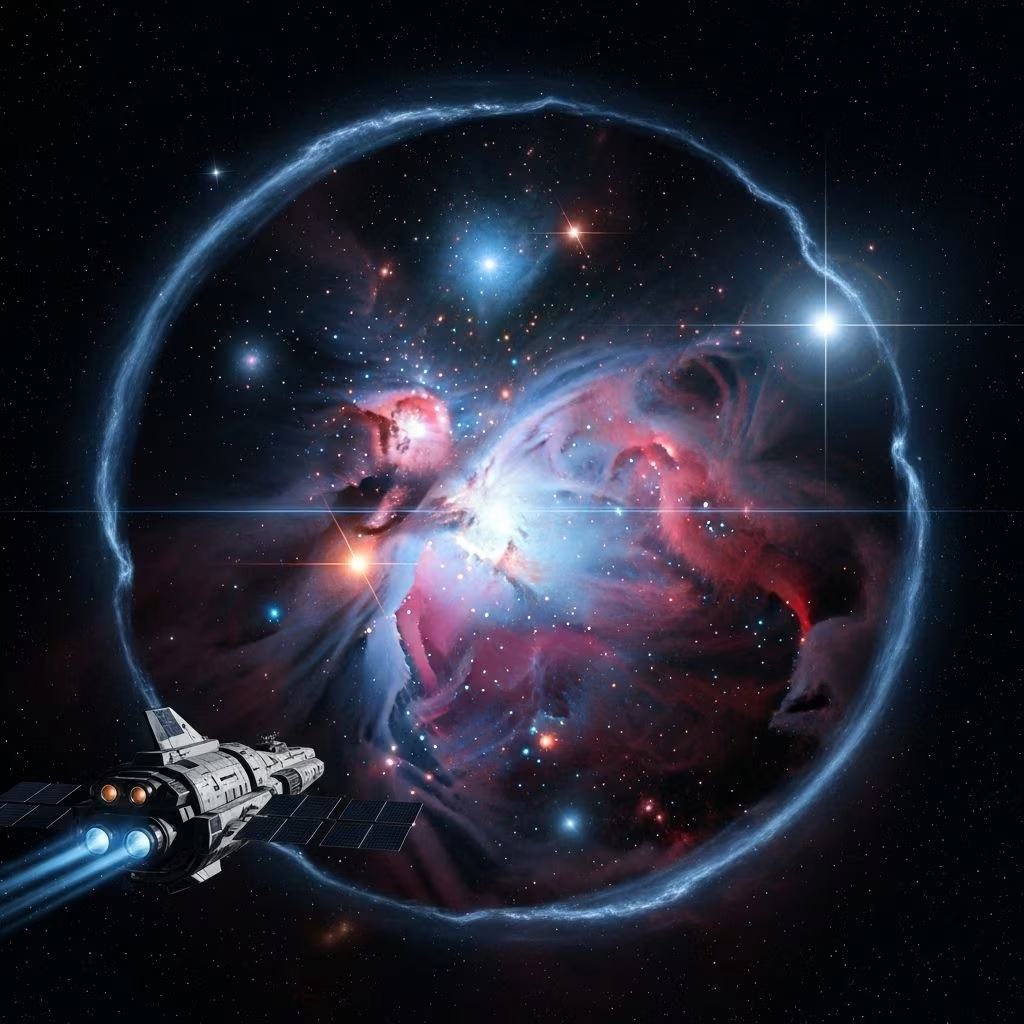
- The edge of interstellar space around the Sun is the heliopause: the point where the pressure from the outward-flowing solar wind balances with the pressure from the incoming interstellar medium.
- Inside the heliosphere (the Sun’s protective bubble), the solar wind and magnetic field dominate.
- Beyond the heliopause, the Sun’s influence wanes, and the environment is shaped by the galaxy, not our star.
Key Features of the Heliopause
- Located an average of about 120 astronomical units (AU) from the Sun (1 AU = distance from Earth to Sun).
- The exact distance can vary, given the fluctuating strength of the solar wind and surrounding interstellar medium.
- Acts as the official boundary between the Sun’s domain and interstellar space.
The Solar Wind and the Heliosphere
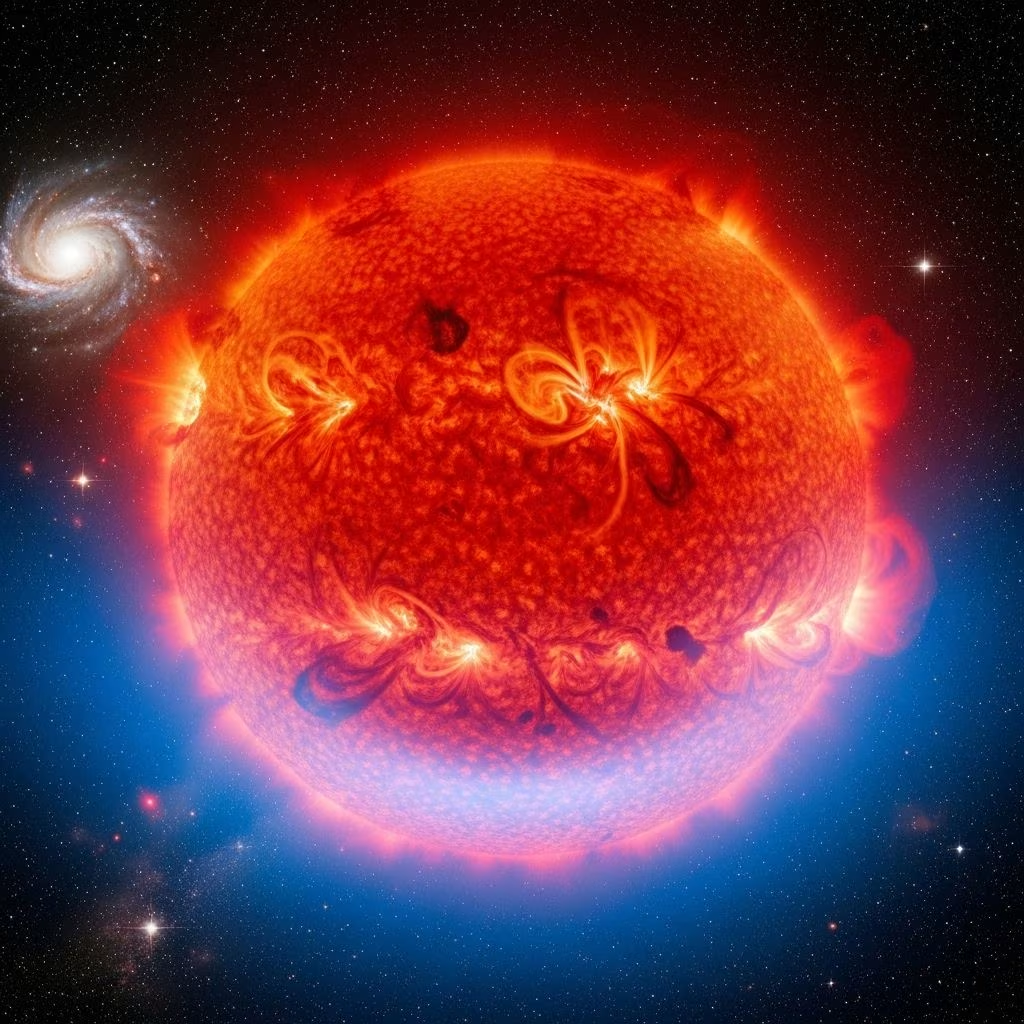
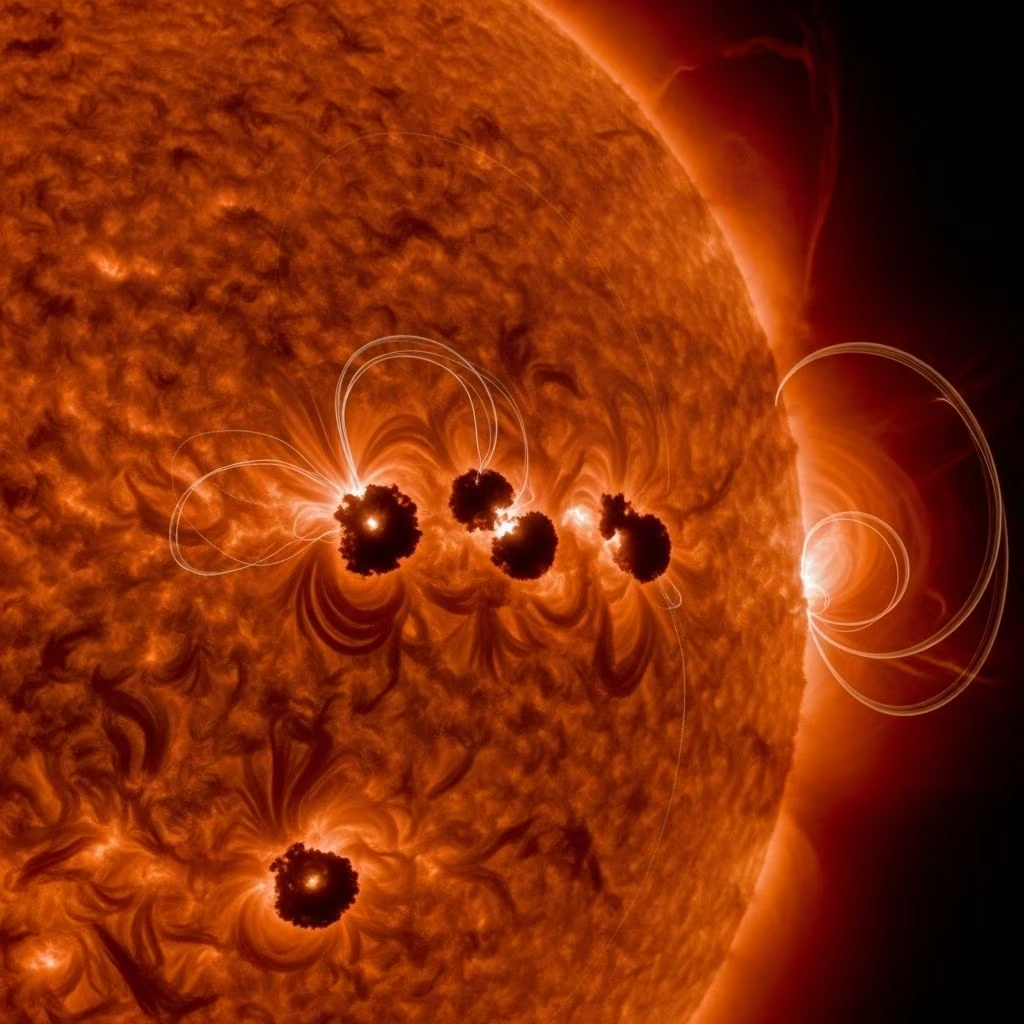
The Sun continually emits a stream of charged particles known as the solar wind. This wind flows outward at over 670,000 miles per hour, filling a vast bubble (the heliosphere) and forming a boundary with interstellar space.
- The heliosphere is essentially the region of space shaped and dominated by the solar wind.
- The solar wind gradually thins with distance, until it meets the interstellar medium—creating the heliopause.
- Beyond this, the density and type of particles change: solar wind particles become scarce, replaced by colder, denser interstellar particles.
What Makes Up Interstellar Space?
Contrary to popular imagination, interstellar space is not empty. Instead, it’s filled with a tenuous collection of particles, electromagnetic fields, and radiation:
- Interstellar Medium (ISM): Composed primarily of hydrogen atoms (about 70%), helium (most of the rest), and traces of heavier elements. This material forms clouds, dust lanes, and gives rise to new stars and planetary systems over cosmic time.
- Cosmic Rays: High-energy atomic nuclei and subatomic particles traveling at almost the speed of light, originating from supernovae and other energetic events.
- Magnetic Fields: The interstellar medium is threaded by weak but pervasive magnetic fields.
- Electromagnetic Radiation: Includes visible light, radio waves, x-rays, and more—contributing to the interstellar radiation field.
- Dust Grains: Microscopic particles that can coalesce into clouds and are important for blocking, scattering, and emitting radiation; crucial to the chemistry of the galaxy.
Interstellar Density and Composition
- Average number density in interstellar space is about 1 atom per cubic centimeter—vastly less dense than any vacuum achieved on Earth.
- Density can vary from thin regions (hot ionized gas) to dense molecular clouds where stars are born (108–1012 atoms per cubic meter).
How Do We Know We’ve Reached Interstellar Space?
Since there are no physical walls in space, how do scientists determine when a spacecraft exits the solar system and enters interstellar territory?
- Detection involves measuring the concentration and type of particles, the temperature, and the nature of the magnetic field encountered by a probe.
- Inside the heliosphere: Solar wind particles dominate; they are hotter and moving faster.
- Outside the heliosphere (in interstellar space): Shift to cooler, denser particles and a magnetic field not aligned with the Sun’s own field.
- Spacecraft such as Voyager 1 noticed these changes in the environment, including dramatic drops in solar wind and spikes in cosmic ray intensity, to confirm their crossing over the heliopause.
Spacecraft That Have Entered Interstellar Space
To date, only a few human-made objects have truly passed into interstellar space, transforming theory into observation.
| Spacecraft | Launch Date | Status | Interstellar Crossing |
|---|---|---|---|
| Voyager 1 | 1977 | Active | Crossed heliopause in August 2012 (at around 121 AU) |
| Voyager 2 | 1977 | Active | Crossed heliopause in November 2018 (at about 119 AU) |
| Pioneer 10 | 1972 | No longer sending data | Trajectory will eventually reach interstellar space, but data lost before crossing |
| Pioneer 11 | 1973 | No longer sending data | Similar fate as Pioneer 10 |
| New Horizons | 2006 | Active | Beyond Pluto, projected to reach heliopause in the late 21st century |
- Voyager 1 and Voyager 2 are the only spacecraft to have definitively entered interstellar space, confirmed by particle instrumentation, magnetic-field orientation, and cosmic ray levels.
- Pioneer 10, Pioneer 11, and New Horizons are on trajectories to the stars but have not yet, or did not before contact was lost, entered the region beyond the heliopause[10].
Significance of the Achievement
These journeys give us our only direct measurements of conditions in the interstellar medium—and have profoundly expanded our knowledge of the galaxy’s composition, dynamics, and the transition at the edge of our solar bubble.
Why Defining Interstellar Space Matters
- Knowing where the solar system really ends is crucial for defining the boundary between direct solar influence and the broader galaxy.
- Understanding the interstellar medium helps astronomers theorize the life cycles of stars, the evolution of galaxies, and the processes that create planets and, ultimately, life itself.
- This boundary is not only a physical transition but an opportunity: by sending probes through the heliopause, we can sample unaltered cosmic matter and fields that would otherwise be inaccessible.
Physical Conditions in Interstellar Space
- Interstellar space is characterized by extremely low density, with enormous distances between individual atoms and dust grains.
- The temperature varies—some regions have gases heated to thousands or even millions of degrees by stellar winds and supernovae, while others form cold molecular clouds.
- Magnetic fields can influence the movement of particles and cosmic rays, and electromagnetic radiation bathes the medium in all directions.
Interstellar Space vs. Intergalactic Space
| Feature | Interstellar Space | Intergalactic Space |
|---|---|---|
| Location | Between star systems in a galaxy | Between entire galaxies |
| Main Constituents | Hydrogen, helium, dust, cosmic rays | Hot plasma, even lower density, mostly hydrogen and helium |
| Boundary | Astropause or heliopause | Edge of a galaxy (e.g., galactic halo) |
| Density | ~1 atom/cm³ (very low, but higher than intergalactic) | <1 atom/m³ (orders of magnitude lower density) |
Frequently Asked Questions (FAQs)
Q: Is interstellar space truly empty?
A: No, interstellar space, while extremely diffuse, contains gas (mostly hydrogen and helium), dust particles, cosmic rays, and electromagnetic radiation.
Q: Where does the solar system end and interstellar space begin?
A: The end of the solar system is generally defined at the heliopause, where the Sun’s solar wind can no longer push back the particles from the interstellar medium.
Q: Has any spacecraft entered interstellar space?
A: Yes, NASA’s Voyager 1 (2012) and Voyager 2 (2018) both crossed the heliopause and are now in interstellar space, relaying information back to Earth.
Q: What is the interstellar medium and why is it important?
A: The interstellar medium is the mixture of gas and dust between stars. It’s vital for star and planet formation, and studying it reveals the processes shaping galaxies.
Q: How far is the heliopause from the Sun?
A: The heliopause is about 120 astronomical units (AU) from the Sun, but this distance can change depending on solar and galactic conditions.
Key Takeaways
- Interstellar space is not just the open void between stars—it begins where the Sun’s influence ends, at the heliopause, and is filled with a faint but important mixture of particles and fields.
- Effective exploration began only when spacecraft ventured beyond this invisible boundary, allowing us to sample the true conditions between the stars.
- Understanding interstellar space gives astronomers critical insight into the universe’s evolution, the life cycles of stars, and our place in the galaxy.
References
- https://www.space.com/interstellar-space-definition-explanation
- https://en.wikipedia.org/wiki/Interstellar_medium
- https://science.nasa.gov/solar-system/10-things-going-interstellar/
- https://www.youtube.com/watch?v=Zve2F5vAfuc
- https://spaceplace.nasa.gov/interstellar/en/
- https://en.wikipedia.org/wiki/Interstellar_space
- https://spacedictionary.com/interstellar_space
- https://www.space.com/27692-science-of-interstellar-infographic.html
- https://www.merriam-webster.com/dictionary/interstellar
- https://www.universetoday.com/articles/interstellar-space
- https://www.youtube.com/watch?v=PLBZOleebsE
- https://dictionary.cambridge.org/us/example/english/interstellar-space
- https://www.discovermagazine.com/how-astronomers-define-where-a-galaxy-ends-and-interstellar-space-begins-46698
- https://askbib.com/space-exploration/interstellar-space-vs-intergalactic-space
- https://study.com/academy/lesson/what-is-the-interstellar-medium.html