


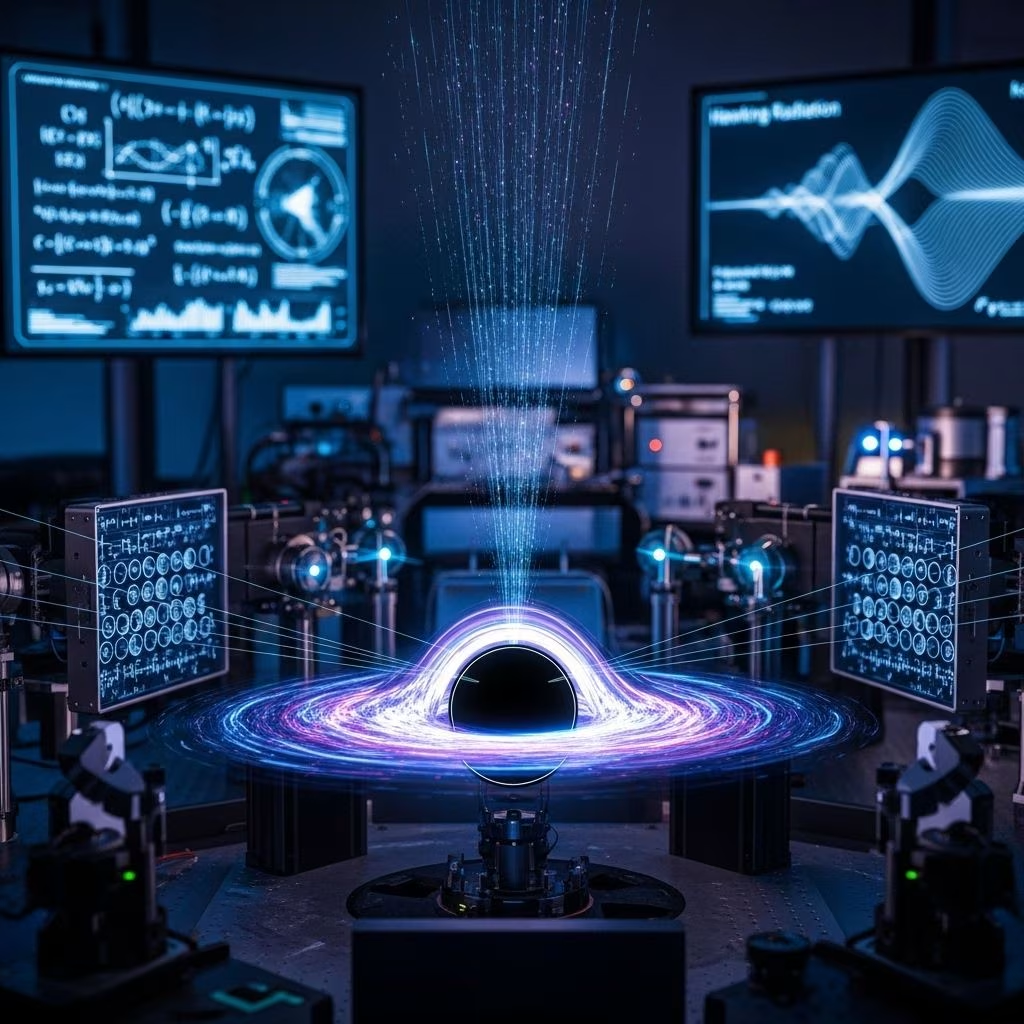
Lab-Created Black Holes Illuminate Hawking’s Groundbreaking Prediction
Physicists have long grappled with the paradoxical nature of black holes: these cosmic giants seem to absorb everything, even light, yet Stephen Hawking’s 1974 theory predicted they must also emit faint radiation. Today, a new chapter in this story unfolds. By creating analogues of black holes in laboratory settings, scientists have recently observed processes that mimic the elusive Hawking radiation, offering direct experimental support for a theory once deemed beyond empirical reach.
Contents
- Stephen Hawking’s Prediction: Black Holes Aren’t Completely Black
- Quantum Vacuums: Virtual Particles at Play
- Synthesizing a Black Hole in the Lab
- Testing Hawking’s Theory: Recent Breakthrough Experiment
- Key Findings: What Did Scientists Actually Observe?
- The Next Frontier: Implications and Future Research
- Frequently Asked Questions (FAQ)
Stephen Hawking’s Prediction: Black Holes Aren’t Completely Black
Stephen Hawking’s revolutionary insight in 1974 upended the conventional assumption that nothing, not even light, could escape the tremendous gravitational grip of a black hole. By leveraging intricate quantum physics and Einstein’s theory of general relativity, Hawking showed that black holes should emit a weak, spontaneous glow at their event horizons – the boundary beyond which nothing can return.
This glow, now termed Hawking radiation, arises not from familiar processes, but from the strange quantum phenomena permitted by the laws of physics:
- Empty space, according to quantum field theory, is never truly empty but filled with fleeting “virtual particles.”
- Strong gravitational fields near a black hole’s event horizon can grant these virtual particles enough energy to become real, observable particles.
- This photon emission was predicted to be extremely faint, explaining why Hawking radiation has not yet been detected in space with telescopes.
Quantum Vacuums: Virtual Particles at Play
To understand Hawking radiation, it’s crucial to grasp a few quantum essentials. Quantum field theory states there is no such thing as a true vacuum. Instead:
- Space teems with potential energy and minute vibrations even in apparent emptiness.
- These fluctuations can randomly manifest as pairs of virtual particles – particle-antiparticle pairs that emerge and annihilate almost instantly, often producing a fleeting burst of light.
- Under extreme gravity, like at a black hole’s event horizon, these virtual particles can be separated before annihilation, with one particle escaping as radiation while the other falls into the black hole.
- This process results in what we call Hawking radiation.
Synthesizing a Black Hole in the Lab
Given that naturally occurring black holes are lightyears away and Hawking radiation is theorized to be exceptionally weak, direct observation is nearly impossible. Scientists thus turn to analog black holes created in laboratories to put theory to the test.
Key points about how these analogues are built:
- Researchers construct “event horizons” using well-controlled chains of atoms or exotic states of matter chilled to extreme cold.
- One common approach: using a one-dimensional chain of atoms (single-file chain) or systems like Bose-Einstein condensates (BECs), where atoms move in unison as a quantum whole.
- By creating sudden shifts in potential energy (akin to a “waterfall” in the system), scientists divide the flow of atomic excitations — quantum entities that play the role of photons — into regions analogous to the inside and outside of a black hole’s event horizon.
- Within such analogues, phonons (quantum sound waves) or photons act as stand-ins for the real particles Hawking discussed.
Testing Hawking’s Theory: Recent Breakthrough Experiment
In a significant experiment published in Physical Review Research in November, a team of researchers reported using a chain of atoms to simulate a black hole’s event horizon. Their aim was to see if such a system would emit radiation consistent with Hawking’s prediction.
- Scientists created a one-dimensional atomic chain to act as a stand-in for a black hole’s edge.
- By precisely controlling the system’s energy landscape, they emulated the conditions expected right at the event horizon, where quantum effects should be most intense.
- The researchers monitored how virtual particle pairs appeared in their system, tracking whether a faint “glow” of radiation emerged just as Hawking’s theory projected.
Experimental Details: An Analogue Event Horizon
The synthetic black hole was crafted by manipulating atoms to mimic the drastic energy gradient present at the boundary of a real black hole. As described in multiple supporting sources:
- Scientists cooled thousands of rubidium atoms to near absolute zero, generating a Bose-Einstein condensate — a state of matter where all atoms behave as a single quantum object.
- By firing laser beams to control the atoms, they created an energy “cliff.” On one side of this cliff, atoms (and associated quantum waves called phonons) moved faster than the speed of sound in the medium; on the other, they moved slower.
- This “cliff” acts like a simulated event horizon, dividing space so that phonons on one side can escape, while those on the other are trapped — closely mirroring how light behaves at a black hole’s event horizon.
Key Findings: What Did Scientists Actually Observe?
The laboratory analog not only matched theoretical predictions but also revealed several core insights about black hole behavior and Hawking radiation:
- A faint glow of radiation was indeed emitted from the system’s synthetic event horizon, consistent with Hawking’s expectations.
- Most of the detected radiation — analogous to photons in space — appeared right at the boundary, showing that intense quantum effects are localized at the “edges.”
- The emissions were stationary, not changing in intensity over time, echoing another key Hawking prediction that black hole radiation should be constant, like a blackbody.
Visual Summary: Experimental Setup & Observations
| Aspect | Description |
|---|---|
| System | Chain of atoms (BEC or 1D atomic array) |
| Event Horizon Simulation | Laser-induced energy cliff divides fast/slow atomic flows |
| Hawking “particles” | Phonons (quantum sound waves) or photons |
| Main Observation | Radiation “glow” predominantly at event horizon (edges) |
| Stationary Emission | Glow did not fluctuate — remained constant over time |
The Next Frontier: Implications and Future Research
These drop-in-the-ocean pulses of artificial Hawking radiation hint at broader consequences for quantum physics, gravitation, and the ongoing quest for unification. Some crucial implications and further questions include:
- Experimental support for quantum gravitational effects: By mimicking the event horizon and observing emission, the experiment demonstrates how quantum field theory and general relativity can coexist, at least in analog systems.
- Probing the black hole information paradox: Deeper lab studies may illuminate whether information is lost as it crosses real event horizons, a profound question sitting at the crossroads of physics.
- Advancing measurement techniques: These analogues offer fresh tools for investigating phenomena too subtle or distant to observe directly with astronomical instruments.
While these synthetic horizons are still many orders of magnitude removed from true black holes, they provide a unique window into processes thought to occur in some of the universe’s most extreme locations.
Frequently Asked Questions (FAQ)
Q: What exactly is Hawking radiation?
A: Hawking radiation is a theoretical prediction that black holes emit faint radiation caused by quantum effects near their event horizons, gradually losing mass over astronomical timescales.
Q: Why can’t we directly observe Hawking radiation in space?
A: The emission is expected to be extraordinarily weak — far fainter than the cosmic microwave background and current instrument sensitivity, making direct detection extremely challenging.
Q: How do scientists simulate an event horizon in the lab?
A: By manipulating cold atoms in precisely controlled environments, researchers create steep boundaries in atomic flows that mirror the conditions of a black hole’s event horizon, allowing them to study how quantum ripples and particle pairs behave at such limits.
Q: What is the significance of producing a stationary emission?
A: Stationary emission matches the expectation for real black holes: their Hawking radiation should be steady (like a warm object’s glow), not vary over time, supporting Hawking’s prediction.
Q: Will these findings impact other areas of physics?
A: Yes. These lab-made analogues may help solve the black hole information paradox, offer experimental grounds for quantum gravity research, and inspire new technological innovations in quantum information science.
Conclusion: Bridging Cosmos and Laboratory
The creation of synthetic black holes in the laboratory — and the emerging evidence for Hawking-like radiation — represents a significant step in unraveling mysteries that once seemed reserved for the distant cosmos. By cleverly recreating quantum boundaries under highly controlled conditions, scientists are bringing theoretical predictions to life, confirming the reality of phenomena once thought forever out of reach, and setting the stage for new breakthroughs in our quest to understand space, time, and the quantum universe.
References
- https://www.space.com/synthetic-black-hole-matches-hawking-prediction
- https://www.livescience.com/synthetic-electron-black-hole-matches-hawking-prediction
- https://phys.org/news/2022-11-synthetic-black-holes-real.html
- https://en.wikipedia.org/wiki/Black_hole_information_paradox
- https://www.sciencealert.com/physicists-simulated-a-black-hole-in-the-lab-and-then-it-started-to-glow
- https://en.wikipedia.org/wiki/Black_hole
- https://www.sciencealert.com/a-lab-made-black-hole-might-have-finally-proved-stephen-hawking-right
- https://www.livescience.com/black-hole-analog-confirms-hawking.html
- https://pocketmags.com/us/all-about-space-magazine/issue-138/articles/a-lab-grown-black-hole-may-prove-stephen-hawking-s-most-challenging-theory-right
- https://www.iflscience.com/labmade-sonic-black-hole-confirms-hawkings-predictions-52642
- https://iop.uva.nl/content/news/2022/11/synthetic-black-holes-radiate-like-real-ones.html
- https://as.cornell.edu/news/hawkings-black-hole-theorem-observationally-confirmed
- https://universemagazine.com/en/scientists-recorded-the-elusive-hawking-radiation-in-an-artificial-black-hole/
- https://theweek.com/speedreads/643196/man-created-black-hole-lab-prove-decadesold-stephen-hawking-theory
- https://english.sawtbeirut.com/world/scientists-create-black-hole-analog-and-it-behaves-just-like-hawking-predicted/
- https://www.science.org/content/article/have-scientists-finally-made-sense-hawking-s-famous-formula-disorder-black-hole
- https://www.sciencetimes.com/articles/40935/20221115/lab-made-black-hole-channel-elusive-hawking-radiation.htm
- https://www.simonsfoundation.org/2025/09/10/ringing-black-hole-confirms-einstein-and-hawkings-predictions/
- https://www.space.com/sonic-black-hole-spews-hawking-radiation.html


