Why Earth is Closest to the Sun in the Depths of Northern Winter
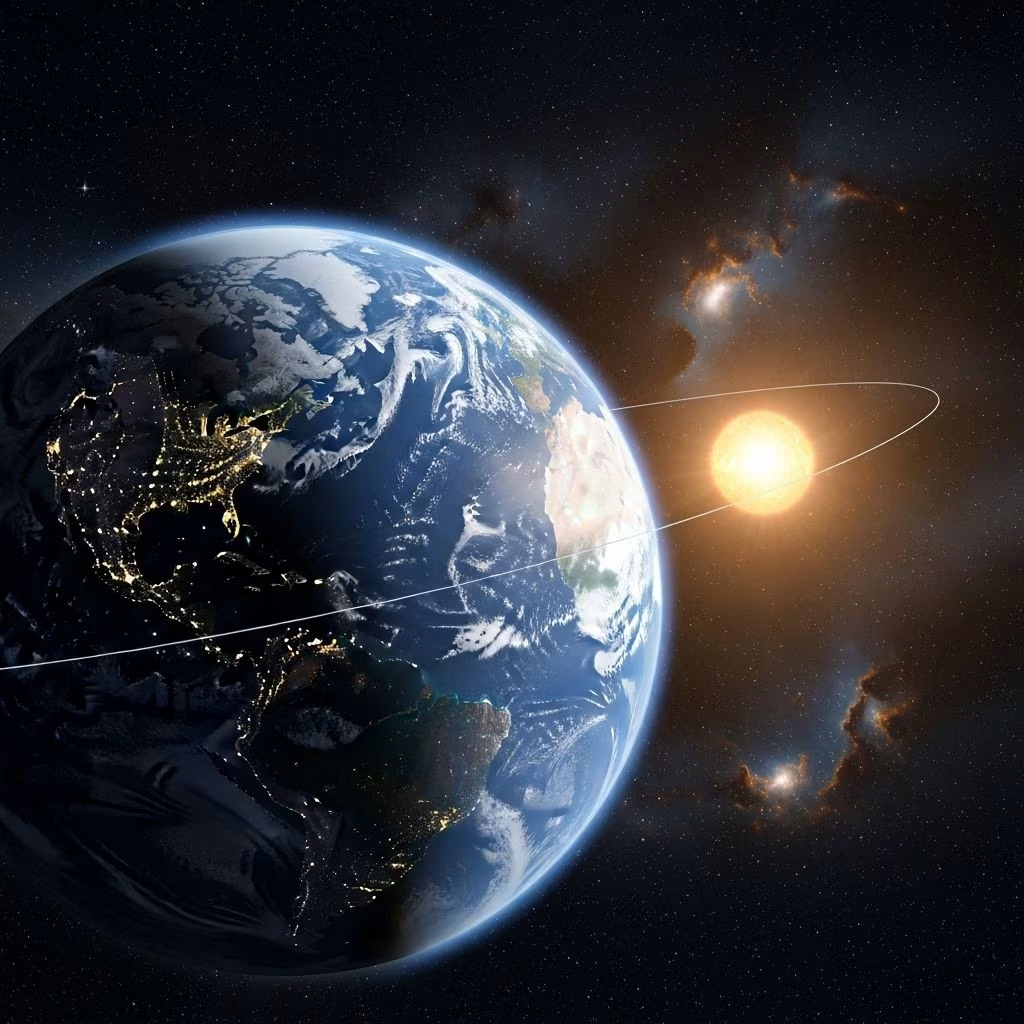
Each year, while the Northern Hemisphere braces itself against the bitter cold of January, Earth quietly glides to its closest point to the Sun. This seemingly paradoxical timing—Earth’s greatest proximity to its star during winter—raises questions about our planet’s orbit, the mechanics of the seasons, and the subtleties of climate. To understand this cosmic oddity, we must explore the shape of Earth’s path around the Sun, the role of axial tilt, and how aphelion and perihelion define our journey through space.
Annual Earth-Sun Distance: The Basics
Earth’s orbit around the Sun is not a perfect circle. Instead, it’s slightly elliptical—a stretched circle known as an ellipse. At two points during this yearly journey, our distance from the Sun hits an extreme:
- Perihelion: The point where Earth is closest to the Sun. This usually occurs in early January.
- Aphelion: The point where Earth is farthest from the Sun. This occurs in early July.
During perihelion, Earth is about 91.4 million miles (147.1 million km) from the Sun, while at aphelion, the distance extends to about 94.5 million miles (152.1 million km). The average distance between Earth and the Sun is approximately 92.96 million miles (149.6 million km).
The Science of Earth’s Orbit: Ellipses and Apsides
Earth’s elliptical orbit creates two key points called apsides:
- Perihelion (peri-, near; helios, Sun): Closest approach to the Sun.
- Aphelion (apo-, away): Farthest point from the Sun.
These events occur at specific times each year—typically in early January (perihelion) and early July (aphelion)—though the exact date shifts over centuries due to gravitational influences from other planets, especially massive ones like Jupiter and Saturn.
The Table of Distances
| Event | Distance from Sun | Approximate Date |
|---|---|---|
| Perihelion (Closest) | 91.4 million miles (147.1 million km) | Early January |
| Aphelion (Farthest) | 94.5 million miles (152.1 million km) | Early July |
Why Isn’t It Warmer When We’re Closest to the Sun?
If proximity to the Sun determined Earth’s seasons, our winters should be balmy and summers frigid, at least in the Northern Hemisphere. Yet the opposite is true: January, when Earth is nearest the Sun, is winter in the north and summer in the Southern Hemisphere.
- The difference in Earth-Sun distance between perihelion and aphelion is about 3.1 million miles, or roughly 3.4% of the total distance.
- This variation causes about a 7% increase in incoming solar energy at perihelion compared to aphelion.
- However, this energy increase has only a minor influence on temperature due to a more powerful factor: the tilt of Earth’s axis.
Earth’s Axial Tilt: The True Architect of Seasons
The dominant cause of seasons is not our distance from the Sun, but the inclination of Earth’s axis—tilted at about 23.5 degrees relative to its orbital plane. This tilt directs the Sun’s rays more directly onto one hemisphere and away from the other throughout the year.
- In the Northern Hemisphere winter, the North Pole tilts away from the Sun, leading to shorter days, more oblique sunlight, and colder temperatures—even though Earth is closer to the Sun.
- Conversely, during Southern Hemisphere summer, the South Pole tilts toward the Sun, resulting in longer, warmer days.
Thus, axial tilt, not orbital distance, is overwhelmingly responsible for seasonal changes and temperature shifts.
Perihelion and Aphelion: Energy and Climate Impact
Even though Earth receives about 7% more solar energy at perihelion, the effect on global climate is largely masked by two factors:
- Earth’s tilt, which dictates the distribution of sunlight more than the modest variation in distance.
- Ocean-dominated southern hemisphere: During Southern Hemisphere summer (when perihelion occurs), vast oceans absorb much of the additional energy, moderating temperature extremes.
Still, the difference between perihelion and aphelion can subtly affect seasonal weather—Northern Hemisphere winters can be slightly milder, and Southern summers a bit warmer, than if Earth’s orbit were perfectly circular.
The Long-term Story: Orbit Changes Over Millennia
Earth’s orbit slowly shifts over tens of thousands of years because of gravitational tugs from other planets. The eccentricity—the roundness versus ovalness—of our orbit varies through cycles called Milankovitch cycles. Right now, Earth’s orbit is nearly circular.
- In about 200,000 years, the orbit will be most elliptical, potentially causing up to a 23% difference in solar energy received between perihelion and aphelion.
- Such differences have played a role in the timing of past ice ages and global climate patterns.
Key Terms and Concepts
- Aphelion: Earth’s farthest point from the Sun, occurring in July.
- Perihelion: Closest point to the Sun, in January.
- Apsis: General term for the closest or farthest points in an orbit around another body.
- Axial tilt: The angle (23.5°) Earth’s axis makes with the vertical, driving seasonal changes.
- Milankovitch cycles: Long-term variations in Earth’s orbit and tilt that affect climate.
The Effects Around the Globe
- Northern Hemisphere:
- Coldest season occurs during perihelion.
- Winters slightly moderated by closer proximity to Sun, but colder due to tilt.
- Summers are slightly milder than if Earth’s orbit were perfectly circular.
- Southern Hemisphere:
- Summer happens at perihelion; receives extra solar energy.
- Vast ocean coverage moderates potential heat extremes.
- Climate slightly warmer during southern summer than northern summer, on average.
Separating Fact from Myth: Distance vs. Seasons
A persistent misconception is that Earth’s distance from the Sun is what creates the seasons. In reality, even though Earth is closer to the Sun in January, the Northern Hemisphere shivers through winter, while the Southern Hemisphere basks in summer heat. This seasonal reversal between hemispheres proves that it’s tilt, not distance, that truly drives weather shifts through the year.
How Perihelion and Aphelion Shift Over Time
The positions of perihelion and aphelion change gradually due to gravitational pull from the Moon and planets. Over thousands of years, perihelion occurs at different times in the calendar year. Roughly 10,000 years from now, perihelion will occur during the Northern Hemisphere’s summer—potentially creating slightly hotter summers and cooler winters in the north, and vice versa for the south.
Observing the January Sun
Those who enjoy astronomical observation may notice that the Sun appears slightly larger in the sky in early January—about 3.4% bigger—than in July, a reflection of our proximity at perihelion. However, this change is not typically visible to the unaided eye.
Frequently Asked Questions (FAQs)
Q: If we’re closer to the Sun in January, why is it still cold in the Northern Hemisphere?
A: The low angle of sunlight and shorter days caused by Earth’s axial tilt result in less energy received per square meter, making it cold despite closer proximity.
Q: How much does the Sun’s distance change between perihelion and aphelion?
A: The distance varies by about 3.1 million miles (5 million km), or roughly 3.4% of the average distance.
Q: Does the varying distance affect Earth’s temperature?
A: The 7% increase in solar energy at perihelion is far less significant than the effect of axial tilt, but it does cause minor differences, such as slightly milder northern winters and warmer southern summers.
Q: Can Earth’s orbital changes lead to climate change?
A: Yes, over tens of thousands of years, changes in orbit shape and tilt can and have triggered ice ages and global climate fluctuations, known as Milankovitch cycles.
Q: Will perihelion always occur in January?
A: No, due to precession and orbital changes, perihelion slowly shifts relative to the calendar, so in thousands of years, it will occur in different months and seasons.
Fun Facts and Did You Know?
- The words perihelion and aphelion are from Greek: peri- means near, apo- means away, helios means Sun.
- Other planets have much more eccentric (less circular) orbits—Mercury’s distance from the Sun changes dramatically through the year!
- Earth’s orbital eccentricity is currently very low, making the difference between perihelion and aphelion relatively small, but this will increase again in the far future.
- The difference in apparent solar size is about as large as the Moon’s size varies from perigee to apogee.
Summary Table: Earth’s Orbit, Sun Distance, and Seasons
| Event | Distance from Sun | Northern Hemisphere Season | Southern Hemisphere Season |
|---|---|---|---|
| Perihelion | 91.4 million miles (147.1 million km) | Winter | Summer |
| Aphelion | 94.5 million miles (152.1 million km) | Summer | Winter |
Visualizing Our Dynamic Orbit
Earth’s relationship with the Sun is a dance orchestrated by gravity, geometry, and the cosmic cycles of time. The closest embrace in January is a subtle reminder of the complexity that shapes our weather and planetary climate—where orbital science meets daily experience. As Earth continues its long journey, the timing, distance, and tilt will keep shifting, weaving the story of seasons, climate, and change for eons to come.
References
- https://www.space.com/3304-earth-closest-sun-dead-winter.html
- https://www.timeanddate.com/astronomy/perihelion-aphelion-solstice.html
- https://www.earthdate.org/episodes/winter-sun-close-encounter
- https://en.wikipedia.org/wiki/Apsis
- https://www.farmersalmanac.com/aphelion-and-perihelion
- https://coolcosmos.ipac.caltech.edu/ask/8-How-far-away-is-the-Sun-
- https://spaceplace.nasa.gov/seasons/en/
- https://www.weather.gov/fsd/season
- https://ssec.si.edu/stemvisions-blog/what-winter-solstice
- https://en.wikipedia.org/wiki/Earth’s_orbit
- https://www.youtube.com/watch?v=ogVXjSwfZkw
- https://www.rutgers.edu/news/earth-sun-distance-sharply-alters-seasons-tropical-pacific-22000-year-cycle
- https://www.space.com/earth-perihelion-closest-sun-approach-2020.html
- https://sten.astronomycafe.net/what-is-the-distance-from-the-sun-to-the-earth-for-each-month-of-the-year/
- https://www.youtube.com/watch?v=1fX-JR9GcxY
- https://testbook.com/question-answer/when-the-earth-is-closest-to-the-sun-it-is-known–5f5a8b0becfb7b4424c8362d