Is Our Universe Trapped Inside a Black Hole? The JWST Discovery That Challenges Cosmology
James Webb Space Telescope (JWST) is revolutionizing how we perceive the cosmos, especially after its recent findings hint at a preferred direction of galactic rotation within the universe. This enigmatic trend fuels bold speculation that our universe itself might reside inside a black hole, challenging established cosmological theories and inviting scientists to reconsider how our universe began and evolved.
Contents
- The Revolutionary Impact of the James Webb Space Telescope
- Galactic Rotation: Surprising Patterns in Deep Space
- Black Hole Cosmology: Can Our Universe Exist Inside a Black Hole?
- Implications for Cosmology and Physics
- JADES — The Deep Extragalactic Survey Behind the Discovery
- Alternative Explanations and Scientific Debate
- Frequently Asked Questions (FAQs)
The Revolutionary Impact of the James Webb Space Telescope
Launched with a price tag of $10 billion, the James Webb Space Telescope began observations in Summer 2022. It was engineered to unlock the secrets of the early universe, using infrared imaging to see further and deeper into space than any predecessor. JWST provides high-resolution data on the structure and evolution of galaxies, the properties of ancient stars, and the mysterious phenomena surrounding black holes.
- High-Sensitivity Instruments: Allow JWST to observe faint galaxies and cosmic events, such as black hole genesis and galactic mergers.
- Advanced Imaging: With NIRCam and MIRI, JWST achieves unprecedented spatial and spectral detail.
- Global Collaboration: NASA, ESA, and numerous international teams interpret and analyze JWST’s discoveries.
Galactic Rotation: Surprising Patterns in Deep Space
One of JWST’s most provocative findings reveals that galaxies observed in deep space do not exhibit random spin orientations. Instead:
- About two-thirds of galaxies rotate clockwise.
- The remaining one-third rotate counter-clockwise.
Such a preference is unexpected. In a truly random universe, astronomers would anticipate an even 50/50 split between clockwise and counter-clockwise spinning galaxies. However, Webb’s data, compiled from observing 263 galaxies as part of the JADES survey, challenges this expectation.
“It is still not clear what causes this coordinated rotation, but two primary explanations have emerged,” says Lior Shamir, associate professor at Carl R. Ice College of Engineering.
Table: Galactic Spin Patterns
| Spinning Direction | Expected Percent (Random) | Observed Percent (JWST) |
|---|---|---|
| Clockwise | 50% | ~66% |
| Counter-Clockwise | 50% | ~34% |
Black Hole Cosmology: Can Our Universe Exist Inside a Black Hole?
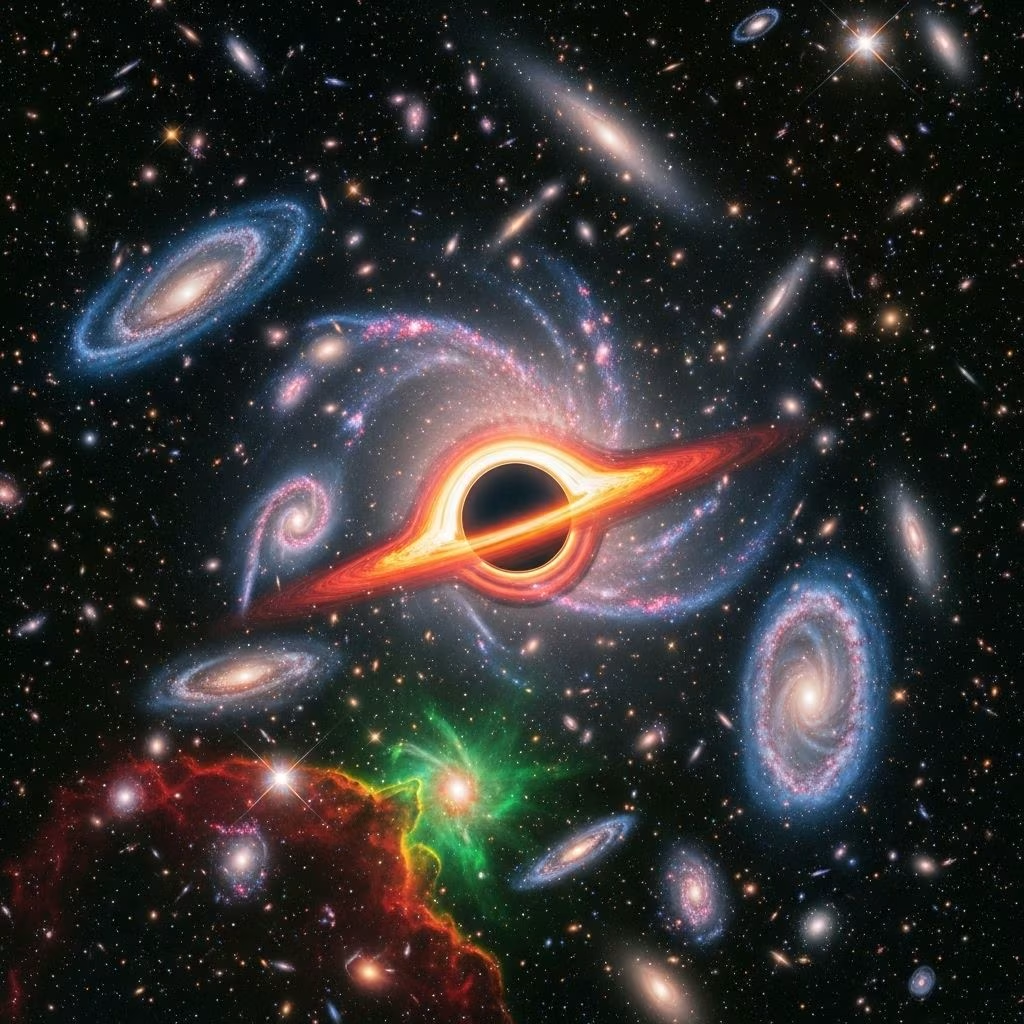
The black hole cosmology hypothesis posits that our universe could be the interior of a massive black hole – a concept supported by the observed preferential galactic rotation. Webb’s findings suggest a primordial cosmic spin, implying the universe may have begun rotating. Such a framework aligns with theories in black hole cosmology, which propose that black holes could contain entire universes within their event horizons.
Key ideas within black hole cosmology:
- Event Horizon: The boundary beyond which nothing escapes could coincide with the edge of our universe.
- Primordial Rotation: The universe may possess a net angular momentum inherited from its birth inside a rotating black hole.
- Impacts on Physics and Geometry: A rotating universe could affect time, space, and cosmic structure in novel ways, challenging Einstein’s General Relativity and standard cosmological models.
This hypothesis, while controversial, opens profound questions about the structure, origin, and fate of the universe itself.
Implications for Cosmology and Physics
If the universe was born with rotation, as JWST’s coordinated galactic spins suggest, current cosmological theories may require substantial revision. Traditionally, cosmologists assume the universe has no global spin – its properties are statistically random on large scales. However, JWST’s observations imply otherwise.
- Incomplete Theories: Existing models, such as the Big Bang and Cosmic Inflation, do not predict a global spin or preferential galactic rotation.
- New Questions: What caused the universe to rotate? Did a parent universe or a massive black hole instigate this cosmic spin?
- Observable Consequences: Rotation could influence galaxy formation, cosmic microwave background, and even fundamental constants.
Such findings represent not just a challenge, but a call to seek deeper understanding through both observation and theory.
JADES — The Deep Extragalactic Survey Behind the Discovery
The James Webb Space Telescope Advanced Deep Extragalactic Survey (JADES) is essential to this discovery. By targeting the faintest, most distant galaxies, JADES collects valuable data about the early universe, its composition, and dynamics.
- Scope: JADES focuses on regions previously examined by Hubble, providing extended wavelength coverage and improved sensitivity.
- Sample: The surprise emerged from analysis of 263 galaxies’ rotation directions.
- Methodology: By mapping spin patterns at varying redshifts, astronomers can probe universal structure back to just a few hundred million years after the Big Bang.
Alternative Explanations and Scientific Debate
While black hole cosmology offers one explanation, it is vital to recognize that these observations are still subject to scrutiny and debate. Other interpretations include:
- Primordial Fields: Unknown quantum or gravitational effects in the early universe may have imposed a rotational bias.
- Anisotropic Initial Conditions: The universe’s birth could have been influenced by uneven distributions of mass or energy.
- Measurement Bias: The survey, though extensive, may reflect selection effects or unaccounted-for observational asymmetries.
As the JWST continues its survey, more data will clarify whether this coordinated spin is a universal property, or an artifact of how we study the cosmos. The scientific community remains split – some embrace radical cosmological revisions, while others seek more mundane explanations for the anomaly.
Frequently Asked Questions (FAQs)
Q: What is the significance of JWST finding coordinated galactic spins?
The finding challenges the assumption that the universe is statistically random and suggests it may have a global property such as rotation, which has dramatic implications for models of cosmic evolution.
Q: What does “black hole cosmology” mean?
This is a theory proposing the universe exists inside the event horizon of a supermassive black hole, meaning what we perceive as the universe could be the “interior” of such a cosmic object.
Q: Were these results expected?
No. Astronomers anticipated random orientation of galactic spins. JWST’s discovery of a preferred direction was surprising and not predicted by existing theories.
Q: What is JADES and why is it important?
JADES stands for the James Webb Space Telescope Advanced Deep Extragalactic Survey. It provides high-quality data about the deepest, earliest galaxies, essential for testing cosmological models.
Q: Does this mean the Big Bang theory is wrong?
Not necessarily. The findings suggest our understanding may be incomplete — current theories may need revision or extension to account for these new observations.
Q: How might a rotating universe affect our understanding of physics?
A rotating universe could lead to new insights about the structure of spacetime, the behavior of fundamental forces, and the possible connection between black holes and cosmic origins.
Key Takeaways & Next Steps
- The James Webb Space Telescope has found a surprising pattern in galactic rotation, challenging traditional cosmological wisdom.
- The “black hole cosmology” hypothesis is receiving renewed attention as a potential explanation for the universe’s coordinated spin.
- JADES survey data offers the clearest evidence yet for these phenomena, but further research is needed to confirm their universality.
- Scientists are actively debating both radical and conservative interpretations of the JWST findings, with far-reaching implications for physics and metaphysics.
Further Reading & Related Topics
- Latest advancements in deep field surveys
- The role of rotational symmetry in cosmology
- How black holes shape galactic evolution
- JWST’s discoveries on early universe structure
- Challenges to the standard Big Bang paradigm
Summary
The James Webb Space Telescope’s recent revelations about the coordinated rotation of galaxies in the early universe prompt new questions in cosmology. By possibly hinting at a rotating universe or a black hole interior, these findings challenge foundational assumptions and open new avenues for research into the origin, structure, and eventual fate of everything we know.
References
- https://www.space.com/space-exploration/james-webb-space-telescope/is-our-universe-trapped-inside-a-black-hole-this-james-webb-space-telescope-discovery-might-blow-your-mind
- https://science.nasa.gov/blogs/webb/2025/07/15/nasas-webb-finds-possible-direct-collapse-black-hole/
- https://www.space.com/astronomy/black-holes/james-webb-space-telescope-finds-black-holes-that-waited-patiently-before-devouring-stars-in-dusty-galaxies
- https://esawebb.org/news/weic2413/
- https://news.mit.edu/2025/astronomers-discover-star-shredding-black-holes-hiding-in-dusty-galaxies-0724
- https://www.youtube.com/watch?v=7HUq_61mXHw
- https://science.nasa.gov/missions/webb/webb-reveals-rapid-fire-light-show-from-milky-ways-central-black-hole/
- https://www.livescience.com/space/black-holes/not-little-red-dots-or-roaring-quasars-james-webb-telescope-uncovers-new-kind-of-hidden-black-hole-never-seen-before
- https://www.youtube.com/watch?v=EIhahXWYP1A
- https://www.jameswebbdiscovery.com/discoveries/james-webb-space-telescope-unveils-record-breaking-black-hole-uhz1
- https://www.jameswebbdiscovery.com/discoveries/james-webb-telescope-discovers-most-ancient-supermassive-black-hole
- https://www.livescience.com/space/black-holes/james-webb-telescope-spots-earliest-black-hole-in-the-known-universe-looking-as-far-back-as-you-can-practically-go
- https://timesofindia.indiatimes.com/science/are-we-living-inside-a-black-hole-nasa-james-webb-findings-stun-scientists/articleshow/121971556.cms
- https://www.quantamagazine.org/a-single-naked-black-hole-rewrites-the-history-of-the-universe-20250912/
- https://indianexpress.com/article/technology/science/black-hole-discovery-james-webb-telescope-scientists-alarmed-10071718/
- https://www.iflscience.com/unexpected-jwst-observations-hint-we-might-be-inside-a-black-hole-78407
- https://en.wikipedia.org/wiki/James_Webb_Space_Telescope
- https://www.rudebaguette.com/en/2025/06/were-trapped-in-a-black-hole-james-webbs-latest-discovery-sparks-existential-panic-across-the-global-scientific-community/