


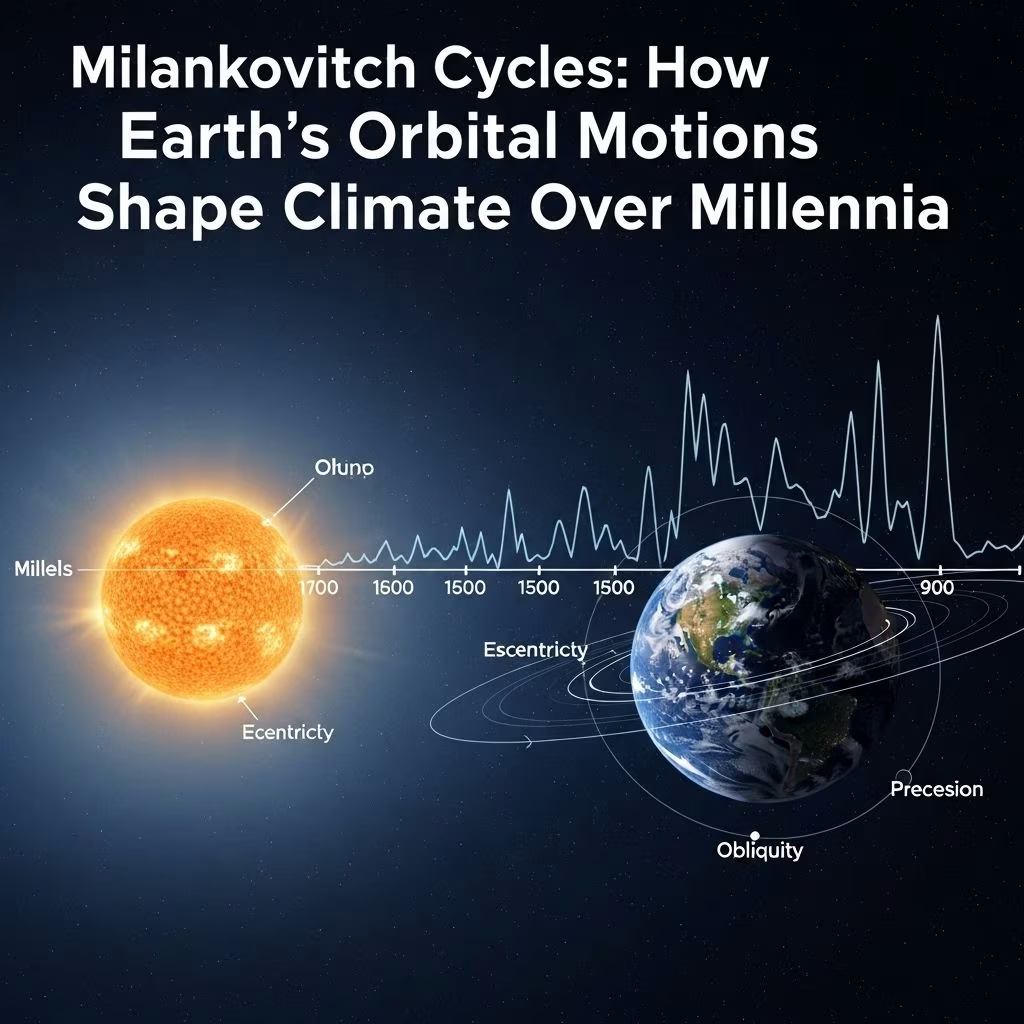
Milankovitch Cycles: The Astronomical Forces Behind Earth’s Climate Patterns
Earth’s climate has shifted radically over millions of years, swinging between icy glacial periods and warmer interglacials. But what orchestrates these colossal changes? While greenhouse gases, volcanism, and ocean currents all influence climate, one of the most fundamental drivers is a trio of astronomical cycles—Milankovitch cycles. These orbital variations, first quantified by Serbian mathematician Milutin Milanković in the early 20th century, continually shape the sunlight falling on Earth and trigger long-term climate swings, including the advance and retreat of ice sheets.
Origins & Historical Development
The concept of Earth’s orbital cycles influencing climate originated with early scientists such as Joseph Adhemar and James Croll, but gained traction after Milutin Milanković integrated mathematics and astronomy to demonstrate that subtle shifts in Earth’s orbit and orientation could modulate the distribution of solar energy across the planet. Initially met with skepticism, his ideas gained support with the discovery of geological and ice core records corroborating periodic ice ages tied to these cycles.
- Milanković’s calculations showed how changes in Earth’s position altered global temperature and could trigger ice ages.
- His theory became widely accepted after deep-sea cores revealed glacial cycles matching predicted orbital periods.
- The foundational paper “Variations in the Earth’s Orbit: Pacemaker of the Ice Ages” (Hays, Imbrie & Shackleton, 1976) established close links between orbital cycles and major climate shifts.
The Three Milankovitch Cycles
Milankovitch cycles comprise three main types of orbital variation, each operating over tens to hundreds of thousands of years:
| Cycle Name | Period (Years) | Key Effect |
|---|---|---|
| Eccentricity | ~100,000 | Changes shape of Earth’s orbit |
| Obliquity | ~41,000 | Changes tilt of Earth’s axis |
| Precession | ~23,000 | Wobble in Earth’s rotational axis |
Eccentricity: The Shape of Earth’s Orbit
Eccentricity refers to Earth’s orbital shape around the Sun, which fluctuates between more circular and more elliptical over about 100,000 years.
- When the orbit is more elliptical, Earth’s distance from the Sun changes more throughout the year, affecting the amount of solar energy received.
- A circular orbit creates less seasonal variation, while an elliptical orbit increases differences in solar radiation—and therefore temperature—between seasons.
- Lower eccentricity leads to milder seasons, favoring ice sheet buildup.
Obliquity: The Tilt of Earth’s Axis
Obliquity is the angle of Earth’s axis relative to its orbital plane. This tilt shifts from about 22.1° to 24.5° in a cycle repeating every 41,000 years.
- Currently, Earth’s obliquity is 23.44° and is decreasing.
- A larger tilt intensifies seasonal differences, making summers hotter and winters colder, especially at higher latitudes.
- Smaller tilt results in milder seasons and colder summers, enabling glacial ice to accumulate.
Precession: The Wobble of Earth’s Axis
Precession describes the slow wobble in Earth’s axis, changing the timing of seasons and which hemisphere tilts toward the Sun at different points in orbit. This cycle occurs over approximately 23,000 years.
- Precession affects whether the Northern or Southern Hemisphere experiences greater seasonal contrast.
- Alters the strength and duration of summers and winters over millennia.
Milankovitch Cycles and Climate Change
The interplay of eccentricity, obliquity, and precession determines how much sunlight strikes various regions of the planet, especially high latitudes. These changes in insolation (incoming solar radiation) drive large-scale climate shifts:
- Ice Ages: Lower summer insolation at high latitudes—often due to lower tilt and high eccentricity—prevents ice sheets from melting, triggering glacial periods.
- Interglacials: Increased tilt or altered precession can bring about warmer summers, melting ice and creating interglacial periods.
- Feedback loops, such as changes in greenhouse gases and ice sheet dynamics, amplify the initial effects of orbital cycles.
Summary Table: Milankovitch Cycles’ Effects on Climate
| Cycle | Main Climate Effect |
|---|---|
| Eccentricity | Controls the difference between seasons due to orbital shape; modulates ice sheet growth. |
| Obliquity | Sets severity of seasons, particularly summers at high latitudes; affects ice sheet melting. |
| Precession | Changes timing of seasons; can intensify heating/cooling of hemispheres over cycles. |
Long-Term Climate Patterns
Milankovitch cycles explain repeated ice ages during the Quaternary Period (past ~2.6 million years). These cycles, combined with carbon dioxide feedback and other factors, produce a complex rhythm of glaciations and interglacials spanning hundreds of thousands of years.
Why Milankovitch Cycles Cannot Explain Modern Climate Change
Though Milankovitch cycles have driven climate changes for millions of years, they don’t account for the rapid warming observed over the past century. Key distinctions include:
- Current orbital trends suggest Earth should be slowly cooling—if anything, headed toward a future ice age.
- Present-day warming is occurring on a much shorter timescale (decades), far faster than any orbital cycle could produce.
- Evidence shows human-generated greenhouse gases are the main driver of recent warming, not Milankovitch cycles.
In short: Milankovitch cycles set the stage for natural climate variation, but cannot explain the accelerated changes of the 21st century.
Evidence Supporting Milankovitch Theory
The theory has strong empirical support:
- Deep ocean cores reveal layers of glacial debris matching orbital cycles predicted by Milanković.
- Ice cores from Greenland and Antarctica display timing of ice ages and interglacials that correspond to eccentricity and obliquity cycles.
- Advances in radiometric dating allow scientists to correlate climate proxies with orbital cycles over millions of years.
Scientific Challenges and Open Questions
Despite their predictive power, Milankovitch cycles present scientific puzzles:
- 100,000-year problem: The strongest climate response is at the 100,000-year scale (eccentricity), yet its direct solar forcing is surprisingly small. Scientists propose amplifying feedbacks (CO₂, ice sheets) to explain this discrepancy.
- 400,000-year problem: Less pronounced but influential cycles exist over 400,000 years; their climate effects are less clear.
- Some aspects of ice age timing, amplitude, and feedback remain active areas of research.
Can Milankovitch Cycles Predict Future Ice Ages?
Given current orbital trends, Earth may eventually return to a glacial phase—but only on timescales of tens of thousands of years and contingent on anthropogenic effects. Human activities may fundamentally alter natural climate rhythms.
Frequently Asked Questions (FAQs)
What are Milankovitch cycles?
Milankovitch cycles are periodic changes in Earth’s orbit and axis that alter the distribution and intensity of sunlight reaching the planet, driving long-term climate shifts such as ice ages and interglacials.
How do Milankovitch cycles affect ice ages?
These cycles modulate solar energy at high latitudes, allowing ice sheets to grow or melt. Certain combinations (e.g., low tilt, high eccentricity) reduce summer melting, often triggering an ice age.
Can Milankovitch cycles explain current global warming?
No. The rapid pace and magnitude of present-day warming are linked to human sources of greenhouse gases, not orbital cycles. Milankovitch trends would predict gradual cooling, not warming, in today’s era.
Why is the 100,000-year cycle so influential?
Although eccentricity cycles exert modest direct effect, powerful feedbacks involving CO₂, ice sheets, and ocean currents magnify their climate impact, leading to dominant glacial-interglacial rhythms.
How were Milankovitch cycles confirmed?
Analysis of deep-ocean sediments and ice cores revealed cycles matching theoretical predictions. The 1976 study by Hays, Imbrie, and Shackleton linked orbital rhythms with ice age timing.
Are there other astronomical cycles?
Yes. Earth’s orbital inclination and long-period planetary gravitational influences can also contribute to minor climate variations, though the main effects stem from eccentricity, obliquity, and precession.
Further Reading
- “Milankovitch (Orbital) Cycles and Their Role in Earth’s Climate” – NASA Earth Science
- “Milankovitch Cycles” – Wikipedia
- “Why Milankovitch Cycles Can’t Explain Earth’s Current Warming” – NASA
Summary
Milankovitch cycles reveal how tiny, slow-moving changes in Earth’s orbital dynamics hold the keys to the planet’s greatest climate transformations. Their science allows us to decode the past, understand ice ages, and anticipate how astronomical rhythms may shape our future—always tempered by the new force of human activity.
References
- https://science.nasa.gov/science-research/earth-science/milankovitch-orbital-cycles-and-their-role-in-earths-climate/
- https://en.wikipedia.org/wiki/Milankovitch_cycles
- https://science.nasa.gov/science-research/earth-science/why-milankovitch-orbital-cycles-cant-explain-earths-current-warming/
- http://www.climatedata.info/forcing/milankovitch-cycles/
- https://earthhow.com/milankovitch-cycle/
- https://greenly.earth/en-gb/blog/ecology-news/the-influence-of-milankovitch-cycles-on-climate
- https://en.wikipedia.org/?title=Milankovitch_cycle&redirect=no
- https://courses.seas.harvard.edu/climate/eli/Courses/EPS281r/Sources/Glacial-cycles/Milankovitch-cycles-Wikipedia.pdf
- https://www.savemyexams.com/dp/environmental-systems-and-societies-ess/ib/24/hl/revision-notes/6-atmosphere-and-climate-change/6-1-introduction-to-the-atmosphere/milankovitch-cycles-hl/
- https://ossfoundation.org/projects/environment/global-warming/milankovitch-cycles/
- https://energyeducation.ca/encyclopedia/Milankovitch_cycle
- https://www.youtube.com/watch?v=iA788usYNWA
- https://www.youtube.com/watch?v=SReo3r3X3q8
- https://geoetc.com/milankovich-cycles/
- https://www.amnh.org/learn-teach/curriculum-collections/earth-inside-and-out/milutin-milankovitch-seeking-the-cause-of-the-ice-ages
- https://fiveable.me/key-terms/introduction-environmental-science/milankovitch-cycles
- https://library.fiveable.me/key-terms/intro-astronomy/milankovitch-cycles
- https://www.universetoday.com/articles/milankovitch-cycle


