The Greatest Spaceships of Science Fiction
Humanity’s fascination with space travel is reflected throughout popular culture, and nowhere is this more evident than in the legendary spaceships imagined by science fiction creators. From the pulse-pounding dogfights of intergalactic warships to quirky vessels that bend the very fabric of reality, these ships have become icons in their own right. Whether forged in the universe of movies, television, or gaming, these spacecraft capture our collective dreams, inspire real technological advances, and have attained cult status in the hearts of fans everywhere.
Why Spaceships Captivate Our Imaginations
Spaceships in science fiction often embody humanity’s greatest hopes and wildest fears for the future. They symbolize exploration, technological progress, adventure, and sometimes, existential dread. These vessels serve as settings for epic narratives or become central characters themselves, steering the course of legendary sagas and titanic conflicts.
- Exploration & Adventure: Spaceships enable characters (and viewers) to voyage beyond the familiar, discovering new worlds and civilizations.
- Technological Marvels: Ships represent the pinnacle of fictional engineering, often far surpassing our real-world counterparts.
- Iconic Design: Unforgettable shapes, interiors, and features elevate certain ships to instant recognition.
- Symbolic Meaning: Some vessels stand as metaphors for the journeys and struggles of humanity itself.
Legendary Spacecraft: The Icons of Science Fiction
Across decades of speculative storytelling, some spaceships have emerged as true legends. The following vessels are chosen for their influence on pop culture, the ingenuity of their design, and the pivotal roles they play in their respective universes.
UNSC Infinity (“Halo” Franchise)
The UNSC Infinity is the largest and most technologically sophisticated warship in the “Halo” gaming universe. Commissioned to lead humanity’s defense, the Infinity features:
- Advanced Forerunner technology integrated with human engineering
- Tremendous firepower — including energy projectors and a complement of smaller attack craft
- Capability to deploy thousands of troops and vehicles for ground operations
The Infinity stands as the ultimate show of force in the “Halo” narrative, frequently acting as the last hope against alien threats.
Heighliner (“Dune” 2021)
From Frank Herbert’s “Dune” saga, the Heighliner is a colossal, cylindrical spacecraft operated by the Spacing Guild. These ships are unique for their ability to:
- Transport entire armies, vehicles, and cargo across interstellar distances instantaneously
- Utilize foldspace technology, relying on telepathic Navigators empowered by the spice melange
- Enable the complex feudal politics of the Dune universe by uniting distant worlds
Heighliners are more than transports — they are both technological marvels and pawns in the grand chessboard of interstellar intrigue.
TARDIS (“Doctor Who”, 1963-)
Unlike any conventional vessel, the TARDIS (Time And Relative Dimension In Space) is the time machine of the Doctor, a Time Lord from Gallifrey. The outside is a humble blue police box, but appearances deceive:
- It is “dimensionally transcendental”: far larger inside than outside
- Capable of traveling anywhere in time and space
- Almost indestructible, self-aware, and occasionally operates with a will of its own
The TARDIS is both vehicle and character, inseparable from the grand, decades-spanning saga of “Doctor Who.”
Battlestar Galactica (“Battlestar Galactica”, 2004-09)
As nearly all of humanity falls to the Cylons, the Battlestar Galactica leads the survivors on a desperate search for a new home. Notable features include:
- A combination of massive firepower and robust defensive armor
- Ability to launch and recover Viper fighters for both attack and defense
- Central to the series’ themes of hope, resilience, and the search for meaning in adversity
Galactica’s battered hull and dogged persistence mirror those of its crew, fighting against seemingly impossible odds.
Elysium Ship (“Elysium”, 2013)
The titular orbiting habitat in “Elysium” is not a warship, but a symbol of both progress and inequality. Key aspects:
- Massive torus structure — a self-contained space habitat, echoing the concept of an O’Neill Cylinder
- Luxurious living conditions for Earth’s elite, in stark contrast to the impoverished surface below
- Visualizes the intersection of technology with themes of class and privilege
The ship’s utopian surface belies the harsh social truths it helps perpetuate.
Reapers (“Mass Effect” Franchise)
The Reapers are among the most terrifying antagonists in gaming lore — colossal, sentient machines that cyclically exterminate advanced civilizations. Their defining characteristics:
- Organic-machine hybrid construction, millions of years old
- Immeasurable firepower and near-invulnerability
- Ability to indoctrinate and control other species across the galaxy
Reapers are a potent metaphor for forces—technological and otherwise—beyond comprehension or control.
USS Enterprise Line (“Star Trek” Franchise)
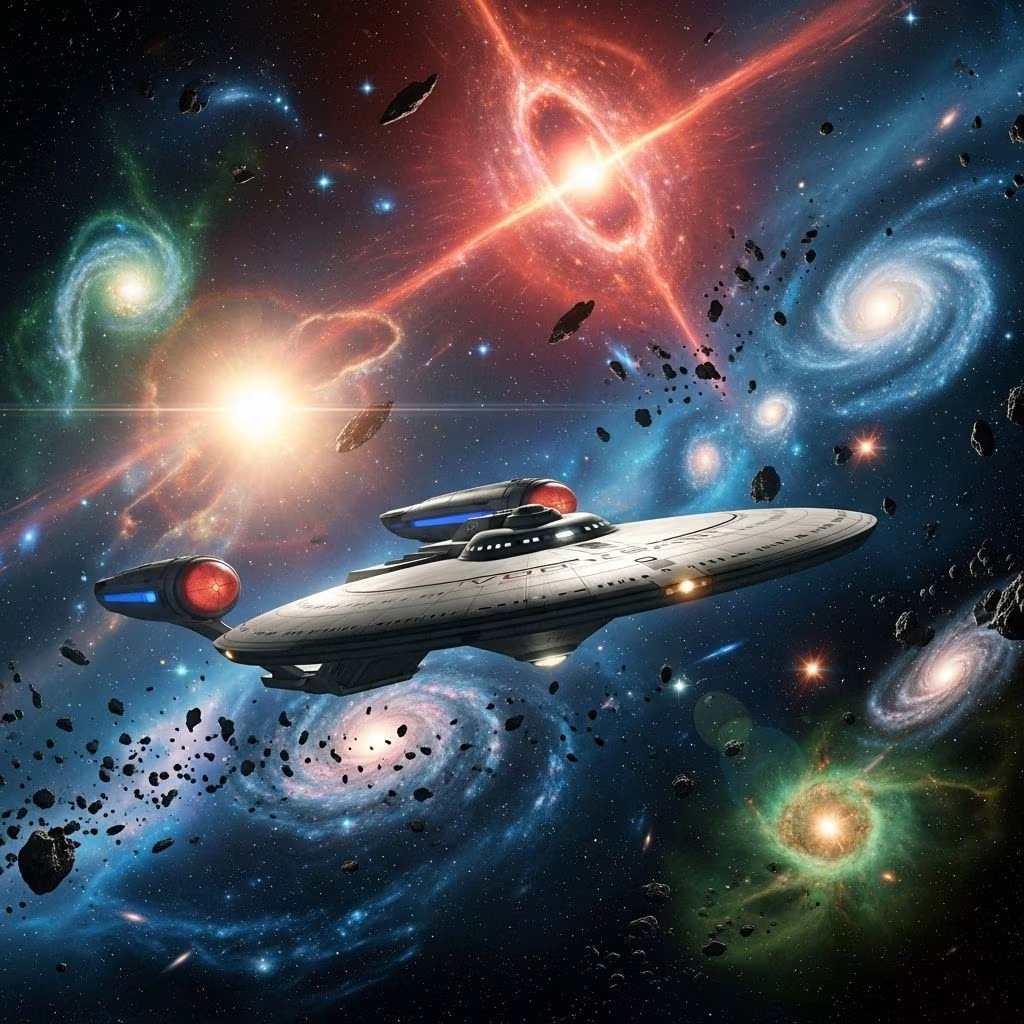
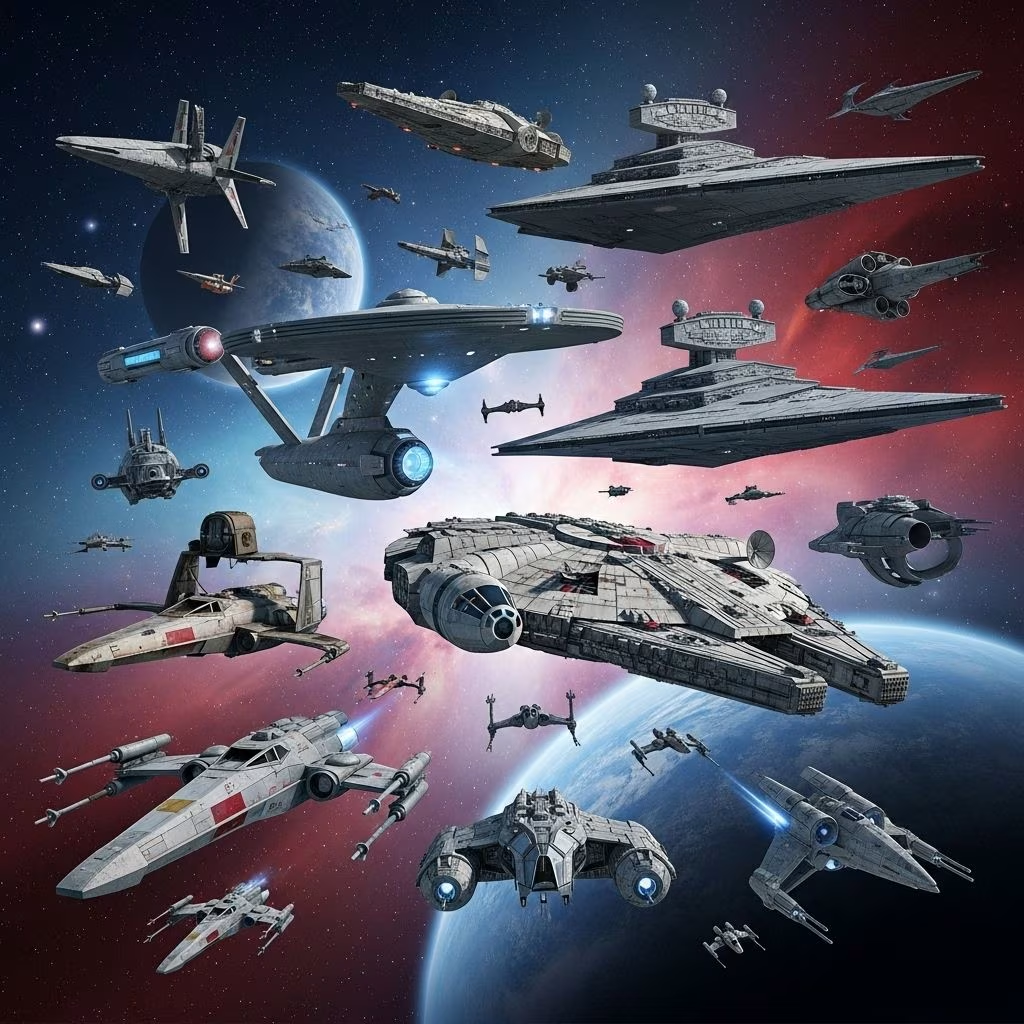
The USS Enterprise is perhaps the most famous spaceship in sci-fi, with multiple incarnations spanning centuries within the “Star Trek” universe. Across all versions, the Enterprise is known for:
- Exploration-driven missions — “to boldly go where no one has gone before”
- Advanced technologies: warp drive, transporters, replicators, deflector shields
- Serving as both setting and character, shaping countless adventures and moral dilemmas
| Enterprise Model | Era | Notable Features |
|---|---|---|
| NX-01 | 22nd Century | Proto-warp technology |
| NCC-1701 | 23rd Century | First contact and diplomacy |
| NCC-1701-D | 24th Century | Holodecks, families on board |
The Enterprise is the gold standard for science fiction starships — inspiring generations with its vision of hope, unity, and exploration.
Millennium Falcon (“Star Wars” Franchise)
Han Solo’s Millennium Falcon is the quintessential “hunk of junk” with a heart of gold and the speed to match. Celebrated for:
- Record-breaking speed and maneuverability, thanks to extensive (and sometimes questionable) modifications
- Hiding massive firepower in a stout freighter frame
- Being the vessel of choice for heroes, smugglers, and legends throughout the galactic civil war
The Falcon’s underdog charisma, battered shape, and unforgettable silhouette have propelled it to all-time icon status.
Serenity (“Firefly” Franchise)
The Serenity is a “Firefly-class” transport ship captained by Malcolm Reynolds and his ragtag crew of misfits. The ship stands out for:
- Blending lived-in realism and homely charm — “home is where your crew is”
- Serving as a sanctuary for the outcast and hunted
- Symbolizing freedom, independence, and rebellion
Serenity gained cult status, beloved for its distinctive shape and role in one of sci-fi television’s most cherished short-lived series.
Alien Ships in “Arrival” (2016)
The mysterious, gravity-defying vessels in “Arrival” instantly set themselves apart with their unique design and function:
- Oblong, monolithic “shells” that hover above Earth at seemingly random locations
- Defy traditional human methods of communication and understanding
- Enable the film’s themes of language, time, and interconnectedness
These ships challenge the very conventions of what a spaceship should look like or how it should function.
The Endurance (“Interstellar” 2014)
Wormhole travel and desperate hope define the mission of The Endurance in “Interstellar.” The ship is acclaimed for:
- Advanced modular design: a ring of connected habitats that simulate gravity
- Support for long-duration, deep-space missions
- Acting as a stage for the film’s emotional stakes and moral questions
The Endurance combines realism with the romance of cosmic adventure, rooted in plausible scientific concepts.
Spaceball One (“Spaceballs”, 1987)
Blending parody with absurdity, Spaceball One is the flagship of absurd villain Dark Helmet. It is best known for:
- Cramming every cliche of sci-fi starships into one hilarious vessel
- Comically oversized — transforms into a maid for the film’s climactic gag
- Poking fun at blockbuster franchises while lovingly embracing them
Spaceball One is a comedic tribute to the excesses and absurdities of spacecraft in pop culture.
Spaceships in Pop Culture: More Than Mere Hardware
Spaceships in science fiction are never just functional machines. They act as homes, battlegrounds, symbols, and sometimes, villains themselves. Their appearances influence real-world aesthetics and even inspire serious innovation among engineers and visionaries. From NASA to private space enterprises, echoes of sci-fi designs can be seen in everyday conversations about the future of human spaceflight.
- Community & Identity: Ships often define communities within their stories, forging a sense of belonging among characters (and fans).
- Technological Inspiration: Concepts like warp drive, artificial gravity, and advanced AI have played an indirect role in motivating scientific research.
- Storytelling Centerpieces: The journeys of these ships are allegories for human adventure and struggle.
Frequently Asked Questions (FAQs)
Which is the fastest spaceship in science fiction?
Depending on the definition, the Millennium Falcon is famed for its “less than twelve parsecs” Kessel Run, but the TARDIS from “Doctor Who” can travel instantly across time and space, arguably making it the fastest vessel of all.
Are any of these spaceships based on real science?
Several ships, notably the Endurance in “Interstellar,” draw on the input of real astrophysicists and engineers for authenticity, whereas most blend scientific ideas with creative liberties.
What makes a spaceship ‘iconic’ in science fiction?
Design, narrative centrality, technological invention, and impact on audiences all contribute. Ships like the USS Enterprise and Millennium Falcon are instantly recognizable and resonate beyond their stories.
Are there any ships that are also characters?
Yes. The TARDIS is sentient and self-aware, and ships like Serenity and the Millennium Falcon are deeply intertwined with the journeys and identities of their crews.
How has real-world spaceflight drawn inspiration from sci-fi ships?
Designers and visionaries such as Elon Musk and Jeff Bezos have cited influences from fiction. The boundary between sci-fi dreams and real engineering is increasingly porous, making these ships powerful sources of inspiration.
Final Thoughts
The enduring appeal of fictional starships is a testament to the power of imagination. By dreaming up starcruisers, time machines, and universe-spanning flagships, science fiction writers, filmmakers, and artists expand what is possible — not just on screen or in print, but in human culture. As our own technology evolves, the line between the possible and impossible will continue to blur, but the greatest spaceships of science fiction will always be our guides to the stars.
References
- https://www.space.com/42312-greatest-spaceships-of-science-fiction.html
- https://en.wikipedia.org/wiki/List_of_fictional_spacecraft
- https://richardaustinwriter.com/2017/01/26/top-50-spaceships-ever-plus-mine/
- https://www.gamesradar.com/top-50-sci-fi-spaceships/
- https://scifi.fandom.com/wiki/List_of_fictional_spacecraft
- https://www.space.com/42312-greatest-spaceships-of-science-fiction/2.html
- https://collider.com/best-movie-tv-spaceships/
- https://www.youtube.com/watch?v=5cNtOvrSdDI
- https://www.youtube.com/watch?v=3nDtudJQPGY
- https://www.sciencefictionclassics.com/explore-the-galaxy-with-these-15-iconic-sci-fi-spaceships-found-on-amazon/
- https://thefantasyreviews.com/2023/05/15/top-9-iconic-spaceships-in-science-fiction-books/
- https://spacespecialists.com/fun-stories/coolest-craziest-sci-fi-spacecraft/
- https://screenrant.com/sci-fi-space-ships-ranked/
- https://www.gamesradar.com/top-50-sci-fi-spaceships/2/
- https://sciencefiction.com/2011/12/15/top-10-sci-fi-movie-spaceships/
- https://www.syfy.com/syfy-wire/best-spaceships-millennium-falcon-enterprise-tardis-the-ark
- https://science.howstuffworks.com/the-10-coolest-spaceships-in-movie-and-tv-history.htm