


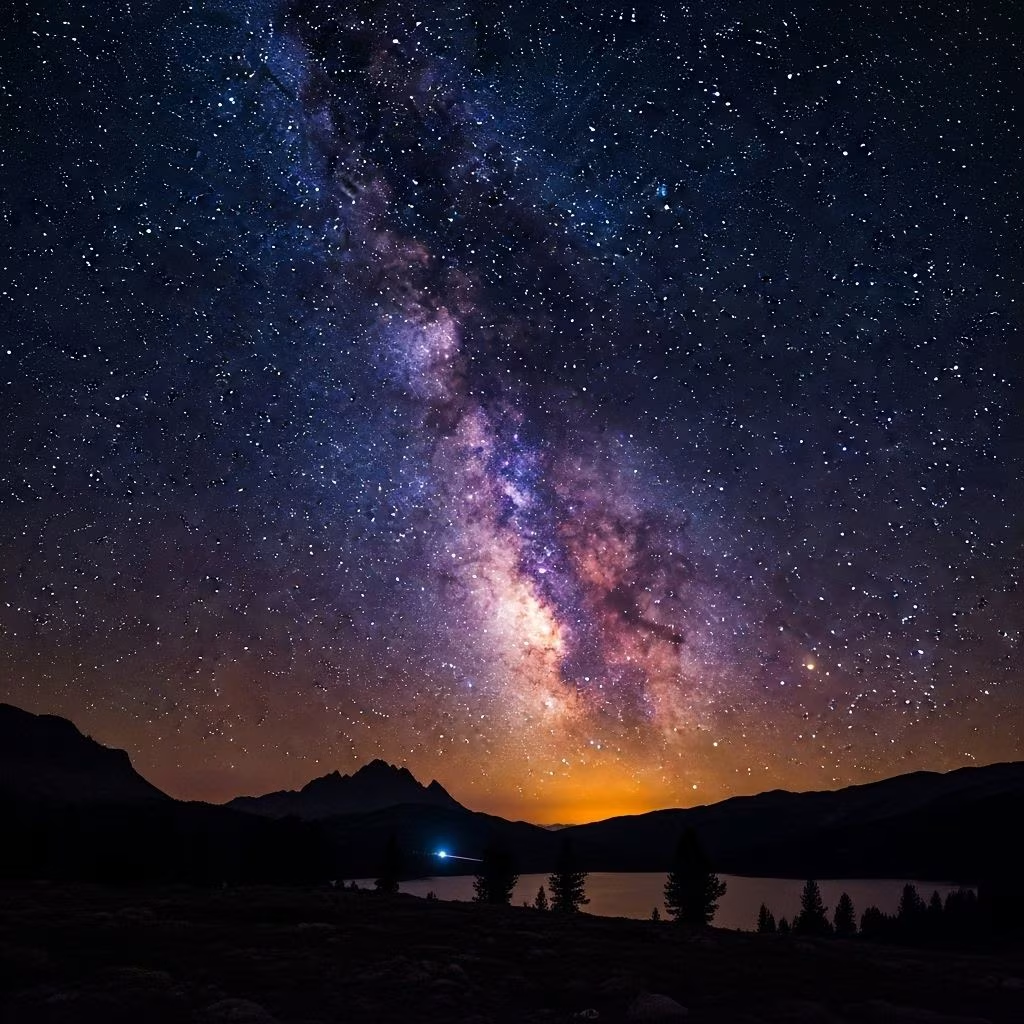
The Milky Way Illuminates the Moonless Summer Night Sky
Each year, during the height of summer, the night sky offers one of its most breathtaking spectacles: the Milky Way soaring overhead. On moonless nights, far from urban lights, the Galaxy’s bright core becomes a sparkling river of stars, nebulae, and cosmic dust spread across the darkness. This comprehensive guide will help you understand when, where, and how to view the Milky Way at its most radiant, and offers practical advice to make the experience unforgettable whether you’re a newcomer or a seasoned stargazer.
Contents
- Why the Milky Way Shines in Summer
- Choosing the Right Time and Place
- How to Spot the Milky Way Core
- Constellations and Celestial Landmarks
- Optimal Viewing Conditions
- Tips for Photographing the Milky Way
- Frequently Asked Questions
Why the Milky Way Shines in Summer
During summer months in the Northern Hemisphere, Earth’s nightly rotation brings us face-to-face with the bustling center of our galaxy—the Milky Way’s core. The galactic core is packed with stars, radiant nebulae, and dark dust lanes, giving the Milky Way its spectacularly bright and mottled appearance across the sky. In winter, we look outward into the sparser spiral arms, but in summer we look inward, and that’s why the difference is so dramatic.
What we perceive as a glowing band is actually an edge-on view into the center of our spiral galaxy, roughly 26,000 light-years away and located in the direction of the constellations Sagittarius and Scorpius.
Choosing the Right Time and Place
To witness the Milky Way at its most resplendent, proper timing and location are crucial. The following key factors maximize your chances:
- Moonless Nights: The absence of bright moonlight is essential, as the Moon can easily wash out the delicate glow of the Milky Way. The best opportunities occur around the new moon.
- Time of Year: In North America and Europe, the galactic core is most visible from May through August, with peak visibility in June and July when the core crosses highest above the southern horizon during night hours.
- Dark Locations: Seek sites with minimal light pollution. National parks, remote countryside, and certified Dark Sky Parks are prime choices.
If possible, plan your outing around a clear night forecast and consult a light pollution map or stargazing app for the darkest spots nearby.
Best Milky Way Viewing Windows (2025)
| Month | Core Visibility | Recommended Hours |
|---|---|---|
| Late May | Low on horizon (SE after midnight) | 12am–3am |
| June | Rises in evening, highest by midnight | 10pm–2am |
| July | Core well above horizon at nightfall | 10pm–3am |
| August | Core declining after midnight | 9:30pm–1:30am |
These times may vary with latitude and local terrain. Southern viewers see the Milky Way core slightly earlier than those farther north, and those closer to the equator get longer viewing windows.
How to Spot the Milky Way Core
Finding the Milky Way is easier than you might think, once you know where to look:
- Face South: In the Northern Hemisphere, the brightest part—the galactic core—appears in the southern sky, arching east to west above the horizon between late evening and early morning, depending on the month.
- Look for a Faint Cloud: With dark-adapted eyes, you’ll notice what looks like a pale, irregular cloud stretching obliquely across the sky. This is the projected plane of the Milky Way.
Use a star map app or consult the positions of bright summer stars to help orient yourself, especially if you’re new to stargazing.
Constellations and Celestial Landmarks
Several constellations serve as guides to the Milky Way’s position throughout the night:
- Sagittarius: The constellation’s distinctive shape (“the Teapot”) points directly to the galactic core—the brightest, most dramatic Milky Way region.
- Scorpius: Look west of Sagittarius for the hook-shaped Scorpius, whose red “heart,” Antares, stands out distinctly.
- The Summer Triangle: Formed by Vega (Lyra), Deneb (Cygnus), and Altair (Aquila). This trio rises high in the east after dark and sits atop the Milky Way’s glowing arc.
Recognizing these patterns makes it easier to spot the flowing stellar river of the Milky Way.
Optimal Viewing Conditions and Key Tips
To maximize your viewing experience, consider these essential tips:
- Give Eyes Time to Adjust: It takes 20-30 minutes for human eyes to become fully dark-adapted. Minimize use of white lights; use a red flashlight if necessary.
- Check the Weather: Clouds can obscure the stars, so choose a night with a clear forecast for best results.
- Avoid Light Pollution: Even distant city glow can diminish the Milky Way’s details. Get as far from urban centers as you can.
- Dress for the Night: Even summer nights can get chilly at remote stargazing sites. Bring light layers, snacks, and insect repellent where needed.
- Use an App or Almanac: Digital apps can provide nightly starmaps, moon phase data, and real-time sky locations.
Recognizing the Milky Way’s Structure
On an ideal night, you’ll see:
- The bright core near Sagittarius—densest with stars and colorful nebulae.
- Prominent dark dust lanes cutting through the glowing band.
- Fainter arms branching north and south, sometimes arching directly overhead.
Prime Locations for Stargazing
- National Parks: Many U.S. and international parks are certified Dark Sky places with minimal light interference.
- High Altitude Sites: Mountains or high plateaus offer cleaner air and less atmospheric disturbance.
- Remote Countryside: Farms, rural fields, and wilderness lakes can offer incredible views if you find a safe vantage point.
Tips for Photographing the Milky Way
Capturing the Milky Way in photographs can immortalize your night under the stars. Here’s how to get the best results:
- Use a Tripod: Stability is essential for long exposures required to capture faint galactic details.
- Wide-Angle Lens: The broader the frame, the more of the sky you can include, and f/2.8 or faster is best.
- Manual Mode: Control ISO, aperture, and shutter speed for 20–30 second exposures, ISO 1600–3200 as a starting point.
- Focus on the Stars: Autofocus won’t work in the dark; use manual focus or focus at infinity.
- Experiment: Try different settings and compositions with interesting ground features for spectacular results.
Editing later can bring out more colors and contrast, but shooting under perfectly dark skies is the most important ingredient.
Frequently Asked Questions (FAQs)
Q: Can I see the Milky Way without a telescope?
A: Yes, the Milky Way is visible to the naked eye under dark skies, especially during summer’s moonless nights. Telescopes can show more detail, but aren’t necessary to appreciate its beauty.
Q: Why don’t I see the Milky Way from my neighborhood?
A: Light pollution from cities and suburbs drowns out the Milky Way’s faint glow. Traveling to a dark-sky location away from artificial lights is essential for viewing.
Q: What is the Milky Way?
A: The Milky Way is the barred spiral galaxy that includes our solar system. Its bright band is a dense gathering of stars, gas, and dust seen from inside its disk.
Q: How can I find the Milky Way if I’m new to stargazing?
A: Use a stargazing app or plan your night to coincide with the appearance of the Summer Triangle or Sagittarius/Scorpius constellations as guides. Facing south and looking for a pale, uninterrupted band will help you identify it quickly.
Q: When is the Milky Way core highest in the sky?
A: In mid-June to mid-July, the core transits the highest point in the southern sky during midnight hours. Visibility times vary by latitude, but this window is generally optimal in the Northern Hemisphere.
Summary: Celebrating the Milky Way’s Summer Glories
Summer’s moonless nights offer a spectacular pilgrimage for night sky watchers. With the galactic center at its most prominent, the Milky Way puts on a show for those willing to seek dark skies, patience, and a little preparation. Use this guide to plan your adventure, and experience the magic of our galaxy lighting up the night.
References
- https://www.space.com/stargazing/the-milky-way-brightens-the-moonless-summer-sky-this-week-heres-where-to-look
- https://capturetheatlas.com/best-time-to-see-the-milky-way/
- https://www.jacknicholsphoto.com/milky-way-season-trip-planner
- https://www.usatoday.com/story/news/nation/2025/06/30/milky-way-galaxy-independence-day-what-time/84413094007/
- https://www.livescience.com/space/the-best-time-to-see-the-milky-way-is-fast-approaching-how-to-see-our-galaxy-at-its-best-in-june
- https://www.livescience.com/space/astronomy/the-milky-way-will-be-visible-without-a-telescope-this-summer-here-are-the-key-nights-to-watch-for
- https://www.space.com/26901-milky-way-summer-observing-tips.html
- https://www.astronomy.com/observing/now-is-the-best-time-to-see-the-summer-milky-way/
- https://capturetheatlas.com/milky-way-calendars/
- https://whenthecurveslineup.com/2025/07/02/2025-july-17-look-for-the-milky-way/
- https://www.youtube.com/watch?v=ieLCvyVnwWI
- https://silvanadellacamera.com/offerings-2/milky-way-calendar/
- https://science.nasa.gov/solar-system/whats-up-august-2025-skywatching-tips-from-nasa/
- https://jontic.com/best-nights-to-see-the-milky-way-this-summer/
- https://www.usatoday.com/story/news/nation/2025/05/22/milky-way-galaxy-visible-may-memorial-day/83764488007/


