


Europa: Jupiter’s Icy Moon of Mystery and Potential
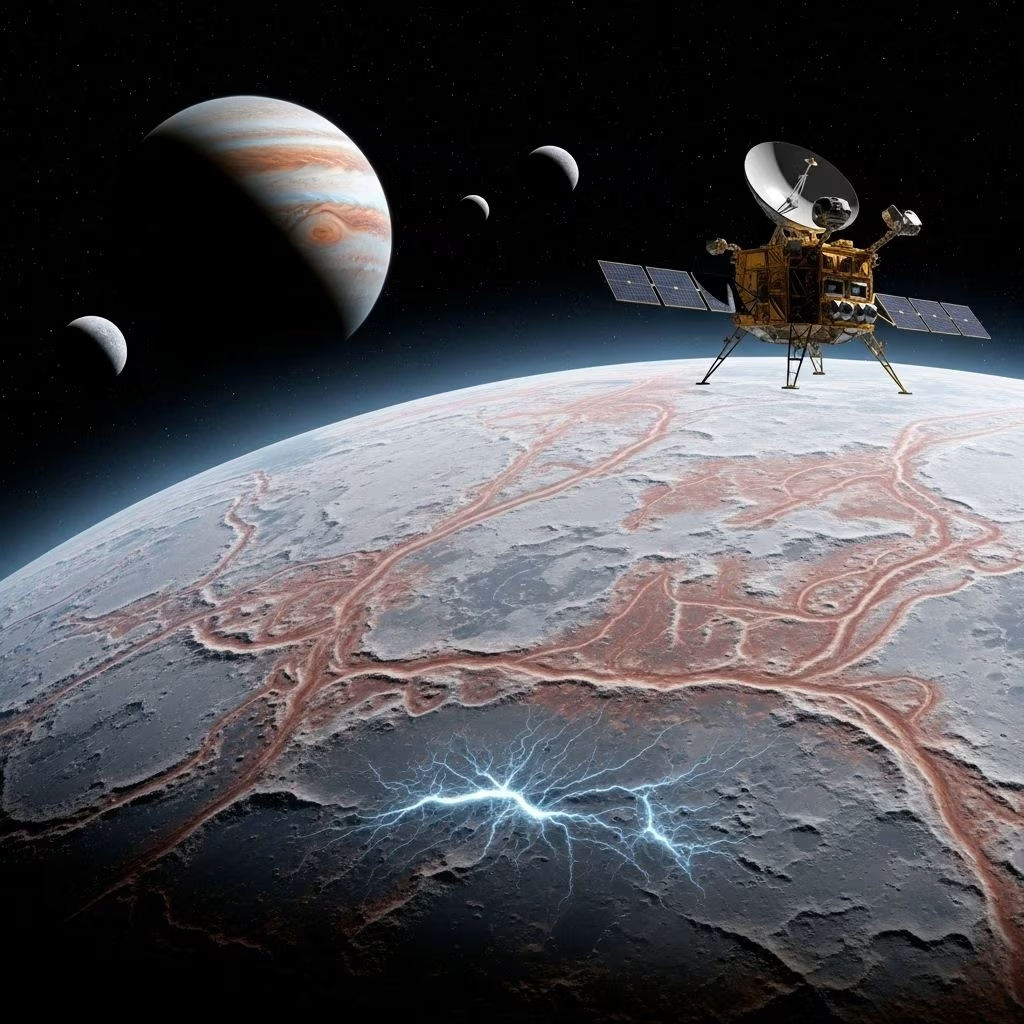
Europa, one of Jupiter’s four largest moons, stands out in the solar system as a bright, smooth world of frozen intrigue. With a deeply fractured icy crust, persistent hints of a global ocean beneath its exterior, and the possibility of harboring life, Europa has become a prime target for scientific investigation. Now, as NASA’s Europa Clipper mission prepares for launch, our quest to unlock Europa’s secrets enters an ambitious, unprecedented era.
The Compelling Case for Exploring Europa
Europa captures scientific imagination for several critical reasons:
- Hidden Ocean: Evidence points to a salty, subsurface ocean with more liquid water than found on Earth, potentially in contact with a rocky mantle — a crucial ingredient for astrobiology.
- Complex Surface Features: The moon’s icy crust is scarred with ridges, cracks, and possible water plumes, suggesting ongoing geological activity and exchange between surface and interior.
- Potential Habitability: The combination of water, energy sources, and essential chemical elements positions Europa as one of the most promising places beyond Earth to search for extraterrestrial life.
Decades of Discovery: How We Learned About Europa
Europa’s journey from a distant point of light in the night sky to the focus of detailed scientific missions has taken centuries, shaped by both telescope observations and close spacecraft encounters.
Historical Perspective and Key Observations
- Galileo’s Discovery (1610): Europa was discovered by Galileo Galilei, alongside Io, Ganymede, and Callisto — now known as the Galilean moons.
- Voyager Missions (1979): NASA’s Voyager spacecraft provided the first close-up images, revealing Europa’s distinctive, bright surface and linear features.
- Galileo Orbiter (1995–2003): The Galileo spacecraft’s extended observations hinted at a layered structure with a thin ice shell covering a vast liquid water ocean.
Key Scientific Findings
- Europa’s surface is one of the smoothest in the solar system, with few large craters, indicating recent geological activity.
- Magnetometer readings found disturbances consistent with a conductive, subsurface layer — likely a salty ocean.
- Observations of “chaos terrain” and disrupted surface blocks suggest that the ice shell interacts dynamically with liquid water below.
The Structure of Europa: Surface, Ice, and Ocean
Europa’s unique physical and geological features make it a tantalizing subject for studying both planetary evolution and habitability beyond Earth.
Key Characteristics of Europa
| Feature | Description |
|---|---|
| Diameter | 3,121.6 kilometers (slightly smaller than Earth’s Moon) |
| Surface | Bright water-ice crust crisscrossed with ridges and bands |
| Interior | Metallic iron core, rocky mantle, global salty ocean, icy shell |
| Temperature | ~ -160°C (-260°F) at the surface |
Europa’s Icy Shell and Subsurface Ocean
Below its surface, Europa is believed to host an ocean up to 100 kilometers deep, dwarfing Earth’s oceanic volume. The thickness of the overlying ice shell may range from a few kilometers to tens of kilometers, with some evidence of localized thinning and potential water upwelling.
- Surface Features: Linear fractures, double ridges, and “chaos terrain” imply frequent crack formation, migration, and possibly even water plumes escaping through the ice.
- Plume Activity: Multiple lines of evidence — including Hubble Space Telescope observations — suggest transient water vapor plumes venting from the surface, possibly linked to subsurface ocean communication.
Geological and Astrobiological Implications
- Interaction between ocean water and surface material may deliver nutrients and promote chemical mixing — vital for habitability.
- Hydrothermal activity at the rocky-ocean interface (if present, like on Earth’s seafloors) could further increase Europa’s potential to support microbial life.
NASA’s Europa Clipper Mission: Unveiling the Unknown
To unravel the mysteries of Europa’s hidden ocean and potential for life, NASA is preparing the Europa Clipper orbiter mission, one of the most sophisticated planet science missions ever developed.
Europa Clipper: Mission Overview
- Launch Date: Scheduled for October 2024
- Arrival at Jupiter: Expected in 2030
- Mission Duration: 4 years of intensive observations
- Number of Flybys: Nearly 50 close encounters with Europa at altitudes as low as 25 km
- Lead Institutions: NASA Jet Propulsion Laboratory, Johns Hopkins Applied Physics Lab, and academic partners
Mission Goals and Scientific Objectives
- Determine the thickness of Europa’s ice shell and the characteristics of its ocean.
- Investigate the surface composition and identify key chemical ingredients.
- Understand the geology and activity of the crust, including plume events and recent surface changes.
- Assess past and present environments for their potential to host life.
Scientific Instruments on Europa Clipper
- Imaging Systems: High-resolution cameras and spectrometers (including the Europa Imaging System and Mapping Imaging Spectrometer for Europa)
- Radar Sounder: Radar for Europa Assessment and Sounding: Ocean to Near-surface (REASON) to probe ice thickness and detect sub-ice liquid layers
- Magnetometer & Plasma Instruments: To detect the magnetic signatures of ocean water and study the moon’s interaction with Jupiter’s magnetic field
- Thermal Imager: To search for active “hot spots” on or near the surface (indicative of recent geologic or water activity)
- Dust and Mass Analyzers: To study surface composition and particles released into space
Why Clipper Uses Flybys, Not Orbit
Europa orbits within Jupiter’s powerful radiation belts. Remaining too close for extended periods would quickly degrade spacecraft electronics. Instead, Europa Clipper will fly past Europa on looping orbits around Jupiter, minimizing radiation exposure and allowing repeated close approaches to different regions of the moon’s surface.
Beyond Clipper: The Case for a Europa Lander
While Europa Clipper will revolutionize our understanding of the moon, the ultimate test for life lies in direct analysis of surface and near-surface materials. NASA and science teams have begun designing concepts for a potential Europa lander.
Goals and Instruments for a Potential Europa Lander
- Search for biomolecules and chemical signs of life in surface and shallow subsurface ice samples[11].
- Analyze the textures and structures beneath Europa’s crust.
- Assess habitability by characterizing water, chemistry, and energy sources near the surface.
Such a lander would need an advanced suite of analytical tools, including:
- Organic compositional analyzer
- High-resolution microscope
- Vibrational spectrometer
Mission challenges would include landing safely on a rough, icy surface; drilling or melting below the harsh, radiation-bombarded crust; and ensuring the spacecraft remains sterile to avoid biological contamination[11].
The Search for Life: Why Europa Inspires Astrobiology
Europa inspires the scientific quest to answer one of humanity’s oldest questions: Are we alone? The moon’s unique combination of water, chemistry, and energy — all within the reach of direct robotic exploration — makes it an exceptional test case for finding life in the solar system.
Key Reasons for Astrobiological Interest
- Subsurface Oceans: Unlike most planetary bodies, Europa’s ocean is believed to be in direct contact with a silicate mantle, allowing hydrothermal and chemical processes to create gradients that could support metabolisms similar to extreme forms of life on Earth.
- Surface-Ocean Exchange: Fractures and chaos terrain may deliver oxidants and other essential chemicals from the irradiated surface into the ocean, fueling possible biospheres below.
- Fulfillment of Life’s Three Pillars: Europa is rich in water, may possess chemical raw materials, and receives energy both from tidal heating and from Jupiter’s intense radiation, which could drive organic chemistry and maintain a habitable environment beneath the ice.
Challenges and the Future: What Lies Ahead for Europa Exploration
The exploration of Europa is technically demanding, from surviving Jupiter’s radiation to navigating the moon’s unpredictable surface terrain. Yet the potential rewards — the detection of alien biology or deep insights into planetary evolution — are profound.
- Technological advances are required for autonomous landing, drilling or melting through ice, and operating in extreme cold and radiation.
- Future concepts include subsurface ‘cryobots’, ice-penetrating probes, and even tiny robotic submersibles for ocean exploration far in the future.
- The science enabled by the upcoming Europa Clipper could pave the way for subsequent landers and life-detection missions, setting the stage for a new era of solar system exploration.
Europa Facts and Figures
| Attribute | Data |
|---|---|
| Distance from Jupiter | 671,000 km |
| Average Surface Temperature | -160°C |
| Day Length | 3.55 Earth days |
| Diameter | 3,121.6 km |
| Discovery | Galileo Galilei, 1610 |
Frequently Asked Questions (FAQs)
Q: Why is Europa considered one of the best places to search for life?
A: Europa’s subsurface ocean, in contact with a rocky core and possibly enriched by surface chemicals, offers the essential ingredients for life — water, chemistry, and energy — making it a primary target for astrobiology.
Q: What will the Europa Clipper do?
A: The Europa Clipper spacecraft will conduct dozens of flybys, collecting data on Europa’s surface composition, ice shell structure, potential plumes, and habitability, bringing us closer than ever to understanding this ocean world.
Q: When will Europa Clipper launch and arrive at Jupiter?
A: Europa Clipper is scheduled to launch in October 2024 and will arrive at Jupiter in 2030, beginning its science mission with nearly 50 close flybys over a four-year period.
Q: How might Europa’s ocean be explored in the future?
A: Future landers or robotic probes could drill through the ice to access surface or subsurface samples, with eventual concepts involving cryobots or submersible robots to explore the alien ocean itself if technical challenges can be met.
Q: What are the main dangers to a spacecraft at Europa?
A: Jupiter’s intense magnetic field traps high-energy particles, creating a harsh radiation environment that requires heavily shielded spacecraft and strict mission designs to ensure electronics remain operational throughout the mission.
References
- https://www.jpl.nasa.gov/missions/europa-clipper/
- https://en.wikipedia.org/wiki/Europa_(moon)
- https://science.nasa.gov/jupiter/jupiter-moons/europa/
- https://en.wikipedia.org/wiki/Moons_of_Jupiter
- https://www.youtube.com/watch?v=sD6BNag4Xys
- https://www.jhuapl.edu/destinations/missions/europa-clipper
- https://www.planetary.org/worlds/europa
- https://phys.org/news/2024-08-missions-jupiter-moon-europa.html
- https://lasp.colorado.edu/missions/europa-clipper/
- https://missions.info-quest.org/MISSION-JUPITER-EUROPA.html
- https://www.space.com/35655-nasa-lander-jupiter-moon-europa.html
- https://www.planetary.org/space-missions/europa-clipper
- https://www.youtube.com/watch?v=q88fSdGMbys
- https://arcfieldweather.com/blog/2024/10/3/715-am-mission-to-jupiters-icy-moon-europa-begins-a-week-from-now-on-october-10thamazing-work-by-galileo-400-years-ago-on-the-largest-planet-in-our-solar-system-and-its-moons
- https://www.dlr.de/en/latest/news/2024/is-there-an-ocean-under-the-icy-surface-of-jupiters-moon-europa/the-nasa-europa-clipper-mission-to-jupiters-moon-europa
- https://www.space.com/13883-nasa-jupiter-moon-europa-lander-mission.html
- https://universalinstitutions.com/nasas-europa-clipper-mission-to-explore-jupiters-moon/


