


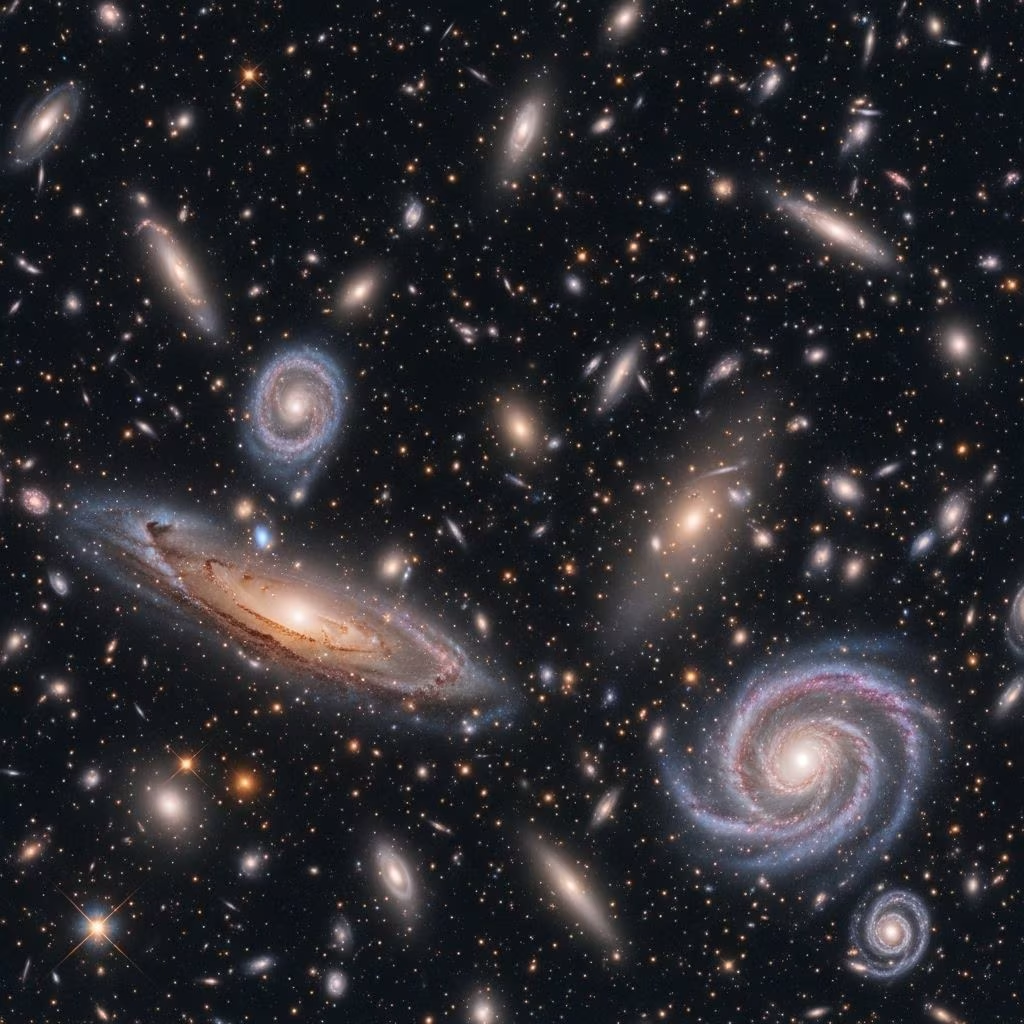
How Many Galaxies Are in the Universe?
For centuries, the cosmos has both inspired and mystified humanity, its vastness beckoning astronomers to probe ever deeper into the night sky. One of the most profound questions in the field of astronomy asks: How many galaxies are there in the universe? While a final answer remains elusive, scientific progress has brought remarkable insights, revealing a universe far richer and more complex than previously imagined.
What Is a Galaxy?
To understand the grand tally, it first helps to define a galaxy. A galaxy is a massive system bound together by gravity, containing billions or even trillions of stars, vast clouds of gas and dust, dark matter, stellar remnants, planetary systems, and often a supermassive black hole at its center. Our own home, the Milky Way, is just one among this cosmic multitude.
How Do Astronomers Estimate the Number of Galaxies?
Astronomers cannot simply count each galaxy one by one. Even with the most advanced telescopes, many galaxies are too faint, small, or hidden behind other cosmic objects to directly observe. Instead, scientists employ a combination of observations, deep-sky imaging, extrapolation, and theoretical modeling to estimate the number of galaxies residing within the observable universe.
- Deep Field Surveys: By targeting small, seemingly empty regions of the sky and collecting long-exposure images, researchers reveal thousands of galaxies packed into a tiny patch. The Hubble Deep Field and Hubble eXtreme Deep Field (XDF) are iconic examples of this approach, showing the richness of galaxies in a minuscule portion of the cosmos.
- Extrapolation: Astronomers analyze galaxy counts from these narrow but deep surveys and extrapolate their findings to estimate the total across the entire sky.
- Theoretical Models: Cosmological simulations help account for galaxies too faint, distant, or obscured to be observed directly, providing estimates for the “missing” galaxies.
- Technological Limits: The limitations of our telescopes mean current counts always represent a lower bound, with new discoveries constantly pushing estimates upward.
The Observable Universe vs. The Entire Universe
One key distinction is between the observable universe and the universe as a whole. The observable universe spans about 92 billion light-years in diameter—an immense but ultimately limited perspective constrained by the speed of light and the age of the cosmos. Galaxies farther than this limit exist beyond our view because their light has not yet had time to reach Earth since the Big Bang. Thus, all estimates refer only to the observable universe; the grand total may be vastly greater—or even infinite—if the universe itself has no limits.
A Brief History of Galaxy Estimates
The number of galaxies in the universe has undergone stunning revision as astronomical technology and theory have advanced:
- Mid-20th Century: Pioneering astronomers such as Edwin Hubble established that there were galaxies beyond the Milky Way, but the true scale remained hotly debated.
- Late 20th Century: Carl Sagan famously popularized the phrase “billions and billions”—referring both to the number of stars in our galaxy and galaxies in the universe. Early studies suggested roughly 100 billion galaxies in the observable universe.
- 1990s–2000s: Hubble Space Telescope surveys—such as the original Deep Field (1995) and subsequent Ultra Deep Fields—counted galaxies in tiny sky slices and extrapolated, confirming previous estimates but also hinting at the existence of many more.
- 2010s–Present: More comprehensive modeling and deeper Hubble observations shattered earlier assumptions. In 2016, researchers estimated there could be two trillion galaxies in the observable universe—ten times previous estimates. Subsequent simulation studies and statistical analyses have recently suggested numbers potentially rising to as many as 6 to 20 trillion galaxies, with most still too faint and distant to detect.
Galaxy Estimate Evolution Table
| Year/Source | Estimated Number of Galaxies | Method/Note |
|---|---|---|
| Mid-20th century | ~100 billion | Optical observations, early extrapolations |
| 1990s–2000s | 100–200 billion | Hubble Deep Field imaging |
| 2016 (Hubble) | ~2 trillion | 3D conversions, statistical modeling, Hubble images |
| Recent (Simulations) | 6–20 trillion | Theoretical models including faint, undetectable galaxies |
Barriers to Counting Galaxies
There are several challenges that make counting all the galaxies in the universe an extraordinary task:
- Observational limits: Even the most sensitive telescopes leave a vast swath of faint and distant galaxies unaccounted for, simply because their light has not reached us or is too dim to detect.
- Galaxies hidden by cosmic dust or nearby bright objects can be completely invisible to certain instruments.
- The universe may be infinite: If so, the total number of galaxies would also be infinite, rendering the question unanswerable in absolute terms.
- Overlapping objects and gravitational lensing: Objects can appear merged, or their images can be distorted by massive foreground clusters, complicating true counts.
- Evolving universe: Many galaxies formed, merged, or disappeared over billions of years, so what we see reflects the universe at different stages of its history.
How the Hubble Space Telescope Changed Our Perspective
The launch of the Hubble Space Telescope in 1990 revolutionized our cosmic census. By peering at the most remote corners of space, Hubble revealed:
- Galaxies of startling diversity, ranging from luminous behemoths to faint, compact dwarfs.
- The sheer density of galaxies even in the smallest observed patch—a “pinprick” on the sky reveals thousands of swirling galaxies, including some from the universe’s earliest epochs.
- Following deep field campaigns, including the Hubble Ultra Deep Field and later the Hubble eXtreme Deep Field (XDF), astronomers estimated that 90% of galaxies in the observable universe might remain out of reach for today’s telescopes, because they are far too faint and small.
A Universe of Many Galaxies: Types and Groupings
The universe’s galaxies are not scattered at random. Instead, they are grouped in various structures:
- Local Group: Our Milky Way sits with the Andromeda Galaxy, the Triangulum Galaxy, and more than 30 smaller companions in a gravitationally bound collection called the Local Group.
- Galaxy Clusters: Larger structures bind hundreds or thousands of galaxies together, such as the Virgo Cluster.
- Superclusters: Assembled into enormous web-like filaments called superclusters, these span vast distances across space.
Galaxies themselves come in a variety of forms:
- Spiral galaxies: Like the Milky Way and Andromeda, with beautiful rotating arms.
- Elliptical galaxies: Ranging from nearly spherical to elongated shapes, often older and filled with ancient stars.
- Irregular galaxies: Chaotic shapes, often resulting from gravitational interactions and mergers.
Is There an Infinite Number of Galaxies?
One of the most intriguing implications of recent astronomical theory is the possibility that the universe itself is infinite. If the universe has no boundary, then there may, quite literally, be an infinite number of galaxies. However, from our observational boundary—the distance light has traveled since the Big Bang—the number of detectable galaxies remains finite, albeit staggeringly large.
The Future: New Tools and New Estimates
Because current numbers are based on technology that can only see so far, future telescopes and instruments may force astronomers to revise their numbers dramatically upward once again:
- James Webb Space Telescope (JWST): Launched in December 2021, JWST will peer deeper into the universe and observe galaxies from even earlier epochs, refining our estimates.
- Next-generation ground telescopes: Facilities like the Vera C. Rubin Observatory and the Extremely Large Telescope will map new swaths of the sky with unprecedented detail.
- Radio and Infrared observatories: Observing at different wavelengths reveals galaxies hidden to optical telescopes, especially very early or dust-obscured ones.
Each step forward brings us closer to understanding how galaxies form, evolve, and populate the vast universe.
Why Does Counting Galaxies Matter?
Determining the number of galaxies in the universe is not just a matter of statistics. These estimates inform our understanding of:
- Cosmic evolution: How matter clumped and evolved since the Big Bang.
- Dark matter and dark energy: The balance of visible and invisible mass affects galaxy formation and large-scale structure.
- Potential for life: More galaxies mean more stars, more planets, and vastly greater potential habitats for life.
- The fate of the universe: Knowing the number and distribution of galaxies helps model cosmic expansion and the ultimate fate of all matter and energy.
Frequently Asked Questions (FAQs)
Q: How do astronomers actually count galaxies?
A: Scientists count galaxies in small, representative regions of the sky using deep-space images (such as those from the Hubble Space Telescope) and then extrapolate those counts across the sky. Further corrections are made for galaxies that are too faint or distant to detect.
Q: Could there be more galaxies than current estimates?
A: Yes. Estimates are regularly revised upward as technology improves. Many faint galaxies remain undetectable today, and only future telescopes will reveal their true abundance.
Q: What is the difference between the observable universe and the whole universe?
A: The observable universe is the region of space from which light has reached us since the Big Bang, limited by the universe’s age and the speed of light. The whole universe could be much larger—or even infinite.
Q: Which galaxies are closest to the Milky Way?
A: The closest large galaxies are the Andromeda Galaxy and the Triangulum Galaxy. These, along with the Milky Way and dozens of dwarfs, form the Local Group.
Q: Why do galaxy estimates vary between sources?
A: Estimates depend on the depth and coverage of observations, technological sensitivity, and the mathematical models used to infer undetectable galaxies. As theories and instruments develop, so do the numbers.
The Never-Ending Quest
While the exact number will remain uncertain for the foreseeable future, it is clear that the universe is inconceivably rich with galaxies. From the hundreds of billions counted in the late twentieth century to the trillions now inferred through deep imaging and simulations, the cosmic tally is a testament to the ever-expanding horizon of human curiosity and capability. Each revelation not only answers old questions but also poses new ones, ensuring that the story of our universe’s galaxies remains an open-ended adventure, guided by the light of discovery.
References
- https://bigthink.com/starts-with-a-bang/galaxies-in-universe/
- https://www.skyatnightmagazine.com/space-science/how-many-galaxies-in-universe
- https://science.nasa.gov/missions/hubble/hubble-reveals-observable-universe-contains-10-times-more-galaxies-than-previously-thought/
- https://www.sciencefocus.com/space/how-many-galaxies-are-in-the-universe
- https://www.livescience.com/space/how-many-galaxies-are-in-the-universe
- https://en.wikipedia.org/wiki/Galaxy
- https://www.space.com/25303-how-many-galaxies-are-in-the-universe.html
- https://www.youtube.com/watch?v=MDaiJODTAIQ
- https://esahubble.org/videos/heic1620a/
- https://rubinobservatory.org/education/first-look-lasting-impact-resources-for-educators/unpacking-first-look-images-2/unpacking-first-look-images
- https://en.wikipedia.org/wiki/Observable_universe
- https://coolcosmos.ipac.caltech.edu/ask/240-How-many-galaxies-are-in-the-Universe-
- https://www.youtube.com/watch?v=TKocdmPBd8M
- https://bigthink.com/starts-with-a-bang/how-many-galaxies/
- https://universemagazine.com/en/new-calculations-reveal-less-galaxies-in-the-universe/
- https://esahubble.org/news/heic1620/


