


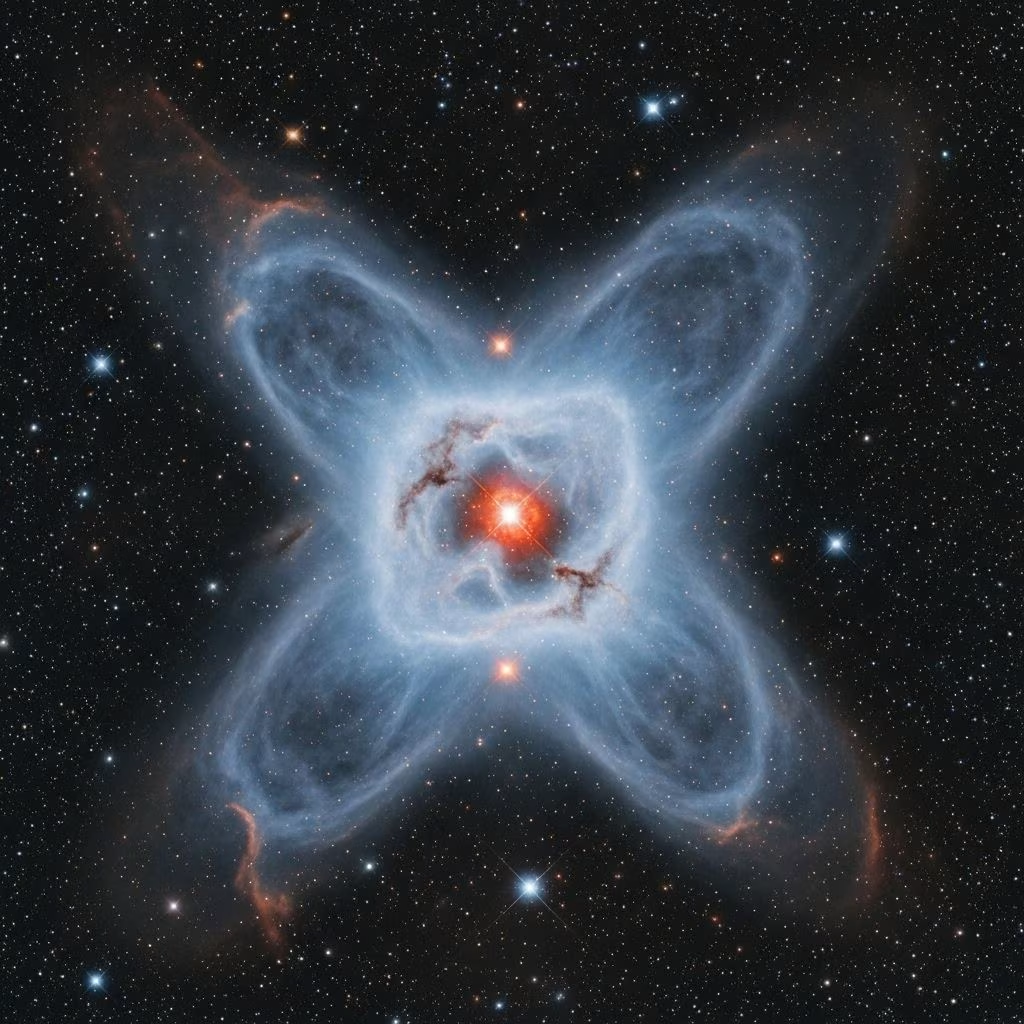
The Astonishing Chill of the Universe
Throughout the cosmos, stars blaze and galaxies whirl in a spectacular and violent interplay of heat and matter. Yet, in the dark reaches between the stars, the universe is overwhelmingly cold. No place exemplifies this icy extremity more than the Boomerang Nebula, a young nebula lying thousands of light-years from Earth. It holds the record for the coldest naturally occurring temperature ever observed in the universe, dipping even lower than the cosmic background radiation left from the Big Bang.
Where is the Boomerang Nebula Located?
The Boomerang Nebula resides in the constellation Centaurus, about 5,000 light-years from Earth. This cosmic object is a planetary nebula, a glowing shell of gas ejected from a dying star, representing a fleeting phase common in the later life stages of sun-like stars.
- Constellation: Centaurus
- Distance from Earth: ~5,000 light-years
- Type: Young planetary nebula (or preplanetary nebula)
What Makes the Boomerang Nebula So Cold?
The Boomerang Nebula’s remarkable coldness, nearing absolute zero, is fundamentally due to rapid gas expansion from a dying star. As the central star of the nebula expels gas at incredible speeds—approximately 500,000 kilometers per hour—the expanding gas cools dramatically, much like air from a rapidly deflating balloon becomes cold.
Most nebulas are quite hot, sometimes exceeding 10,000 Kelvin. By contrast, the Boomerang Nebula defies this pattern:
- Temperature: ~1 Kelvin (–458°F or –272°C), just a single degree above absolute zero
- Cooler than the cosmic microwave background (CMB), which hovers at about –270°C (2.7 Kelvin)
- It is the only known naturally occurring object colder than the CMB, the relic radiation left from the universe’s formation.
This deep cold means the nebula actually draws in heat from the surrounding space, absorbing what little warmth remains in the cosmic void.
The Cosmic Microwave Background vs. Extremes of Cold
The cosmic microwave background (CMB) is the faint afterglow of the Big Bang, bathing the universe with a near-uniform coolness of about 2.7 Kelvin. Under most circumstances, nothing in the natural universe dips below this temperature—except, incredibly, the Boomerang Nebula.
Because of its rapid expansion, the nebula’s gas cools to colder than the CMB, making it the ultimate cosmic refrigerator.
Why Is Absolute Zero So Significant?
Absolute zero (0 Kelvin, –459.67°F, or –273.15°C) is the lowest possible temperature in physics. At this point, all atomic and molecular motion stops, and matter has no thermal energy left. In practice, no natural object can hit precise absolute zero, but the Boomerang Nebula comes impressively close.
| Location/Object | Temperature (Kelvin) | Temperature (Celsius) | Notes |
|---|---|---|---|
| Boomerang Nebula | 1 K | –272°C | Coldest known |
| Cosmic Microwave Background (CMB) | 2.7 K | –270°C | Background temperature of universe |
| Orion Nebula | ~10,000 K | ~9,700°C | Typical hot nebula |
| Moon (night low) | ~140 K | –130°C | Lowest at lunar night |
| Antarctica, Earth (coldest measured) | 175 K | –98°C | Earth’s coldest spot |
| Absolute Zero | 0 K | –273.15°C | Theoretical lowest limit |
The Discovery: How Astronomers Found the Universe’s Coldest Spot
The groundbreaking discovery of the Boomerang Nebula’s temperature came in 1995, thanks to astronomers Raghvendra Sahai and Lars-Åke Nyman. Using the 15-metre Swedish ESO Submillimetre Telescope in Chile, they observed the nebula and measured its astonishingly low temperature. Their findings overturned prior assumptions that nothing could naturally be colder than the CMB.
Subsequent imaging by the NASA/ESA Hubble Space Telescope revealed intricate structures in the nebula, showing not only its unique temperature but also its striking visual beauty.
What Is a Planetary Nebula?
A planetary nebula forms when a medium-mass star (like our Sun) exhausts its fuel, sheds its outer layers, and exposes its hot core. This core illuminates the ejected gas, creating a glowing, expanding shell. Despite the name, planetary nebulas have nothing to do with planets—the term dates back to early astronomers who, peering through small telescopes, thought their round shapes resembled planets.
- Type: Young or preplanetary nebula—so fresh, the Boomerang Nebula hasn’t even taken its final, stable form yet.
- Formation: Rapid loss of material from a dying star, creating an envelope of extremely cold molecular gas.
Why Is the Boomerang Nebula Colder Than Space?
The answer lies in the mechanisms of adiabatic cooling. As the gas rushes away from the central star at speeds matched by few other stellar objects, it expands and loses energy. This expansion causes its temperature to plummet far beyond typical nebular or interstellar values—making it colder than even the persistent chill of the CMB.
No other natural region in the universe is known to break this temperature threshold. Even frigid intergalactic space, with its meager CMB heat, remains slightly warmer.
How Cold Is Space Compared to the Boomerang Nebula?
While much of deep space is cold due to the absence of matter and energy sources, its average temperature is not as low as one might imagine. Thanks to the omnipresent CMB, space hovers just above absolute zero—around 2.7 Kelvin, or –270°C. Yet the Boomerang Nebula dips substantially lower, making it an outlier among cosmic objects.
Comparing Cosmic Extremes
- Boomerang Nebula: –272°C (1 K)
- Average space (CMB): –270°C (2.7 K)
- Coldest recorded on Moon (night): –130°C
- Coldest place on Earth: –98°C (recorded in Antarctica)
What Makes the Boomerang Nebula Different from Other Nebulas?
Most nebulas are sites of intense activity: stars are born, gas clouds are heated, and light blazes forth. The Boomerang Nebula, by contrast, is unique for its intense and efficient cooling mechanism.
- Youth: It is extremely young—even considered ‘preplanetary.’
- Rapid Expansion: Gas is escaping at much higher velocities than in typical nebulas.
- Absence of New Stars: While many nebulas birth stars, the Boomerang Nebula forms after a star’s death, and hasn’t yet produced new stellar cores.
- Shape: Early Hubble observations revealed a shape roughly resembling a bow tie or boomerang, explaining its evocative name.
Visual Wonders: The Appearance of the Boomerang Nebula
Images from the Hubble Space Telescope present the Boomerang Nebula as a stunning cosmic sculpture. The structure displays:
- Hourglass or bow-tie shape, symmetrical around the dying central star
- Rich blues due to illuminated cold molecular gas
- Dark, shadowy regions shaped by thick clouds of expelled material
Implications and Curiosities: Why Study Ultra-Cold Cosmic Objects?
The existence of such cold environments fascinates astronomers and physicists for several reasons:
- Testing physical laws: The nebula becomes a natural laboratory for studying the behavior of matter and energy close to absolute zero, advancing our understanding of fundamental physics.
- Stellar evolution: Observations help unravel the final stages of star life cycles and the processes that shape the cosmic landscape.
- Astrochemistry: Ultra-cold conditions can drive unique chemical reactions, creating complex molecules found nowhere else.
Eyes on the Future: Could Even Colder Places be Found?
For now, the Boomerang Nebula holds its title uncontested. However, the universe is vast, and astronomers are continuously developing new, more sensitive instruments. Future surveys may yet uncover other objects or phenomena capable of reaching or surpassing this frigid record.
Frequently Asked Questions (FAQs)
Q: What exactly is the Boomerang Nebula?
A: The Boomerang Nebula is a young (preplanetary) planetary nebula resulting from a dying star shedding its outer gases at extreme speeds, creating a region of intense cold.
Q: How was its temperature measured?
A: In 1995, astronomers used the 15-metre Swedish ESO Submillimetre Telescope in Chile to measure the radiation signature of the nebula’s gas, determining its temperature to be about 1 Kelvin.
Q: Why is it colder than the cosmic microwave background?
A: The high-speed expansion of gas in the nebula causes rapid cooling (adiabatic expansion), dropping its temperature below even the CMB, which is generally considered the coldest standard in space.
Q: Can anything on Earth reach similar temperatures?
A: In natural settings on Earth, temperatures do not come close. Absolute zero has never been achieved in the lab, though scientists have approached fractions of a Kelvin above it using specialized cooling techniques. The Boomerang Nebula’s cold is naturally occurring and much more extreme than anything experienced on our planet.
Q: Could we find anything colder in the universe?
A: So far, the Boomerang Nebula is uniquely cold, but astronomers continue the search for other such cosmic wonders. Given advances in technology, it is possible we may one day discover an object or phenomenon even colder.
References
- https://www.space.com/coldest-place-in-the-universe
- https://www.space.com/how-cold-is-space
- https://www.youtube.com/watch?v=bAGGrzMCnnc
- https://www.skyatnightmagazine.com/space-science/coldest-place-universe
- https://www.popularmechanics.com/space/deep-space/a46188982/coldest-place-in-the-universe/
- https://esahubble.org/images/heic0301a/
- https://www.livescience.com/coldest-place-in-solar-system
- https://science.howstuffworks.com/coldest-place-in-universe.htm
- https://www.littlepassports.com/blog/space/the-coldest-place-in-the-universe/
- https://en.wikipedia.org/wiki/Boomerang_Nebula
- https://www.jameswebbdiscovery.com/faqs/what-is-the-coldest-place-in-the-universe
- https://myspacemuseum.com/coldest-place-universe
- https://www.littlepassports.com/blog/space/the-coldest-place-in-the-universe/?srsltid=AfmBOorfW9w-k3zBDRmGcNkf-YtjdF0pERAl1A3i0-qhWH29qLOpVN
- https://www.youtube.com/watch?v=SCDcvrEpGio
- https://www.zmescience.com/feature-post/space-astronomy/astronomy-articles/coldest-place-universe-90534/
- https://www.sciencenewstoday.org/the-coldest-places-in-the-universe
- https://www.livescience.com/32259-whats-the-coolest-place-in-the-universe.html


