


The Oort Cloud: The Solar System’s Mysterious Outer Shell
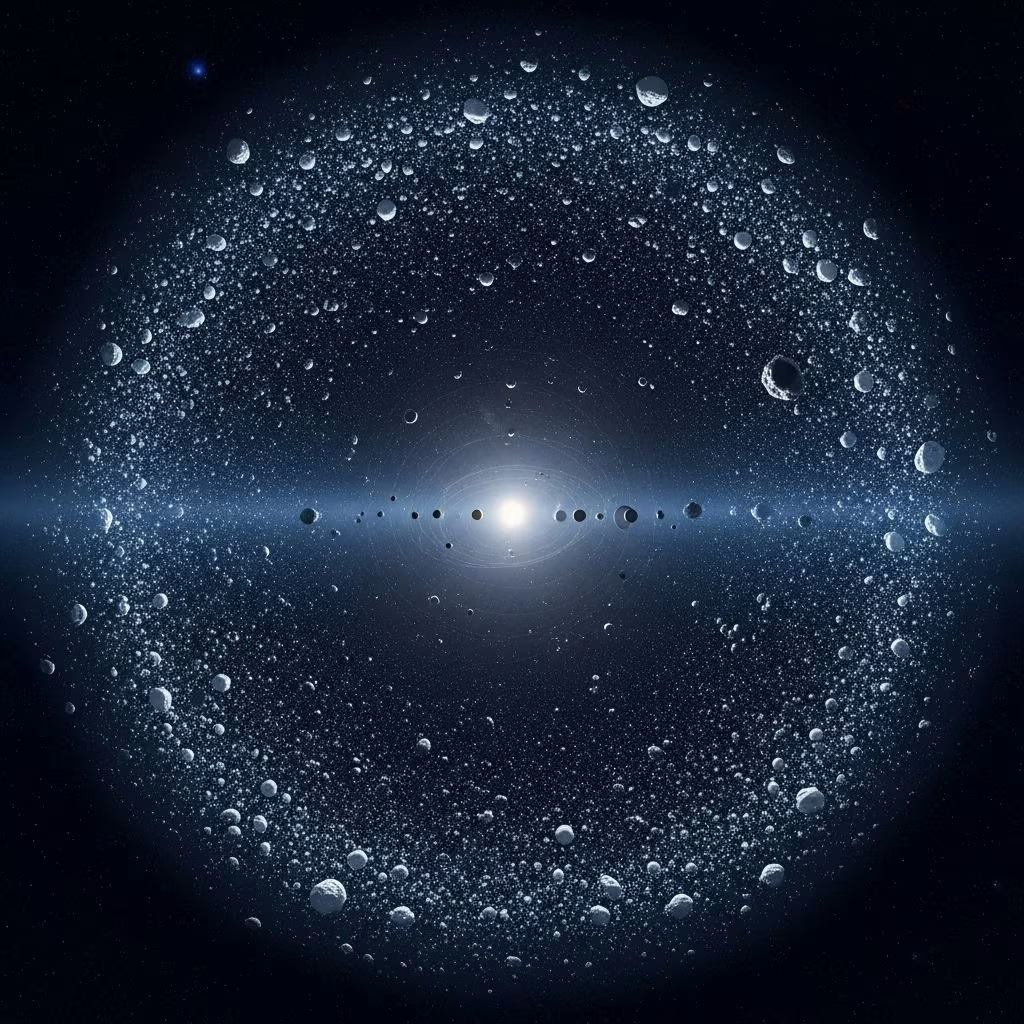
Far beyond the known worlds of the solar system, past the majestic orbits of giant planets and even the icy circle of Pluto, lies one of the most enigmatic and uncharted frontiers in all of astronomy: the Oort Cloud. This immense, hypothetical sphere of frozen bodies surrounds our planetary family like an ancient cosmic shell, preserving relics from the dawn of solar history and marking the boundary between our Sun’s domain and the rest of the galaxy.
While never directly observed, the Oort Cloud remains an object of fascination—shaping our understanding of the solar system’s edge, the origin of comets, and the ultimate limit of the Sun’s gravitational reach.
What Is the Oort Cloud?
The Oort Cloud is a theoretical, spherical shell of countless icy bodies thought to encircle the entire solar system. It lies at an almost unimaginable distance—its inner edge beginning far beyond Neptune, and its outer edge stretching nearly halfway to the nearest star system. It represents astronomy’s “final frontier” around our Sun, a cold and silent domain where the Sun’s influence wanes and interstellar space begins.[10]
- Composed primarily of: Water ice, ammonia ice, methane ice, and dust
- Estimated population: Billions, possibly trillions, of icy objects
- Main significance: Regarded as the source of long-period comets and a remnant from the solar system’s formation
- Inner edge: Thought to start from about 2,000 astronomical units (AU) from the Sun (1 AU = distance from Earth to the Sun)
- Outer edge: Could extend as far as 100,000 AU or about 1.5–2 light-years away
The Discovery and Origins of the Oort Cloud
The idea of the Oort Cloud was first proposed in the early 20th century by Estonian astronomer Ernst Öpik and later refined by Dutch astronomer Jan Oort, after whom the cloud is named. They noticed a curious phenomenon in the orbits of comets—particularly long-period comets, which can take hundreds of thousands of years to complete a single journey around the Sun.
Key historical insights:
- Öpik (1932) suggested that a remote reservoir of comets existed, occasionally sending some toward the inner solar system.
- Oort (1950) calculated the probable distances and population of this theoretical cloud based on observed comet orbits.
- The randomness in the approach directions of long-period comets indicated a vast, spherical shell rather than a disk (like the Kuiper Belt).
Oort and Öpik never saw the cloud directly—no one has—but their inferences from the behavior of distant comets convinced astronomers that such a structure must exist.
Structure and Scale of the Oort Cloud
The Oort Cloud is not a solid shell but rather a sparsely populated swarm of icy planetesimals. It is thought to have two distinct components:
- Outer Oort Cloud: A spherical shell forming the main body, from about 20,000 to 100,000 AU from the Sun, defining the cosmic “edge” of the solar system’s influence.
- Inner Oort Cloud (Hills Cloud): A denser, disk-like region extending from roughly 2,000 to 20,000 AU, possibly acting as a reservoir to replenish the outer Oort Cloud.
| Region | Shape | Estimated Range (AU) | Main Features |
|---|---|---|---|
| Outer Oort Cloud | Spherical | ~20,000 – 100,000+ | Defines Sun’s limit; source of most long-period comets |
| Inner Oort Cloud (Hills Cloud) | Thick disc/spheroid | ~2,000 – 20,000 | Dense population, possible comet reservoir |
For perspective, Pluto orbits at only 39 AU from the Sun; the Oort Cloud starts at roughly fifty times that distance and extends thousands of times farther, out almost two light-years—halfway toward Proxima Centauri, the closest neighboring star.
Composition: What Is the Oort Cloud Made Of?
Though never directly observed, astronomers infer the Oort Cloud’s makeup from the comets that occasionally escape it and visit the inner solar system. These objects are believed to be chunks of primordial ices and dust—cold relics left over from the solar system’s formation.
- Predominant ices: Water, ammonia, methane
- Other materials: Rock, organic compounds, and possibly some minerals
- Comet nuclei: Range in size from a few kilometers to tens of kilometers across
Many Oort Cloud objects are dark and nearly invisible in visible light, which further complicates efforts to observe them directly.
The Mysterious Formation of the Oort Cloud
How did such a sprawling, distant shell of icy bodies come to exist? The prevailing theories propose that during the early years of the solar system, the giant planets (especially Jupiter and Saturn) interacted gravitationally with lingering planetesimals—ejecting some into distant, eccentric orbits.
- Scattering effect: Early planetary movements flung material outward, some captured by the Sun’s gravity at vast distances
- Possible interstellar visitors: Some objects in the cloud could be comets captured from other stars passing nearby
- Collisional history: Cosmic collisions and interactions over billions of years may have shaped the cloud’s distribution
The Oort Cloud is thought to preserve the original chemical signature and composition of the solar nebula—providing a cosmic time capsule from an era when the planets themselves were forming.
Comets: Messengers from the Oort Cloud
Long-period comets—moving on very long, eccentric orbits—are believed to originate in the Oort Cloud. These comets occasionally fall toward the inner solar system, perhaps nudged by the pull of nearby stars, galactic tides, or even rogue interstellar objects.
- Long-period comets: Orbits lasting thousands to millions of years; typical examples include Comet Hale-Bopp and Comet ISON.
- Their appearance strengthens the case for a distant, spherical source region, as their arrival directions are completely random
- These comets often deliver insight into the chemical makeup of the early solar system
Because Oort Cloud comets approach from all directions in space, their orbits are nearly random—unlike the regular, flat orbits of Kuiper Belt objects and short-period comets.
Oort Cloud vs. Kuiper Belt
| Feature | Oort Cloud | Kuiper Belt |
|---|---|---|
| Shape | Spherical Shell | Flat Disc |
| Distance from Sun | ~2,000 – 100,000+ AU | ~30 – 50 AU |
| Comet Types | Long-period | Short-period |
| Known Members | Theoretical, unobserved directly | Thousands catalogued (e.g. Pluto, Eris, Haumea) |
The Kuiper Belt is a much closer, disc-shaped reservoir of icy bodies. By contrast, the Oort Cloud surrounds the entire solar system like a ghostly sphere.
Why Is the Oort Cloud So Hard to Observe?
Despite its presumed vastness, the Oort Cloud is effectively invisible to today’s telescopes. Its objects are cold, dark, tiny, and separated by enormous distances. No spacecraft has ever come remotely close to its inner edge.
- Distance: Even the nearest Oort Cloud objects are more than 2,000 AU away—about 300 billion kilometers
- Size of objects: Most are small (less than 100 km across), difficult to detect by reflected sunlight
- Brightness: At such distances, their reflected sunlight is extremely dim and requires telescopes far more sensitive than those currently available
Our only evidence for the Oort Cloud’s existence comes from the way long-period comets behave as they appear in the inner solar system.
The Oort Cloud’s Role in Solar System Evolution
Besides being a source of comets, the Oort Cloud might help define the limits of our solar system’s gravitational influence: beyond its outer edge, the Sun’s gravity yields to that of the neighboring stars. The cloud also represents a time capsule from the earliest chapter of planetary formation.
- Shields and delivers: The Oort Cloud both preserves ancient material and occasionally launches it into the solar system, where it may impact planets.
- Shedding clues: Each cometary visitor brings new data about the building blocks of planets and the early solar system
- Astrobiological significance: Such comets might even have delivered water and organic compounds to Earth or other worlds in the ancient past
The Future: Exploring the Oort Cloud
Despite decades of speculation, humanity remains far from directly visiting or observing the Oort Cloud. The closest spacecraft—like Voyager 1 and Voyager 2—are only just approaching the heliopause (the boundary of the solar wind’s influence) at about 120–130 AU, still thousands of times closer in than even the innermost Oort Cloud.
- No mission is yet planned or technically feasible to reach, sample, or observe Oort Cloud objects directly.
- Future generations of sensitive optical and infrared observatories might one day detect evidence for Oort Cloud objects.
- Continued study of long-period comets remains our primary source of information.
Until then, the Oort Cloud remains a mixture of theory, inference, and scientific imagination—a fitting cosmic enigma.
Frequently Asked Questions (FAQs)
Q: Has the Oort Cloud ever been directly observed?
A: No. The Oort Cloud has never been seen directly by telescopes or spacecraft; its existence is inferred from the behavior and orbits of long-period comets.
Q: What is the difference between the Oort Cloud and the Kuiper Belt?
A: The Kuiper Belt is a flat disc of icy bodies beyond Neptune, ranging from 30 to 50 AU from the Sun. The Oort Cloud is a distant, spherical shell surrounding the whole solar system, starting around 2,000 AU and possibly extending out 100,000 AU or more.
Q: Might the Oort Cloud contain objects from other star systems?
A: Yes, some theories suggest that during the Sun’s early history, it may have captured comets and icy material from other young stars passing near our solar nebula.
Q: How do comets escape the Oort Cloud and enter the inner solar system?
A: External gravitational disturbances—such as the passage of a nearby star, or tidal forces from the Milky Way—can jostle Oort Cloud objects, sending them sunward as observable long-period comets.
Q: Will we ever visit the Oort Cloud?
A: With current technology, sending a probe to the Oort Cloud would take many thousands of years. For now, studying its comets remains our best window into this distant frontier.
References
- https://en.wikipedia.org/wiki/Oort_cloud
- https://science.nasa.gov/solar-system/oort-cloud/facts/
- https://science.nasa.gov/solar-system/oort-cloud/
- https://www.skyatnightmagazine.com/space-science/what-is-the-oort-cloud
- https://lco.global/spacebook/solar-system/comets-kuiper-belt-and-oort-cloud/
- https://www.astronomy.com/science/mysteries-of-the-oort-cloud-at-the-edge-of-our-solar-system/
- https://www.youtube.com/watch?v=K8Slss_lhAw
- https://www.youtube.com/watch?v=q4mc-alL92U
- https://www.astronomytrek.com/oort-cloud-the-solar-systems-icy-shell/
- https://www.sciencenewstoday.org/the-oort-cloud-the-solar-systems-mysterious-outer-shell
- https://web.archive.org/web/20180213105327/http:/www.astronomytrek.com/oort-cloud-the-solar-systems-icy-shell/
- https://nasaspacenews.com/2025/02/a-spiral-found-at-the-solar-systems-edge-and-its-full-of-surprises/
- https://study.com/academy/lesson/what-is-the-oort-cloud-definition-location-facts.html
- https://www.adastraspace.com/p/kuiper-belt-oort-cloud
- https://sentinelmission.org/planetary-science-glossary/oort-cloud/
- https://www.ebsco.com/research-starters/history/oort-cloud
- https://astro4edu.org/resources/glossary/term/465/


