


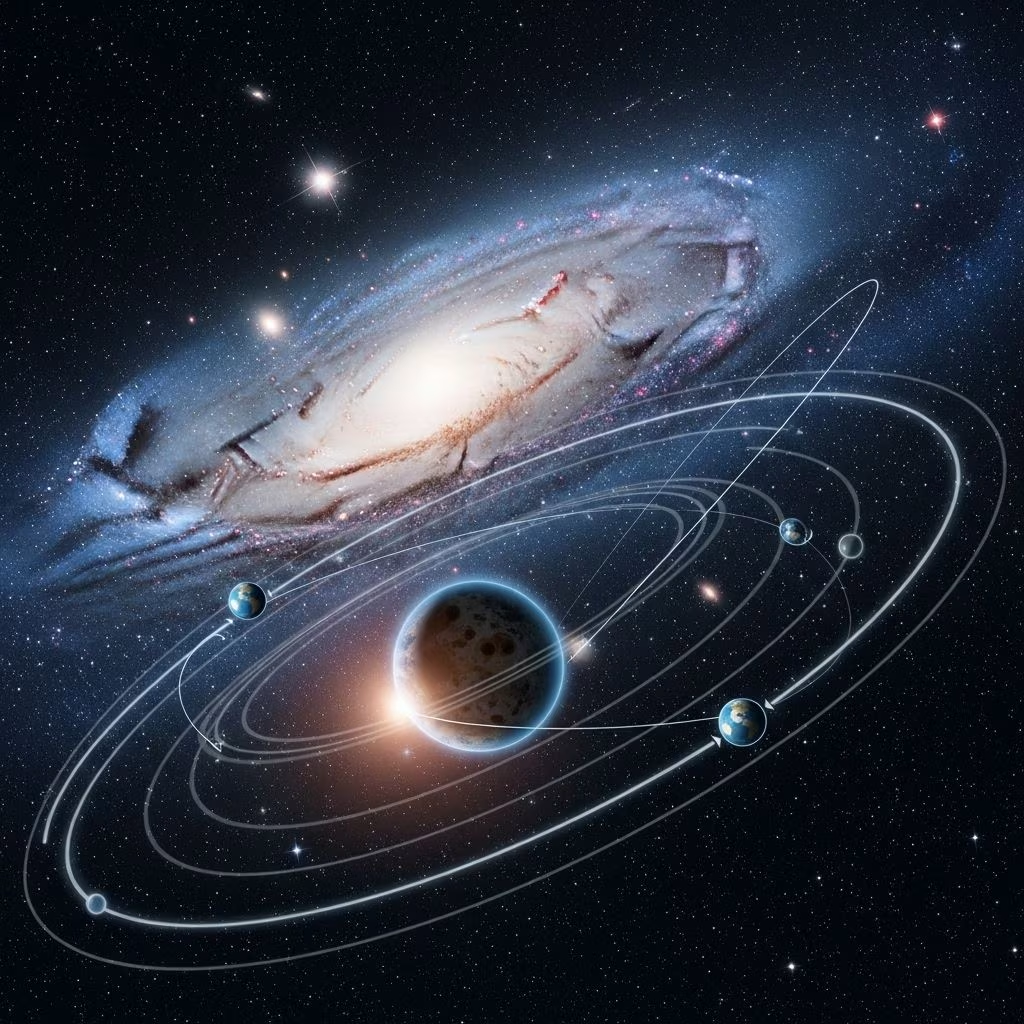
What Is Parallax?
Parallax is the observed shift in the apparent position of an object when it is viewed from two different vantage points. In daily life, you can notice parallax by holding out your thumb and alternately closing each eye—your thumb appears to jump side to side compared to the background. This simple principle, when applied on an astronomical scale, allows astronomers and scientists to decipher the depths of space and unlock cosmic distances.
The key aspect of parallax is that nearer objects show a greater apparent shift than those farther away. This concept underpins depth perception for humans and many animals, enables reliable distance measurement in numerous optical instruments, and forms the foundation for measuring the universe’s scale in astronomy.
Understanding the Mechanics of Parallax
To comprehend parallax, imagine viewing a distant tree first from your left eye, then your right. The tree seems to move relative to the far-off mountains. The angle subtended by this apparent movement—the parallax angle—is used to calculate distance:
- Bigger parallax angles mean the object is closer.
- Smaller parallax angles mean the object is farther away.
In astronomy, this method relies on observing a star (or planet) from two widely separated positions along Earth’s orbit around the Sun. The baseline for this triangle is typically the diameter of Earth’s orbit—about 300 million kilometers.
Parallax Angle Equation
The geometrical relationship allows the following formula for distance estimation:
Distance = Baseline / (2 × tan(parallax angle / 2))For small angles (as in stellar parallax), this simplifies to:
Distance (parsecs) = 1 / Parallax angle (arcseconds)The Cosmic Distance Ladder: Parallax as Its Foundation
One of parallax’s most profound contributions is serving as the first rung of the cosmic distance ladder. This ‘ladder’ is a series of techniques by which astronomers piece together distances to increasingly far-flung cosmic objects. Accurate parallax measurements provide the base for all methods built upon it.
- Direct parallax measures distances to nearby stars (within hundreds of light-years).
- These measurements calibrate other methods (like Cepheid variable stars) used for more distant galaxies.
- Ultimately, all cosmic distance measurements rely on parallax as their initial anchor.
Historical Development of Parallax in Astronomy
The concept of parallax fascinated astronomers for centuries, but technological limitations made its measurement challenging. Early astronomers searched in vain for stellar parallax—hoping its detection would confirm Earth’s orbital motion around the Sun.
It was not until the 1830s that the first successful measurements occurred:
- Friedrich Bessel measured the parallax of 61 Cygni in 1838, providing the first proof of Earth’s orbit and inspiring a revolution in astronomy.
- Thomas Henderson and Friedrich Georg Wilhelm von Struve soon followed, measuring the parallaxes of Alpha Centauri and Vega respectively.
The extremely tiny angles involved—often less than a single arcsecond (1/3600 of a degree)—posed significant observational challenges, requiring precise instruments and new techniques.
Key Historical Milestones
| Year | Astronomer | Object | Significance |
|---|---|---|---|
| 1832 | Thomas Henderson | Alpha Centauri | First practical parallax measurement |
| 1837 | Friedrich von Struve | Vega | Early demonstration of stellar parallax |
| 1838 | Friedrich Bessel | 61 Cygni | First accurate stellar parallax |
Applications of Parallax
While parallax is a pillar of astronomy, its reach extends far beyond stargazing. Here are its key applications:
- Stellar parallax: Determines distances to nearby stars, enabling models of stellar structure and galactic mapping.
- Optical devices: Used in rifle scopes, binoculars, microscopes, and cameras to provide accurate distance estimation and correct image alignment.
- Human vision: Stereopsis, or depth perception, relies on the parallax created by our dual eyes with overlapping fields of view.
- Computer vision: Computer stereo vision uses parallax to estimate three-dimensional positions and create depth maps for robotics, augmented reality, and more.
- Rangefinders: Devices such as parallax rangefinders use the principle to estimate the range and sometimes the altitude of targets, crucial in navigation and targeting.
Everyday Parallax Examples
- Mechanical speedometers: The speed indicated by a needle can appear to change when viewed from different angles, a result of parallax.
- Car dashboards: Misreading caused by viewing from the passenger seat rather than head-on.
Stellar Parallax: Astronomy’s Distance Yardstick
Stellar parallax specifically refers to the apparent shift in the position of a nearby star relative to the background of much more distant stars as Earth moves from one side of its orbit to the other. This effect is minute and detectable only for stars relatively close to Earth.
The parallax angle is defined as half the total shift, given the baseline equals the distance from Earth to Sun (1 astronomical unit, or AU). Since the angles are so small, astronomers often express distances in parsecs, where:
- 1 parsec = distance at which a star would show 1 arcsecond of parallax.
- 1 parsec ≈ 3.26 light-years.
The farther the star, the smaller its parallax, limiting this method’s practical range to a few thousand light-years even with the most sensitive equipment.
Modern Measurements and Technological Advances
New technologies have revolutionized parallax measurement, pushing the limits far beyond what Earth-bound astronomy could achieve. The Hipparcos satellite (launched by ESA in 1989) and later the Gaia mission (launched in 2013) have dramatically increased range, precision, and the number of stars cataloged using parallax.
- Hipparcos measured parallaxes for over 100,000 stars with an accuracy of up to 1 milliarcsecond.
- Gaia’s ongoing mission is expected to refine distances to over 1 billion stars, offering accuracy of a few microarcseconds for the brightest targets.
This trove of precise parallax data allows astronomers to map the 3D structure of our galaxy and test stellar evolution models with unprecedented certainty.
Limits of Parallax and the Cosmic Distance Ladder
While invaluable, the technique has its limits because the baseline (even using the diameter of Earth’s orbit) is small relative to the vast distances in space. As such, parallax is usually reliable for stars within several thousand light-years.
For objects further away, astronomers use other methods, all of which rely on accurately calibrated parallax distances for nearby objects. These steps are known collectively as the cosmic distance ladder:
- Parallax measurements of nearby stars.
- Calibration of brightness-based measurements (such as Cepheid variables) for more distant stars and galaxies.
- Type Ia supernovae and redshift measurements for gauging the farthest galaxies and cosmic expansion.
Parallax in Interstellar Navigation and Space Missions
Parallax’s utility goes beyond astronomical measurement—it’s also being proposed as a solution for navigation of interplanetary and interstellar spacecraft. Traditionally, spacecraft in our solar system are tracked using Earth-based communications and radio waves to triangulate position and speed, but future missions to other stars might not have this luxury.
A contemporary proposal involves equipping spacecraft with systems to measure stellar positions and parallax angles directly. By observing the apparent shifts in stars and combining this with the observed aberration of starlight (caused by special relativity when traveling at high speeds), a spacecraft could determine its precise 3D position and velocity relative to the galaxy, independent of Earth tracking.
- If a spacecraft can measure positions of around 20 stars with 1 arcsecond accuracy, it could localize itself within the galaxy to about 3 light-years, enough for broad interstellar navigation.
- Aberration (shifting of star positions caused by motion at relativistic speeds) allows determination of velocity, complementing position data from parallax.
Parallax Beyond Astronomy: Other Scientific and Practical Uses
Parallax is intensely relevant outside the context of space:
- Microscopes and cameras: Correcting for parallax improves image precision and dimensionality.
- Surveying and topography: Engineers use calibrated parallax to determine land features’ heights and positions accurately.
- Augmented and virtual reality: Simulated parallax is pivotal in creating the illusion of depth in digital environments.
Frequently Asked Questions (FAQs)
Q: Why do parallax measurements become less accurate for distant stars?
A: For very distant stars, the angle of shift becomes so small that it is challenging to detect against the background noise of measurement uncertainties, even with advanced instruments.
Q: Can parallax be observed in daily life?
A: Yes, parallax occurs any time you view an object from two slightly different positions. Simple examples include shifting the view of a pen or car dashboard needle by moving your head from left to right.
Q: What is a parsec and how is it related to parallax?
A: A parsec is a unit of distance used in astronomy, defined as the distance at which an object would have a parallax angle of exactly one arcsecond when Earth moves 1 AU perpendicular to the line of sight. 1 parsec equals about 3.26 light-years.
Q: How precise are modern parallax measurements?
A: Thanks to missions like Hipparcos and Gaia, modern measurements can reach precisions of a few microarcseconds for the brightest stars, enabling mapping of stars thousands of light-years away.
Q: How important is parallax to astronomy?
A: Parallax is absolutely critical, serving as the foundation for almost all measurements of distance in astronomy and enabling us to decode the structure and scale of the universe itself.
Summary Table: Parallax at a Glance
| Aspect | Description |
|---|---|
| Definition | Apparent shift of an object’s position viewed from two different locations |
| Main Use in Astronomy | Measuring distances to nearby stars |
| Unit of Measurement | Arcseconds for angles; parsecs for distances |
| Historical Firsts | Bessel, Henderson, Struve in the 1830s |
| Modern Missions | Hipparcos, Gaia |
| Key Limitation | Less effective for objects thousands of light-years away or more |
References
- https://www.space.com/interstellar-spacecraft-navigation-by-stellar-parallax
- https://lco.global/spacebook/distance/parallax-and-distance-measurement/
- https://profmattstrassler.com/articles-and-posts/relativity-space-astronomy-and-cosmology/parallax-seeing-in-depth/
- https://www.britannica.com/summary/parallax
- https://www.space.com
- https://payloadspace.com/category/parallax/
- https://en.wikipedia.org/wiki/Parallax
- https://www.sciencealert.com/what-is-parallax
- https://en.wikipedia.org/wiki/Stellar_parallax
- https://www.britannica.com/science/parallax
- https://dotcommagazine.com/2023/10/parallax-top-five-important-things-you-need-to-know/
- https://www.nasa.gov/solar-system/nasas-new-horizons-conducts-the-first-interstellar-parallax-experiment/
- https://github.com/latuminggi/bganimation/blob/master/parallax-star.html
- https://www.snexplores.org/article/experiment-parallax-measure-star-distances
- https://www.tes.com/teaching-resource/parallax-science-research-project-template-74-astronomy-astrophysics-13141666


