What Are Sunspots?
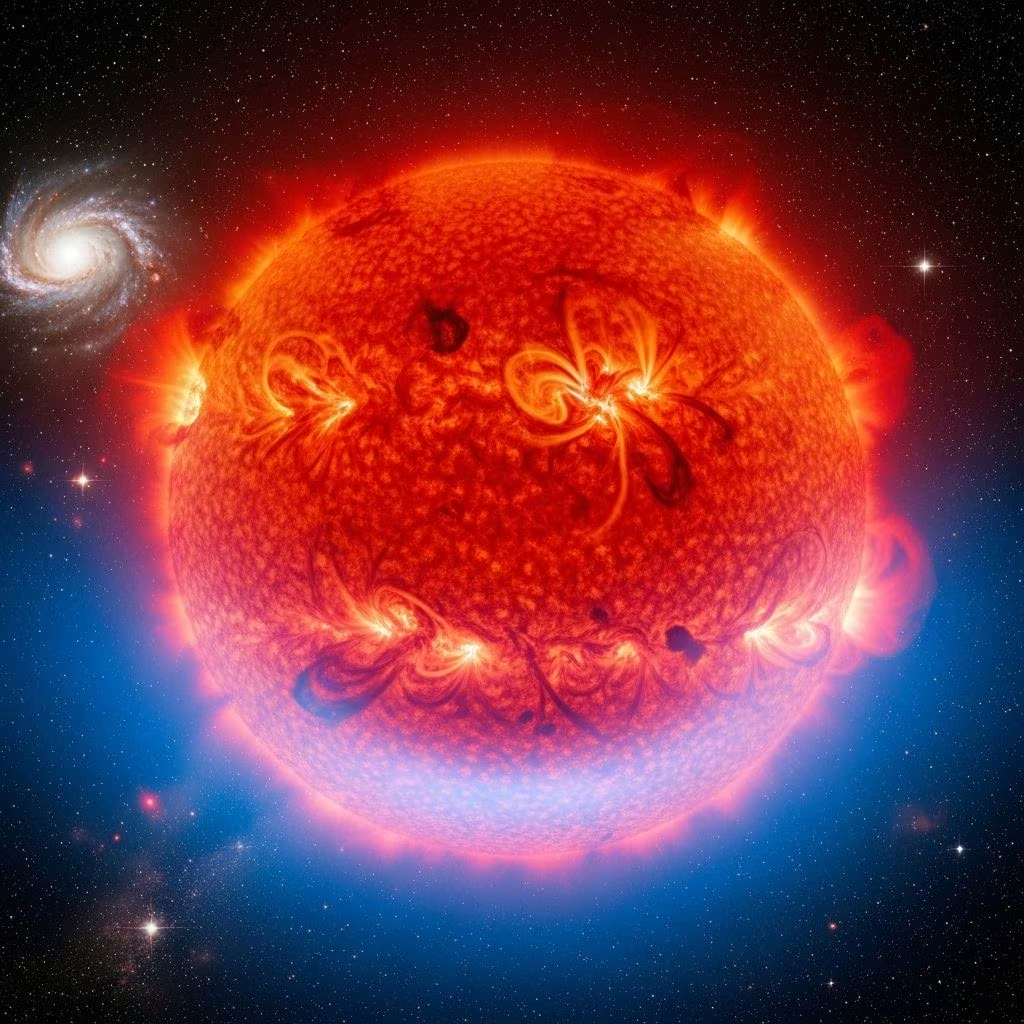
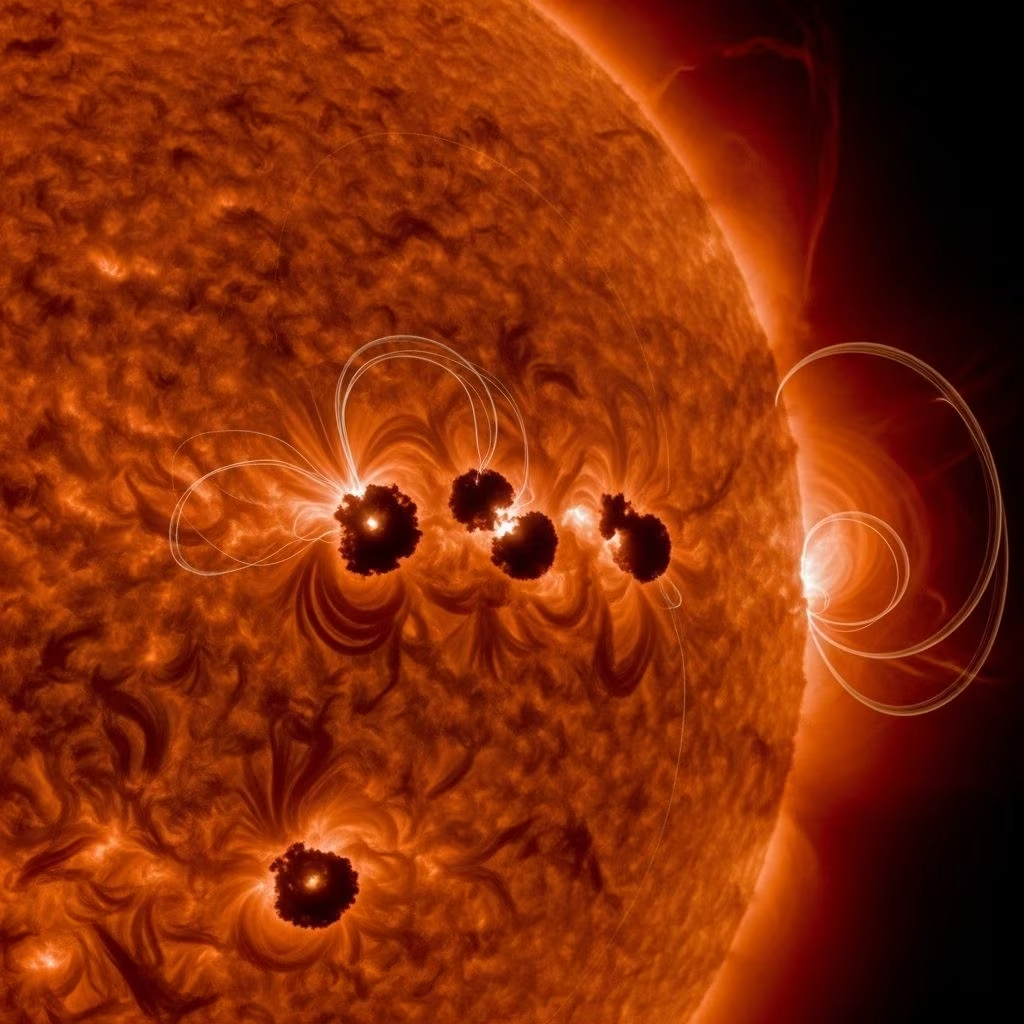
Sunspots are dark, planet-sized regions found on the surface of the sun, distinguished by their intense magnetic fields and notably cooler temperatures than the surrounding solar surface. These fascinating features are crucial for understanding solar activity, as they’re often associated with eruptive phenomena such as solar flares and coronal mass ejections.
On average, sunspots are about the same size as Earth, but their actual dimensions can range from hundreds to tens of thousands of miles across. Sunspots consist of a central dark region known as the umbra and a surrounding, lighter halo called the penumbra.
Sunspot Quick Facts
- Temperature: Sunspots are cooler (~6,000°F) than the typical photosphere (~10,000°F).
- Appearance: Dark spots due to their cooler temperature.
- Structure: Central umbra and outer penumbra.
- Association: Linked to strong magnetic fields and active solar regions.
- Impact: Sites for solar flares and eruptions.
How Do Sunspots Form?
The formation of sunspots is primarily attributed to the magnetic field dynamics within the sun. The process begins deep inside the sun, where magnetic field lines are shaped by the movement of electrically charged plasma.
This turbulent interior movement causes the sun’s magnetic fields to twist, turn, and become entangled. Because the sun rotates faster at the equator than at its poles—a phenomenon called differential rotation—these magnetic fields (conceptualized as loops like rubber bands) wind ever tighter and grow increasingly complex.
Eventually, the magnetic fields ‘snap,’ pierce through the surface, and create disturbances that form pores. These initially small pores may merge, growing into larger structures known as proto-spots, and ultimately into full-fledged sunspots. A group of sunspots is called an active region.
Formation Mechanism Table
| Step | Description |
|---|---|
| Differential Rotation | The sun’s equator rotates faster than the poles, tangling magnetic field lines. |
| Magnetic Field Amplification | Magnetic loops tighten and intensify within the sun’s interior. |
| Surface Emergence | Stressed fields break through the surface to form pores/proto-spots. |
| Sunspot Formation | Pores merge, forming sunspots characterized by strong, complex magnetic activity. |
The Structure of Sunspots
Sunspots have distinct structural features:
- Umbra: The central, darkest region, where magnetic fields are strongest and temperature is lowest.
- Penumbra: The lighter area surrounding the umbra, made up of alternating dark and light filaments, which can span more than 1,200 miles (2,000 kilometers) long and are thin—about 90 miles (150 km) wide.
Recent research has shown sunspots are sites of rapid vertical gas flows. Observations have revealed dark downflows reaching over 2,200 miles per hour (3,600 kph) and bright upflows over 6,600 miles per hour (10,800 kph). These results confirm that sunspot filaments are generated by patterns of hot and cold gases rising and sinking, a process called convective flow.
Key Points About Sunspot Structure
- Umbra: Coolest, darkest, magnetic heart of the sunspot.
- Penumbra: Bright runners of gas, thin filaments tracing magnetic flow.
- Convective flows: Hot plasma rising, cooling, and then sinking.
Historical Discovery and Study of Sunspots
Sunspots have intrigued humanity for centuries. Observations date back to the early 17th century, when Galileo pointed his telescope at the sun. The frequency and patterns of sunspots have been tracked since then, revealing that the sun is far from a static star and undergoes regular changes in activity.
Significant scientific progress came with the proposal of the magnetic field theory by astronomer Horace Babcock in 1961, which remains foundational in modern sunspot studies.
Discovery Timeline
- 17th century: First telescopic sunspot observations (Galileo).
- 20th century: Magnetic field theory established (Babcock, 1961).
- Modern era: Detailed imaging and data analysis with solar telescopes and space-based instruments.
Sunspots and the Solar Cycle
The number, size, and duration of sunspots fluctuate in accordance with the solar cycle, a repeating rhythm of solar activity lasting approximately 11 years. As the sun moves through this cycle, sunspots wax and wane in number, reflected in changing patterns of solar flare activity and overall solar weather.
Solar Maximum vs. Solar Minimum
- Solar Maximum: Many sunspots, more frequent solar storms and flares, enhanced solar activity. The sun’s magnetic poles flip during peak activity.
- Solar Minimum: Few or no sunspots, quieter sun, reduced solar storms and flare occurrence.
The most recent solar cycle, Solar Cycle 25, began in 2019, continuing the historical record of periodic activity first tracked by scientists centuries ago.
Sunspot Activity and Space Weather
Sunspots play a central role in driving solar eruptions such as flares and coronal mass ejections. These phenomena not only create stunning auroras on Earth but may also disrupt electronic infrastructure, satellites, and pose hazards to astronauts.
Effects of Sunspot Activity
- Geomagnetic storms: Caused by particles released during sunspot-associated solar flares.
- Auroras: Beautiful atmospheric displays near Earth’s poles.
- Technology risks: Sunspot-driven eruptions can disrupt power grids, air travel, and communications satellites.
Monitoring sunspot groups enables agencies like NASA and NOAA to predict solar cycle progression and space weather, safeguarding our technology-dependent world.
Mysterious Sunspot Droughts and Anomalies
Not all solar cycles are alike. Occasionally, the sun experiences extended periods with few or no sunspots—a phenomenon that puzzles solar scientists and points toward deeper mysteries in the sun’s interior processes.
An example is the unusual minimum that occurred at the end of Solar Cycle 23, with a prolonged absence of sunspots and a weak polar field. This extraordinary drought ended with the onset of the next solar cycle, underscoring the complexity and unpredictability of solar behavior.
Sunspot Predictive Research
Recent advances allow scientists to detect subtle signs on the solar surface indicating where and when sunspots are likely to emerge, sometimes up to a day in advance. These precursors are detectable thanks to high-resolution imaging and sophisticated data analysis. However, the signals are subtle and statistically significant only in regions with groups of emerging sunspots; thus, precise prediction for single spots remains a work in progress.
Sunspots: Significance for Science and Society
Sunspot observation is not merely an academic exercise: it is vital for tracking and predicting solar and space weather patterns, preparing for potentially disruptive solar storms, and contributing to our understanding of stellar magnetic fields and planetary habitability throughout the universe.
- Sunspot studies help forecast solar storms impacting satellites and electrical systems.
- They serve as visible tracers for deeper magnetic processes within the sun.
- Understanding sunspots contributes to broader research on star formation and activity in astrophysics.
Frequently Asked Questions (FAQs) About Sunspots
Q: What causes sunspots to be darker than their surroundings?
A: Sunspots appear darker because they are several thousand degrees cooler than the surrounding solar surface. The intense magnetic fields present in sunspots inhibit the flow of hot plasma from below, reducing local heat and thus emitting less light.
Q: How big can sunspots get?
A: Sunspots vary in size from tiny pores to vast regions spanning tens of thousands of miles, often similar to or larger than the diameter of Earth.
Q: Are sunspots dangerous for Earth?
A: Sunspots themselves are not directly harmful, but they are sources of solar activity such as flares and coronal mass ejections. These eruptions can disrupt communications, power grids, and pose risks to spacecraft and astronauts.
Q: How often do sunspots occur?
A: The appearance of sunspots fluctuates throughout the approximately 11-year solar cycle, alternating between solar maximum (many sunspots) and solar minimum (few or no sunspots).
Q: Can scientists predict when and where new sunspots will form?
A: Advanced observations can detect subtle precursors to sunspot formation up to a day before emergence, especially for clusters, though precise prediction for individual spots remains challenging.
Conclusion: Unlocking Solar Secrets
From their mysterious origins deep within the sun’s tangled magnetic fields to their far-reaching impact on Earth’s technology and atmosphere, sunspots are more than solar blemishes—they are visible proof of an energetic cosmos. Continued research promises not only to solve remaining mysteries of sunspot formation and prediction but also to protect our planet in a connected age.
References
- https://nso.edu/press-release/scientists-discover-solar-precursors-of-where-when-sunspots-will-emerge/
- https://www.space.com/sunspots-formation-discovery-observations
- https://www.space.com/11858-dark-sunspots-origins-explained.html
- https://science.nasa.gov/sun/sunspots/
- https://www.space.com/11005-missing-sunspots-sun-mystery.html
- https://www.space.com/the-mysterious-sunspots
- https://www.space.com/58-the-sun-formation-facts-and-characteristics.html
- https://www.space.com/39021-200-year-old-journal-rare-sunspot-records.html
- https://www.space.com/solar-flares-effects-classification-formation
- https://www.space.com/sun-solar-cycle-anomaly-discovered-korean-texts