Pisces Constellation: An Intricate Tapestry of Myth, Stars, and Science
The Pisces constellation, Latin for “the Fishes,” stands as one of the most enduring and recognizable patterns in the night sky. Occupying an intersection of mythology, ancient history, and modern astronomy, Pisces is replete with stories, features, and celestial phenomena that have fascinated humanity for millennia. This article delves deep into the constellation’s location, notable stars, mythological roots, and astronomical wonders, providing both an accessible guide for amateur stargazers and a reference for lovers of celestial lore.
Overview: Pisces at a Glance
- Latin Name: Pisces (“the Fishes”)
- Astronomical Symbol: ♓
- Family: Zodiac
- Area: 889 square degrees (14th largest)
- Quadrant: First northern (NQ1)
- Best Viewing Months: November to March in the Northern Hemisphere
- Visible Between: +90° and -65° latitude
- Bordering Constellations: Andromeda, Pegasus, Aries, Aquarius, Cetus, Triangulum
- Brightest Star: Alpherg (Eta Piscium)
Mythology and Symbolism: The Story of Pisces
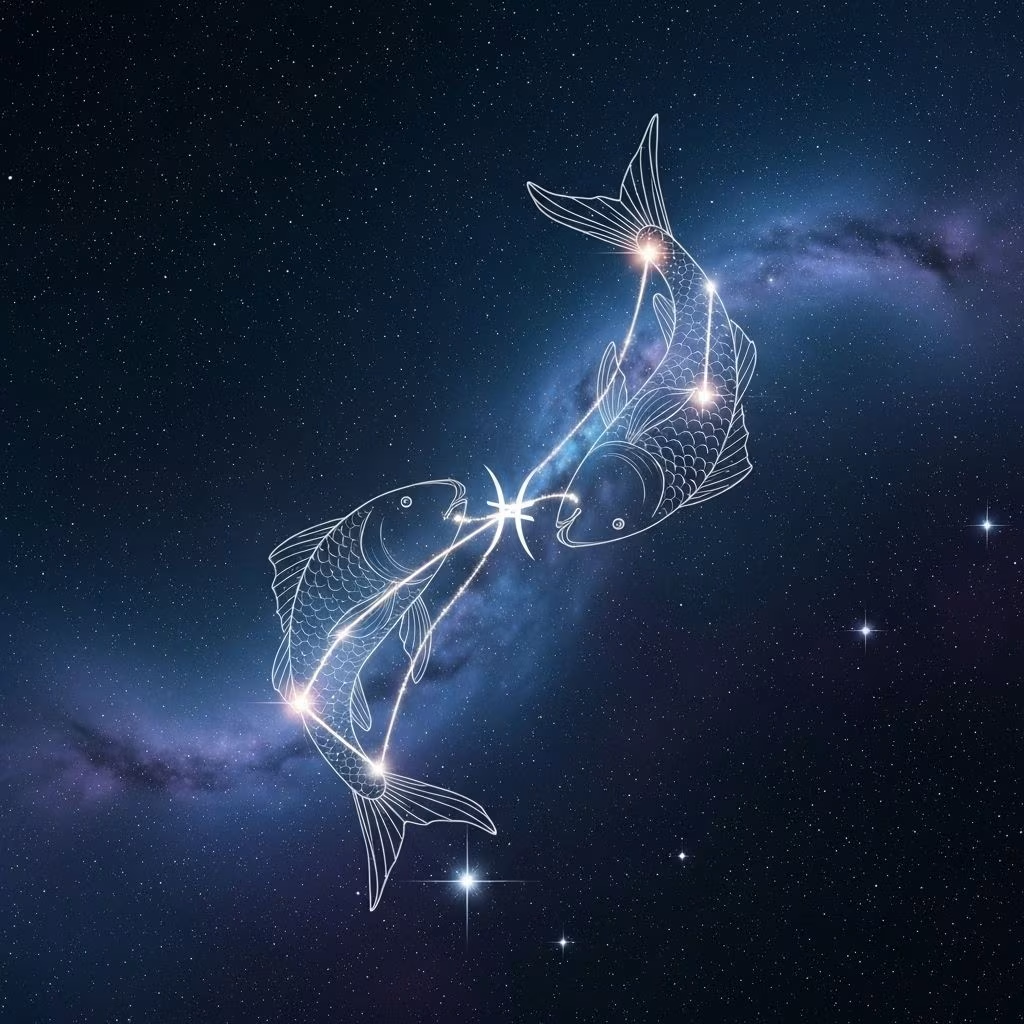
One of the defining characteristics of Pisces is its rich mythological tapestry, with roots stretching back to ancient Babylon and Greece. Pisces was seen as ‘Nunu,’ meaning fish, by the Babylonians, a depiction perpetuated in later Greco-Roman traditions. The most widely known myth recounts the dramatic escape of the goddess Aphrodite and her son Eros (Roman Venus and Cupid) from Typhon, a monstrous offspring of Earth and Tartarus. To elude this terror, mother and son transformed into fish and tied themselves together with a cord—an image that endures in the constellation’s iconic form.
Alternative versions of the myth say two fish rescued and carried the pair to safety. This linkage is why Pisces is typically depicted as two fish swimming in opposite directions, connected by a long, threadlike bond. This story, symbolizing union, transformation, and escape, has endured in astronomical lore and astrological interpretation alike.
Locating Pisces in the Night Sky
Pisces can seem elusive amid brighter neighboring constellations, but stargazers equipped with a basic star chart can pinpoint its subtle pattern. The constellation lies nestled among Aries to the east; Aquarius and Pegasus to the west and north; Cetus to the south; Andromeda and Triangulum to the northwest.
- One prominent feature is The Circlet, a asterism forming a ring at the western end of Pisces, marking the head of the western fish.
- The constellation stretches like a wide ‘V’ shape across the sky, with fainter stars, so a clear, dark sky is ideal for viewing.
- Pisces’ stars create two uneven arcs—each representing one of the mythological fish—joined by a string of stars (the cord).
For northern observers, the best viewing window is from November through March, when Pisces reaches its highest point in the night sky.
Astronomical Significance: The Vernal Equinox and Pisces
Pisces holds an honored position in the celestial calendar as the present location of the vernal equinox—the point where the Sun crosses the celestial equator moving northward each year, marking the beginning of astronomical spring in the northern hemisphere, around March 21.
This intersection of the ecliptic (the Sun’s path) and the celestial equator (Earth’s equator projected onto the sky) is called the “First Point of Aries.” Due to the precession of Earth’s axis—a slow wobble over millennia—this point has shifted from Aries and now rests in Pisces.
- The vernal equinox in Pisces means the Sun spends a period each year within the boundaries of this constellation.
- This shift has astronomical, astrological, and calendrical importance, as it was formerly the cornerstone of ancient calendars and zodiac divisions.
Pisces in Context: The Zodiac
| Constellation | Latin Name | Symbol | Dates* | Family |
|---|---|---|---|---|
| Pisces | Pisces | ♓ | February 19 – March 20* | Zodiac |
| Neighboring: Aries | Aries | ♈ | March 21 – April 19* | Zodiac |
| Neighboring: Aquarius | Aquarius | ♒ | January 20 – February 18* | Zodiac |
*Zodiac dates based on astrological tradition; actual constellation boundaries as defined by astronomers may differ.
Key Stars of Pisces
Pisces is not known for particularly bright stars, but several within its borders lend character and structure to the constellation:
- Alpherg (Eta Piscium): The brightest star, magnitude 3.6, a yellow giant located around 350 light-years from Earth.
- Alrescha (Alpha Piscium): Name means “the cord” in Arabic, marking the point where the two fish are tied. It is a binary (double) star about 139 light-years away.
- Other Named Stars: Bélénos, Citadelle, Ebla, Fumalsamakah, Parumleo, Revati, and Torcular—all officially recognized by the International Astronomical Union (IAU).
- There are ten stars in Pisces with known planets, and several more with significant scientific interest.
Notable Asterisms: The Circlet
The Circlet is a small grouping of stars in the western part of Pisces, forming a rough circle. It represents the head of one of the mythological fish and serves as a useful reference point for skywatchers locating the constellation under low light pollution conditions.
Deep Sky Wonders in Pisces
Despite its faint visible stars, Pisces is home to several important and interesting deep-sky objects:
- Messier 74 (M74/NGC 628): A classic “grand design” spiral galaxy, face-on from our viewpoint. About 32 million light-years away, M74 is prized by amateur astronomers for its symmetry and definition. Under dark skies, it’s a challenge for small telescopes, but a treat for larger apertures.
- Pisces Dwarf Galaxy: A dim, irregular galaxy, satellite to the much larger Andromeda Galaxy. It is difficult to observe but notable in galactic studies.
- Colliding Galaxy Pair Arp 284: Comprising two interacting galaxies, NGC 7714 and NGC 7715.
- 3C 31: A radio galaxy noted for its extensive jets, observed primarily by professional astronomers with large telescopes.
Pisces Meteor Shower: The Piscids
Pisces is host to the annual Piscid meteor shower, peaking around late September each year. Though generally minor compared to other showers, it occasionally provides heightened activity for observers in the northern hemisphere.
Pisces in Culture and Astrology
Beyond astronomy, Pisces looms large in cultural and astrological traditions. Its glyph (♓) of two fish tied together is a common astrological symbol. In Western astrology, Pisces is linked with qualities like empathy, intuition, and versatility, with those born under this sign (usually between February 19th and March 20th) said to inherit its traits.
Historically, Pisces also served as an agricultural and fishing marker in various Mediterranean and Middle Eastern calendars, signaling seasonal transitions.
How to Find Pisces: Observing Tips
- Best time to observe: Pisces is highest in the sky around midnight in October and early November.
- Find The Circlet: Use the neighboring constellations Pegasus and Aquarius to locate the general vicinity; The Circlet is visible just east of the bright Great Square of Pegasus.
- Dark sky is key: Pisces’ fainter stars are best viewed away from urban light sources and under a moonless sky.
- Look for the overall ‘V’ shape formed by the constellation’s stars, representing the two fish and their connecting cord.
Frequently Asked Questions (FAQs) About Pisces
Q: Is Pisces a prominent constellation to the naked eye?
A: While large, Pisces contains mostly dim stars, so it is best seen from dark viewing locations on clear nights.
Q: What is the significance of Pisces in astronomy?
A: Pisces is astronomically important as the current location of the vernal equinox and for its presence in the zodiac. It also features several notable deep-sky objects such as Messier 74.
Q: How old is the Pisces constellation as a concept?
A: Pisces was catalogued by Ptolemy in the 2nd century, but earlier versions date to Babylonian astronomy and mythology.
Q: Which is the brightest star in Pisces?
A: Alpherg (Eta Piscium) is the brightest, with a magnitude just below 4, making it visible to the unaided eye under good conditions.
Q: Does Pisces feature any meteor showers?
A: Yes, the Piscid meteor shower, a minor annual event, peaks in late September.
Quick Facts Table
| Attribute | Detail |
|---|---|
| Zodiac Symbol | ♓ (Two fish connected by a cord) |
| Area in Sky | 889 sq. degrees |
| Visible From | +90° to -65° latitude |
| Messier Objects | 1 (Messier 74) |
| Brightest Star | Alpherg (Eta Piscium) |
| Meteor Showers | Piscids (late September) |
| Family | Zodiac |
Pisces: Legacy and Wonder for Modern Stargazers
Pisces continues to inspire fascination for astronomers and mythology enthusiasts alike. Whether drawn to its age-old stories, its role in marking the equinoctial point, or the challenge of spotting its subtle pattern, those who turn their gaze to Pisces are welcomed into a legacy that stretches from the ancient world to the outer reaches of modern space discovery. With dark skies and a patient eye, the Fishes reveal their secrets one star at a time.
References
- https://www.space.com/21456-pisces-constellation.html
- https://www.constellation-guide.com/constellation-list/pisces-constellation/
- https://en.wikipedia.org/wiki/Pisces_(constellation)
- https://www.go-astronomy.com/constellations.php?Name=Pisces
- https://theplanets.org/constellations/pisces-constellation/
- https://www.britannica.com/place/Pisces
- https://theskylive.com/sky/constellations/pisces-constellation
- https://www.jameswebbdiscovery.com/universe/100-fascinating-facts-about-pisces-constellation
- https://lovethenightsky.com/pisces-constellation-guide/
- https://starregister.org/pisces.php
- https://astro4edu.org/resources/diagram/5t4fz51Q587/
- https://www.youtube.com/watch?v=gFXrMMVxAgU
- https://en.wikipedia.org/wiki/Piscis_Austrinus
- https://nineplanets.org/kids/pisces-constellation/
- https://www.skyatnightmagazine.com/advice/constellation-pisces
- https://www.solarsystemquick.com/universe/pisces-constellation
- https://nineplanets.org/pisces-constellation/
- https://www.planetguide.net/pisces-constellation/