The Sun’s Magnetic Field Flip: A Cosmic Cycle Explained
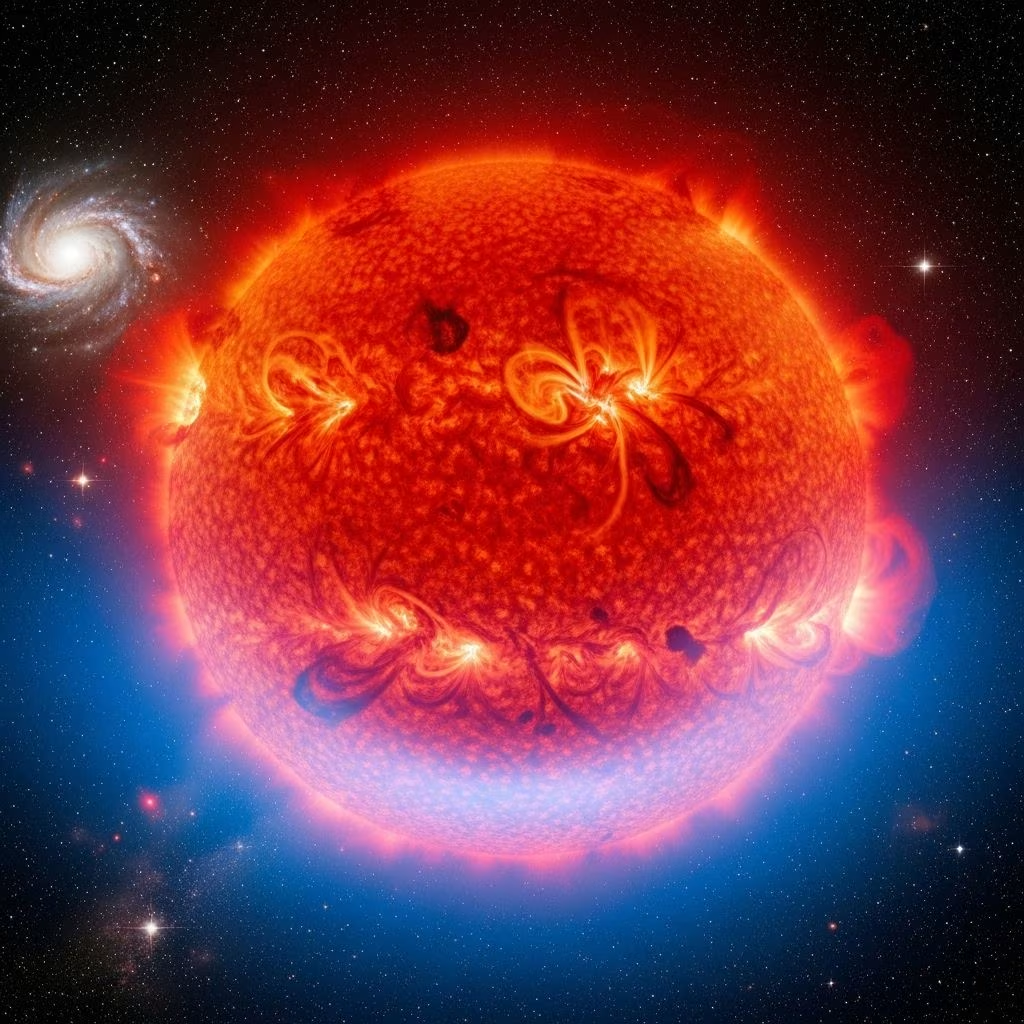
Every eleven years, the Sun undergoes a remarkable transformation: its vast magnetic field, stretching billions of miles into the solar system, completely reverses polarity. This solar magnetic field flip is a pivotal event in the solar cycle, closely watched by scientists due to its influence on space weather, planetary environments, and even technological systems on Earth.
What Is the Sun’s Magnetic Field Flip?
The Sun’s magnetic field flip is a phenomenon where the magnetic north and south poles of the Sun switch places. This is not a sudden event but a gradual process occurring approximately every 11 years during what is called the solar maximum—the peak of solar activity in the Sun’s 11-year solar cycle.
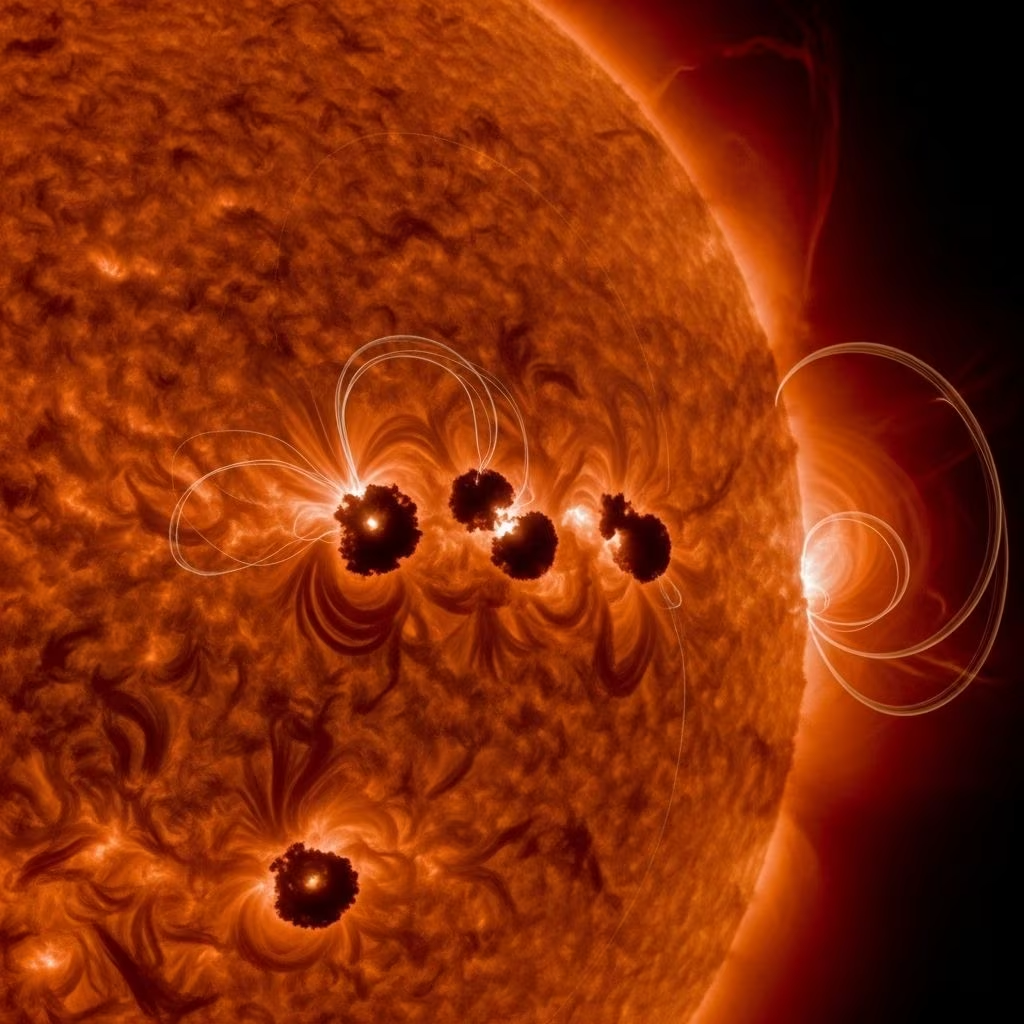
At solar maximum, the number of sunspots—dark regions of intense magnetic activity—reaches its highest point. The last recorded flip occurred near the end of 2013, and current observations predict the next will culminate between late 2024 and early 2026.
The Solar Cycle: Foundation of the Flip
The solar cycle, the rhythm of solar activity, is defined by two main stages:
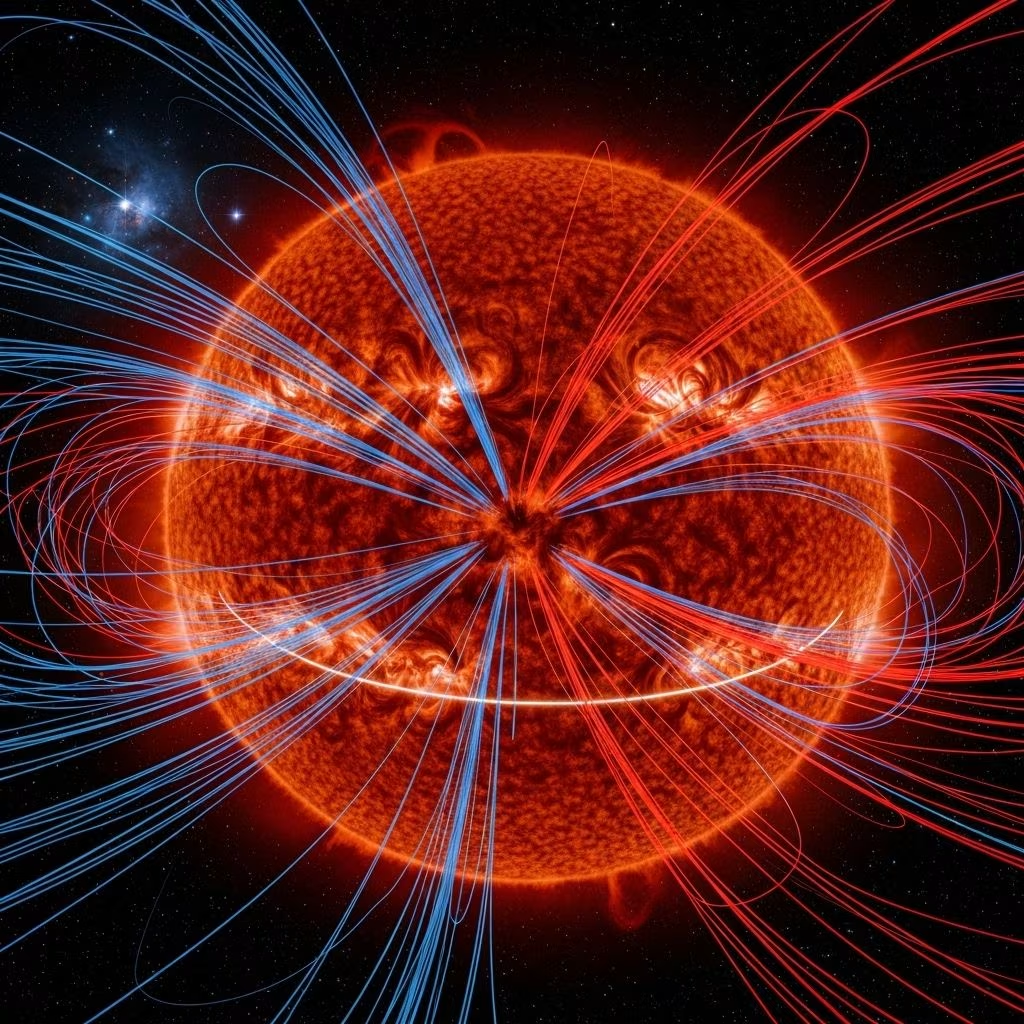
- Solar Minimum: The lowest period of sunspot activity; the Sun’s magnetic field is more orderly, resembling a dipole with clear north and south poles—similar to Earth’s field.
- Solar Maximum: A period of heightened solar activity when sunspot numbers peak, the magnetic field becomes tangled, and polarity reversal unfolds.
The culmination of this 11-year cycle marks not just a top in sunspot numbers, but also a subtle transition in the magnetic orientation of the Sun. Layered over this is the 22-year Hale cycle, which encompasses two 11-year cycles: one flip to the opposite polarity and another flip back, restoring the original orientation.
The Dynamo Within: Mechanisms Behind the Flip
Why does the Sun’s magnetic field flip? The answer lies in the Sun’s internal solar dynamo—a process resulting from the motions of electrically charged plasma that constitute the Sun’s “surface” and interior.
- Differential Rotation: The Sun is made of plasma (ionized gas), not solid matter. Its equator rotates much faster (about 25 days) than its poles (about 35 days), causing the magnetic field lines to twist and wrap around themselves over time—a bit like winding up a rubber band.
- Magnetic Field Emergence: These stressed lines erupt through the Sun’s visible surface (the photosphere) as concentrated regions called sunspots, where complex local magnetic activity often triggers powerful solar events.
- Poleward Migration: Over the course of several years, magnetic fields from new sunspots migrate poleward, carrying opposite polarity to that of the existing poles. This cancels out the old polarity and gradually establishes the new configuration—a process described by Hale’s Law.
Despite general understanding, certain details are still under study; the Sun’s internal progressions are so intricate that scientists lack a fully consistent mathematical model describing every nuance of the reversal. As a result, while the location and emergence of sunspots can be monitored, predicting specifics, such as when the flip will finish, remains an open scientific challenge.
Visualizing the Flip: Polar Field Migration
During the solar cycle, visualizations based on solar observatory data show streaks of magnetic polarity (positive and negative) appearing at low latitudes (near the equator) as sunspots and gradually migrating toward the poles. As these regions accumulate near a pole, the net magnetic field there weakens until it reverses.
Key observations:
- In the lead-up to the flip, the Sun’s field resembles a twisted, interlocking web rather than a tidy bar-magnet structure.
- Once the flip is complete, the orderly dipole is restored—but with the polarities swapped.
Sunspots, Flares, and Coronal Mass Ejections: Magnetic Manifestations
Sunspots are not only markers of magnetic turmoil but can also be sources of dramatic solar phenomena:
- Solar Flares: Sudden explosions of energy caused by the tangling, crossing, or reorganizing of magnetic field lines near sunspots. Flares release X-rays and ultraviolet radiation and can affect communication and navigational systems on Earth.
- Coronal Mass Ejections (CMEs): Vast clouds of charged particles hurled into space. If directed toward Earth, CMEs can trigger geomagnetic storms, increase atmospheric drag on satellites, and produce intense auroras.
These phenomena become more frequent around the time of solar maximum—and, thus, during the period of magnetic reversal.
Space Weather and Earthly Impact
Understandably, the Sun’s magnetic field flip may sound alarming, but it is a natural and regular event in solar physics. Notably:
- No direct danger to life on Earth. The process does not threaten the biosphere; Earth’s magnetic field and atmosphere provide substantial protection against solar and cosmic radiation.
- Induced Space Weather Effects: During and after the flip, the likelihood and intensity of auroras, geomagnetic storms, and disruptions to radio communications and satellite operations increase. These impacts result from intensified solar activity feeding the complex interplay between solar and terrestrial magnetic fields.
- Influence on Radiation Levels in Deep Space: The reversal also affects the heliosphere’s ability to shield the solar system from cosmic rays, briefly exposing space missions and planetary surfaces to higher levels of energetic particles.
The Magnetic Flip Compared: The Sun vs. Earth
| Feature | Sun | Earth |
|---|---|---|
| Cycle Length | ~11 years (solar cycle), 22 years (Hale cycle) | Irregular, hundreds of thousands to millions of years |
| Nature of Flip | Regular reversal, well-studied | Irregular geomagnetic reversals (less understood) |
| Impact | Drives space weather; effects on satellites & communication | Unknown if direct impact; no records of extinction-level effects |
| Main Driver | Solar dynamo (plasma movement and differential rotation) | Geodynamo (liquid iron core movement) |
| Protective Role | Shields solar system from cosmic rays (via heliosphere) | Protects Earth’s life from solar wind and cosmic radiation |
Frequently Asked Questions (FAQs) about the Sun’s Magnetic Field Flip
Q: How does the magnetic field flip affect auroras?
A: Auroras are often more frequent and intense near solar maximum and during the magnetic field flip, because increased solar activity drives more charged particles into Earth’s atmosphere, lighting up the skies near the poles.
Q: Can the Sun’s magnetic field flip harm humans?
A: The event itself poses no direct threat to human health. However, the increased solar activity can disrupt technology, communications, and satellites. Enhanced space weather may moderately elevate radiation for astronauts and high-flying aircraft at polar routes.
Q: Why does the Sun’s field flip so frequently compared to the Earth’s?
A: The difference stems from their internal processes. The Sun’s turbulent, fast-moving plasma ensures dynamic, short cycles (11 years), while Earth’s liquid iron core undergoes much slower and less unpredictable magnetic reversals.
Q: How do scientists observe or measure the Sun’s magnetic field?
A: Observatories worldwide, as well as satellites, monitor the Sun’s magnetic lines of force using techniques like Zeeman splitting (effect of magnetic fields on atomic spectra). Visualization movies, maps of active regions, and computer models also help track and predict reversals.
Recent Magnetic Flips and Current Predictions
During Solar Cycle 24, scientists documented both poles flipping between 2012 and 2013—the north pole switched polarity in June 2012, the south in July 2013. Observers expect the next magnetic field reversal to occur between late 2024 and early 2026, once again splitting the solar cycle into two halves.
The Hale Cycle: The Sun’s 22-Year Magnetism
While the 11-year solar cycle tracks sunspot activity and magnetic flips, it is part of a larger Hale cycle. Every two solar cycles (about 22 years), the Sun returns its magnetic field to its original orientation, completing a full magnetic oscillation. This discovery, made by astronomer George Ellery Hale in the early 20th century, underpins much of our understanding of solar magnetic activity. It also explains patterns observed in sunspot polarity and the large-scale organization of solar magnetic regions.
Why Study the Sun’s Magnetic Field?
- Space Weather Protection: Predicting solar activity helps prevent disruptions to power grids, satellite networks, and astronaut safety.
- Fundamental Physics: The solar dynamo is a laboratory for plasma physics and magnetic field generation, aiding our grasp of cosmic magnetism.
- Planetary Impacts: Understanding the Sun’s magnetic behavior informs climate models, assessments of long-term space radiation, and plans for future Mars missions where planetary protection is minimal compared to Earth.
Looking Ahead: What To Expect With the Upcoming Solar Maximum
As the Sun approaches its next magnetic flip, public interest grows—especially after recent increases in solar flare activity and spectacular auroras visible far from the poles. Scientists encourage increased monitoring, as the event signals not only a peak in solar storm risk but also an indispensable opportunity for solar research.
- Amateur observers: Can look for pronounced sunspot clustering and occasional bright auroras during geomagnetic storms.
- Researchers: Use the flip to validate and improve models of the solar dynamo, helping us understand how stars evolve and behave in our galaxy and beyond.
- Society at large: Should be aware of increased potential for radio blackouts and GPS disruptions, but not fearful, as such events are usually well-forecasted and manageable.
References and Further Reading
- “The sun’s magnetic field will flip soon. Here’s what to expect.” – Space.com
- NASA Heliophysics Division: The Sun’s Magnetic Field is About to Flip
- The Sun Today: The Sun’s Magnetic Poles Have Flipped
- Wikipedia: Solar Cycle
- Space Weather Prediction Center – NOAA
References
- https://www.space.com/the-universe/sun/sun-magnetic-field-flip
- https://www.nasa.gov/science-research/heliophysics/the-suns-magnetic-field-is-about-to-flip/
- https://www.thesuntoday.org/solar-science/suns-magnetic-poles-flipped-solar-max-is-here/
- https://nso.edu/blog/polar-magnetic-field-reversal/
- https://svs.gsfc.nasa.gov/5344/
- https://www.youtube.com/watch?v=PnVbT-tpot8
- https://en.wikipedia.org/wiki/Solar_cycle
- https://en.wikipedia.org/wiki/Geomagnetic_reversal
- https://www.planetary.org/articles/its-not-magic-its-magnetic
- https://www.youtube.com/watch?v=IxnqrEBxmm4
- https://www.wtamu.edu/~cbaird/sq/2013/08/07/how-often-does-the-suns-magnetic-field-flip/
- https://www.space.com/22310-sun-magnetic-field-flip-mystery.html
- https://www.wtamu.edu/~cbaird/sq/mobile/2013/08/07/how-often-does-the-suns-magnetic-field-flip/
- https://astronomynow.com/2025/02/11/the-suns-magnetic-field-is-about-to-flip/
- https://newspaceeconomy.ca/2024/06/24/the-suns-magnetic-poles-are-flipping-what-it-means-for-earth/
- https://timesofindia.indiatimes.com/home/science/the-suns-magnetic-field-flip-what-to-expect-and-when-earth-aurora-weather-change/articleshow/111016488.cms