


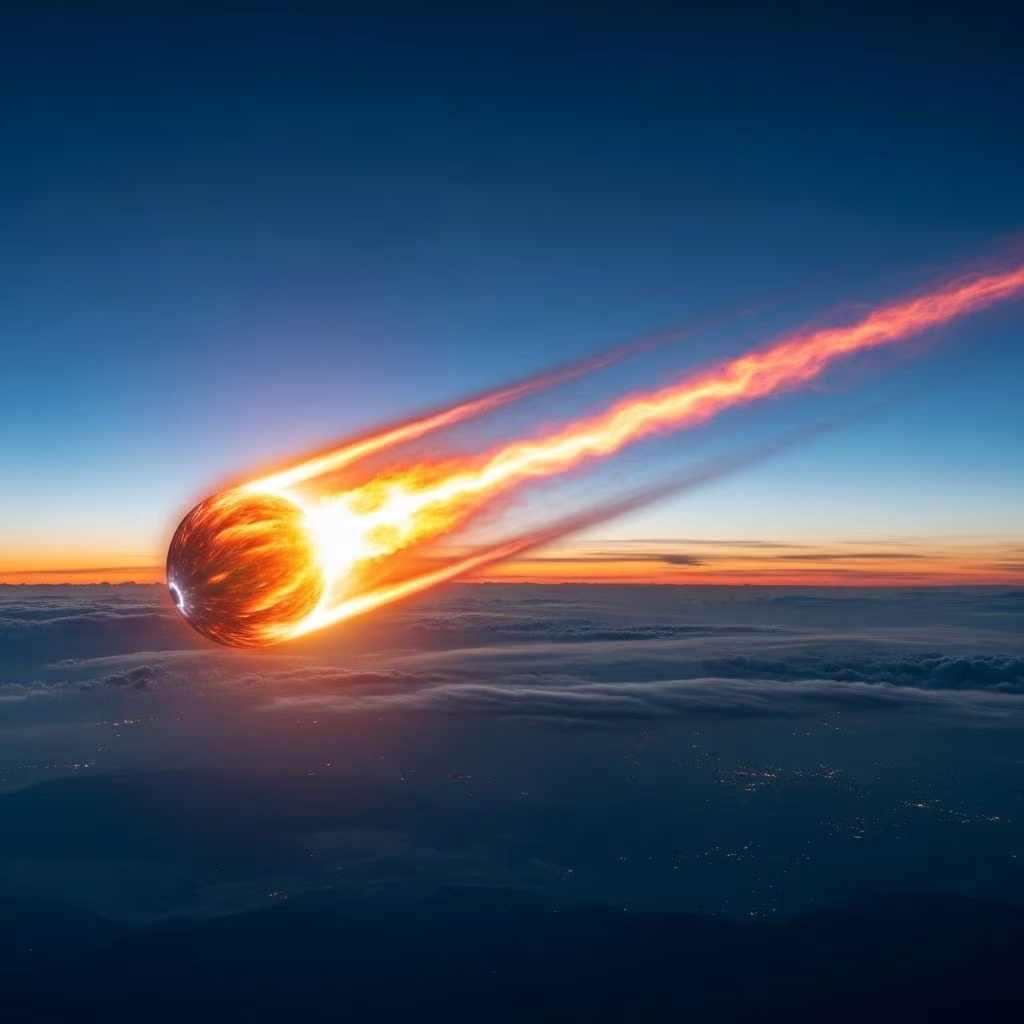
SpaceX Starlink Satellite’s Fiery Fall Captivates the US
Stargazers across multiple US states were treated to a stunning celestial event when a SpaceX Starlink satellite, reentering Earth’s atmosphere, created a brilliant fireball streaking across the night sky. The bright, slow-moving trail drew thousands to social media, eager to share videos and photos of the spectacular event. Such reentries are striking reminders of our technological reach—and the atmospheric drama satellites can create as they return to Earth.
This article delves into how and why the Starlink satellite created this luminous fireball, with insights into the science of satellite reentry, public and expert response, the context of the Starlink program, and what this means for orbital debris and future stargazing.
Contents
- The Night the Starlink Satellite Became a Fireball
- Public Videos and Eye-Witness Accounts
- The Science Behind Satellite Reentry
- What Happens to Satellite Debris?
- What Is the SpaceX Starlink Program?
- Public Response and Fascination
- Expert Perspectives on Space Debris
- Looking Ahead: Starlink and the Future of Satellite Reentry
- Frequently Asked Questions (FAQs)
The Night the Starlink Satellite Became a Fireball
On a clear night, observers in parts of the United States looked up to see a glowing object blazing through the atmosphere. The fireball was caused by an old Starlink satellite—a part of SpaceX’s rapidly expanding low-Earth orbital constellation—undergoing an uncontrolled reentry. Unlike fleeting meteors, this fireball lasted longer and was visible across several states, offering ample opportunity for observation and recording.
Key highlights of the event:
- The fireball originated from the disintegration of a SpaceX Starlink satellite as it reentered Earth’s atmosphere.
- Sightings were reported across wide regions, from the Midwest to the Southeastern United States.
- Social media posts and videos quickly circulated as people sought to identify the source of the extraordinary light show.
Public Videos and Eye-Witness Accounts
In the digital age, the fireball was widely documented. Hundreds of videos and photos surfaced across platforms like Twitter (now X), Reddit, and YouTube, giving scientists and the general public various perspectives on the event. Slow-moving compared to a meteor, the object’s prolonged brilliance allowed witnesses to capture detailed footage.
- Many viewers described the object as “the slowest, brightest meteor I’ve ever seen”—but experts clarified its artificial origin.
- The fireball’s trail often appeared in multiple fragments, suggesting the satellite was breaking up as it burned, a characteristic sign of reentering space hardware.
- Several videos showed the object glowing orange and breaking into smaller pieces as it streaked across the night sky.
Such immediate sharing of observations helps astronomers and satellite trackers confirm the nature and origin of fireballs.
The Science Behind Satellite Reentry
When a satellite like Starlink completes its operational lifetime or fails, its orbit around Earth gradually decays due to atmospheric drag—a process especially rapid for objects in low Earth orbit (LEO). Eventually, the satellite reenters the denser parts of the atmosphere, and friction quickly heats it up, producing a fiery tail visible from the ground.
How Satellite Reentry Works:
- As the satellite descends below ~120 kilometers (75 miles), atmospheric particles generate intense heat through compression and friction.
- The heat causes the satellite structure to disintegrate; the metal melts and burns up, which creates a glowing fireball effect.
- Most of the satellite is vaporized before it can reach the surface. Only the densest components—such as titanium fuel tanks—might survive, but these are rarely found.
- Satellite reentries are usually planned for uninhabited zones like the South Pacific Ocean to minimize risks.
The Starlink satellites are specifically designed to burn up almost completely during reentry, to reduce the risk of fallen debris on Earth.
What Happens to Satellite Debris?
Concerns about space debris and falling satellites are common, but in most cases, debris from small satellites burns up harmlessly. Only a small fraction of mass may survive the journey through the atmosphere. Precautions taken by companies like SpaceX help ensure that the risk to life or property is extremely low.
What determines the fate of reentering satellites?
- Altitude: Lower-orbit satellites deorbit quicker due to greater atmospheric drag.
- Materials: Satellites made of lightweight and low-melting-point materials are more likely to fully vaporize.
- Size and mass: Smaller, lighter satellites—as in the Starlink constellation—pose less risk than massive, older hardware.
Space agencies and private corporations track satellites’ end-of-life objects to predict possible reentries and, when feasible, steer large pieces away from inhabited areas.
What Is the SpaceX Starlink Program?
Starlink is SpaceX’s ambitious project to create a globe-spanning internet service using thousands of small satellites in low Earth orbit. These satellites provide high-speed, low-latency connectivity to users in even the most remote regions. As of September 2025, nearly 2,000 Starlink satellites have been launched, with multiple launches occurring each month to expand and refresh the constellation.
Key facts about Starlink:
- The first Starlink satellites launched in 2019.
- Each satellite weighs approximately 260 kg (573 pounds) and has a flat-panel design.
- Satellites operate at altitudes between 340 and 550 km (211–342 miles).
- Regular launches send batches of up to 60 satellites at a time, though 28-satellite launches are common in late 2025.
- The network is constantly replenished as older satellites decay and new ones are deployed.
| Date | Number of Satellites | Launch Vehicle | Launch Site |
|---|---|---|---|
| 21 Sept 2025 | 28 | Falcon 9 | Cape Canaveral |
| 5 Sept 2025 | 28 | Falcon 9 (B1069) | Kennedy Space Center |
| 3 Sept 2025 | 28 | Falcon 9 | Cape Canaveral |
Starlink satellites are designed with responsible end-of-life plans, including the ability for autonomous deorbiting if an issue is detected.
Public Response and Fascination
The dramatic fireball ignited the imaginations of both amateur astronomers and casual witnesses. For many, such rare sights foster curiosity about the science and technology behind modern spaceflight.
- Social media trends: Hashtags related to the fireball event trended as users posted footage and speculated about the object’s identity.
- Community science: Amateur astronomers used information from tracking websites and orbital predictions to confirm the object’s Starlink origin.
- Media coverage: The event made national headlines, with some initial confusion about whether the object was a meteor or space debris, later clarified by experts.
Widespread online sharing of videos and photos is an increasingly important tool in tracking and understanding satellite reentries, helping both the public and the scientific community.
Expert Perspectives on Space Debris
Astrophysicists and satellite tracking experts routinely analyze reentry events, using them as case studies in orbital mechanics and atmospheric burn-up. The vast majority of such reentries are harmless, but as the number of satellites increases, experts emphasize the importance of sustainable practices and international coordination.
Key expert concerns and comments:
- Overall risk to populations from reentering satellites is extremely low, especially with modern designs meant for full burn-up.
- Global tracking networks—using radar and telescopes—allow timely identification of incoming objects.
- Responsible deorbiting guidelines, including southern ocean “graveyards,” are becoming standard best practice.
- Organizations such as the U.S. Space Surveillance Network and European Space Agency communicate predictions and analyze unusual reentry cases.
SpaceX’s Starlink satellites, similar to most newer LEO payloads, include onboard software and propulsion to autonomously deorbit at mission end, minimizing their debris footprint.
Looking Ahead: Starlink and the Future of Satellite Reentry
With thousands of satellites orbiting above and more planned, satellite reentries will become more common—but rarely pose danger thanks to improved tracking and engineering.
Important developments to watch:
- Starlink is refining satellite design for cleaner burns and less residual debris during atmospheric reentry.
- SpaceX and other operators now employ autonomous deorbit systems to ensure reliable end-of-life disposal.
- International guidelines for responsible spaceflight are under continuous review as more nations and private companies join the satellite revolution.
- The public’s interest in skywatching grows with each visible event, encouraging broader engagement with science and astronomy.
As new generations of Starlink and similar constellations fill the night sky, brief but spectacular fireballs will occasionally remind us of the human-made presence above—and the science, engineering, and collaboration making it all possible.
Frequently Asked Questions (FAQs)
Q: What caused the fireball seen across the US?
A Starlink satellite from the SpaceX constellation reentered Earth’s atmosphere, producing a fiery trail as it burned up due to friction and heat.
Q: Are such satellite reentries dangerous?
For modern satellites like Starlink, most material vaporizes on the way down, making ground risk extremely rare. Any surviving fragments are unlikely to cause harm.
Q: How do experts know the fireball was from a Starlink satellite and not a meteor?
Satellite tracking networks, time and position of reentry, and the slow, fragmenting burn pattern help experts distinguish artificial satellites from natural meteors.
Q: Will more fireballs happen as more satellites are launched?
Occasional fireballs from satellite reentries will occur more often as constellations like Starlink grow, but such displays are still relatively rare compared to total launches.
Q: Can people track upcoming reentries and launches?
Yes. Tracking websites, organizations like NORAD, and even SpaceX’s own resources allow the public to monitor future launches and predicted reentry events.
References
- https://www.spacex.com/launches/
- https://www.space.com/space-exploration/launches-spacecraft/spacex-satellite-starlink-launch-group-10-27
- https://aiaa.org/2025/09/02/spacex-launches-1900th-starlink-satellite-to-orbit-in-2025/
- https://www.youtube.com/watch?v=Dp071dcltvg
- https://www.youtube.com/watch?v=hlwlcZZFz8w
- https://spaceflightnow.com/2025/09/20/live-coverage-spacex-to-launch-28-starlink-satellites-on-falcon-9-rocket-from-cape-canaveral-12/
- https://spaceflightnow.com/2025/09/25/live-coverage-spacex-to-launch-28-starlink-satellites-on-falcon-9-rocket-from-cape-canaveral-13/
- https://aiaa.org/2025/09/08/spacex-marks-2000-starlink-satellites-deployed-in-2025/
- https://www.space.com/space-exploration/launches-spacecraft/spacex-starlink-satellite-launch-group-10-61
- https://en.wikipedia.org/wiki/Starlink
- https://starwalk.space/en/news/spacex-starlink-satellites-night-sky-visibility-guide
- https://www.rocketlaunch.live/?tag=series-spacex-starlink
- https://dailygalaxy.com/2025/09/blazing-fireball-shocked-americans-sky/
- https://ts2.tech/en/spacex-falcon-9-starlink-launch-set-for-sept-21-2025-mission-details-viewing-tips-more/
- https://archeonis.com/space/spacex-launches-28-starlink-satellites-sunrise-mission-september-2025
- https://www.rocketlaunch.live/launch/starlink-10-27
- https://spacex.page/?past
- https://www.clickorlando.com/news/space-news/2025/09/19/spacex-to-launch-more-starlink-satellites-from-floridas-space-coast/


