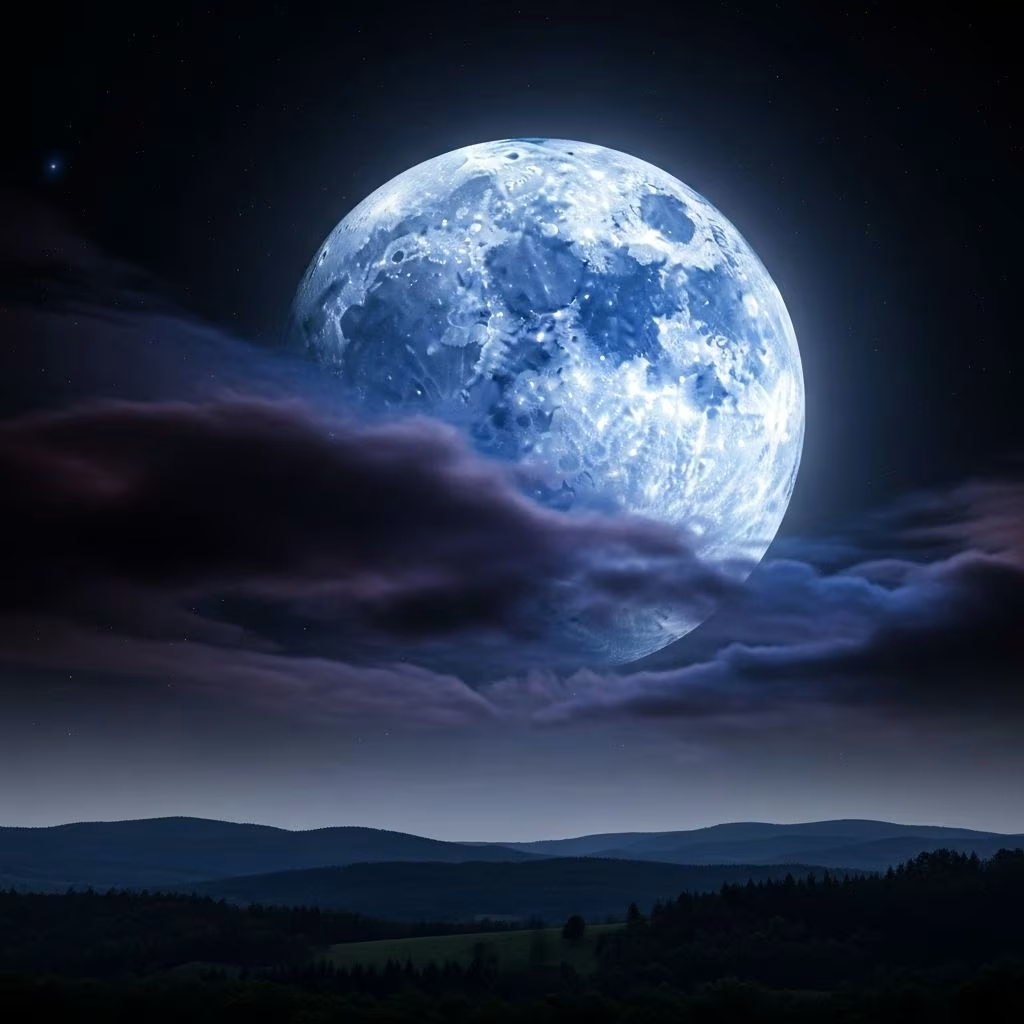
Every so often, the night sky delivers an event so distinctive that even casual stargazers take notice. August 19, 2024, is one such night, bringing together a Blue Moon, a Supermoon, and the traditional Sturgeon Moon in a single display—an astronomical spectacle that promises beauty, rarity, and a dash of cosmic history.
This article provides everything you need to know about the August 2024 Blue Moon: what it is, why it matters, how to see it, its cultural significance, common questions, and more.
Why Is the August 2024 Moon Special?
August 2024’s full Moon is unique because it combines three rare lunar events:
- Blue Moon: Not named for its color, but for its rarity in the lunar calendar cycle.
- Supermoon: The Moon appears larger and brighter than usual because it is near its closest point (perigee) to Earth.
- Sturgeon Moon: This is the traditional name for August’s full Moon in North American folklore.
The confluence of these phenomena is uncommon—such triple alignments occur only a few times per few decades—making August 19, 2024, a date to mark for both seasoned astronomers and curious skywatchers.
What Is a Blue Moon?
The term “Blue Moon” refers to the occurrence of an extra full Moon in a specific period, not to the Moon’s color, which remains its usual gray or ivory glow. The phrase “once in a blue Moon” has become synonymous with something rare or unusual.
Historically, the meaning of a Blue Moon has evolved:
- It first appeared in the mid-16th century, possibly alluding to rare atmospheric conditions where the Moon could actually appear bluish, due to smoke, dust, or volcanic activity.
- Another early meaning comes from the old English phrase for a “betrayer Moon,” referencing how an unexpected extra full Moon could disrupt timekeeping and traditional calendars.
Modern Usage
Today, two definitions are recognized for a Blue Moon:
- Seasonal Blue Moon: The third full Moon in a season that has four full Moons (rather than the usual three).
- Monthly Blue Moon: The second full Moon in a single calendar month (a meaning popularized in the 20th century as a result of a misinterpretation).
The August 2024 Blue Moon is a seasonal Blue Moon, the third of four full Moons occurring in a single astronomical summer.
Types of Blue Moons: Seasonal vs. Monthly
| Type | Definition | Example |
|---|---|---|
| Seasonal Blue Moon | Third full Moon in a season with four full Moons (based on astronomical seasons) | August 19, 2024 |
| Monthly Blue Moon | Second full Moon in a single calendar month | August 31, 2023 |
This distinction can cause confusion, but both are widely accepted today.
- Seasonal Blue Moons tend to follow the original, traditional meaning.
- Monthly Blue Moons emerged from a 20th-century misunderstanding but are now a common alternative meaning.
What Makes a Supermoon?
A Supermoon occurs when a full Moon coincides with the Moon’s closest approach (perigee) to Earth. This makes the Moon appear slightly larger and noticeably brighter in the night sky.
- The August 2024 Blue Moon is also a Supermoon, making it one of the largest and brightest full Moons of the year.
- The term “Supermoon” is informal and was popularized in recent decades by astronomers and the media.
- On August 19, the Moon will be just over 357,000 km (about 222,000 miles) from Earth—much closer than its average distance of roughly 384,400 km (238,855 miles).
While the difference in appearance between a Supermoon and a regular full Moon may seem subtle to the casual observer, careful watchers often notice a Moon that looks about 7–14% larger and up to 30% brighter.
The Sturgeon Moon: August’s Traditional Full Moon
The full Moon of August has long been known as the Sturgeon Moon. According to North American Indigenous folklore and the Old Farmer’s Almanac, this name derives from the plentiful sturgeon caught in the Great Lakes and other bodies of water during the late summer period.
- This tradition of giving unique names to each month’s full Moon reflects seasonal changes and agricultural practices.
- Alternative names for August’s Moon include the “Green Corn Moon” and the “Grain Moon.”
In 2024, the Sturgeon Moon is even more significant, coinciding with both a Supermoon and a Blue Moon, an event that adds layers of tradition and rarity to the lunar show.
The Science Behind the August 2024 Event
The convergence of a seasonal Blue Moon with a Supermoon on August 19, 2024, is due to the interplay of lunar cycles, orbital mechanics, and the calendar:
- Lunar Cycle: The average lunar cycle (synodic month) is 29.53 days. Since this is shorter than the average calendar month, extra full Moons occasionally slip into seasonal or monthly groupings.
- Seasons and Full Moons: An astronomical season is roughly three months. Most seasons have three full Moons, but every few years, a season will host a fourth due to the Moon’s slightly shorter cycle.
- Perigee: The Moon’s orbit is elliptical, so at times it is closer (perigee) or farther (apogee) from Earth. When a full Moon occurs near perigee, we have a Supermoon.
The rarity of such triple alignments—Blue Moon, Supermoon, and Sturgeon Moon—stems from the periods each event spans and the differences between the lunar and solar calendars.
How and When to See the August 2024 Blue Moon
- Date of Maximum Fullness: August 19, 2024
- Best Viewing Time: The Moon will rise around sunset and set around sunrise, offering ideal viewing conditions just after local sunset and before sunrise the next morning.
- Appearance: The Moon will appear brighter and larger than most full Moons of the year due to the supermoon effect.
- Visibility: The event will be visible worldwide, but best appreciated in areas with clear, dark skies and minimal light pollution.
Urban skywatchers are encouraged to find locations away from city lights, as the enhanced brightness and size of the Super Blue Moon are more striking under darker skies. No special equipment is required, but binoculars or a telescope can reveal craters and maria in greater detail.
Blue Moon Myths and Legends
The rare occurrence of a Blue Moon has inspired folklore, superstitions, and a wealth of culture references:
- “Once in a Blue Moon” entered common language to represent something that happens rarely or unexpectedly.
- Historically, extra full Moons could alter the timing of religious holidays or agricultural events, hence the older term “betrayer Moon.”
- Popular tales suggest a Blue Moon might be linked to mysterious or magical happenings, an idea perpetuated in literature, music, and film.
Despite the name, the Moon seldom appears blue. True blue Moons—caused by atmospheric particles—are even rarer than calendrical Blue Moons.
Frequently Asked Questions (FAQs)
- Q: Will the August 2024 Blue Moon actually look blue?
A: No, the Moon will not appear blue to the naked eye. The term refers to its rarity, not its color. Rarely, atmospheric dust from events like volcanic eruptions can give the Moon a blue hue, but this is unrelated to calendrical blue Moons. - Q: How often do Super Blue Moons occur?
A: The combination of a Supermoon and a Blue Moon is infrequent—happening only a few times every few decades. The next such event after August 2024 will not occur for several years. - Q: Can I see the Blue Moon from anywhere on Earth?
A: Yes, the Blue Moon will be visible worldwide, weather permitting. Moonrise and set times vary by location, so check local times for the best viewing. - Q: Is there any special significance to the Blue Moon in science?
A: Blue Moons hold no special scientific significance, but they are noteworthy for highlighting the way lunar and solar calendars interact and because they draw the public’s attention to lunar cycles. - Q: How can I photograph the Super Blue Moon?
A: To photograph the Blue Moon, use a DSLR or mirrorless camera with a telephoto lens. A tripod and remote shutter release help avoid blur. Capture the Moon near the horizon for dramatic landscape shots.
Tips for Skywatchers and Photographers
- Scout an observation site with a clear view to the eastern horizon to watch the Moon rise and a western view for Moonset at dawn.
- Arrive early: crowds tend to gather for rare Moon events, and good positions fill quickly in popular locations.
- If using binoculars or a telescope, look for prominent craters like Tycho and Copernicus and the distinctive lunar “seas” (maria).
- For smartphone cameras, use zoom with caution, and try to stabilize the camera by bracing it or using a tripod.
- Adjust your exposure to prevent overexposed shots—Moons are much brighter than they appear to the eye.
- Include a foreground—trees, buildings, or water—for dramatic context and scale in photos.
Quick Facts
- Date of Event: August 19, 2024
- Type: Seasonal Blue Moon & Supermoon (also Sturgeon Moon)
- Visibility: Worldwide (weather permitting)
- Significance: One of the rarest lunar events of the decade
Further Reading
- Learn about the phases of the Moon and their cultural meanings
- Read about the history and modern science of lunar naming traditions
- Explore supermoon observations by space agencies and amateur astronomers
The August 2024 Blue Moon is a unique opportunity to engage with the rhythms of the cosmos and to marvel at a sky that has inspired calendars, stories, and science across the ages. Whether you’re a passionate stargazer, a first-time observer, or simply seeking wonder in the natural world, this rare lunar event is not to be missed!
References
- https://www.space.com/blue-moon-august-2024
- https://www.space.com/supermoon-blue-moon-august-2024-what-to-expect
- https://science.nasa.gov/solar-system/moon/super-blue-moons-your-questions-answered/
- https://www.syfy.com/syfy-wire/everything-to-know-about-august-2024s-full-blue-supermoon
- https://www.ndtv.com/science/rare-supermoon-blue-moon-to-occur-on-august-19-all-you-need-to-know-6362970
- https://www.cloudynights.com/topic/933763-is-the-aug-19-full-moon-really-a-blue-moon/
- https://www.dailymotion.com/video/x959i2k
- https://www.skyatnightmagazine.com/advice/super-blue-moon-19-august-2024
- https://www.youtube.com/watch?v=VBSA8CazSdQ
- https://en.wikipedia.org/wiki/Blue_Moon_(spacecraft)
- https://www.theweathernetwork.com/en/news/science/space/rare-super-blue-moon-shines-in-august-2024
- https://www.youtube.com/watch?v=6HXwWnw9_-E
- https://www.cbsnews.com/news/full-blue-super-moon-august-2024/
- https://spaceplace.nasa.gov/full-moons/en/
- https://www.indystar.com/story/news/local/2024/08/07/when-is-the-next-full-moon-august-2024-what-is-seasonal-blue-moon-which-date-perseid-meteor-shower/74684895007/
- https://orbitaltoday.com/2023/08/16/a-once-in-a-blue-moon-spectacle-the-august-2023-super-blue-moon-meets-saturn/
- https://en.as.com/latest_news/how-and-when-to-see-the-rare-super-blue-moon-in-august-when-will-it-peak-n
- https://www.livescience.com/space/the-moon/supermoon-blue-moon-2024-top-photos-from-around-the-world?trk=public_post_comment-text