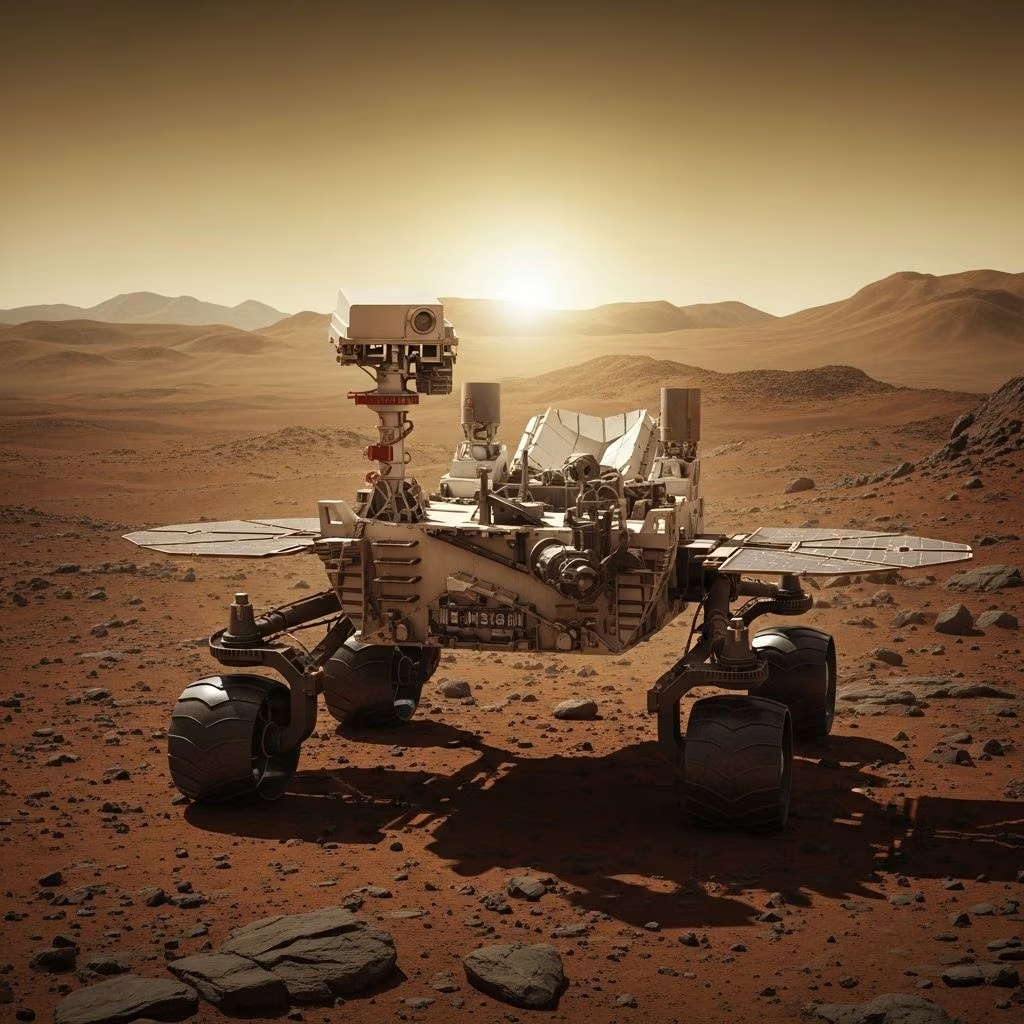
Opportunity Rover: A Triumph of Endurance and Discovery on Mars
Opportunity rover, part of NASA’s Mars Exploration Rover program, stands as one of humanity’s most successful interplanetary probes. Launched in 2003 and active for nearly 15 years, Opportunity far exceeded its planned mission, unveiling Mars’ geologic and environmental past and strengthening the case for ancient water—and possibly life—on the red planet.
Mission Background and Launch
Opportunity, officially known as Mars Exploration Rover – B (MER-B) or MER-1 and fondly nicknamed “Oppy,” was the second of two twin robotic rovers launched in mid-2003. Its sister rover, Spirit (MER-A), landed three weeks earlier on the opposite side of Mars. Opportunity was sent on a mission of discovery: to search for signs of ancient water in the Martian terrain and answer fundamental questions about Mars’ ability to have supported microbial life in its past.
- Launch Date: July 7, 2003 from Cape Canaveral, Florida via Delta 7925H Rocket
- Mars Landing Date: January 25, 2004 (Meridiani Planum)
- Mission Planned Duration: 90 sols (about 92.5 Earth days)
- Mission Actual Duration: 5,111 sols (over 14 Earth years)
- Total Distance Traveled: 45.16 km (28.06 miles)
The Mars Exploration Rover Mission Goals
Opportunity’s mission objectives mirrored those of Spirit but were uniquely tailored to their respective landing sites. NASA scientists designed the project to answer several fundamental scientific questions about Mars:
- Search for and analyze rocks and soils that provide clues to the presence and activity of past water.
- Study planetary geology: Investigate geologic processes that have shaped the terrain, such as volcanic, hydrothermal, and sedimentary processes.
- Identify water-related minerals: Search for mineral types formed or altered in water (e.g., iron-bearing carbonates, sulfates).
- Explore past habitability: Assess if environmental conditions once supported life.
- Calibrate surface observations made by Mars orbiters for cross-validation.
Engineering Marvels: Opportunity’s Design and Instruments
Opportunity was a testament to robust engineering, equipped with a suite of scientific tools and advanced systems designed for Martian exploration. Its solar-powered architecture and mechanical resilience enabled far-longevity beyond expectation. The rover was assembled by NASA’s Jet Propulsion Laboratory (JPL) and weighed 185 kg (408 lbs).
Key scientific instruments included:
- Panoramic Camera (Pancam): Captured high-resolution, color, and stereo images of the Martian terrain.
- Microscopic Imager (MI): Offered detailed close-ups of rock and soil textures.
- Miniature Thermal Emission Spectrometer (Mini-TES): Detected the composition of rocks and soils from a distance.
- Mössbauer Spectrometer (MB): Analyzed iron-bearing minerals crucial for interpreting Mars’ environmental history.
- Alpha Particle X-ray Spectrometer (APXS): Identified elemental composition in rocks and soils.
- Rock Abrasion Tool (RAT): Drilled into rocks to expose fresh surfaces for other instruments.
- Magnet Arrays: Collected airborne dust to determine its magnetic properties.
- Hazard Avoidance Cameras (Hazcams) & Navigation Cameras (Navcams): Helped guide rover traversal and ensure safe navigation.
Landing and First Discoveries
Opportunity’s precision landing in the flat plain of Meridiani Planum was a triumph, capturing the scientific imagination with its immediate findings. Within weeks, the rover made groundbreaking discoveries:
- Layered bedrock exposures: The rover observed outcrops of sedimentary rocks, indicating possible historical water activity.
- Hematite concretions: Nicknamed “blueberries,” these small, iron-rich spherules signaled the past presence of liquid water.
The rover’s cameras and spectrometers provided dramatic evidence that Mars had, in at least some areas, liquid water for extended periods. Such conditions could have been suitable for microbial life.
Key Mission Highlights and Achievements
- Heat Shield Rock: Opportunity discovered and analyzed the first meteorite ever identified on another planet.
- Long-Distance Trekking: Opportunity set the off-world driving record, surpassing a marathon (42.195 km) in 2015, and ultimately traveled over 45 km.
- Victoria Crater Exploration: The rover spent over two years studying this large impact crater, revealing vital clues about Mars’ sedimentary history.
- Endeavour Crater: In 2011, Opportunity reached Endeavour Crater, where it uncovered ancient clay minerals—signatures of a more life-friendly, neutral-pH environment than previously found.
- Longevity: Designed for a 90-sol mission, Opportunity remained operational for over 5,000 sols (almost 15 Earth years), providing a treasure trove of scientific data.
Scientific Discoveries and Impact
Opportunity’s suite of instruments made critical discoveries that reshaped the understanding of Mars, including:
- Evidence of Ancient Water: The detection of hydrated sulfates, layered sedimentary rocks, and spherules suggested periodic water-rich environments in Mars’ distant past.
- Clues to Habitability: Opportunity’s findings of clay minerals and chemical signatures signaled that some Martian environments had the right chemistry to support microbial life, at least in the past.
- Mineralogy and Rock Textures: Identification of diverse minerals and rock textures, providing insight into Mars’ geologic evolution and climate transitions.
- Surface Weathering Effects: Investigation of Martian dust, meteorites, and erosional features contributed to understanding Mars’ active surface processes.
Challenges and Survival Against the Odds
Opportunity became a symbol of engineering resilience, overcoming numerous hazards during its Martian odyssey:
- Dust Storm Survival: The rover weathered many dust storms by shutting down activity and hibernating to conserve power, emerging each time as conditions cleared.
- Harsh Environment: The rover braved extreme temperature swings and regular threats of getting stuck in soft dunes and rough terrain.
- Longevity Challenges: Despite its age and wear, with some failing components and diminishing solar panel efficiency, Opportunity continued to return valuable data.
The End of the Opportunity Mission
In June 2018, Opportunity encountered its greatest challenge—a massive, planet-sized Martian dust storm. Reduced sunlight caused by the thick dust blocked solar energy, preventing battery charging. The rover’s final communication was received on June 10, 2018. Engineers at JPL sent over 1,000 recovery commands throughout the following months, hoping for a wind event to clear the solar panels. Ultimately, on February 13, 2019, NASA officially declared the mission over, with the rover’s final resting place in Perseverance Valley on the western rim of Endeavour Crater.
| Key Milestone | Date | Details |
|---|---|---|
| Launch | July 7, 2003 | Delta 7925H from Cape Canaveral |
| Mars Landing | January 25, 2004 | Meridiani Planum, Mars |
| Planned Mission End | April 2004 | Expected 90 sols operation |
| Endurance Crater Arrived | May 2004 | Studied bedrock layers |
| Victoria Crater Explored | 2006-2008 | Detailed crater rim studies |
| Endeavour Crater Reached | August 2011 | Discovery of clay minerals |
| Last Communication | June 10, 2018 | Severe dust storm ends contact |
| Mission Officially Ended | February 13, 2019 | After all recovery efforts failed |
Legacy of Opportunity
Opportunity’s success reverberates through planetary science and engineering. Among its many legacies:
- Expanded Mission Lifespan: Opportunity operated 60 times longer than designed, demonstrating how engineering robustness can exceed expectations.
- Marathon Record: Opportunity became the first human-made object to cover a distance greater than a marathon on another world.
- Opportunity’s Data Archive: The trove of images, datasets, and geological samples continues to inform Mars research and train the next generation of planetary scientists.
- Public Engagement: The rover’s journey captured the public imagination, becoming a beloved symbol of exploration and perseverance, often referred to affectionately as “Oppy.”
- Paving the Way for Future Missions: Learnings from Opportunity have guided the design and scientific focus of subsequent Mars rovers, including Curiosity and Perseverance.
Opportunity by the Numbers
- 5111 sols (Mars days) active (~15 Earth years)
- 28.06 miles (45.16 km) traveled
- 217,594 images transmitted to Earth
- Numerous craters, outcrops, meteorites, and geologic features explored
Comparison: Opportunity and Spirit
| Feature | Opportunity (MER-B) | Spirit (MER-A) |
|---|---|---|
| Landing Site | Meridiani Planum | Gusev Crater |
| Landing Date | Jan 25, 2004 | Jan 4, 2004 |
| Operation Duration | 5,111 sols (~15 years) | 2,208 sols (~6 years) |
| Distance Traveled | 45.16 km (28.06 mi) | 7.73 km (4.8 mi) |
| Mission End | Feb 13, 2019 | March 2010 |
Frequently Asked Questions (FAQs)
Q: Why did Opportunity last so much longer than planned?
A: Although designed for just 90 sols, Opportunity benefited from periodic wind events that cleared dust from its solar panels, robust engineering, and careful mission management, allowing it to operate for almost 15 years.
Q: What was Opportunity’s biggest discovery?
A: Opportunity’s detection of hematite “blueberries,” layered sedimentary rocks, and clay minerals provided the strongest evidence to date that liquid water existed on ancient Mars for significant periods.
Q: How did Opportunity communicate with Earth?
A: The rover relayed data via direct-to-Earth transmissions and through Mars orbiters acting as communication links, using high-gain and low-gain antennas.
Q: What ultimately ended Opportunity’s mission?
A: A planet-encircling dust storm in June 2018 blocked sunlight from reaching Opportunity’s solar panels, depleting its batteries. After months of attempted recontact, NASA concluded the mission had ended in February 2019.
Q: What is Opportunity’s legacy for future Mars missions?
A: Opportunity set benchmarks for longevity and scientific discovery, inspiring the design and ambitions of current and future rovers, such as Mars Curiosity and Perseverance.
Q: Where is Opportunity now?
A: Opportunity remains at its final location, Perseverance Valley, a silent monument to its historic mission on the rim of Endeavour Crater, Mars.
References
- https://www.jpl.nasa.gov/missions/mars-exploration-rover-opportunity-mer/
- https://en.wikipedia.org/wiki/Opportunity_(rover)
- https://science.nasa.gov/mission/mer-opportunity/
- https://www.space.com/18289-opportunity-rover.html
- https://www.youtube.com/watch?v=1Ll-VHYxWXU
- https://en.wikipedia.org/wiki/Timeline_of_Opportunity
- https://www.weforum.org/stories/2019/02/nasas-opportunity-rover-mission-on-mars-comes-to-end/
- https://www.cbsnews.com/news/mars-rover-opportunity-rover-bites-the-dust-on-mars-ending-15-year-mission/
- https://www.planetary.org/space-missions/mars-exploration-rovers
- https://www.planetary.org/articles/mer-update
- https://www.smithsonianmag.com/science-nature/how-nasas-opportunity-rover-made-mars-part-earth-180971484/
- https://www.science.org/content/article/winds-fail-revive-nasa-s-opportunity-rover
- https://study.com/academy/lesson/mars-opportunity-rover-overview-objectives-facts.html
- https://web.archive.org/web/20190520111112/https:/mars.nasa.gov/news/8413/nasas-opportunity-rover-mission-on-mars-comes-to-end/
- https://www.britannica.com/topic/Mars-Exploration-Rover
- https://www.iflscience.com/the-haunting-last-message-from-nasas-opportunity-rover-sent-from-inside-a-planet-wide-storm-79921
- https://an.rsl.wustl.edu/help/Content/About%20the%20mission/MER/MER%20mission.htm
- https://www.youtube.com/watch?v=A336FYg0CGc