


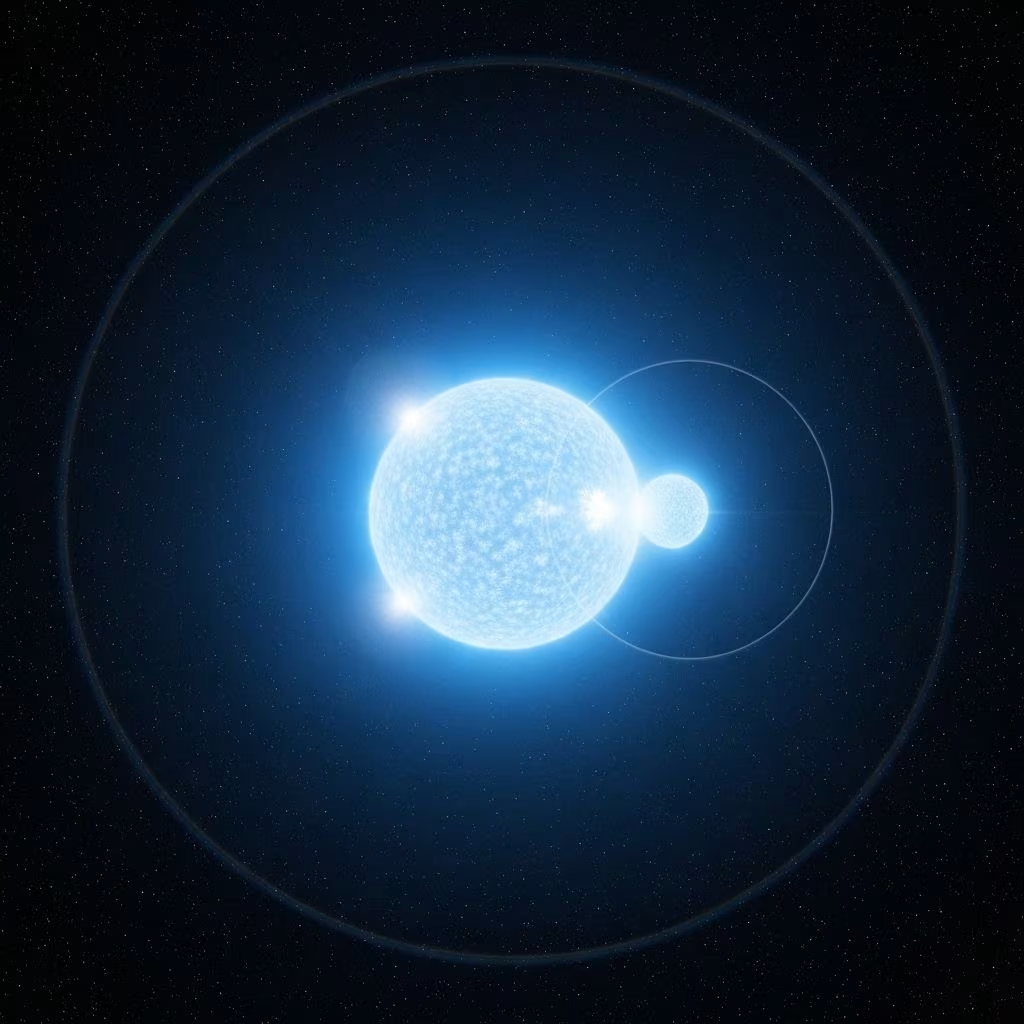
Spica: The Close Binary Star of Virgo Constellation
Spica stands as the most luminous star in the constellation Virgo, ranking as the 15th brightest star in the night sky. Renowned for its distinct blue color and its importance to astronomers for centuries, Spica’s true wonder lies in its binary nature: it is two massive stars tightly locked in an extraordinarily close orbit, each warping the other with their intense gravitational pull and extreme temperatures.
Location and Visibility
Spica, officially designated as Alpha Virginis, sits deep within the constellation Virgo. For much of the year, this star can be found dominating the spring and early summer skies in both the Northern and Southern Hemispheres. As a first-magnitude star, it is unmistakable, shining starkly with a blue-white brilliance that sets it apart from neighboring stars. Its celestial coordinates are:
- Right Ascension: 13h 25m 11.58s
- Declination: –11° 09′ 41″
Spica’s blue glow is best seen in spring evenings. To locate it, trace the curving arc of the Big Dipper’s handle down to bright Arcturus, and continue the path to a splendid blue point: Spica.
Physical Properties of Spica
Though Spica appears as one star to the naked eye, it is actually a binary system—two massive stars in a tight, rapid orbit.
- Primary Star (Spica A): Classified as a B1 III-IV, it is a blue giant with about 10 times the mass of the Sun and over 12,000 times the Sun’s luminosity.
- Secondary Star (Spica B): Slightly less massive and luminous, but still categorized as a hot blue star (about 7 solar masses).
- Distance from Earth: Approx. 250 light-years (77 parsecs).
- Combined Spectral Type: B1 III-IV + B2 V (blue subgiant and blue main sequence star).
- Apparent Magnitude: About 0.98, making Spica one of the brightest stars observable.
Temperature: The temperature at the surface of Spica’s primary is extreme—nearly 22,400 Kelvin, much hotter than the Sun’s 5,778 Kelvin. This gives Spica its brilliant blue-white coloration.
A True Close Binary
What sets Spica apart from most other double stars is just how closely the two stellar components orbit. The two stars revolve around their common center of mass in about four days, separated on average by less than 18 million kilometers—closer than Mercury is to the Sun! This proximity causes both stars to become distorted, resembling footballs or eggs more than perfect spheres, due to each star’s gravitational pull on the other. This tidal distortion leads to constant changes in their shapes and atmospheres.
| Parameter | Spica A (primary) | Spica B (secondary) |
|---|---|---|
| Mass (in Solar Masses) | ~10 | ~7 |
| Radius (in Solar Radii) | ~7.4 | ~3.6 |
| Temperature (Kelvin) | ~22,400 | ~18,500 |
| Orbital Period (days) | ~4.0145 | |
History and Naming
Spica’s name has ancient roots, derived from the Latin word for “ear of grain” (spīca), reflecting its association with the harvest and the goddess of agriculture in Roman mythology. The star is sometimes referred to as Azimech or Alaraph. Spica’s prominent position in the sky and striking color have made it a prized object for star gazers across cultures and eras.
- Babylonian Tales: Spica was associated with the goddess Shala, worshiped as the Lady of the Ear of Grain.
- Greek and Roman Influence: The star was linked to Demeter (Greek) or Ceres (Roman), both deities of harvest and agriculture.
- Navigation: Spica was essential in ancient navigation and for determining the timing of planting and harvesting in agricultural societies.
Astronomical Importance
Spica’s status as a close binary makes it an invaluable subject for astrophysical study and stellar modeling. The system is an example of a “spectroscopic binary,” meaning the dual nature was discovered not by sight, but by examining how the system’s light is split into spectra. The Doppler shifts in the stars’ spectra reveal their rapid orbits and mutual influence. Among binary systems, Spica’s components are among the most massive visible to the naked eye, making it a prime case for observing tidal effects, stellar evolution, and the mass-luminosity relationship for massive stars.
- Provides a laboratory for studying tidal deformation, mass transfer, and close stellar dynamics.
- Key calibrator for the masses and temperatures of other massive stars in our galaxy.
- Has been scrutinized by space telescopes and ground-based observatories alike due to its proximity and brightness.
Modern Scientific Study
Spica continues to be a focus of research, often used to test and refine models of binary star interaction and stellar structure. Space-based missions have recorded its light curves, revealing small periodic brightness and spectral variations—signatures of the ongoing gravitational dance between its two stars. These subtle changes help scientists understand how stars interact under extreme conditions, such as those found in close, hot binaries.
Highlights of modern research include:
- Precise Mass and Luminosity Measurements: Using orbital data and advanced modeling, astronomers have determined the masses and evolutionary stages of Spica’s two stars, contributing to broader knowledge of stellar lifecycles.
- Pulsating Behavior: Evidence suggests the primary component exhibits slight pulsations, influenced by both tidal forces and its own internal processes.
- Testing Stellar Evolution Theories: The close orbit and distortion allow analysis of how mass transfer and mutual gravity affect star lifespan and structure.
Spica in the Night Sky
Amateur astronomers enjoy viewing Spica for its rich hue and strategic sky location. Here are tips for finding Spica:
- Look for Spica in the constellation Virgo, best visible in evening skies during spring and early summer (Northern Hemisphere).
- Follow the arc from the Big Dipper’s handle through bright Arcturus to Spica—mnemonic: “Follow the arc to Arcturus, then speed on to Spica.”
- For observers in the Southern Hemisphere, Spica appears high in the evening sky from March to August.
Essential Facts at a Glance
| Category | Details |
|---|---|
| Constellation | Virgo |
| Apparent Magnitude | 0.98 |
| Distance from Earth | ~250 light-years |
| System Type | Close Spectroscopic Binary |
| Primary Star Type | B1 III-IV (Blue Subgiant) |
| Secondary Star Type | B2 V (Blue Main Sequence) |
| Orbital Period | 4.0145 days |
| Main Color | Blue-white |
Spica and Its Place in Culture
Beyond science, Spica’s striking presence has influenced mythology, literature, zodiac traditions, and even navigation:
- Mythology: Often symbolized as the ear of wheat held by Virgo, Spica was associated with fertility and harvest in ancient cultures, especially Babylonian, Greek, and Roman societies.
- Astronomical Traditions: Used for millennia to mark the timing of seasons and for agricultural planning.
- Navigation: Used by ancient mariners and desert travelers as a celestial signpost.
The star’s striking color and beauty made it a prominent feature in sky-watching traditions and astronomical records across civilizations.
Frequently Asked Questions (FAQs)
Q: Why does Spica look blue in the night sky?
A: Spica’s primary star is extremely hot (over 22,000 K), emitting mostly blue and ultraviolet light, which gives the system its intense blue-white appearance.
Q: How can I spot Spica in the sky?
A: Find the Big Dipper, trace the arc through Arcturus (in Bootes), and continue the line to reach Spica in Virgo. In spring, it rises in the southeast and sets in the southwest.
Q: What makes Spica a spectroscopic binary and not a visual double?
A: The two stars are so close together they cannot be seen as separate points even with telescopes; instead, their binary nature is revealed through periodic Doppler shifts in their spectral lines.
Q: How does Spica compare to our Sun?
A: Both of Spica’s stars are much more massive, larger, hotter, and more luminous than the Sun. Spica A is about 10 times as massive and over 12,000 times as luminous.
Q: What role does Spica play in science?
A: Spica is studied to understand how massive stars evolve, how close binary systems interact, and to refine models of stellar interiors and gravitational effects in binaries.
Q: Can Spica be occulted by the moon or planets?
A: Yes, the Moon can occasionally occult Spica, and these rare events are valuable for scientific observations.
In Summary: Spica’s Lasting Legacy
Spica’s blue-white twinkle is more than just a beacon in the night; it is a laboratory for astrophysics, a bridge across mythologies and centuries, and a gateway to understanding how the most massive stars live and die. Its proximity, prominence, and double nature make Spica a jewel of the Virgo constellation, captivating astronomers and sky watchers alike.
References
- https://www.space.com/22049-spica.html
- https://www.space.com/moon-hides-spica-lunar-occultation-july-2024
- https://www.thespacereview.com/article/3934/1
- https://www.spica.com/news/workforce-management-integration-with-sap
- https://en.wikipedia.org/wiki/SPICA_(spacecraft)
- https://www.spica.com/news/time-and-space-v11-40
- https://academic.oup.com/nar/article/50/D1/D1109/6423180
- https://starwalk.space/en/news/spica-virgo-brightest-star
- https://arxiv.org/abs/0911.3974
- https://www.britannica.com/place/Spica
- https://mediabiasfactcheck.com/space-com/
- https://whenthecurveslineup.com/2021/08/28/2021-september-5-venus-spica-conjunction/
- https://astrophotographylens.com/blogs/astro/spica-star?srsltid=AfmBOoq5CZEpf9ru5qtRd2xKIfVS5dDWvwB2iIXA1x1FTgXp6PlKGG3F
- https://ttu-ir.tdl.org/server/api/core/bitstreams/364f845d-a559-4c0d-bfc5-961345f6bda5/content
- https://en.wikipedia.org/wiki/Spica
- https://sci.esa.int/documents/34923/36148/SPICA_Mission_Study_Summary_Report.pdf
- https://www.youtube.com/watch?v=aZ4qDm0rqy4
- https://creatrixmag.com/spica-and-arcturus-protectors-of-humanity-alchemy-of-the-stars/


