


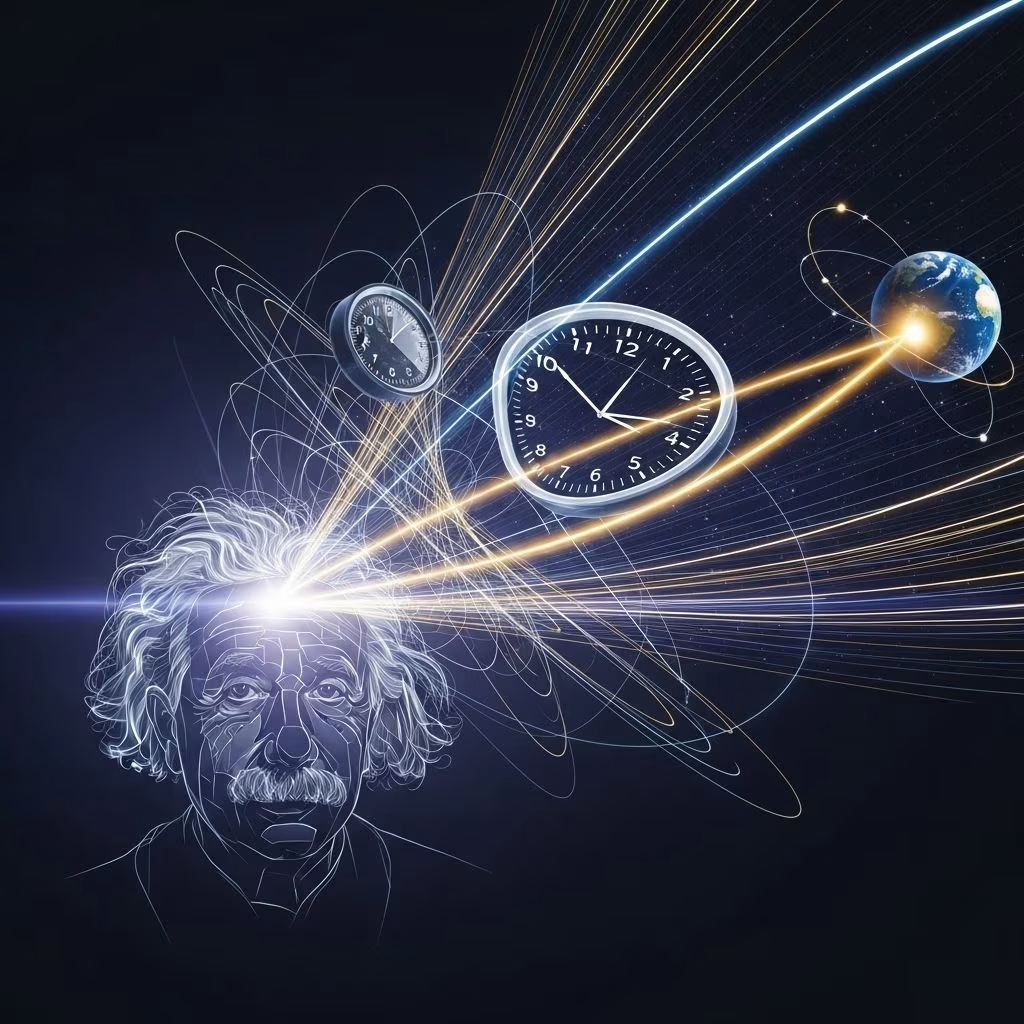
Einstein’s Special Relativity: Redefining Space and Time
More than a century ago, Albert Einstein published the theory of special relativity, forever altering our understanding of space, time, and motion. This groundbreaking theory reshaped physics and led to many surprising, experimentally-verified consequences that still underpin modern science.
What Is Special Relativity?
Special relativity is a scientific theory describing the relationship between space and time for objects moving at constant velocity relative to one another[12]. It applies exclusively in situations where no acceleration or gravity is involved—that is, in so-called inertial reference frames. The theory was introduced by Einstein in 1905, rejecting previous assumptions about space and time and establishing new universal rules for the cosmos.
- Published by Einstein in 1905
- Explains motion in inertial (non-accelerating) frames
- Core topics: Time dilation, length contraction, mass-energy equivalence
The State of Physics Before Einstein
Before special relativity, most physicists believed that space and time were absolute, independent “backgrounds” within which events occurred. The prevailing model placed these phenomena within an ether—a hypothetical, invisible medium assumed necessary for light waves to travel. The search for “ether” was central, but experimental results (like the Michelson-Morley experiment) failed to find any evidence of it. Einstein discarded the ether, relying solely on proven experimental results, and sought new principles based on universal symmetry.
- “Ether” was believed to exist as a medium for light.
- Experiments failed to detect the ether.
- Einstein made a bold move: He relied on experiments, not assumptions.
- His approach was: If experiments refuted an idea, the theory must change.
The Two Fundamental Postulates
Special relativity relies on just two crucial postulates, each with deep implications for physics[12]:
| Postulate | Description | Implications |
|---|---|---|
| Relativity Principle | The laws of physics are identical in every inertial frame of reference. | Experiments performed in moving or stationary frames yield the same physical laws. |
| Constancy of Light Speed | The speed of light (c) in vacuum is the same for all observers, no matter their relative motion. | No observer will ever see light travel faster or slower than c. |
- These postulates were radical for their time, especially discarding the idea that time and space are absolute.
- Together, they force a fundamental change in how we measure time and space.
Key Consequences of Special Relativity
Special relativity has multiple, profound consequences—each universality supported by experiment and experience, even if counterintuitive[12]:
Time Dilation
The passage of time is not absolute, but varies with velocity. When an object moves close to the speed of light, time for that object slows down relative to stationary observers.
- Moving clocks tick more slowly than stationary ones.
- Time dilation is described mathematically by:
t' = t / sqrt(1 - v^2/c^2)where v is the velocity and c is the speed of light. - Confirmed by decaying muons from cosmic rays and atomic clocks aboard jets.
Length Contraction
Objects moving near the speed of light will appear shortened in the direction of motion to outside observers.
- Length contraction formula:
L = L0 * sqrt(1 - v^2/c^2)where L is contracted length, L0 is proper length. - This effect does not occur at “everyday” speeds, but is crucial at relativistic speeds.
Relativity of Simultaneity
Events that appear simultaneous in one frame may not be simultaneous in another. The ordering of events depends on the observer’s motion.
- Challenges intuitive notions of time—there is no universal “now”.
- Critical for understanding causality at high speeds.
Mass-Energy Equivalence
Perhaps the most famous result of special relativity is the formula:
E = mc2
- Energy and mass are interchangeable.
- This principle underlies nuclear reactions and the production of energy from nuclear fission and fusion.
Mathematical Foundations
The mathematics of special relativity can be grasped with basic algebra and the Pythagorean theorem. At its heart is the ability to transform coordinates between moving observers, called Lorentz transformations.
- Lorentz transformations relate time and space coordinates in different inertial frames.
- They replace traditional Galilean transformations, which do not account for relativistic effects.
- All conclusions—time dilation, length contraction, and relativity of simultaneity—are derived using Lorentz transformations.
Experimental Evidence
Multiple experiments and observations confirm the predictions made by special relativity:
- Michelson-Morley Experiment: Failed to find evidence of ether, supporting Einstein’s principles.
- Atomic Clocks in Jets: Clocks flown on aircraft show measurable time dilation.
- Muon Decay: Muons, created by cosmic rays in Earth’s atmosphere, decay more slowly due to their high speeds, validating time dilation predictions.
Impact and Applications
- Special relativity is essential for modern technologies like GPS, which require extremely precise time measurement. GPS satellites adjust for both special and general relativistic effects.
- It laid the foundation for particle physics, quantum field theory, and cosmology.
- Crucial for understanding nuclear reactions, particle accelerators, and the behavior of high-speed particles.
Special vs. General Relativity
| Special Relativity | General Relativity |
|---|---|
| Applies to inertial frames (no acceleration or gravity) | Applies to all frames, includes gravity and acceleration |
| Key concepts: Constancy of light speed, time dilation, length contraction | Key concepts: Gravity as space-time curvature, geodesics, black holes |
| Published in 1905 | Published in 1915 |
| Does not include gravity | Describes gravity as geometric property of space-time |
- Special relativity “specializes” in linear, uniform motion.
- General relativity expands the theory to include acceleration and gravitation.
- Both theories together revolutionized physics.
Misconceptions and Common Questions
- Does special relativity contradict Newtonian physics?—No, it extends and refines Newton’s laws. At low velocities, relativity reduces to Newtonian predictions.
- Is the speed of light the highest possible speed?—Yes, in vacuum, nothing can travel faster than light.
- Is time travel possible due to relativity?—Special relativity allows for “travel” into the future due to time dilation but not into the past.
- Do everyday objects show relativistic effects?—Only at speeds close to light do these effects become noticeable; at everyday speeds, they’re negligible.
Frequently Asked Questions (FAQs)
Q: Why is it called ‘special’ relativity?
A: It’s “special” because it deals only with uniform motion (inertial frames), without considering gravity or acceleration. “General” relativity expands the scope to include these cases.
Q: What is an inertial frame of reference?
An inertial frame is any position or object moving at a constant speed in a straight line, not accelerating. All physical laws are identical in such frames.
Q: How does special relativity affect GPS systems?
Because GPS satellites move rapidly relative to observers on Earth, time dilation and relativistic corrections must be made; otherwise, location calculations would quickly become inaccurate.
Q: Did Einstein invent E=mc2 with special relativity?
Yes, the mass-energy equivalence formula originates directly from the equations and logic of special relativity.
Q: Can special relativity be tested experimentally?
Yes! Experiments with particle accelerators, atomic clocks, and cosmic particles confirm its predictions with extraordinary accuracy.
Q: Does special relativity allow for superluminal (faster-than-light) travel?
No, according to all evidence and the math of relativity, nothing with mass can be accelerated to or beyond the speed of light in a vacuum.
The Enduring Importance of Special Relativity
Special relativity remains one of the cornerstones of modern physics. Its predictions and logic extend far beyond abstract theory, influencing technologies, advancing our understanding of the universe, and challenging our most basic notions of space and time. From everyday electronics to deep-space exploration, its legacy is woven throughout the tapestry of science.
- Special relativity is taught worldwide as a fundamental aspect of physics.
- Its consequences push the boundaries of our imaginations and fuel continued innovation.
- The symphony of space and time, as described by Einstein, is an enduring testament to human curiosity and the power of logical reasoning.
References
- https://en.wikipedia.org/wiki/Special_relativity
- https://www.space.com/36273-theory-special-relativity.html
- https://www.energy.gov/science/doe-explainsrelativity
- https://www.youtube.com/watch?v=AInCqm5nCzw
- https://science.howstuffworks.com/science-vs-myth/everyday-myths/relativity5.htm
- https://profoundphysics.com/special-relativity-for-dummies-an-intuitive-introduction/
- https://www.dummies.com/article/academics-the-arts/science/physics/einsteins-special-relativity-193336/
- https://www.ebsco.com/research-starters/history/einstein-states-his-theory-special-relativity
- https://www.britannica.com/science/special-relativity
- https://en.wikipedia.org/wiki/Theory_of_relativity
- https://www.sciencealert.com/special-relativity
- https://study.com/learn/lesson/special-theory-of-relativity-overview.html
- https://byjus.com/physics/special-theory-of-relativity/
- https://www.britannica.com/science/relativity/Special-relativity
- https://www.marxists.org/reference/archive/einstein/works/1910s/relative/relativity.pdf
- https://testbook.com/physics/special-theory-of-relativity
- https://www.youtube.com/watch?v=9A0bMiuQVLs
- https://www.ebsco.com/research-starters/physics/special-relativity


