


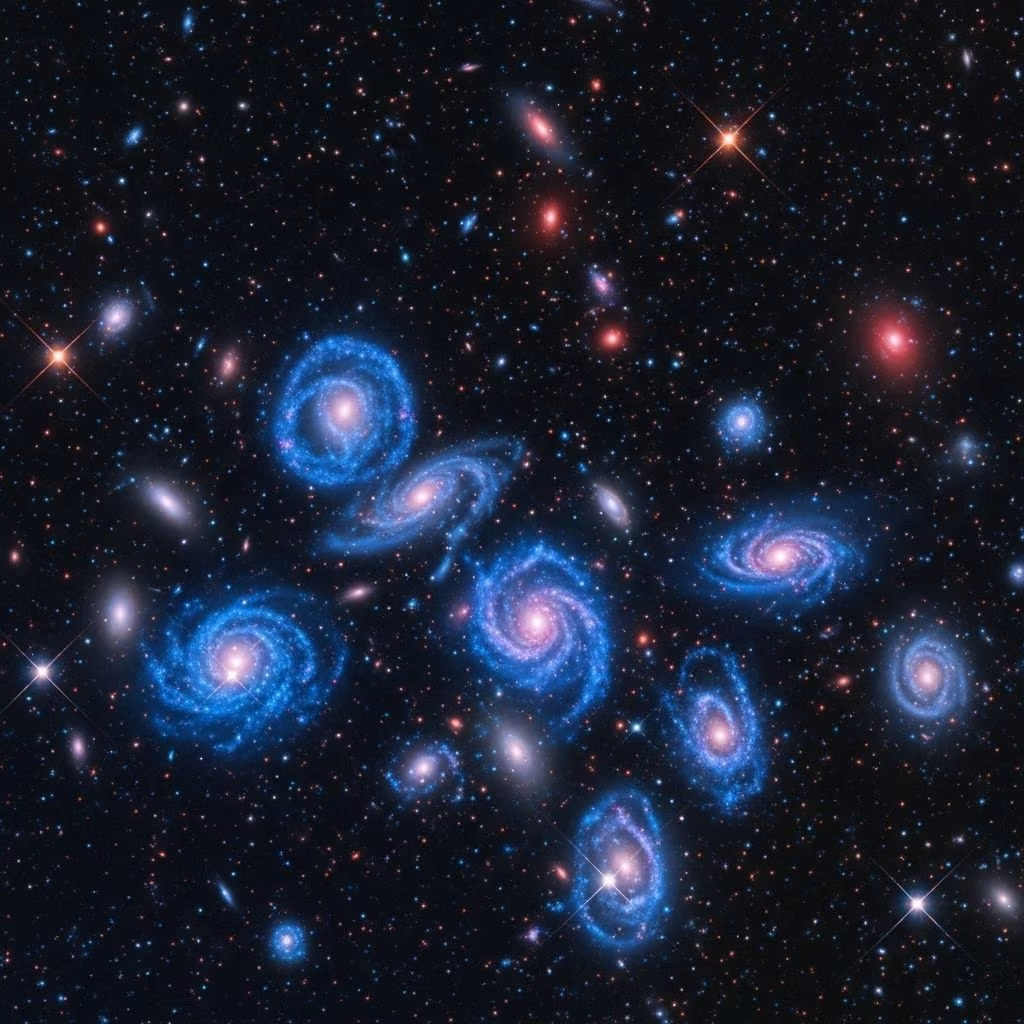
Cosmic Origins: JWST Reveals the Earliest Galaxies Ever Seen
In a historic leap for astronomy, NASA’s James Webb Space Telescope (JWST) has broken new ground by discovering two of the earliest and most distant galaxies ever confirmed, dating back to around 300 million years after the Big Bang. These findings mark a transformative moment in our efforts to unravel the cosmic dawn and answer the profound question: How did the universe take shape in its infancy?
The Breakthrough Discovery
In May 2024, an international team of astronomers, led by the JWST Advanced Deep Extragalactic Survey (JADES) collaboration, announced the detection of two record-holding galaxies. These galaxies, observed within a small region near the iconic Hubble Ultra Deep Field, not only set new cosmic distance records but also offer an intimate glimpse into the universe’s earliest galactic structures.
- Earliest Galaxies Discovered: The galaxies date back to only 300 million years after the Big Bang.
- Instrument: JWST’s cutting-edge infrared observatories were essential for these detections.
- Scientific Milestone: The discoveries extend humanity’s reach into the cosmic past by at least 40% compared to what was possible prior to JWST’s launch.
Understanding Redshift: Looking Back in Time
The distances of these galaxies are gauged not in kilometers, but in time, using a phenomenon known as redshift. As the universe expands, light from distant galaxies is stretched into longer, redder wavelengths:
- Redshift (z): The galaxies exhibit a redshift of over 13, meaning their light has been stretched by a factor of 15 from its original wavelength.
- Infrared Observations: JWST’s unrivaled sensitivity to infrared allows it to see this ancient light, which no other telescope can access effectively.
Dr. Brant Robertson, co-leader of the JADES project, stated, “This demonstrates the immediate impact new JWST observations can have on our knowledge of the distant universe.”
How JWST Achieved This Discovery
JWST’s discovery was accomplished using advanced instruments and survey techniques:
- NIRCam: The Near-Infrared Camera captured deep images of select sky regions, targeting the faintest, most primordial galaxies.
- Spectroscopy: NIRSpec (Near-Infrared Spectrograph) split light from these galaxies into its components, enabling scientists to measure precise redshift values and study their properties.
- Survey Approach: The JADES team selected regions adjacent to the Hubble Ultra Deep Field—a part of the sky previously imaged by Hubble—to maximize the chances of finding ancient galaxies.
Why This Discovery Is a Cosmic Miracle
The findings have astonished experts worldwide and prompted the astronomy community to reassess prevailing models of galaxy formation. Key points of significance include:
- Unprecedented Age: These galaxies formed remarkably soon after the universe became transparent to light, during an epoch known as the “cosmic dawn.”
- Brightness and Size: Their observed brightness defies expectations, suggesting that complex structures and star formation began quickly in the early universe.
- Scientific Impact: These galaxies add essential data points that challenge and refine cosmological theories about the evolution of structure within the universe.
The Era of Reionization: Shining Light on Cosmic History
The galaxies discovered by JWST offer direct evidence from the era known as reionization—a transformative phase 300 to 600 million years after the Big Bang. During this period, emergent stars and galaxies flooded the cosmos with ultraviolet light, ionizing the surrounding hydrogen gas and clearing the primordial cosmic fog.
| Era | Timeline (after Big Bang) | Key Events |
|---|---|---|
| Dark Ages | 0-300 million years | Universe cools, first atoms form; space is foggy and dark |
| Cosmic Dawn (Reionization) | 300-600 million years | First stars and galaxies ignite; ultraviolet light starts clearing the fog |
| First Full Light | 600 million+ years | Most hydrogen becomes ionized; universe becomes transparent |
Galaxies: Cradles of Early Star and Element Formation
Observations of these galaxies enhance our understanding of how the first stars and chemical elements emerged:
- Stellar Populations: Analysis of their light reveals the presence of young, hot, massive stars.
- Chemical Evolution: The galaxies enable astronomers to trace the buildup of elements heavier than hydrogen and helium.
- Structure Formation: The findings suggest that galaxies assembled more rapidly and were brighter in the early universe than previously thought.
Major Milestone in Cosmic Exploration
As astronomers probe these distant realms, they are not simply seeking individual objects but mapping the transition from a universe of simple atoms to one rich in complexity and possibility. JWST’s discoveries have catalyzed a new era of exploration:
- Extending the Reach: With these new redshift records, humankind’s view of cosmic history stretches ever closer to the era of the Big Bang, opening a critical window for studying the first galaxies and black holes.
- Unanswered Questions: How did such massive and bright galaxies assemble so rapidly? Are we seeing the effects of new, unexpected processes at play in the early universe?
The JADES Team and Their Scientific Approach
The JADES collaboration is an international team of scientists utilizing JWST to conduct deep, long-exposure surveys over key regions of the sky. Their research strategy includes:
- Deep Imaging: Capturing extremely faint signals billions of light years away, equivalent to looking back over 13.5 billion years in time.
- Multiple Instruments: Employing both camera and spectrograph data for robust confirmation of high-redshift candidates.
- Data Sharing: Rapid public data releases encourage worldwide collaboration and peer review.
Key researchers highlighted the “completely unanticipated” nature of this discovery, describing it as potentially the most significant extragalactic result from JWST so far.
Expert Reactions and Scientific Implications
This cosmic leap has energized astronomers and cosmologists alike:
- Dr. Francesco D’Eugenio, Kavli Institute for Cosmology (University of Cambridge): “[These] join a small but growing population of galaxies from the first half billion years of cosmic history where we can really probe the stellar populations and the distinctive patterns of chemical elements within them.”
- Broader scientific community: The discoveries challenge previous assumptions of a slower onset of star formation and structure in the first billion years.
- Impact on Future Research: New telescopic campaigns are now planned to hunt for even fainter and older galaxies.
JWST’s Unique Capabilities
JWST’s power lies in a combination of engineering marvels and scientific mission planning:
- Infrared Sensitivity: Allows JWST to see through cosmic dust and beyond the reach of visible-light telescopes.
- Large Aperture: Its primary mirror, 6.5 meters in diameter, gathers more light than any previous space-based observatory.
- Orbit and Shielding: Positioned nearly a million miles from Earth for optimal stability and equipped with a multi-layered sunshield.
The Road Ahead: What’s Next For Cosmic Archaeology?
The quest for the universe’s origins is ongoing. This discovery is only the beginning;
- Continuous deep-field surveys are expected to reveal more about the early universe’s complex evolution.
- Refined models of star formation, galaxy assembly, and cosmic reionization will be tested against JWST’s findings.
- Astronomers eagerly anticipate future unexpected discoveries that will further reshape our cosmic narrative.
FAQs
What are the newly discovered galaxies called?
The earliest galaxies discovered have been designated with identifications such as JADES-GS-z14-0, marking their discovery by the JWST Advanced Deep Extragalactic Survey.
How close are we to witnessing the actual Big Bang?
These galaxies appeared only 300 million years after the Big Bang, giving us a view of the universe just 2% into its total age. The Big Bang itself is not directly observable, but JWST is getting us as close as possible to the beginning.
What makes JWST uniquely capable of these observations?
Unlike any previous telescope, JWST’s infrared-optimized instruments can detect the highly redshifted light from galaxies that existed just a few hundred million years after the universe’s birth.
Will even earlier galaxies be found?
Scientists anticipate that JWST and later missions may yet push the observational frontier back even closer to the Big Bang as technology and techniques improve.
Why is studying the earliest galaxies important?
Early galaxy research provides direct insight into how matter organized itself, how stars and heavy elements first formed, and how the cosmic architecture evolved across billions of years.
Key Takeaways
- JWST has revolutionized our view of the early universe by breaking the record for the oldest, most distant galaxies ever seen.
- These discoveries offer unprecedented evidence for the rapid assembly and luminosity of the first galactic structures.
- Astronomy is entering an era of breathtaking discovery, with many cosmic mysteries waiting to be explored.
References
- https://www.space.com/astronomy/cosmic-miracle-james-webb-space-telescope-discovers-the-earliest-galaxy-ever-seen
- https://science.nasa.gov/missions/webb/nasas-webb-sees-galaxy-mysteriously-clearing-fog-of-early-universe/
- https://webbtelescope.org/science/early-universe
- https://www.universityofcalifornia.edu/news/earliest-most-distant-galaxy-discovered-james-webb-space-telescope
- https://science.nasa.gov/missions/webb/webb-finds-early-galaxies-werent-too-big-for-their-britches-after-all/
- https://www.astronomy.com/science/webb-discovers-the-earliest-known-galaxy-for-now/
- https://en.wikipedia.org/wiki/James_Webb_Space_Telescope
- https://news.ucsc.edu/2024/05/galaxy-jades-gs-z14-0/
- https://webbtelescope.org/contents/articles/webb-science-galaxies-through-time
- https://www.space.com/james-webb-space-telescope-galaxies-early-universe-first-light
- https://www.cam.ac.uk/research/news/earliest-most-distant-galaxy-discovered-with-james-webb-space-telescope
- https://www.youtube.com/watch?v=CFgy9rf9oBs
- https://www.livescience.com/space/cosmology/james-webb-telescope-discovers-the-2-earliest-galaxies-in-the-known-universe-and-1-is-shockingly-big
- https://timesofindia.indiatimes.com/science/james-webb-space-telescope-discovers-earliest-galaxy-ever-observed/articleshow/112242122.cms
- https://www.youtube.com/watch?v=qKE6ITlHDOI
- https://www.livescience.com/space/cosmology/james-webb-telescope-sees-birth-of-3-of-the-universes-earliest-galaxies-in-world-1st-observations


