Apophis 2029: A Cosmic Encounter Like No Other
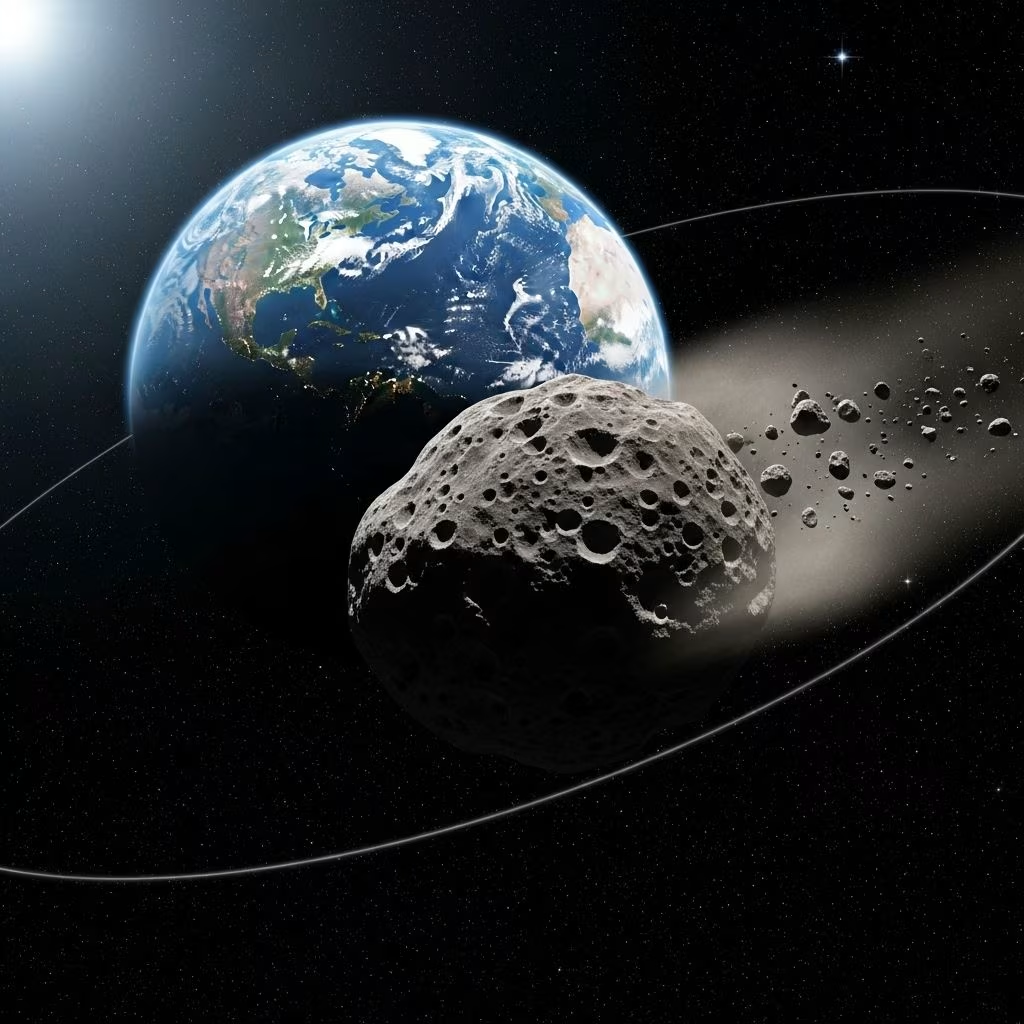
In April 2029, humanity will witness an event not seen in recorded history: the asteroid Apophis, officially known as 99942 Apophis, will pass Earth at a distance closer than many of our high-flying satellites. This massive chunk of cosmic debris—carefully tracked by astronomers and now considered a research opportunity rather than a threat—will come tantalizingly near our planet, prompting a fleet of new and repurposed space missions to prepare for a groundbreaking study.
Key Facts About Apophis
- Diameter: Approximately 340-375 meters (1,115-1,230 feet)
- Speed at Flyby: About 30 kilometers (19 miles) per second
- Closest Approach: April 13, 2029
- Distance from Earth at Closest Point: ~32,000 kilometers (20,000 miles)—closer than geosynchronous satellites
- Risk to Earth: Not considered a direct threat; collision risk now ruled out for the foreseeable future
The History and Significance of Apophis
Apophis was discovered in 2004 and quickly gained infamy. Early calculations indicated a small but alarming chance of an Earth impact in 2029, 2036, or 2068. Given its size, a direct hit would have been catastrophic, prompting its name after the Ancient Egyptian god of chaos and destruction. Subsequent observations eliminated the risk for these dates, allowing scientists to shift focus from fear to fascination—and making the 2029 approach one of the most anticipated astronomical events of the decade.
Why is the 2029 Flyby Such an Opportunity?
Never before has an asteroid of this size come so close to Earth within the span of human observation. The 2029 flyby creates a natural experiment for scientists to observe and measure how a large asteroid physically responds to the gravitational forces of our planet, giving us insights that are otherwise impossible to obtain.
- Unprecedented Proximity: Apophis will pass closer than many communications and weather satellites—yet at a safe distance for Earth.
- Natural Tidal Lab: Earth’s gravity could reshape Apophis’s surface, alter its spin, and perhaps even trigger small landslides or eject dust and debris—phenomena that can only be observed in such close encounters.
- Planetary Defense Practice: By studying real-time changes, scientists hope to sharpen tactics for planetary defense and inform risk models for other near-Earth objects (NEOs).
Meet the Missions: Spacecraft Monitoring Apophis
Lining up to observe this cosmic event are three high-profile spacecraft missions:
| Mission Name | Operator(s) | Roles During 2029 Flyby | Key Instruments/Features |
|---|---|---|---|
| RAMSES | European Space Agency (ESA) | Arriving February 2029, observes Apophis before, during, and after closest approach; maps surface changes and measures properties | 2 CubeSats, high-res optical and infrared imagers, spectrometers, potential seismometers |
| OSIRIS-APEX | NASA (formerly OSIRIS-REx Mission) | Performs detailed mapping and analysis post-flyby; tracks dynamic changes in orbit and spin; gathers spectral and thermal data | Suite of cameras, LIDAR, spectrometers, heritage from Bennu mission |
| DESTINY+ | JAXA (Japan) | Originally targeted another asteroid, now adjusted for a flyby of Apophis; collects additional data and imagery | Dust analyzer, camera instruments, multi-spectral measurements |
Science Goals: What Will We Learn?
The 2029 Apophis flyby enables scientists to observe, in real time, the effects of a close planetary encounter on a medium-sized asteroid. Key research areas include:
- Shape and Structure: Mapping any reshaping or landslides as Apophis is tugged by gravity.
- Surface Changes: Watching for shifting regolith (loose surface material), ejected dust, or small moons or particles created by tidal forces.
- Internal Characteristics: Studying changes in Apophis’s spin rate, axis, and overall motion to deduce its internal makeup and response to stress.
- Trajectory Shifts: Carefully monitoring how close flybys alter the asteroid’s path, improving ability to predict future orbits for all NEOs.
- Planetary Defense Models: Applying this natural experiment to improve models of asteroid deflection, structure, and risk assessment.
How Will the Missions Work Together?
- RAMSES will establish a baseline before Earth’s gravitational encounter, monitoring any subtle changes as Apophis draws near and then recedes.
- OSIRIS-APEX follows up, providing detailed mapping and analysis post-close-approach, looking for measurable changes in surface or motion, using proven sensors from its earlier asteroid work.
- DESTINY+ brings complementary perspectives, swinging by as part of its main interplanetary mission, adding unique observational opportunities with its dust analyzer and imaging suite.
- Combined datasets from these missions will yield unprecedented 3D models of how asteroids react to planetary flybys—and possibly yield dramatic images of reshaping or particle ejection in progress.
From Risk to Opportunity: The Evolution of Apophis’s Story
When first discovered in 2004, Apophis caught the attention of both astronomers and the public for its potential threat. For several years, it topped risk charts for near-Earth objects. Later observations and refined calculations, however, gave Earth a clean bill of health, ruling out any serious risk through at least 2105. This transition allowed the global scientific community to reclassify Apophis as a target for intensive study and learning.
The 2029 flyby is not only an extraordinary moment for space science but also a turning point in planetary defense, providing a practical test of our ability to prepare for, observe, and eventually respond to NEO threats.
Looking Ahead: The Broader Impact of 2029
The Apophis event is forecast to inspire public interest, galvanize planetary defense strategies, and catalyze scientific collaboration worldwide. Future missions may continue the legacy of the 2029 encounter, seeking to:
- Develop rapid response probes for new NEO discoveries.
- Test asteroid deflection techniques (such as the kinetic impactor strategy demonstrated by NASA’s DART mission).
- Engage in accelerated mapping and cataloging of the thousands of additional NEOs populating our solar neighborhood.
- Advance spacecraft autonomy, enabling swarms of CubeSats and nano-probes to observe and sample asteroids on short notice.
Planetary Defense in the 21st Century
Apophis has become a rallying point for planetary defense planning—the science and engineering of identifying, tracking, and, if needed, diverting potentially hazardous objects. Recent missions like NASA’s DART (Double Asteroid Redirection Test) have demonstrated the feasibility of asteroid deflection. Observations from Apophis’s flyby will help calibrate such models, showing how natural gravitational tides compare to purposeful kinetic jolts.[11][13]
Collaboration among space agencies—NASA, ESA, JAXA, and others—fosters international preparedness and technological progress. By pooling resources and scientific expertise, the world is better equipped to resolve the mysteries of our solar system and safeguard the only home we know.
Frequently Asked Questions (FAQs)
Q: Will Apophis hit Earth during the 2029 flyby?
A: No. Precise measurements confirm that Apophis will safely pass at a distance of about 32,000 kilometers—posing no impact risk for 2029 or for a long time after.
Q: What is special about Apophis’s 2029 approach compared to other asteroids?
A: Its size (over 340 meters) and extremely close approach make it unique. For context, Apophis will come closer than many communications satellites, providing a perfect case to observe gravitational effects in action for a large object.
Q: Why are multiple spacecraft involved instead of just one?
A: Each mission—RAMSES, OSIRIS-APEX, and DESTINY+—offers different timing, instrumentation, and vantage points. Together, they allow for continuous monitoring and more sophisticated analysis of the flyby’s before-and-after effects.
Q: How will Earth-based observers participate?
A: The flyby will be visible to the naked eye in some regions, with astronomers and skywatchers across the globe tracking Apophis with telescopes, radar, and optical cameras. Public engagement and citizen science events are expected.
Q: What can we learn about planetary defense from Apophis?
A: By observing Apophis’s response to tidal forces, scientists can refine models that predict asteroid behavior, shape, and movement—giving us an edge in future mitigation or deflection efforts for hazardous asteroids.
Conclusion: A New Era of Space Science and Safety
The 2029 Apophis flyby is not merely a celestial curiosity—it is a focal point for planetary science, engineering, and international cooperation. As the asteroid glides past, monitored by a vanguard of advanced spacecraft, humanity will extract knowledge that secures our present and prepares us for any future challenge from the cosmos. The real value of Apophis’s visit emerges not just from the risk it no longer poses, but from the solutions and understanding it will inspire for generations to come.
References
- https://science.nasa.gov/solar-system/asteroids/apophis-facts/
- https://science.nasa.gov/solar-system/asteroids/apophis/
- https://www.space.com/astronomy/asteroids/god-of-chaos-asteroid-apophis-will-fly-by-earth-in-april-2029-and-these-3-space-probes-will-be-watching
- https://en.wikipedia.org/wiki/99942_Apophis
- https://www.space.com/asteroid-apophis-satellite-spacecraft-mission-2029
- https://www.planetary.org/space-missions/osiris-apex
- https://www.youtube.com/watch?v=i2JMen3191Y
- https://www.universetoday.com/articles/a-mission-to-collect-a-sample-from-apophis
- https://www.planetary.org/articles/will-apophis-hit-earth
- https://www.youtube.com/watch?v=yM38f7lth_k
- https://nasaspacenews.com/2025/09/apophis-asteroid-2029-a-close-encounter-thats-changing-how-we-study-asteroids/
- https://www.popularmechanics.com/space/solar-system/a64531489/apophis-nasa-asteroid/
- https://www.universetoday.com/articles/esa-is-building-a-mission-to-visit-asteroid-apophis-joining-it-for-its-2029-earth-flyby
- https://www.spacedaily.com/reports/ESA_Prepares_for_Close_Encounter_with_Asteroid_Apophis_in_2029_999.html
- https://www.thedefensenews.com/news-details/NASAs-OSIRIS-APEX-Mission-to-Study-Asteroid-Apophis-During-its-Close-Flyby-in-2029/