


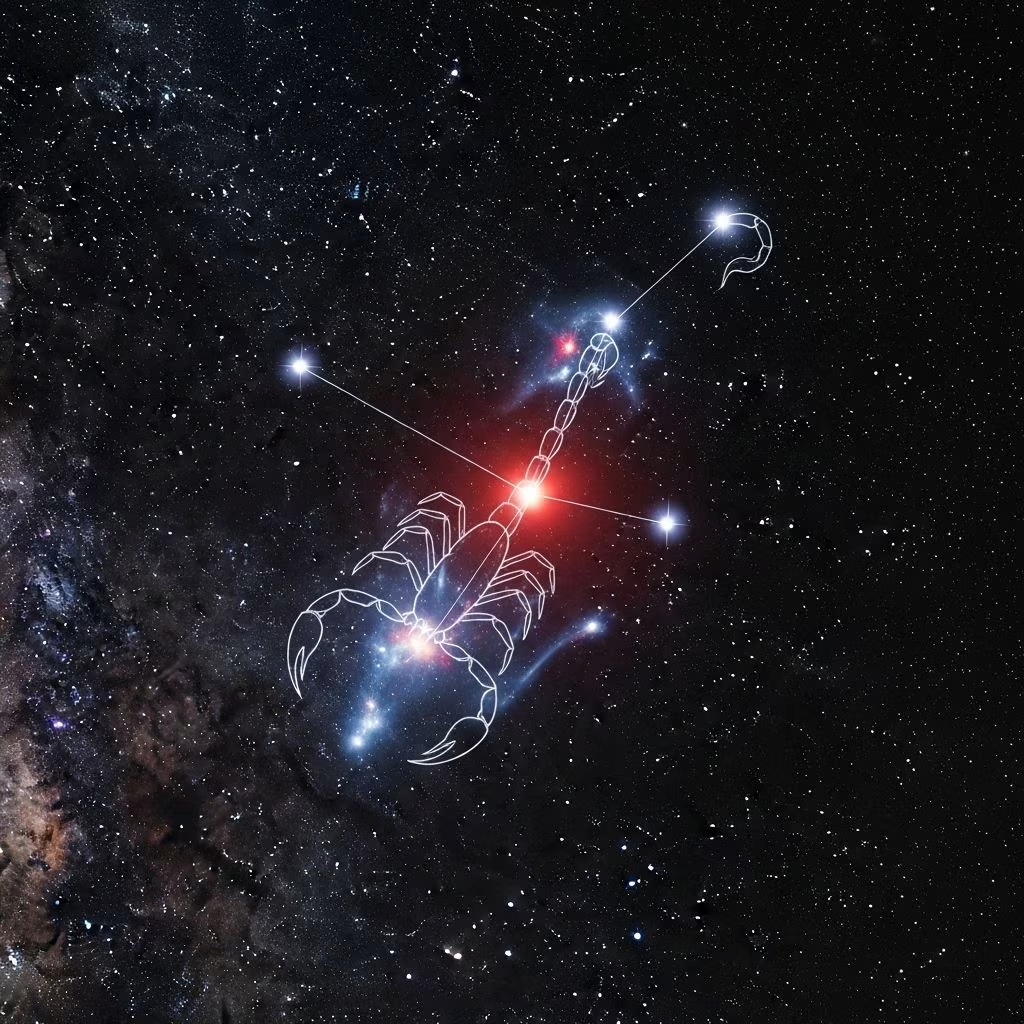
Scorpius Constellation: The Majestic Scorpion of the Sky
Scorpius, the Scorpion, is a striking constellation best known for its vivid shape and the legendary myths entwined with its stars. Stretching across the southern celestial hemisphere, Scorpius is one of the main zodiac constellations that dominates summer skies, captivating both astronomers and stargazers. This guide delves into Scorpius’ astronomical features, mythology, bright stars, and its significance in both science and lore.
Pronunciation, Abbreviation, and Genitive
- Pronunciation: SCOR-pee-us
- Abbreviation: Sco
- Genitive: Scorpii
Scorpius is sometimes referred to as Scorpio in astrological contexts. The name derives from Latin, meaning ‘Scorpion.’
Origin and Mythology
Scorpius boasts deep roots in ancient lore and astronomy. Its scorpion shape and prominent stars have inspired tales in many cultures.
Ancient Catalogues and Associations
- First cataloged by Ptolemy in the 2nd century as one of the original 48 constellations.
- Recognized among the 88 modern constellations by the International Astronomical Union (IAU).
Greek Mythology
In Greek myth, the constellation represents the scorpion sent by Gaia (Earth) to defeat Orion, the great hunter. As a sign of eternal opposition, Orion and Scorpius appear on opposite sides of the night sky: when one rises, the other sets. This celestial chase has inspired generations of skywatchers.
Location and Visibility
Scorpius is found in the southern sky, nestled between Libra and Sagittarius and near Ophiuchus. Its arc of stars vividly outlines the body and tail of a scorpion.
Key Location Details
- Hemisphere: Southern celestial hemisphere.
- Quadrant: SQ3.
- Angular area: 497 square degrees (33rd largest constellation).
- Visibility latitudes: From 40°N to 90°S. Particularly prominent between June and August.
- Right Ascension (average): 16h 52m.
- Declination (average): −33°.
- Scorpius appears ‘upside down’ when viewed from the Southern Hemisphere.
Observing Tips
- Best viewing month: July. Most prominent at 22:00 local time.
- If searching from the Northern Hemisphere, look towards the southern sky on summer nights. In the Southern Hemisphere, look north in winter months.
- The curved line of bright stars, ending in a distinct ‘stinger’, makes Scorpius easy to identify.
Scorpius in the Zodiac
Scorpius is the eighth sign of the zodiac, representing the period from approximately October 23 to November 21 in astrology. In astronomy, the Sun passes through Scorpius’ bounds about a month later than the astrological dates due to precession.
| Zodiac Position | Neighboring Constellations | Astrological Dates |
|---|---|---|
| 8th Sign | Libra (to the west), Sagittarius (to the east) | Oct 23 – Nov 21 |
Scorpius’ placement among the zodiac makes it a symbolically powerful constellation, governing themes of transformation and intensity in astrological lore.
Shape and Structure
Scorpius is renowned for its dramatic ‘scorpion’ shape. Its main features include a curving body and a prominently hooked tail, forming the striking Fish Hook asterism. The constellation is formed by positions of 18 bright stars and dozens visible to the naked eye.
- Body: The midsection curves gently, delineated by a chain of bright stars.
- Tail: The stinger is defined by Shaula and Lesath.
- Heart: Antares marks the center.
Notable Stars in Scorpius
Scorpius possesses some of the most spectacular stars in the night sky. Here are the brightest and most significant:
Antares (Alpha Scorpii)
- Apparent magnitude: 0.96 (15th brightest star)
- Type: Red supergiant
- Nickname: ‘Heart of the Scorpion’
- Color: Deep reddish hue—rivalling Mars (Ares) in brightness and color
- Distance from Earth: ~553 light years
Antares is especially known for its brightness and distinct color, appearing fiery in the sky.
Shaula (Lambda Scorpii) & Lesath (Upsilon Scorpii)
- Location: At the tip of the stinger
- Shaula magnitude: 1.62
- Lesath magnitude: 2.70
- Shaula is a blue subgiant, while Lesath is a blue star.
Dschubba (Delta Scorpii)
- Marks the Scorpion’s forehead
- Magnitude: variable, averaging about 2.32
Other notable stars:
- Sargas (Theta Scorpii): A bright giant near the scorpion’s tail.
- Jabbah (Nu Scorpii): A quadruple star system located near the body curve.
- AH Scorpii: One of the largest known stars, a red hypergiant 1,400 times the Sun’s size.
Deep Sky Objects in Scorpius
The rich star fields of Scorpius are home to spectacular deep sky wonders, visible with telescopes or binoculars:
- Scorpius X-1: The brightest persistent X-ray source in the sky, evidence of a neutron star or black hole.
- M4: A bright globular cluster near Antares—one of the closest globular clusters to Earth.
- M6 (Butterfly Cluster): An open star cluster with a delicate pattern resembling a butterfly’s wings.
- M7 (Ptolemy Cluster): Another bright open cluster, easily visible to the naked eye.
- NGC 6334 (Cat’s Paw Nebula): A vibrant emission nebula in Scorpius’ tail.
Neighboring Constellations
- Libra: West of Scorpius
- Sagittarius: East
- Ophiuchus: Directly above
The Sun, Moon, and planets traverse Scorpius’ region along the ecliptic every year, making it a focal point for planetary observations.
Important Facts & Figures
- Constellation Family: Zodiacal
- Stars hosting known exoplanets: 17
- X-ray stars: Includes Scorpius X-1 and others
| Attribute | Value |
|---|---|
| Area | 497 sq. deg. |
| Brightest Star | Antares (0.96 magnitude) |
| Number of Bright Stars | 18 major |
| Exoplanet Hosts | 17 stars |
| Coordinates | RA: 16h 52m, Dec: −33° |
How to Find and Observe Scorpius
- Look for the curve of bright stars in the southern sky on summer nights (Northern Hemisphere) or northern sky in winter (Southern Hemisphere).
- Antares is easily distinguished by its bright red hue, anchoring the constellation’s shape.
- Shaula and Lesath at the tail form an unmistakable ‘stinger.’
- Best observed away from city lights, with binoculars or telescope for deep sky objects.
Scorpius in Different Cultures
- In Babylonian astronomy, called MUL.GIR.TAB, symbolizing destruction and rebirth.
- In Indigenous Australian lore, Scorpius is the body of the great serpent, with Antares as its head.
- In Hindu tradition, associated with the nakshatra ‘Jyeshtha’.
Astrophysical Significance
- Star formation: Scorpius hosts several stellar nurseries, including the Cat’s Paw Nebula.
- Variable stars: Features a range of variables useful for studying stellar evolution.
- Exoplanet discoveries: 17 known stars with confirmed exoplanets add to its scientific importance.
Its central location and dense star fields make Scorpius a key region for astrophysical research and discovery.
Fun Facts About Scorpius
- Scorpius is one of the few constellations that looks like its namesake.
- Antares, meaning ‘rival of Mars’, is frequently mistaken for the planet Mars due to its color and brightness.
- Shaula is the second brightest star in Scorpius and one of the brightest in the night sky.
- The constellation contains some of the oldest known stars in the galaxy.
Frequently Asked Questions (FAQs)
Q: When is the best time to see Scorpius?
A: The best time to view Scorpius is in July, particularly around 10 pm, when it is highest in the sky in the Northern Hemisphere. In the Southern Hemisphere, it is visible throughout winter months.
Q: What is the easiest way to identify Scorpius?
A: Spot the bright, red Antares at the heart and trace the curve of stars forming the scorpion’s body and stinger.
Q: What is the significance of Antares?
A: Antares is the brightest star in Scorpius, notable for its red color and its role as the ‘Heart of the Scorpion’. It is a red supergiant, among the largest stars visible.
Q: Does Scorpius contain any notable deep sky objects?
A: Yes, it contains the bright globular cluster M4, open clusters M6 (Butterfly Cluster), M7 (Ptolemy Cluster), and nebulae such as the Cat’s Paw. It is also home to Scorpius X-1, the brightest X-ray source in the sky.
Q: Why does Scorpius look upside down in the Southern Hemisphere?
A: Because of its position in the sky, observers below the equator view Scorpius inverted relative to northern observers, making the scorpion’s tail appear above the body.
Summary Table: Scorpius At-A-Glance
| Feature | Details |
|---|---|
| Best Viewing Month | July |
| Brightest Star | Antares |
| Area | 497 sq. degrees |
| Quadrant | SQ3 |
| Exoplanet Host Stars | 17 |
| Deep Sky Objects | M4, M6, M7, Cat’s Paw Nebula, Scorpius X-1 |
| Zodiac Position | 8th Sign |
| Neighbor Constellations | Libra, Sagittarius, Ophiuchus |
Conclusion
Scorpius stands as a dazzling beacon in the night sky, merging myth, science, and visual brilliance. Its fierce scorpion silhouette and the timeless dance with Orion encapsulate the wonder of astronomy. Whether you are an amateur skywatcher or an experienced astronomer, Scorpius offers a gateway to some of the sky’s brightest stars and fascinating cosmic phenomena. Explore Scorpius this season and unravel the mysteries woven into its stellar tapestry.
References
- https://www.go-astronomy.com/constellations.php?Name=Scorpius
- https://theplanets.org/constellations/scorpius-constellation/
- https://www.britannica.com/place/Scorpius
- https://www.space.com/21738-scorpius-constellation-explained.html
- https://www.youtube.com/watch?v=Z9ZuSb495eI
- https://science.nasa.gov/solar-system/skywatching/night-sky-network/july2025-night-sky-notes/
- https://www.youtube.com/watch?v=1sZF8rQH1Vs
- https://theskylive.com/sky/constellations/scorpius-constellation


