


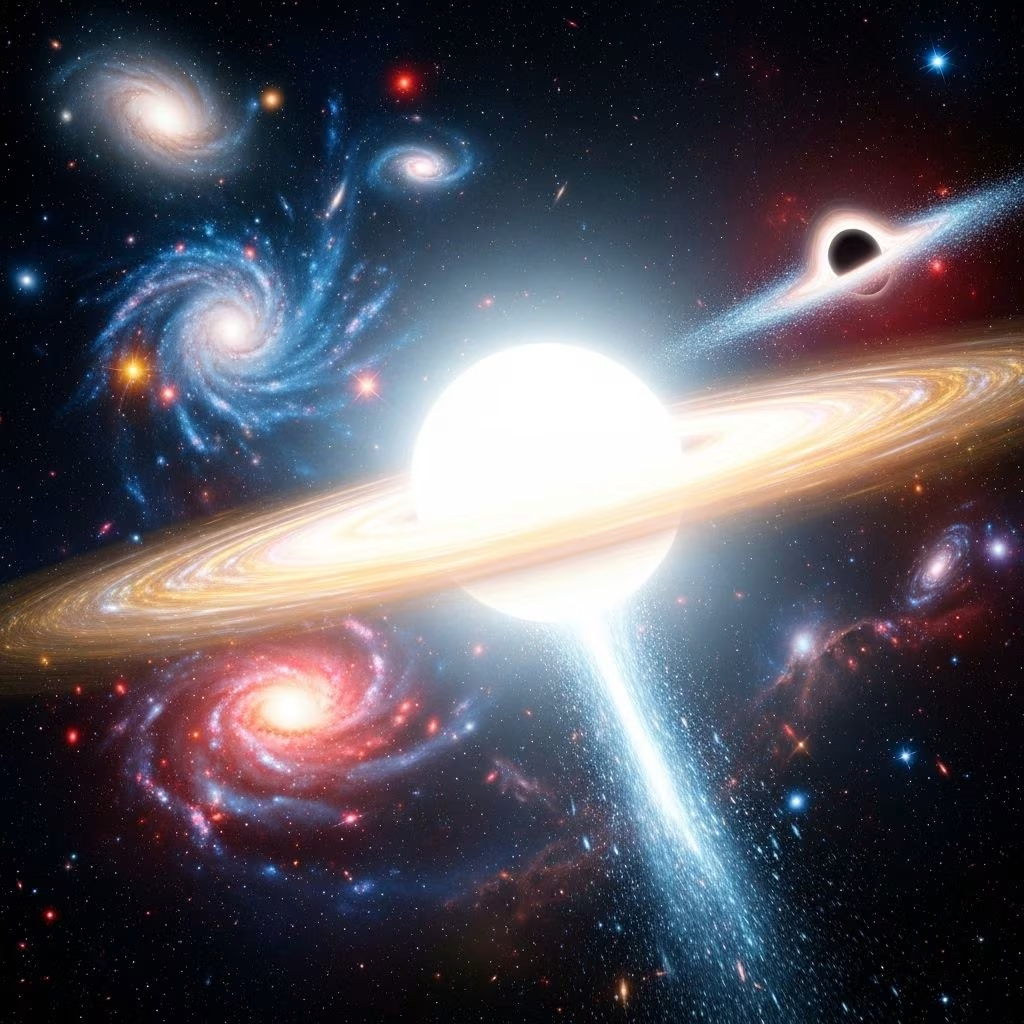
White Holes: Decoding the Universe’s Most Elusive Phenomena
Among the spectacular mysteries posed by modern physics, white holes stand out as one of the most mind-bending and enigmatic. Widely acknowledged as the hypothetical opposites of black holes, white holes ignite both imagination and debate in the astrophysical community. While black holes famously trap everything—including light—within their event horizons, white holes are theorized to eject matter and energy, refusing entry to anything from the outside. Though none have yet been observed, the theoretical implications of white holes could profoundly reshape our fundamental grasp of reality, time, and the universe’s evolution.
What Are White Holes?
White holes are theoretical cosmic regions where matter and light can only escape, but never enter. They arise naturally from the mathematics of Einstein’s general relativity as time-reversed solutions to black holes. In essence, whereas black holes act as cosmic vacuums from which nothing can emerge, white holes could be cosmic fountains: matter and radiation pour out into space, and nothing can cross their event horizon from the outside.
- White holes remain, for now, a mathematical curiosity—no direct empirical evidence exists for their presence in the observable universe.
- The concept originates from extending the equations that model black holes, swapping the arrow of time in the computations.
- If they exist, white holes might be linked to the most energetic and least understood events in the cosmos—or could represent stages in cosmic evolution beyond conventional imagination.
The Theory: White Holes in Einstein’s Equations
The foundations for white holes were laid soon after Einstein published his theory of general relativity. Black holes, predicted by the equations, feature a central singularity enveloped by an event horizon, allowing nothing to escape once entered. If the direction of time in these equations is reversed, a mirror object arises—a white hole—that repels all incoming matter.
- White holes share certain properties with black holes, including an event horizon and a central singularity, but differ fundamentally in how matter and energy interact with them.
- A Schwarzschild white hole—the simplest hypothetical version—would be the exact time reverse of a Schwarzschild black hole.
- This mathematical symmetry raises the question: do white holes physically exist, or are they just theoretical artifacts?
Black Holes vs. White Holes: A Comparative Table
| Feature | Black Hole | White Hole |
|---|---|---|
| Directionality | Matter and light only enter, not escape | Matter and light only escape, not enter |
| Event Horizon | Marks the point of no return for infalling material | Boundary from which matter and light are expelled |
| Physical Observation | Confirmed via gravitational waves, accretion, etc. | Purely theoretical; no confirmed observations |
| Role in Cosmology | Star death, galaxy centers, energy engines | Potential hypothetical sources of cosmic matter |
| Arrow of Time | Aligned with time’s usual direction (future) | Opposite direction (past) |
The Interwoven Fates of Black and White Holes
One of the most intriguing modern proposals posits a cosmic link between black holes and white holes. According to certain models of quantum gravity, black holes may not simply vanish—after losing mass through Hawking radiation, they could rebound as white holes when they shrink to minimum size. This process would effectively convert a region that once only absorbed matter into one that only emits it.
- The conversion of black holes into white holes depends on quantum effects at scales where space-time resists further compression.
- This would comply with the principle that information in the universe can’t be destroyed—the information “swallowed” by the black hole is ultimately “ejected” by the white hole.
- This hypothesis is yet to be confirmed but remains tantalizing for theorists seeking to reconcile general relativity with quantum mechanics.
Could White Holes Be the Source of Dark Matter?
Recent theoretical research has explored whether white holes may account for the elusive dark matter thought to constitute most of the universe’s mass. One suggestion is that extremely tiny white holes, created early in the universe’s history or perhaps even before the Big Bang, could be spread throughout space, remaining undetectable by electromagnetic observations but exerting gravitational influence.
- If such primordial white holes exist, they would be smaller than atoms and have vanishingly small masses—but could be numerous enough to contribute significantly to the universe’s mass budget.
- Because these white holes would not emit any detectable radiation and would be so small, they could be indistinguishable from other forms of “dark” phenomena.
- Matter striking such a white hole would bounce away; neither light nor ordinary particles could enter.
Although this idea is still speculative, it offers an exciting avenue for connecting white holes with one of the most profound mysteries in modern astrophysics.
How Might White Holes Form?
The dominant theories about the origin of white holes include:
- Black Hole Death: Some models suggest that white holes could be the ultimate fate of black holes, emerging when black holes reach the end of their evaporation process and can shrink no further due to quantum limits.
- Primordial Creation: White holes might have formed in the extremely energetic and dense conditions of the early universe, potentially from fluctuations in quantum fields or as remnants from a previous cosmic epoch.
- Multiverse and Cosmic Recycling: Theories involving a cosmic multiverse sometimes propose white holes as “portals” or connectors between universes or between different regions within our own universe.
White Holes and the Arrow of Time
White holes offer a unique lens through which to explore the “arrow of time”—the observed phenomenon that time appears to consistently flow in one direction, from past to future. If white holes exist and are time-reversed versions of black holes, they challenge our deepest assumptions about causality and temporal order in the universe.
- Some theorists speculate that white holes from before the Big Bang could help explain why time in our universe flows forward.
- The possibility that certain processes in physics are not symmetric in time underlies many of the most important questions in cosmology and fundamental physics.
- The study of white holes could reveal new aspects of how entropy, causality, and information operate on the grandest scales imaginable.
Observational Challenges: Why Haven’t We Seen a White Hole?
The search for white holes is complicated by several factors:
- No Known Example: Unlike black holes, which can be inferred from their gravitational effects, radiation signatures, and accretion disks, white holes are expected to be transient, unpredictable, and non-interacting with conventional matter.
- Lack of Observable Signals: By their nature, white holes would not accrete matter (since nothing can enter), so they would avoid most processes that produce visible or high-energy emissions.
- Confusion with Other Phenomena: Any sudden bursts or emissions that could result from white holes might also be explained by more conventional astronomical events, such as gamma-ray bursts or supernovae.
Are Gamma-Ray Bursts Linked to White Holes?
Some researchers have speculated that mysterious cosmic explosions known as gamma-ray bursts could be related to the rare appearance of white holes. These high-energy events, which release more energy in seconds than the Sun does in its entire lifetime, might be powered by processes involving white holes. However, the current consensus points more firmly toward known mechanisms such as the collapse of massive stars or the collision of dense stellar remnants.
White Holes in the Context of Wormholes and Multiverse Theories
In theoretical physics, white holes sometimes play a role in the mathematics of wormholes—hypothetical tunnels through the fabric of space-time connecting distant regions or entirely separate universes. The description of such a “Einstein-Rosen bridge” involves a black hole connected to a white hole, though in practice, such structures would collapse too quickly for anything or anyone to traverse them.
- Some models suggest information or matter falling into a black hole could exit from a white hole located elsewhere or in another universe, but such ideas remain highly speculative.
- Arguments for multiverse cosmologies sometimes use white holes as mechanisms for universe spawning—giving birth to new cosmic domains with their own space and time.
The Role of Quantum Gravity: New Possibilities for White Holes
The study of white holes pushes the boundaries where general relativity meets quantum mechanics. In models of quantum gravity—such as loop quantum gravity—it is postulated that the singularities inside black holes might be replaced by “bounce points,” preventing total collapse and instead generating a white hole as a sort of cosmic rebound. This provides a potential avenue for solving the so-called information paradox associated with black holes.
- Information trapped inside a black hole does not disappear forever but re-emerges from a white hole.
- This “bounce” mechanism would allow the universe to conserve information, preserving one of the bedrock laws of physics.
- Such models may be necessary to unite all forces and particles in a single theoretical framework.
Frequently Asked Questions (FAQs)
Q: Have white holes ever been observed?
A: No, there is no direct observational evidence for white holes. All knowledge of white holes comes from theoretical physics and mathematical solutions to Einstein’s equations.
Q: How do white holes relate to black holes?
A: White holes are conceptually the time-reverse of black holes: where black holes absorb all incoming matter and energy, white holes repulse them, only emitting matter and light.
Q: Could white holes explain cosmic phenomena like dark matter or gamma-ray bursts?
A: Some speculative theories propose tiny primordial white holes as dark matter candidates or rare white hole appearances as explanations for gamma-ray bursts, but neither possibility is currently supported by conclusive evidence.
Q: If information falls into a black hole, could it be ejected from a white hole?
A: Quantum gravity models suggest that, in principle, information swallowed by a black hole might be released by a white hole. This mechanism could resolve the black hole information paradox.
Q: Could our universe be inside a white hole?
A: Certain cosmological models speculate that our universe could have originated from a white hole, potentially resolving the mystery of the Big Bang’s initial conditions. However, this idea remains highly conjectural.
White Holes in Science Fiction and Popular Culture
The allure of white holes extends well beyond the scientific community. Fiction writers and filmmakers have used the concept as a storytelling device: portraying them as cosmic portals, time machines, or gateways to other dimensions. While these interpretations often deviate from established theoretical constraints, they reflect humanity’s voracious curiosity about what lies beyond the known horizon of science.
The Future: What Would It Take to Prove Their Existence?
For white holes to move from mathematical abstraction to scientific reality, astronomers would need to observe effects that cannot be explained by current models. Some possible indicators might include extremely energetic, one-off cosmic events with no apparent progenitor, or anomalous distributions of dark matter that match predictions for primordial white holes.
- Theoretical advancements in quantum gravity and cosmology could provide more testable predictions involving white holes.
- Next-generation observatories and cosmic surveys may reveal new hints—if any white holes exist, the universe may yet allow us a glimpse.
Further Reading: Essential Concepts and Discoveries
- Einstein’s Theory of General Relativity and its predictions
- The Event Horizon Telescope and black hole imaging
- The role of quantum mechanics in modern cosmology
- Dark matter and the missing mass problem
- The search for primordial objects in the early universe
As the frontiers of theoretical physics advance, white holes remain a profound thought experiment challenging our understanding of space, time, and the fate of information in the cosmos. Their study illuminates the mysteries at the heart of reality, pushing the boundaries of what it means to know the universe.
References
- https://www.space.com/40422-are-white-holes-dark-matter.html
- https://www.space.com/space-exploration/james-webb-space-telescope/is-our-universe-trapped-inside-a-black-hole-this-james-webb-space-telescope-discovery-might-blow-your-mind
- https://www.space.com/white-holes.html
- https://www.space.com/could-white-holes-exist-space-mysteries
- https://www.space.com/can-black-holes-become-white-holes
- https://www.space.com/15421-black-holes-facts-formation-discovery-sdcmp.html
- https://www.youtube.com/watch?v=c2Y-8HWFTlo


