


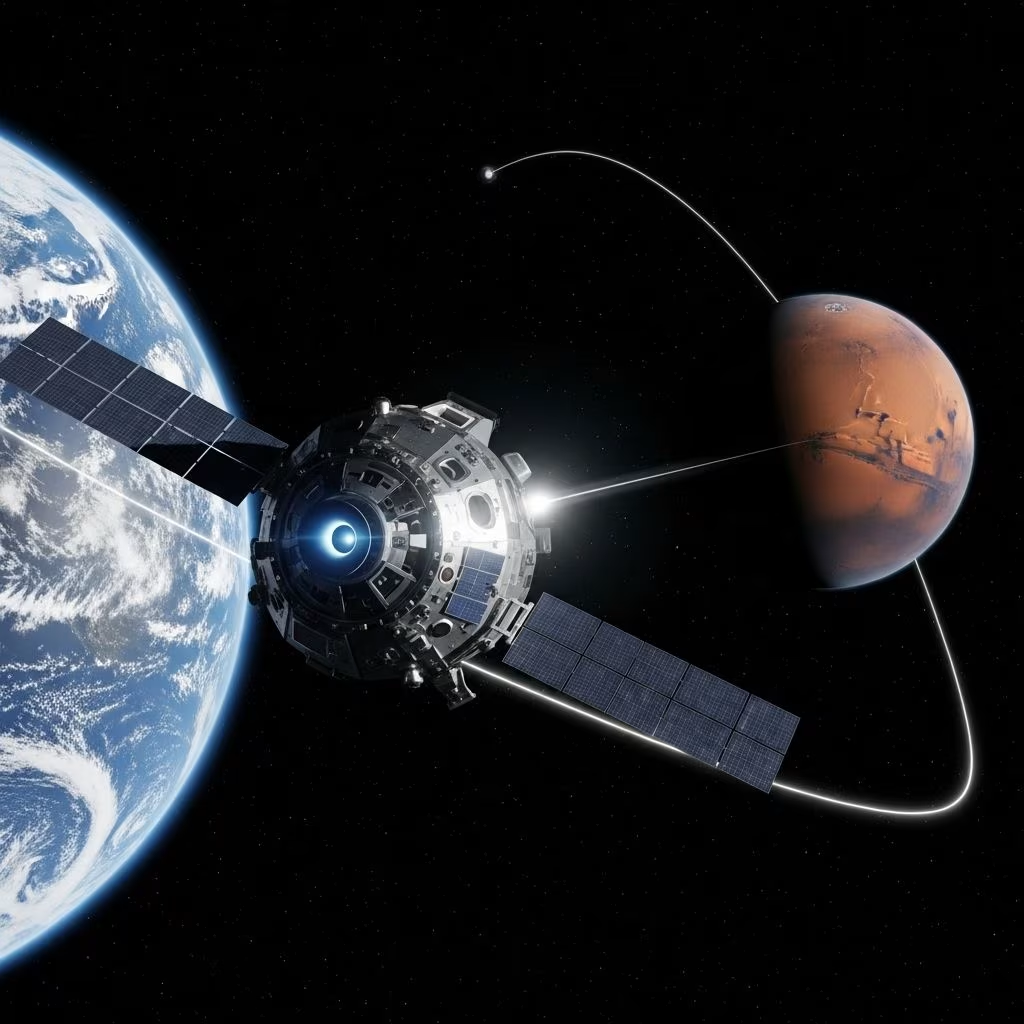
How Long Does It Take to Get to Mars?
The length of time it takes to travel from Earth to Mars depends on a combination of orbital mechanics, current technologies, and mission objectives. For decades, Mars has fascinated scientists, engineers, and the public alike, spurring numerous robotic missions and plans for future crewed journeys. But just how long is the journey to the Red Planet?
The Distance from Earth to Mars: It Keeps Changing
Unlike traveling to the Moon, the distance between Earth and Mars is not fixed. Both planets orbit the Sun at different speeds and distances:
- Earth has an average orbital distance of roughly 93 million miles (150 million kilometers) from the Sun.
- Mars is about 142 million miles (228 million kilometers) from the Sun on average.
- The distance between Earth and Mars varies, reaching a minimum (“closest approach”) of about 33.9 million miles (54.6 million kilometers) and a maximum of approximately 250 million miles (401 million kilometers).
This variability arises because both planets follow elliptical orbits and at times can be on the same or opposite sides of the Sun relative to each other.
Orbital Mechanics and Optimal Launch Windows
Traveling to Mars isn’t as simple as pointing a rocket at the planet and blasting off. Instead, engineers must carefully plan launches to take advantage of orbital alignment:
- The most efficient route is called a Hohmann transfer orbit, discovered in the early 20th century by Walter Hohmann.
- This trajectory launches a spacecraft when Earth and Mars are optimally positioned, allowing the craft to intercept Mars’ orbit as Mars arrives there.
Launch windows for Mars missions only open about every 26 months, during which time the planet’s positions minimize travel time and fuel requirements.
Time Taken by Robotic Missions
Past robotic missions provide real-world examples of Mars trip durations:
- NASA’s Mars Reconnaissance Orbiter: ~7.5 months
- NASA’s MAVEN mission: ~10 months
- Cruise phases for most Mars missions: range from 6 to 10 months depending on alignment and propulsion.
Typical journey duration: Currently, it takes between 7 and 10 months to travel to Mars using chemical propulsion and optimal transfer orbits.
Factors That Affect Mars Travel Time
- Relative Positions: The changing distance between Earth and Mars dictates launch timing and fuel requirements.
- Type of Trajectory: Hohmann transfers are commonly used, but alternative, faster or more energy-efficient paths exist.
- Propulsion System: Current missions use traditional chemical rockets; future technologies (like solar-electric or nuclear propulsion) could alter journey times.
- Spacecraft Mass & Payload: Heavier loads require more energy and may result in slower transfers.
- Mission Profile: Manned and unmanned missions may have different priorities for speed, safety, and fuel efficiency.
How Orbital Mechanics Dictate Timing
Earth completes one orbit around the Sun every year, while Mars takes about 1.88 Earth years. The two planets’ orbits synchronize favorably only every 26 months. Aligning launches with these windows ensures efficient use of energy and time.
| Route | Approximate Time | Notes |
|---|---|---|
| Hohmann Transfer Orbit | 7-10 months | Standard route for most robotic missions. |
| Faster, High-Energy Trajectories | As little as 5-6 months | Requires more fuel and advanced propulsion. |
| Slow, Low-Energy Trajectories | 10+ months | Fuel efficient but much slower. |
Alternative Routes and Recent Innovations
Traditionally, Hohmann transfers suffice, but scientists continue to develop alternatives:
- Ballistic Capture: A new type of transfer route lets spacecraft reach Mars using less fuel and can launch at almost any time, not requiring perfect planetary alignment. This method targets a rendezvous at a point along Mars’ orbit rather than aiming directly at the planet.
- Potential for Quicker Trips: High-thrust, high-efficiency engines (including ion or nuclear propulsion) might enable shorter journeys in the future.
The Influence of Propulsion Technology
The speed of any Mars journey is ultimately limited by propulsion:
- Chemical Rockets: Most Mars missions to date use these tried-and-true engines, balancing fuel, speed, and payload capability.
- Nuclear Propulsion: Could slash trip durations by offering higher thrust and efficiency.
- Solar-Electric Propulsion: Uses electricity generated by solar panels to accelerate ions, providing efficient thrust over time. Ideal for cargo and future crewed missions.
NASA continues to research these technologies with the goal of cutting travel times and maximizing astronaut safety.
Human Missions: Timing, Risks, and Return
Traveling to Mars with humans adds layers of complexity:
- Round-trip Considerations: Astronauts must stay on Mars until Earth and Mars realign for the Hohmann trajectory back. This means missions could last as long as 21 months, including stay and return time.
- Health & Safety: Longer journeys increase exposure to radiation, microgravity, and the psychological effects of isolation.
- NASA’s Mars plans: Current projections aim for round-trip missions of roughly two and a half to three years, including both transit and surface operations.
When Will We Send Humans to Mars?
NASA and other space agencies envision sending astronauts to Mars within the next couple of decades. Key hurdles include:
- Developing reliable propulsion for shorter, safer journeys.
- Building life support systems capable of supporting crews over months or years.
- Creating radiation protection for pilots and explorers.
While NASA’s current technology would require 7-10 months for a one-way trip, ongoing research could shorten this in the future.
Frequently Asked Questions (FAQs) About the Mars Journey
Q: What is the shortest possible time to reach Mars?
A: Using current technology and optimal launch windows, the shortest recorded robotic mission took about 6.5 months. However, hypothetical high-energy missions with advanced propulsion could reduce this to 5 months or less, but at much greater fuel cost.
Q: Why can’t we launch missions to Mars anytime?
A: Mars missions must be launched when Earth and Mars are best aligned. This minimizes the energy needed and ensures the spacecraft can intercept Mars’ orbit efficiently. These launch windows open roughly every 26 months.
Q: What limits journey time to Mars?
A: The main limiting factors are propulsion technology, planetary alignment, the spacecraft’s mass, and mission design. Innovations in propulsion and greater launch flexibility hold promise for future reductions.
Q: How long would it take to walk around Mars?
A: At an average walking speed of 3.1 mph (5 km/h) along the equator, it would take about 4,290 hours, or roughly 174 Martian sols, to walk around the planet continuously—over a quarter of a Martian year. Realistically, rest and supplies would extend this timeline significantly.
Q: How do mission planners deal with Mars’ changing distance from Earth?
A: Planners time missions to leave Earth when the two planets’ positions reduce the travel distance, using intricate calculations based on celestial mechanics to optimize flight time and energy efficiency.
Q: What is the Hohmann transfer orbit?
A: It is an elliptical trajectory that provides the most energy-efficient path for travel between two orbits—in this case, Earth and Mars. It has been used for most Mars missions but limits launch opportunities to specific periods.
Q: Can future technology greatly reduce the journey time?
A: Yes. Advanced propulsion systems under development (such as nuclear and next-gen solar-electric engines) could make travel faster and more flexible. Such advancements could make Mars more accessible for routine crewed missions in the coming decades.
Mars Travel Time Comparison Table
| Mission/Method | Time to Mars | Notes |
|---|---|---|
| Hohmann Transfer (Robotic) | 7-10 months | Standard for most missions. |
| High-Energy Trajectory | 5-6 months | Requires more fuel; less common. |
| Ballistic Capture | Varies (potentially flexible) | Can launch at any time, still under research. |
| Walking Around Mars | ~174 Martian days (continuous walking) | Theoretical, for fun comparison. |
Conclusion
The journey from Earth to Mars is a testament to the ingenuity of scientists and engineers who must contend with vast distances, shifting planetary alignments, and technological hurdles. While current missions average 7-10 months using Hohmann transfer orbits and chemical propulsion, future advances may shorten this timeframe. With each new mission, humanity edges closer to its dream of setting foot on Mars, unraveling not just the mysteries of travel but those of the Red Planet itself.
References
- https://www.space.com/how-long-would-it-take-to-walk-around-mars
- https://www.space.com/30749-the-martian-faster-way-to-mars.html
- https://www.nasa.gov/directorates/smd/how-long-does-it-take-to-get-to-the-moon-mars-jupiter-we-asked-a-nasa-expert-episode-51/
- https://www.space.com/29540-manned-mars-mission-propulsion-technologies.html
- https://www.space.com/16875-how-far-away-is-mars.html
- https://www.space.com/13558-historic-mars-missions.html
- https://science.nasa.gov/mars/facts/


