


Introduction: Mercury’s Mystifying Composition
Mercury, the innermost planet of our Solar System, has long intrigued scientists with its dense, iron-rich interior and distinct surface chemistry. Unlike its terrestrial neighbors, Mercury possesses structural and chemical properties that set it apart in planetary science. Modern space missions and lab studies have shed new light on its core, crust, mantle, and elemental inventory, reshaping our understanding of this enigmatic world.
Overview of Mercury: The Small, Dense Planet
Mercury, the smallest of the four terrestrial planets, orbits closest to the Sun. It has a diameter of approximately 4,879 km and, despite its modest size, boasts a mean density of 5.43 g/cm3, nearly rivaling Earth’s. Mercury is a rocky (terrestrial) planet, largely composed of metals and silicate materials, defying the norms established by Earth, Venus, and Mars. This high density and unusual interior lead astronomers to dig deeper into the planet’s structure and chemistry.
- Diameter: 4,879 km
- Density: 5.43 g/cm3 (second highest after Earth)
- Orbital distance: Approximately 58 million km from the Sun
- Surface gravity: About 38% that of Earth
Bulk Composition: Mercury as the Iron Giant
Mercury stands out for its extreme iron enrichment. Estimates suggest that
- Approximately 70% of the planet’s mass consists of metals, mainly iron and nickel
- The remaining 30% is silicate material (rocky crust and mantle)
This makes Mercury the most iron-rich planet in the Solar System. By comparison, Earth’s core is only about 17% of its volume, while Mercury’s core is estimated to occupy around 57% of its total volume.
Comparative Table: Mercury vs. Earth’s Internal Structure
| Parameter | Mercury | Earth |
|---|---|---|
| Mean Density | 5.43 g/cm3 | 5.52 g/cm3 |
| Core Volume % | ~57% | ~17% |
| Core Diameter (km) | ~3,600 | ~6,900 |
| Crust/Mantle Thickness (km) | ~600 (mantle); 100–200 (crust) | ~2,900 (mantle); ~35 (crust average) |
| Major Metals | Iron, Nickel | Iron, Nickel (less abundant than in Mercury) |
Internal Structure: Breaking Down Mercury’s Layers
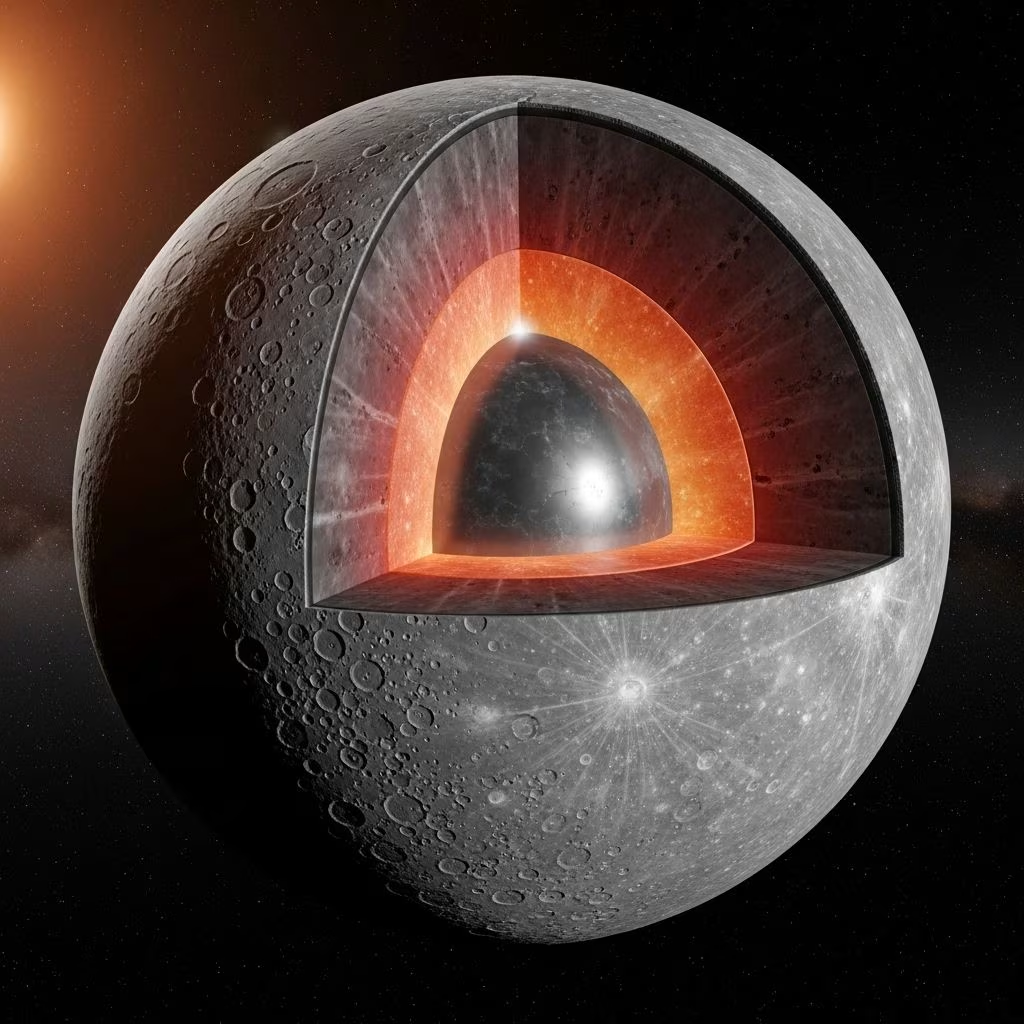
Mercury’s internal structure can be roughly divided into three main layers: a massive iron-rich core, a silicate mantle, and a thin silicate crust.
The Core
- Composed mainly of iron with some nickel, and traces of lighter elements (such as sulfur, carbon, silicon)
- Extends for approximately 3,600 km in diameter, filling almost three-quarters of the entire planet’s diameter
- Consists of a solid inner core, a liquid outer core, and possibly a surrounding solid shell—modeled after geophysical data from rotation rates and gravity measurements
- Mercury’s outer core is estimated to be liquid, enabling the planet’s weak magnetic field
Research suggests the iron core’s large size is either due to planetary impacts that stripped away mantle material or the characteristics of Mercury’s original building blocks.
The Mantle
- Composed primarily of silicate minerals such as olivine and pyroxene
- Estimated thickness ranges between 400 and 600 km
The Crust
- Thin silicate layer overlaying the mantle
- Estimates of thickness vary from 35 km (as per Mariner 10 and MESSENGER missions) to around 100–200 km
- The crust is marked by numerous narrow ridges (lobate scarps) spanning hundreds of kilometers, believed to form as the planet cooled and contracted
Surface Chemistry: A Volatile-Rich Crust
Until recent decades, planetary scientists expected Mercury’s crust and mantle to be depleted in volatile elements because of its close proximity to the Sun and the intense heat it experiences. However, spacecraft data—particularly from NASA’s MESSENGER mission—have overturned this assumption.
- MESSENGER detected high concentrations of volatile elements on Mercury’s surface, including sulfur, carbon, sodium, potassium, and chlorine
- These elements form exotic minerals, such as calcium- and magnesium-bearing sulfides, that are stable only under low-oxygen, highly reduced conditions found on Mercury
- Mercury’s relatively high sulfur abundance is striking; it has about 7 times more sulfur (relative to silicon) than Earth or Mars
This surprising volatile richness suggests Mercury’s formation and geological history were marked by both high-energy impacts and volatile retention mechanisms.
Origins of Mercury’s Unusual Composition
The reasons behind Mercury’s large core and distinctive elemental make-up are actively debated. Theories include:
- Early giant impacts: One or more collisions with other planetesimals could have stripped Mercury of much of its original silicate mantle, leaving behind the metal-rich core
- Solar nebula processes: Mercury may have accreted from material dense in metals or lost lighter rock-forming components through vaporization from intense solar wind and heat before the Sun reached its current output
MESSENGER mission findings have supported an origin for Mercury that involves accretion in a highly reduced, oxygen-poor environment, further complicated by the retention of a suite of volatiles (like sulfur and carbon). The planet’s elemental signature most closely matches meteorites called enstatite chondrites, which formed under similar reducing conditions in the early solar nebula.
Comparing Mercury’s Chemistry to Meteorites
As scientists seek to reconstruct Mercury’s formation, meteorites serve as vital clues. Among the different meteorite classes, chondrites are considered the oldest and most primitive, preserving the solar system’s primordial chemistry. Of all chondrites, enstatite chondrites bear the closest resemblance to Mercury:
- They are deficient in oxygen, similar to Mercury’s crust and mantle
- Contain mineral assemblages stabilized by sulfur, paralleling what is seen on Mercury’s surface
Comparisons with these meteorites help planetary scientists infer the processes and conditions that governed the early solar system.
Geological Activity and Surface Features
Mercury’s surface, while ancient and marked by countless impact craters, also reveals signs of remarkable internal and tectonic activity in its past. Notable features include:
- Numerous lobate scarps (cliffs), which extend for hundreds of kilometers—evidence of global contraction as the core cooled and shrank
- Regions with unusually high-reflectance material (hollows), thought to result from recent volatile loss at or near the surface
- Extensive volcanic plains, signifying that Mercury was once geologically active, with lava flows covering older terrain
These surface characteristics are closely linked to Mercury’s internal evolution and unique chemical environment.
Heat Generation and Radioactive Elements
Mercury produces internal heat mainly from the radioactive decay of isotopes such as uranium, thorium, and potassium. The distribution and behavior of these elements in the planet’s highly reduced environment differ substantially from Earth and other terrestrial planets:
- Because Mercury’s interior is so rich in sulfides, heat-producing elements may incorporate into these phases, affecting their distribution and Mercury’s thermal evolution
- The retention of potassium—observable on the surface—implies Mercury was not as depleted in volatiles as previously thought, challenging initial models
The Role of the MESSENGER Mission
The MESSENGER spacecraft (MErcury Surface, Space ENvironment, GEochemistry, and Ranging), which entered Mercury’s orbit in 2011, revolutionized our understanding of the planet’s composition:
- Mapped the planet’s surface chemistry using X-ray and gamma-ray spectrometry
- Revealed high abundances of sulfur, potassium, sodium, and other volatiles
- Confirmed the existence of a liquid outer core via measurements of Mercury’s tidal response and magnetic field
- Provided detailed images of surface features, mapping hollows, craters, scarps, and volcanic plains
MESSENGER’s data form the backbone of today’s models for Mercury’s geology, chemistry, and thermal history.
Mercury’s Place in the Solar System
Mercury’s distinctive composition offers critical clues about the wider properties and formation conditions of rocky planets. Its large core, volatile-rich surface, and chemically reduced mantle stand in contrast to Earth and Mars, suggesting a wider diversity of planetary outcomes in the solar system than previously recognized. Studies of Mercury help scientists:
- Understand the effects of proximity to the Sun on planetary formation
- Investigate the consequences of giant impacts and solar activity on planetary crusts and mantles
- Clarify the partitioning of elements between a planet’s core and its surface
Mercury continues to serve as a touchstone for testing models of rocky planet formation throughout our Solar System and beyond.
Frequently Asked Questions (FAQs)
Q: Why is Mercury’s core so large compared to other planets?
A: The dominant theory is that one or more giant impacts early in Mercury’s history stripped away much of its silicate mantle, leaving a disproportionately large metallic core. Other hypotheses involve chemical processes in the solar nebula, in which Mercury formed from metal-rich material close to the Sun.
Q: Does Mercury have a magnetic field?
A: Yes. Mercury has a global but weak magnetic field, about 1% as strong as Earth’s. This field arises from the motion of the liquid portion of its iron core.
Q: What is unusual about the chemical elements on Mercury’s surface?
A: Mercury’s surface is surprisingly rich in volatile elements like sulfur, potassium, and sodium. This is unexpected given its high-temperature environment close to the Sun. The planet’s chemistry points to formation in a reducing environment and efficient retention of volatiles.
Q: Which meteorites are chemically similar to Mercury?
A: Enstatite chondrites are considered the closest match. They formed under oxygen-poor conditions, similar to those inferred for Mercury during its accretion.
Q: Has volcanic activity ever occurred on Mercury?
A: Yes. Mercury’s surface shows vast smooth plains created by ancient volcanic eruptions, indicating that volcanic activity played a major role in shaping the planet’s topography in the past.
Conclusion: Mercury’s Continuing Mysteries
Mercury’s unique blend of a massive iron core, thin silicate mantle, and volatile-enriched crust challenges conventional assumptions about rocky planet formation. With current and upcoming missions poised to further explore the innermost planet, Mercury remains a keystone in unraveling our Solar System’s history and the complex chemistry that shaped its diverse worlds.
References
- https://en.wikipedia.org/wiki/Mercury_(planet)
- https://www.universetoday.com/articles/composition-of-mercury
- https://astrobiology.com/2023/10/the-origin-of-mercurys-structure-and-chemical-composition-and-their-astrobiological-implications.html
- https://coolcosmos.ipac.caltech.edu/ask/29-What-is-Mercury-made-of-
- https://depts.washington.edu/astrobio/wordpress/2023/10/10/the-origin-of-mercurys-structure-and-chemical-composition-and-their-astrobiological-implications/
- https://www.britannica.com/place/Mercury-planet/Surface-composition
- https://www.space.com/18643-mercury-composition.html
- https://spaceplace.nasa.gov/all-about-mercury/
- https://study.com/learn/lesson/video/mercury-surface-atmosphere-composition.html


